
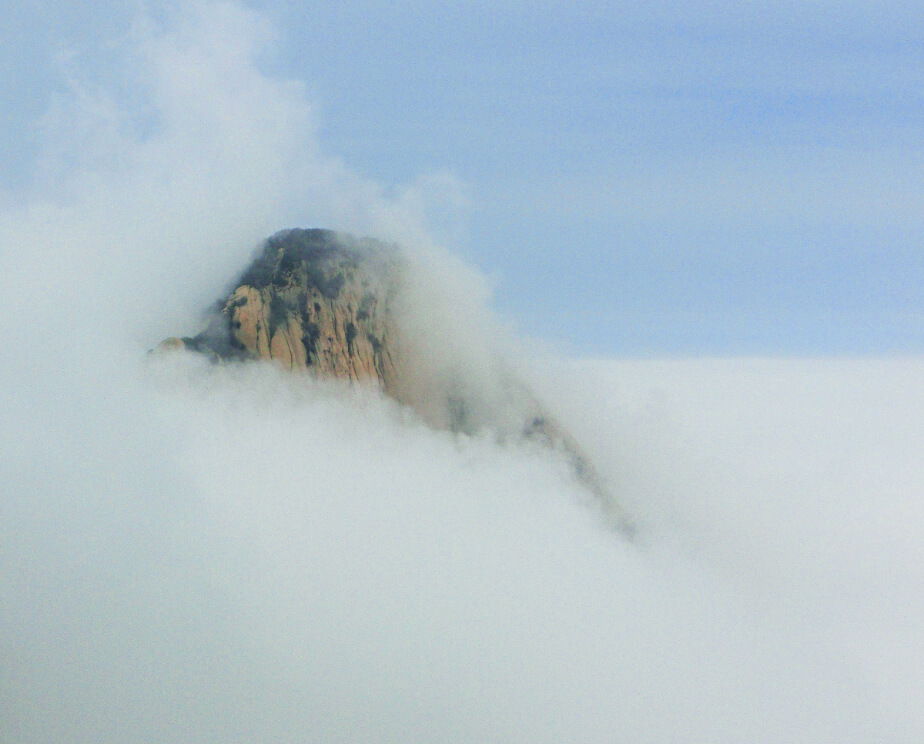
This is part. 2. If you’d like to start at the beginning follow this link here.
The evening we were to leave, I poured some of my mom’s ashes (that I had brought with me from America) into a small box and put them in my backpack. If I made it to the peak then I would leave that little part of her there on that mountain top. It would be the closest I’d ever get to the stars without the use of a plane.
No Joke, China is Crowded
There are things that I experienced in China that I will never experience anywhere else, except perhaps India, and much of this has to do with the sheer numbers of people. At every event, walk, exploration, eating and imbibing, every experience beyond the doors of your home or your work is shaped by the size of the crowd.
Americans have no idea how much space we have. We do not really know crowded. When I had moved to South Korea, other Americans would complain to me about how crowded it was in Seoul. I would think to myself, “sure its crowded“, but it isn’t China crowded. Of course, a place in America can be crowded, or the roads can be busy, and one may think that there are too many people, but imagine never getting away from the crowd. Every public space is a music festival without the music or the celebrity. I’d never experienced anything like China before or since ( I’ve never been to India) and time has faded much of my daily memories, but when I think back on my time there, I mean really think back, I can remember that I had experienced culture shock.
It was too much. Too many lights, too much pollution, too many cars, too much sound, too many people. Sometimes, I didn’t want to go outside even though I needed food. It felt otherworldly at times. As much as Chinese people would look at me as being an outsider and perhaps think I was odd in how I went about my life, I sometimes looked at them like they were mad. I would witness things that seemed beyond my comprehension. Like a man on an e-bike stacked with bricks driving against one way traffic, or fifty-plus people all scrambling to get onto a bus that was still moving. I would argue that much of the “madness” which was only my perception, was due to overcrowding. However, near the end of my time in China, my culture shock had turned into a phrase; “only in China.”
Erqi Square
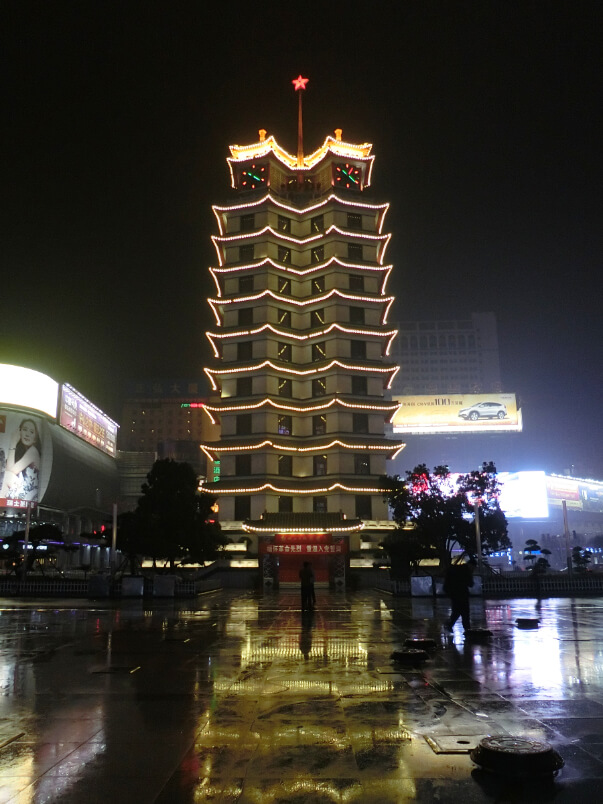
The night before the hike, Sho Boa and Xiang Kai met me at my apartment around 10:30 p.m., and from there we caught a bus to the central train station in Zhengzhou. We arrived near Erqi Square (pronounced Archie) around 11:00 p.m. Our train was scheduled to leave at 1:00 am, so we used the time before departure to shop for snacks for the trip and the hike.
Erqi Square buzzes with people all hours of the day and night. In the center of the square is Erqi Tower or Erqi Memorial Tower. Erqi means February 7th, and the square, district, and tower are all named after the Erqi (Feb. 7th) strike that occurred in 1923. The tower is two conjoined fourteen stories pentagon shaped towers that look like thin pagodas with a five pointed red star at the top. It stands out as the only building of Chinese architecture with sweeping eaves that curve up at the corners. At night the tower is lit up and competes with all the other lit up buildings. Zhengzhou is never dark at night. We wandered around the square posing in front of the tower and taking pictures in the light rain to memorialize our upcoming adventure. After taking photos we wandered into the station.

Zhengzhou Central Train Station
Zhengzhou’s Central train station is a national hub and considered the busiest station in China, which is saying a lot. To put it mildly, the place is crazy. The station is part of the Beijing-Guangzhou Railway and Longhai Railway, which means that if you are taking the train to anywhere in China, you will most likely transfer in Zhengzhou. The place is a nightmare, especially during the day. Aside from the overwhelming throngs of people pushing, shoving, and running through the station, and the difficulty of the language there’s the bathrooms. On this particular visit I was with two Chinese friends who took care of the language obstacles, and it was 1:00 p.m. when our train was to arrive, so the crowds were less in between arrival and departure times. However, the bathroom, I had to contend with on my own. It’s been nearly ten years since I have been there so chances are things have changed, but I wouldn’t be surprised if the bathroom was the same.
The Bathroom
China (at the time) still uses pit toilets and squat toilets. There are places with sitting toilets, but many, many places use squat toilets. This in and of itself isn’t too much of an issue. You can get used to it, but the toilets in the train station were something else. The station has what is called long-drop toilets, and they are communal troughs meaning no doors. They did have dividing walls, so I didn’t have to squat right next to a person, but there were no doors, so there was no privacy.
To use the toilet I had to stand with my feet on either side of the trough as a river of piss and shit flowed under me toward what I assumed to be an exit into a sewer system. I absolutely hated using this bathroom, not only because it was dirty, and I was never good at squatting, but the lack of privacy was my biggest issue. Since I was a foreigner in China, I experienced a lot of staring and this did not stop when I was using the toilet. There were times I felt like I was an animal in a zoo, and my experience in the Zhengzhou station was one of those times.
Not every person that walked by would stare, but the few that did would strain to look at how I actually peed, as if they were wondering if I had the same parts as them. It may have been only two women that did this to me as they walked by, but one was enough. Why would the bathrooms be like this? My guess is that it is easier to clean. Bring in some power washers and spray the whole place down. But when squatting over a trough, trying to keep balance without touching the dividing walls and straining to hold my knees together so that a stranger walking by can’t stare at my vagina as I peed was just the beginning of this trip. A trip that I thought was going to be a spiritual grief healing experience.
Differences in Thought Process
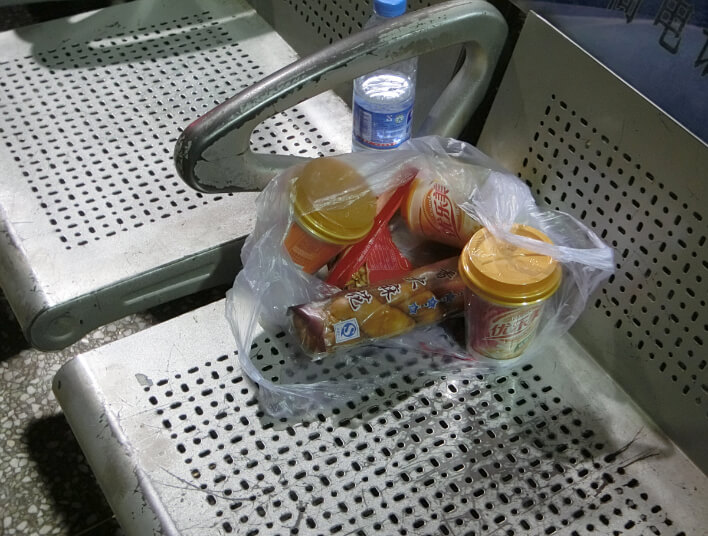
At the mini market Sho Boa picked up some dried noodles, chicken feet, and some hardboiled eggs. We also grabbed some instant porridge and instant coffee along with some water. I wanted some trail mix but wasn’t able to find any. I was concerned that the food we had wasn’t going to be enough sustenance for such a huge hike, but Sho Boa insisted that this was what him and his college friends ate when going on hikes.
“In China this is what we bring to eat on a hike.” He said.
I had to take him at his word. We argued a lot in the store as to what would be the best to eat, but I acquiesced telling myself I was having a Chinese experience and I needed to embrace it. Although my gut was telling me this food was not going to be enough to fuel me. It isn’t always easy to have an authentic experience of a culture that is new and foreign to you, no matter how easy it looks in the movies. So, Chicken feet it was.
The Cheapest Train
As I had said before: Every event, walk, exploration, eating and imbibing, every experience beyond the doors of your home or your work is shaped by the size of the crowd. Every national monument, museum, park, train, pilgrimage, and hike is shaped by the size of the crowd. Money will buy you space, but you need a lot of money, and we didn’t have a lot of money, especially Sho Boa.
Since Sho Boa didn’t have a lot of money he insisted that we take the cheapest slowest train. Xiang Kai and I were teachers, and we had a livable salary, but Sho Boa worked as an office assistant; a runner. The bosses were always telling him to run and get this, run and get that, run and go there, run and go here, and they did not pay him well. I could understand that lack of money would prompt him to choose the cheapest train. However, I suspected that even if he had money, he would still have insisted we take the cheapest train.
What makes the cheapest train cheap are its number of stops and rate of speed. At the time, I was clueless about exactly how slow a slow train was. I knew it was an overnight train and that it would take 8 to 9 hours to get to Huàshān, but I was not aware that a faster train would get us there in 3 to 4 hours. I also was not aware of what the traveling conditions on the train would be like. The idea was to sleep on the train and then to start our hike in the morning. I was fine with an overnight train, but Sho Boa bought regular seats not sleeping compartments, again to save money.

A Crowded Train
I did not sleep on the train for multiple reasons. Number one, the train was packed. On the cheap trains, once all the seats are sold, they continue to sell tickets, and the prices for standing are the same as the prices for seats. So there are people standing in the aisles for up to eight hours. People are crowded in the aisles leaning over the people in the seats all waiting for the moment when someone gets up so they can take the open seat. There is no space, and no fresh air, and if you do get up to use the bathroom you have to climb over people crumpled in the aisle way. When you return you have to argue with the person who took your seat to give you your seat back, which they will do, but they certainly don’t want to give it back, and I can understand why. They paid the exact same amount as you. People are constantly switching seats around every time someone leaves in the hopes that they can sit for a couple of minutes. When you are sitting you have people leaning against you or over you.
We were in a section of six seats. Two rows of three facing each other. Shawn and I were able to sit across from each other but Xiang Kai had to find a seat somewhere else on the train. I am bigger in size than your average Chinese woman, but I am also smaller in size and sometimes width of your average Chinese man. All the seats were occupied by men, sleeping men who were man spreading like cheerleaders doing the splits. These men took every inch of space available leaving me with very little room, and since I did not have the Chinese power of sleeping in impossible places, I was awake for the entire 8 to 9 hour train ride. I was the only foreigner and only white woman in the car, and quite possibly the train. In these situations I would often encounter staring and some people would sneak or blatantly take my photo, but at 1:00 in the morning on a crowded warm train, no one cared about me, other than the fact that I was sitting and my seat was valuable.
When we left Zhengzhou it was crowded with all the seats occupied and some people sleep-standing in the aisles. Once we reached Luoyang, it became more crowded and people were nearly sitting on top of each other. One man slept precariously balanced on the top of my seat and draped over me like a throw blanket.
At one point, a group in the section across from us, who all seemed to be traveling together, had people sitting on top of the backrest. They were laughing, and loudly playing a game, and watching programs on their phones at full volume. Sho Boa who was sitting across from me leaned forward. Thumbing his hand in their direction he said, “Look at them. What do they think they are in? Their house?” He gave them a brief scowl and then quickly feel asleep. I watched him slumber with an envious anger and an incredible urge to kick him awake so he could suffer like I was suffering. Xiang Kai was in a separate car, but had mentioned he had managed to sleep.

Huanyin City, 7:00 a.m.
When we arrived in Huayin City at 7:00 in the morning, I had not slept one wink. Exhausted, I followed the two rested men to hike a mountain peak, that unknown to me at the time, was 7,000 ft.
We had boarded the train around 1:00 am and arrived around 8:30 a.m. We took a taxi from the Huayin station to the village at the base of the mountain, and finally began our hike around 9:00 a.m. We had three large bottles of water, some strange meat paste, a few bready bits of snack food, and a bag of spicy chicken feet.
I was hungry, exhausted, and irritable due to lack of sleep, but I was also very excited. I was about to hike Mt. Hua, China’s most dangerous mountain. Did I know it was considered the most dangerous mountain to hike? Kind of. Word to the wise from the foolish: Do your own research.
Check back for part 3.
I lived in Zhengzhou, China in the Henan Province from the year 2013-2014. My mother died February 19th, 2014, 24 days after her 64th birthday, and five days before my 41st.
This post was created from two previous posts I wrote back in 2015 and 2016. You're welcome to follow the links, but honestly I think this post is the better one.
 An Accidental Vagabond
3 thoughts on “Hiking Hàushān China’s Sacred Mountain: Taking the Train to Shaanxi Province Part. 2”