Hiking Hàushān China’s Sacred Mountain: Taking the Train to Shaanxi Province Part. 2

This is part. 2. If you’d like to start at the beginning follow this link here.

No Joke, China is Crowded

There are things that I experienced in China that I will never experience anywhere else, except perhaps India, and much of this has to do with the sheer numbers of people. At every event, walk, exploration, eating and imbibing, every experience beyond the doors of your home or your work is shaped by the size of the crowd.

Americans have no idea how much space we have. We do not really know crowded. When I had moved to South Korea, other Americans would complain to me about how crowded it was in Seoul. I would think to myself, “sure its crowded“, but it isn’t China crowded. Of course, a place in America can be crowded, or the roads can be busy, and one may think that there are too many people, but imagine never getting away from the crowd. Every public space is a music festival without the music or the celebrity. I’d never experienced anything like China before or since ( I’ve never been to India) and time has faded much of my daily memories, but when I think back on my time there, I mean really think back, I can remember that I had experienced culture shock.

It was too much. Too many lights, too much pollution, too many cars, too much sound, too many people. Sometimes, I didn’t want to go outside even though I needed food. It felt otherworldly at times. As much as Chinese people would look at me as being an outsider and perhaps think I was odd in how I went about my life, I sometimes looked at them like they were mad. I would witness things that seemed beyond my comprehension. Like a man on an e-bike stacked with bricks driving against one way traffic, or fifty-plus people all scrambling to get onto a bus that was still moving. I would argue that much of the “madness” which was only my perception, was due to overcrowding. However, near the end of my time in China, my culture shock had turned into a phrase; “only in China.”
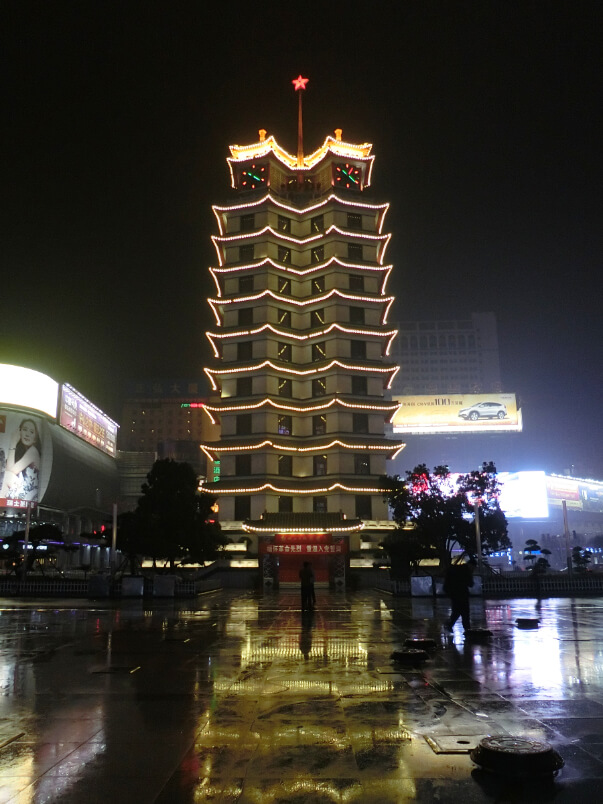
A photograph of Erqi Tower in Erqi Square in Zhenzhou, China.
Erqi Tower in Erqi Square, Zhengzhou, Henan, China.

Erqi Square

The night before the hike, Sho Boa and Xiang Kai met me at my apartment around 10:30 p.m., and from there we caught a bus to the central train station in Zhengzhou. We arrived near Erqi Square (pronounced Archie) around 11:00 p.m. Our train was scheduled to leave at 1:00 am, so we used the time before departure to shop for snacks for the trip and the hike.

Erqi Square buzzes with people all hours of the day and night. In the center of the square is Erqi Tower or Erqi Memorial Tower. Erqi means February 7th, and the square, district, and tower are all named after the Erqi (Feb. 7th) strike that occurred in 1923. The tower is two conjoined fourteen stories pentagon shaped towers that look like thin pagodas with a five pointed red star at the top. It stands out as the only building of Chinese architecture with sweeping eaves that curve up at the corners. At night the tower is lit up and competes with all the other lit up buildings. Zhengzhou is never dark at night. We wandered around the square posing in front of the tower and taking pictures in the light rain to memorialize our upcoming adventure. After taking photos we wandered into the station.

Two friends in China posing in front of Erqi Tower in Zhengzhou.
Xiang Kai and Sho Boa in front of Erqi Tower, Zhengzhou.

Zhengzhou Central Train Station

Zhengzhou’s Central train station is a national hub and considered the busiest station in China, which is saying a lot. To put it mildly, the place is crazy. The station is part of the Beijing-Guangzhou Railway and Longhai Railway, which means that if you are taking the train to anywhere in China, you will most likely transfer in Zhengzhou. The place is a nightmare, especially during the day. Aside from the overwhelming throngs of people pushing, shoving, and running through the station, and the difficulty of the language there’s the bathrooms. On this particular visit I was with two Chinese friends who took care of the language obstacles, and it was 1:00 p.m. when our train was to arrive, so the crowds were less in between arrival and departure times. However, the bathroom, I had to contend with on my own. It’s been nearly ten years since I have been there so chances are things have changed, but I wouldn’t be surprised if the bathroom was the same.

The Bathroom

China (at the time) still uses pit toilets and squat toilets. There are places with sitting toilets, but many, many places use squat toilets. This in and of itself isn’t too much of an issue. You can get used to it, but the toilets in the train station were something else. The station has what is called long-drop toilets, and they are communal troughs meaning no doors. They did have dividing walls, so I didn’t have to squat right next to a person, but there were no doors, so there was no privacy.

To use the toilet I had to stand with my feet on either side of the trough as a river of piss and shit flowed under me toward what I assumed to be an exit into a sewer system. I absolutely hated using this bathroom, not only because it was dirty, and I was never good at squatting, but the lack of privacy was my biggest issue. Since I was a foreigner in China, I experienced a lot of staring and this did not stop when I was using the toilet. There were times I felt like I was an animal in a zoo, and my experience in the Zhengzhou station was one of those times.

Not every person that walked by would stare, but the few that did would strain to look at how I actually peed, as if they were wondering if I had the same parts as them. It may have been only two women that did this to me as they walked by, but one was enough. Why would the bathrooms be like this? My guess is that it is easier to clean. Bring in some power washers and spray the whole place down. But when squatting over a trough, trying to keep balance without touching the dividing walls and straining to hold my knees together so that a stranger walking by can’t stare at my vagina as I peed was just the beginning of this trip. A trip that I thought was going to be a spiritual grief healing experience.
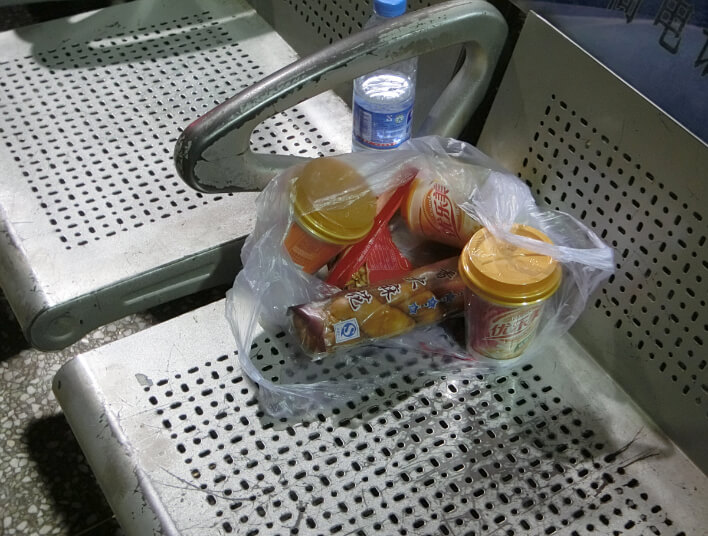
A bag of Chinese snacks on a chair in the Zhengzhou train station.
Snacks for the hike.

Differences in Thought Process

At the mini market Sho Boa picked up some dried noodles, chicken feet, and some hardboiled eggs. We also grabbed some instant porridge and instant coffee along with some water. I wanted some trail mix but wasn’t able to find any. I was concerned that the food we had wasn’t going to be enough sustenance for such a huge hike, but Sho Boa insisted that this was what him and his college friends ate when going on hikes.

“In China this is what we bring to eat on a hike.” He said.

I had to take him at his word. We argued a lot in the store as to what would be the best to eat, but I acquiesced telling myself I was having a Chinese experience and I needed to embrace it. Although my gut was telling me this food was not going to be enough to fuel me. It isn’t always easy to have an authentic experience of a culture that is new and foreign to you, no matter how easy it looks in the movies. So, Chicken feet it was.

The Cheapest Train

As I had said before: Every event, walk, exploration, eating and imbibing, every experience beyond the doors of your home or your work is shaped by the size of the crowd. Every national monument, museum, park, train, pilgrimage, and hike is shaped by the size of the crowd. Money will buy you space, but you need a lot of money, and we didn’t have a lot of money, especially Sho Boa.

Since Sho Boa didn’t have a lot of money he insisted that we take the cheapest slowest train. Xiang Kai and I were teachers, and we had a livable salary, but Sho Boa worked as an office assistant; a runner. The bosses were always telling him to run and get this, run and get that, run and go there, run and go here, and they did not pay him well. I could understand that lack of money would prompt him to choose the cheapest train. However, I suspected that even if he had money, he would still have insisted we take the cheapest train.

What makes the cheapest train cheap are its number of stops and rate of speed. At the time, I was clueless about exactly how slow a slow train was. I knew it was an overnight train and that it would take 8 to 9 hours to get to Huàshān, but I was not aware that a faster train would get us there in 3 to 4 hours. I also was not aware of what the traveling conditions on the train would be like. The idea was to sleep on the train and then to start our hike in the morning. I was fine with an overnight train, but Sho Boa bought regular seats not sleeping compartments, again to save money.

The interior of the Zhengzhou train station after midnight.
Zhengzhou Central Station after midnight.

A Crowded Train

I did not sleep on the train for multiple reasons. Number one, the train was packed. On the cheap trains, once all the seats are sold, they continue to sell tickets, and the prices for standing are the same as the prices for seats. So there are people standing in the aisles for up to eight hours. People are crowded in the aisles leaning over the people in the seats all waiting for the moment when someone gets up so they can take the open seat. There is no space, and no fresh air, and if you do get up to use the bathroom you have to climb over people crumpled in the aisle way. When you return you have to argue with the person who took your seat to give you your seat back, which they will do, but they certainly don’t want to give it back, and I can understand why. They paid the exact same amount as you. People are constantly switching seats around every time someone leaves in the hopes that they can sit for a couple of minutes. When you are sitting you have people leaning against you or over you.

We were in a section of six seats. Two rows of three facing each other. Shawn and I were able to sit across from each other but Xiang Kai had to find a seat somewhere else on the train. I am bigger in size than your average Chinese woman, but I am also smaller in size and sometimes width of your average Chinese man. All the seats were occupied by men, sleeping men who were man spreading like cheerleaders doing the splits. These men took every inch of space available leaving me with very little room, and since I did not have the Chinese power of sleeping in impossible places, I was awake for the entire 8 to 9 hour train ride. I was the only foreigner and only white woman in the car, and quite possibly the train. In these situations I would often encounter staring and some people would sneak or blatantly take my photo, but at 1:00 in the morning on a crowded warm train, no one cared about me, other than the fact that I was sitting and my seat was valuable.

When we left Zhengzhou it was crowded with all the seats occupied and some people sleep-standing in the aisles. Once we reached Luoyang, it became more crowded and people were nearly sitting on top of each other. One man slept precariously balanced on the top of my seat and draped over me like a throw blanket.

At one point, a group in the section across from us, who all seemed to be traveling together, had people sitting on top of the backrest. They were laughing, and loudly playing a game, and watching programs on their phones at full volume. Sho Boa who was sitting across from me leaned forward.  Thumbing his hand in their direction he said, “Look at them. What do they think they are in? Their house?” He gave them a brief scowl and then quickly feel asleep. I watched him slumber with an envious anger and an incredible urge to kick him awake so he could suffer like I was suffering. Xiang Kai was in a separate car, but had mentioned he had managed to sleep.

Packaged chicken feet in a convenient store in China.
Packaged chicken feet.

Huanyin City, 7:00 a.m.

When we arrived in Huayin City at 7:00 in the morning, I had not slept one wink. Exhausted, I followed the two rested men to hike a mountain peak, that unknown to me at the time, was 7,000 ft.

We had boarded the train around 1:00 am and arrived around 8:30 a.m. We took a taxi from the Huayin station to the village at the base of the mountain, and finally began our hike around 9:00 a.m. We had three large bottles of water, some strange meat paste, a few bready bits of snack food, and a bag of spicy chicken feet.

I was hungry, exhausted, and irritable due to lack of sleep, but I was also very excited. I was about to hike Mt. Hua, China’s most dangerous mountain. Did I know it was considered the most dangerous mountain to hike? Kind of. Word to the wise from the foolish: Do your own research.

Check back for part 3.

Hiking China’s Sacred Mountain Hàushān: A Journey to Healing Grief, Part. 1

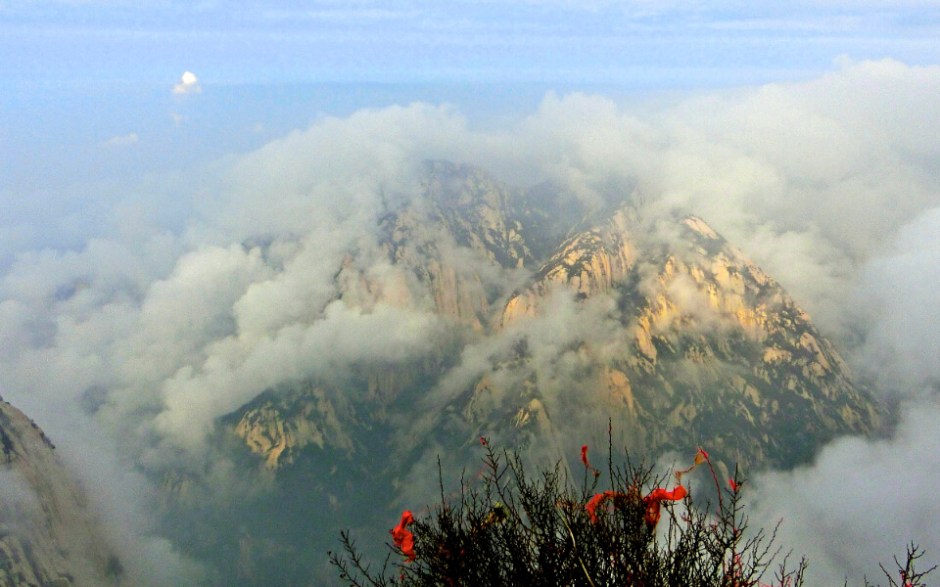
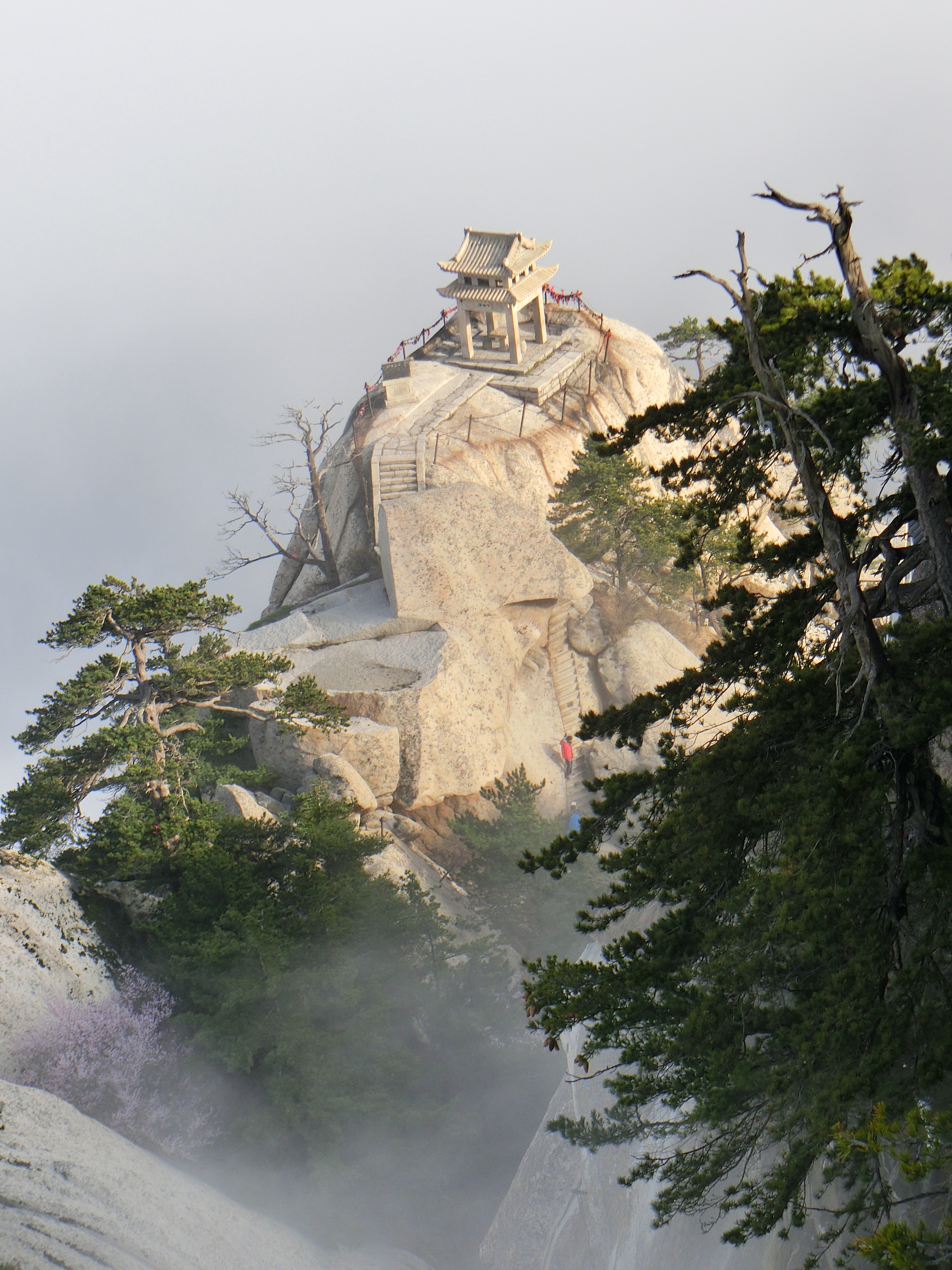
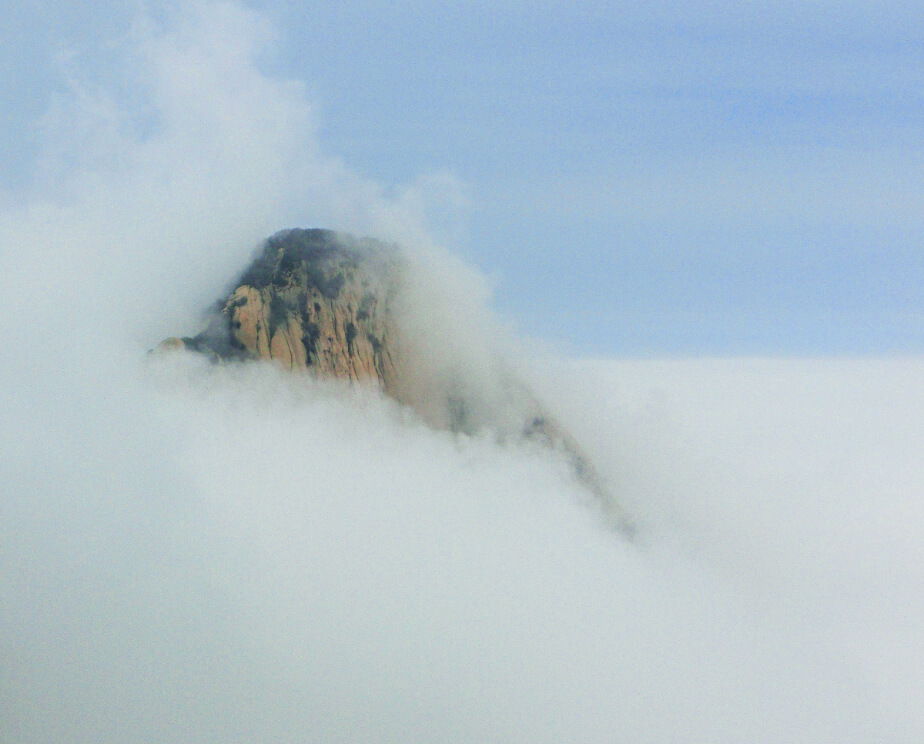
Huashan mountains viewed through the clouds.
Hiking above the clouds
It took us another eight hours of climbing vertical steps through damp vertical caves and along precarious edges of steep cliff sides. Sho Boa was our guide. He wanted to race to the top of the mountain, often criticizing Xiang Kai and me if we wanted to sit for a moment, or if we were moving too slowly. I was grateful to have Xiang Kai on my side. 

Sho Boa claimed he was the true hiker among us. He was climbing the mountain to defeat it. His desire to reach the peak and reach the bottom in the fastest time possible meant he was a conqueror. I’m not this person. I wanted to sit and reflect and bask in nature and observe the multitudes of people around me. I wanted to meditate and reflect. Mt. Hua was one of China's 5 sacred mountains. I wasn't from China, and when would I ever be back? I wanted to absorb it all in, but between the enormous crowds and Sho Boa's constant insistent pushing, hiking Hua Shan felt more like a military drill than a joyous hike. I didn’t know what was going on in Xiang Kai’s mind except that he wanted to stop and sit as much as I did. From time to time, Xiang Kai would shoot me look of irritation and disdain. "Ignore him," he’d say, "let’s sit, make him wait."

My Mother Died While I Was Teaching in China

It isn’t easy to lose a parent under any circumstance. Whether you lose them when you are young, or when they are very old. Whether you lose them to a long lingering illness or to a sudden accident. Each type of death results in the same thing. Your parent is dead and death is for the living to deal with. If I could have chosen how my mom died, I would have picked that she lived at least to her 80’s, and that she had a full joyful life, and that old age had finally decided that it was time for her to go. I would have sat beside her, holding her hand, telling her that I was going to be fine and that she could let go. That’s what I would have chosen. We don’t get to choose.

My mother was found dead on the floor of her bedroom. I wasn’t at her bedside. I was in China getting ready for my classes when I checked a Facebook message telling me to Skype a friend of hers: “that it was important”. Her life had been difficult and full of heartbreak, loss, grief, and addiction. Her greatest fear was to die alone and that is exactly how she died. The death certificate said it was a methamphetamine overdose. My only sliver of consolation regarding her death is that it may have been quick and painless. I hope she didn’t have a moment to know she was dying, so that she didn’t know she was alone at her death. We don’t get to choose. We get what we get.

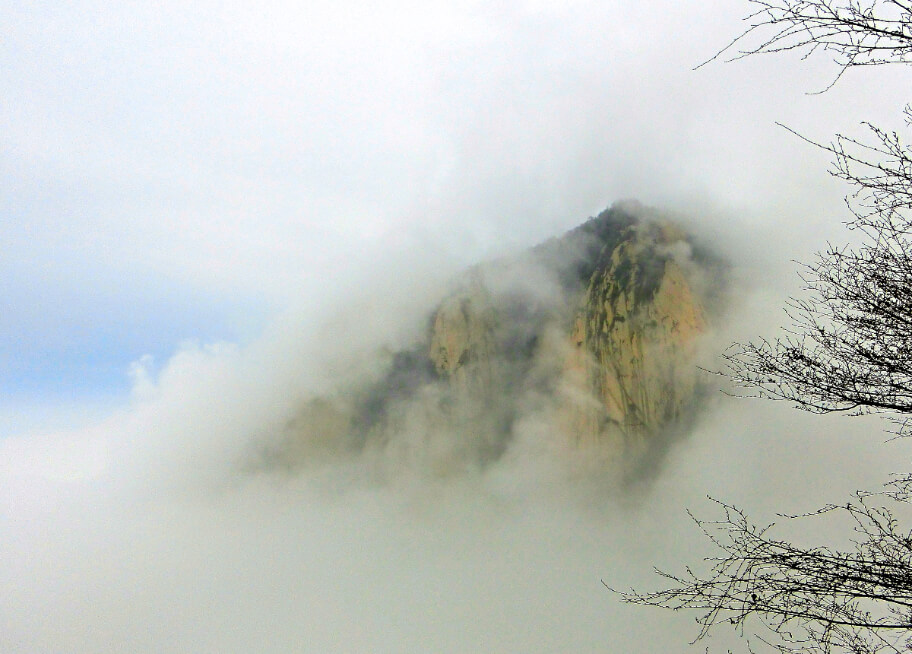
A peek of a mountain top through the clouds from 1,000 meters up.
1,000 meters halfway point to the peak.

Invited to Hike Huashan

The Five Sacred Mountains

Located in Shaanxi Province, not too far from Xi’an (place of the terra cotta warriors), Huashan is the Western Mountain of the 5 sacred mountains of China. The five mountains are Taishan (泰山), the East mountain in the Shangdong province; Hengshan (衡山), the South mountain in the Hunan province; Hengshan (恒山), ( not a mistake it has the same name in pinyin, but is different in Chinese) the North mountain in the Shanxi province; Songshan (嵩山) the Center mountain in Henan province; and Huashan (華山) the West mountain in the Shaanxi province. During my first month in China, I went to Sōng Shān while visiting the Shaolin Temple, but at the time I was not aware of the mountain’s sacred significance.

There are many sacred mountains in China for example Buddhism has four of its own sacred mountains, and Taoism also has four of its own sacred mountains. All of these mountains have been places of pilgrimages throughout Chinese history, and are the subjects of many paintings and poems. The Five Sacred Mountains, also called The Five Great Mountains, have been connected to imperial pilgrimages performed by Chinese emperors. The mountains are connected to the Supreme God of Heaven and the Five Highest Deities. Which may explain many of the stunning temples and hermitages built on the side of Mt. Hua.

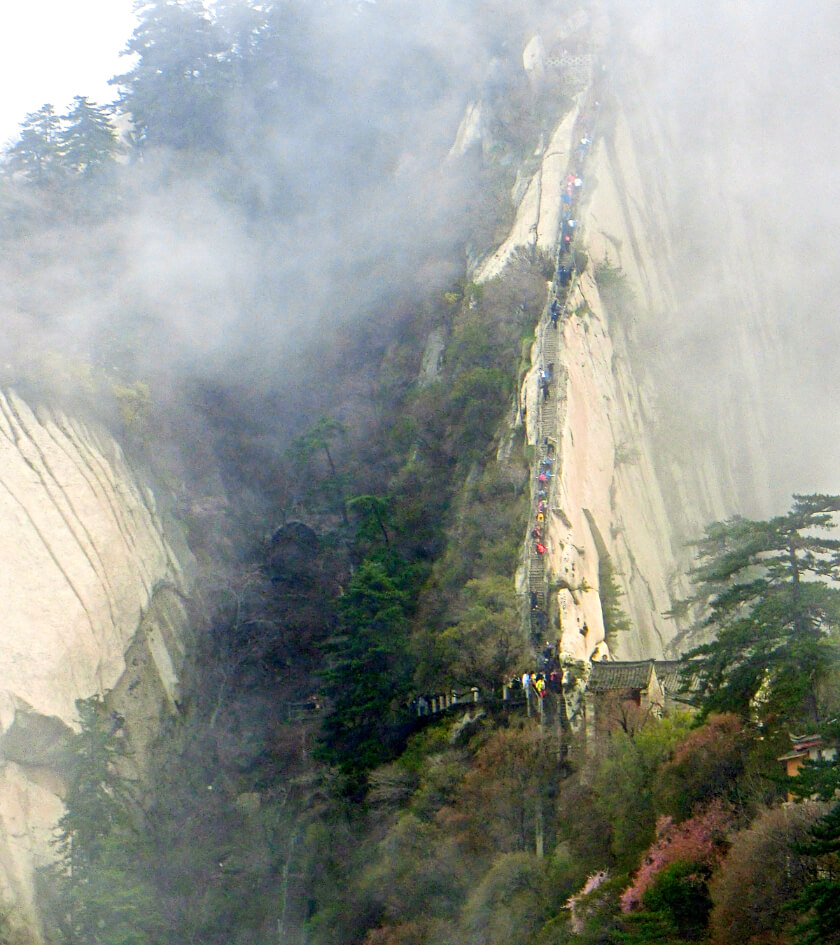
A view of the path on the western mountain of Huashan.
At 1,000 meters. If you look carefully you can see people walking on the blade of a mountain pass.

HuaShan

Huashan, Huà Shān, Hua Mountain, Mount Hua, and “number one steepest mountain under heaven”, however you say the name, it is all the same glorious mountain. Huà in Chinese means flower and shān means mountain, so the literal translation is flower mountain or 華山 flowery mountain. It is said to get its name from the five mountain peaks that look like a lotus flower.

Huashan was close enough to travel to in a day, but proximity does not equal facilely. Its reputation as one of the five sacred mountains is “China’s most dangerous”. It’s difficult to find exact numbers as to how many casualties and deaths may have occurred on Mount Hua, but after my own experience hiking it, I can assume that the number could be relatively high. Sho Boa said that you can’t find any numbers because the government doesn’t want the public to know the casualty rate because they don’t want to deter tourism. I don’t know if he meant city, provincial, or country government, but with the sketchy conditions, and population of inexperienced climbers (myself include), and the trash left behind, a little negative advertisement might be a good thing.

My Own Sacred Pilgrimage

As an outsider to China, it was easy to attach myself to the romantic connotations associated with ancient Chinese traditions. Taoist beliefs and Buddhist rites of passage have a mystic allure to a foreigner like myself. It was easy to imagine myself like the female version of Brad Pitt in Seven Years in Tibet or Bill Murray’s, Larry Darrell in The Razor’s Edge.

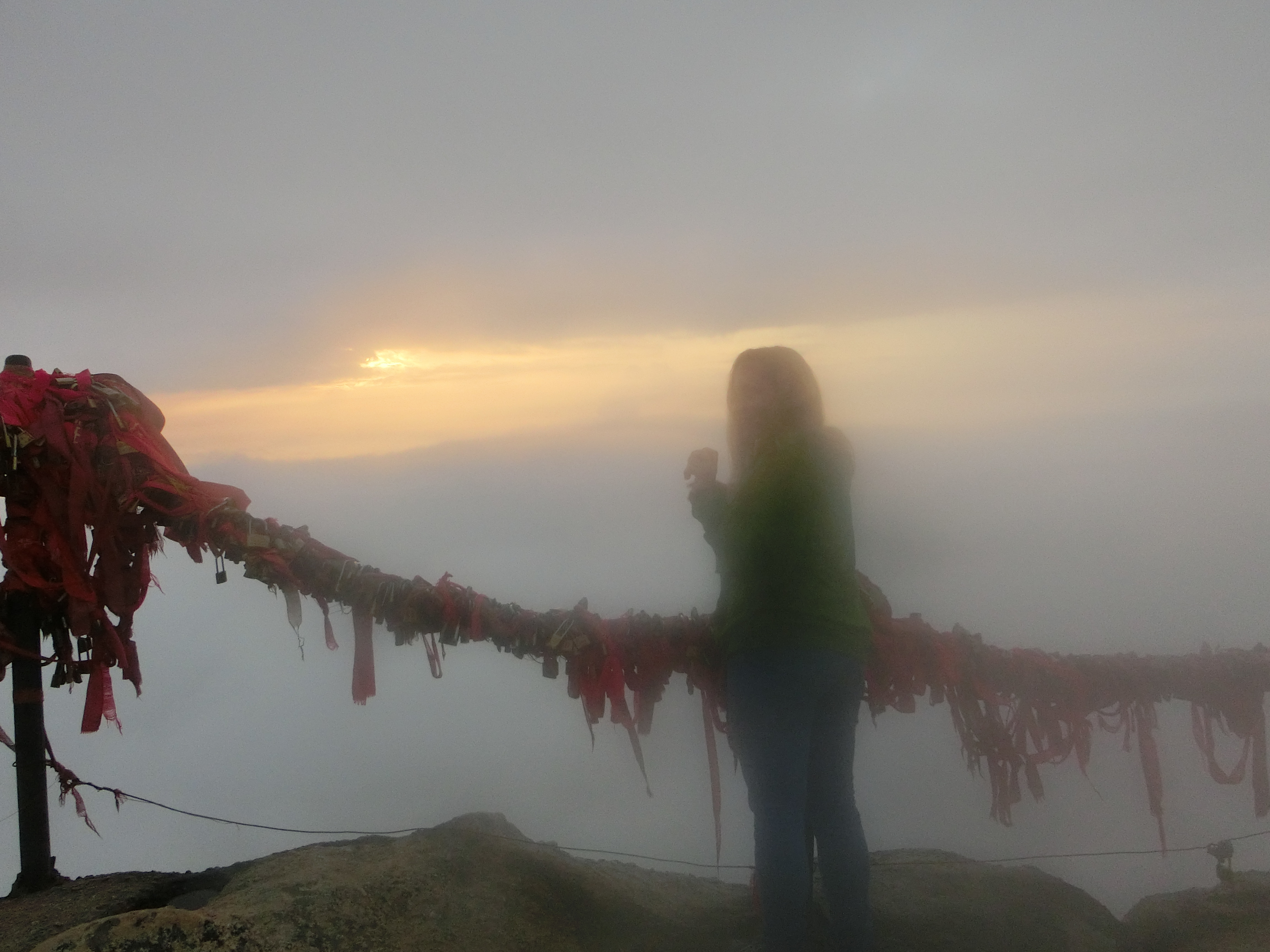
I envisioned myself reaching the peak of the mountain. In a moment of reverie sunlight breaks through the clouds or rises over the crest. I am filled with a sense of peace, gratitude, and a higher understanding of what life is about. Questions as to why we are here, and why I am here are answered. Then I feel a dawning acceptance of my mother’s death. I understand why she died like she did, and why I wasn’t able to save her. I know that death like life is beautiful.

Sadly, but not surprisingly, I did not reach this zenith of enlightenment. I was not awash in answers. I was achy and irritable. In fact, in retrospect, the entire journey from the city to the peak and back was farcical. I was more like John Goodman in the Big Lebowski than anything else, or The Dude maybe. Perhaps my journey was to feel exactly what I felt; achy, despondent, irritable, depressed, frightened, exhausted, in pain, befuddled, grieving, and longing for my mother to be alive. Of course, before the hike I didn’t know I was going to feel anyway other than joyful; and whatever enlightenment feels like.

A bright red prayer ribbon tied to budding blossoms on trees.
A wish for peace

The evening we were to leave, I poured some of my mom’s ashes (that I had brought with me from America) into a small box and put them in my backpack. If I made it to the peak then I would leave that little part of her there on that mountain top. It would be the closest I’d ever get to the stars. If I made it.

I read that it was a dangerous and steep hike. The highest mountain I’ve ever hiked. At least up to that point. I wasn’t sure which peak were were going to tackle, but Sho Boa insisted he had it all figured out, so I packed my bag, and waited for Sho Boa and Xiang Kai to meet me at my apartment. Our overnight train was at 1:00 a.m., but Sho Boa wanted us to get there around 11:00 p.m. so that we could pick up some snacks for the trip.

I had no idea what I was in for, but again, in retrospect, if I had a better idea of what was ahead of me, I would have taken a nap.

Continued…

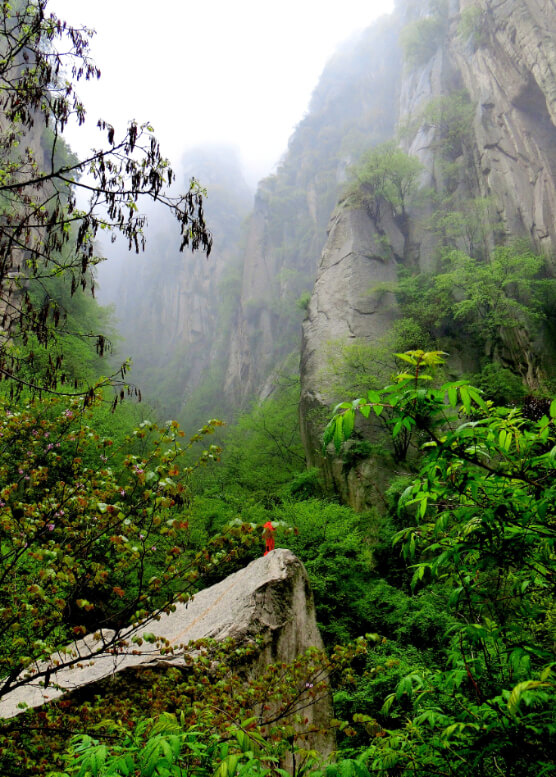
Sharp mountains reach toward a gray sky. Bright green foliage grow around stones.
Base of Huashan

A Winter Visit to Boothbay Harbor, Maine

This a a post about our February trip to Boothbay Harbor in Maine. If you’d like to skip ahead to the things to do and where to eat section you can go directly to Winter in Boothbay Harbor.
As luck would have it, Eun’s school closed for a week at the end of February, and that week just happened to be our birthday week. After a little online searching, we found a place in Boothbay Harbor.

A stone circular sculpture with a square center cut out to look like a window. The view through the sculpture is the sea.
Window of the Sea Wind by Hitoshi Tanaka

It’s 3 and a half hours to drive from East Machias to Boothbay Harbor, so we decided to take a quick stop in Blue Hill, a mere hour and a half down the road. Blue Hill is located is in the Downeast region which is the same region as East Machias.

I chose Blue Hill because I wanted to see the sculpture, The Window of the Sea Wind by Hitoshi Tanaka. The sculpture is located at Emerson Park and is part of the Maine Sculpture Trail. I first heard about The Window of the Sea Wind and the Maine Sculpture Trail from Downeast Cowboy, a local fisherman that also happens to have a pretty popular instagram with a lot of fun and interesting information about Maine. I like to check him out from time to time to see where we should go next.
Long before white settlers arrived in the late 17th century, this land was home to the Etchemin people, part of the great Wabanaki tribes – the “People of the Dawnland” among the Eastern Algonquian nations. Known today as the Malecite and Passamaquoddy, their ancestral roots run deep through Maine’s fertile soil and winding waterways.

For those keen to learn more about these First Peoples’ rich heritage, the University of Maine’s Folklife Center offers an enlightening introduction. Yet a somber truth lies in the fact that out of the 570 federally-recognized Native Nations across this land, the Wabanaki stand apart – excluded from the sovereign tribal rights and protections enshrined in the U.S. Constitution.

To deepen your understanding of the Wabanaki’s struggles and triumphs, one can visit Abbe Museum’s website. And for those seeking to inform themselves about tribal sovereignty’s critical importance and the consequences of its denial to these resilient people, a wealth of knowledge awaits the intrepid learner who follows the path. It is a path worth following.

A blue harbor with floating rafts. A white church with a black spire and roof top stands above a small harbor town. Evergreens line the hill in the distance.
Boothbay Harbor

Although white settlers arrived in the late 1600s, it wasn’t until 1729 that a permanent township took root, christened Townsend by the Scotch-Irish farming families whose descendants would eventually turn to the sea’s bounty. In those days, what is now the proud state of Maine lay under Massachusetts’ domain. Incorporated into the Bay State in 1764, the town’s name shifted to Boothbay.

But Boothbay’s path to today’s tranquil charms was hard-won through the trials of war and repeated British invasions, grievances that stoked Maine’s fight for statehood. For the Old Bay State could not safeguard its easternmost relative from foreign threats. At long last in 1820, the indomitable Pine Tree State claimed its place as the 23rd star on the national flag.

Around the mid-1800s Boothbay was already seen as a summer resort town. Big hotels began popping up by the 1880s, and city folk then called “rusticators” flocked to Boothbay Harbor for a simple bucolic summer. You can still see evidence of this history in Boothbay Harbor. Strolling the idyllic harbor streets today, one is transported through an architectural reverie of that gilded era.

Much of the original industry that sustained Boothbay through the pre-revolution up to the post-Korean War years are gone, but somethings remain. The shipyards and fishing remains with lobster being the pillar of the fishing industry. There is the boat building industry, and of course tourism. Beginning in the late spring and stretching until late fall, Maine’s coastal towns, like Bar Harbor in the Downeast region, and Midcoast Boothbay Harbor along with its neighboring island Southport and Linekin peninsula, fill up with new and ancestral rusticators, and new rusticators. However, winter is a different story.

boats anchored in a harbor.
Boothbay Harbor

Boothbay Harbor, a deep-water port capable of accommodating cruise ships and cargo vessels, belies its quiet, charming coastal town atmosphere. Nestled between the Sheepscot and Damariscotta rivers, the harbor’s tranquil waters envelop a rocky evergreen-topped island that seems to float serenely on the gently rippling surface. Even on the coldest winter days, the Atlantic sparkles with shimmering sunbeam reflections, painting an idyllic scene. Colorful shops lining the streets lend a blithe ambience to this quaint winter retreat.

The Mid-Coast region has long been renowned for its boatbuilding prowess, dating back to the 1816 founding of Hodgdon Brothers in East Boothbay – now the nation’s oldest continuously operating yacht company. Starting with schooners they are now known for building specialized military vessels and yachts. They are also known to build superyachts or megayachts, but we didn’t see anything so lavish on the harbor during our visit. Truthfully, a yacht doesn’t inspire me as much as the tradition of building. These skilled craftsmen continue to carry on a 208-year family legacy, and that is impressive.

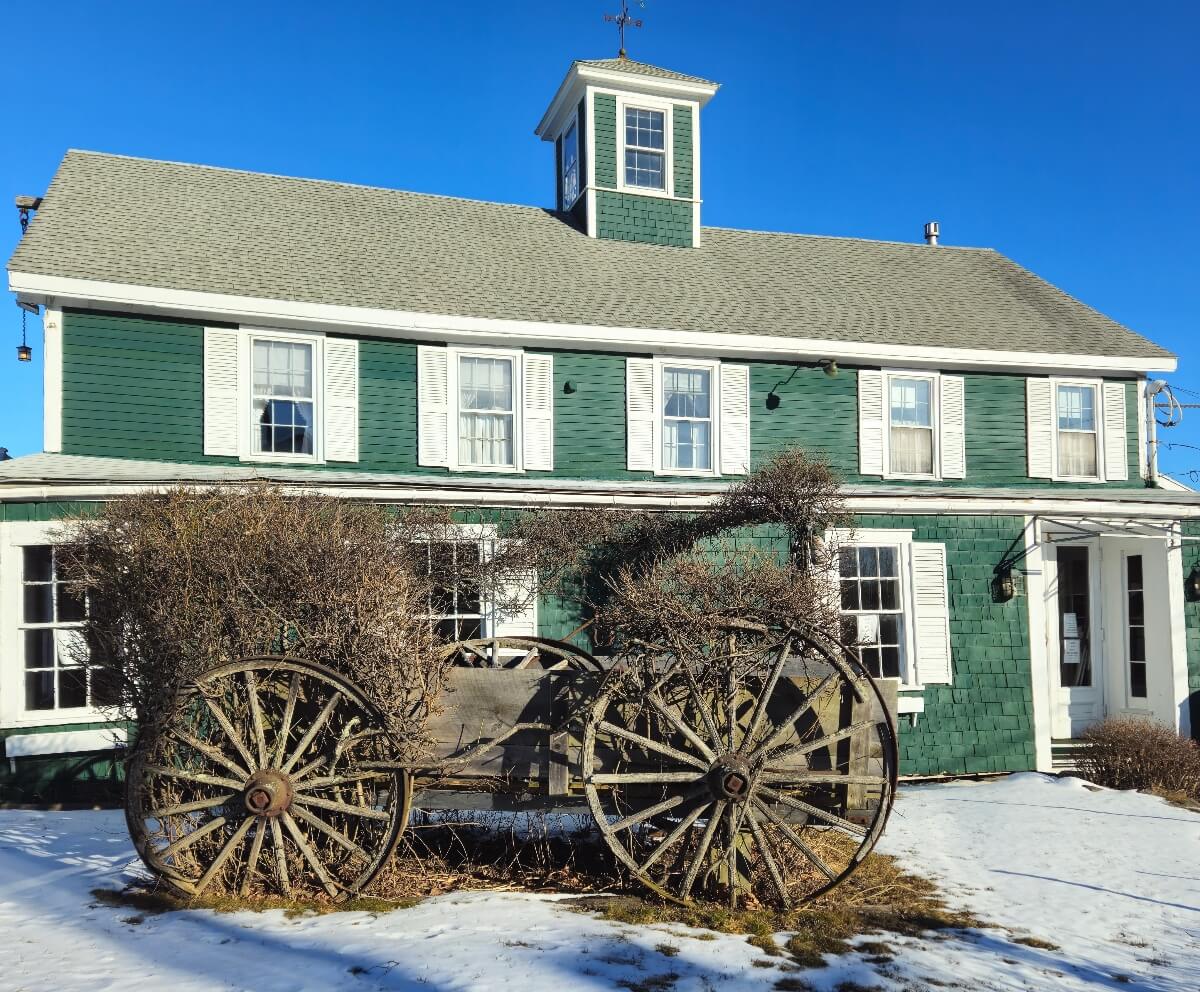
Green house with white trim. An old wagon sits on a snow covered lawn in front of the house.

A few months ago a bad storm with hurricane winds came through a lot of the businesses near the piers and waterfront were flooded, but at the time of our visit we didn’t see any of the damage. However we were told that some places that are normally opened year round had to close due to the storm.

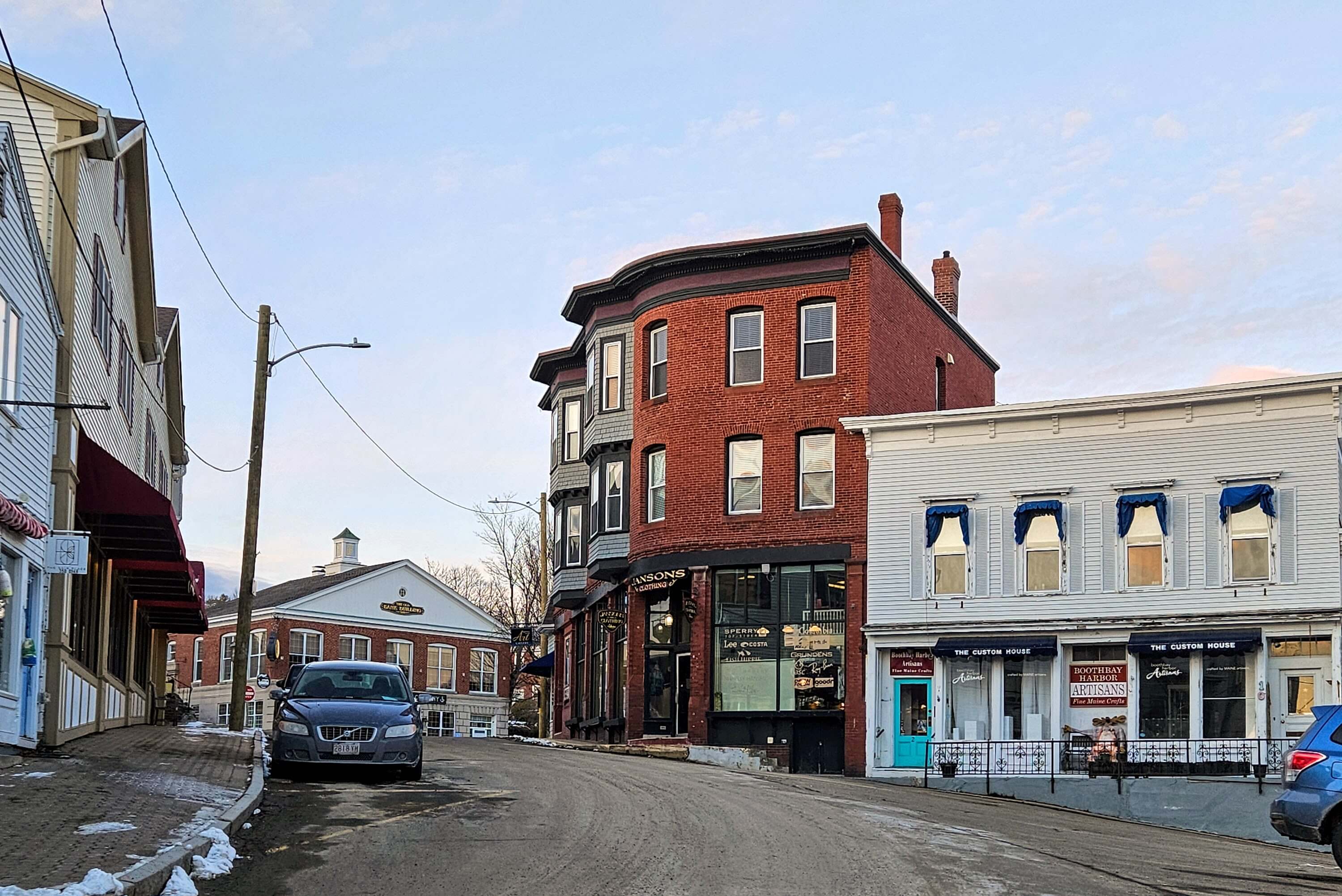
A curving downtown street with small store front building from the late 19th century. A tall three story red brick building stands out and above the other store fronts.
Commercial Street, Boothbay Harbor
  1. Where We Stayed
  2. Where We Ate
  3. What We Did
  4. Where We Shopped

We came at the end of February with snow and ice covering the ground, and most of the restaurants and shops were closed and shuttered. We didn’t mind. We still managed to find a few opened shops and a few opened restaurants, and that’s all we needed. It had just snowed two days before our trip, and blankets of snow covered the sidewalks, wide open spaces, and the piers, but it only added to the serenity we found when we arrived.

We stayed for three nights and days, and during that time we explored several parts of Boothbay Harbor, including East Boothbay, and Southport the neighboring island. Of course there were somethings that we couldn’t do that we would have loved to have experienced like getting a chance to see some puffins, but there are no boating tours until the summer. Still, we had a really nice time wandering the empty streets window shopping and exploring.

We spent a lot of time gazing out across the harbor admiring the incredible view of the sunlight glistening off the harbor’s gentle blue waters as mallards and other dabbling ducks paddled on the mild waves. The night skies were clear and black with beautiful constellations of stars that danced above us.

Two house frame and alleyway that offers a view of the sun soaked golden harbor and house in the distance.
A View of the harbor from Townsend Ave

We stayed right on the harbor near the piers in a space named, “The Coal Shack”. We later learned that the spacious studio was named after the owner’s black lab. The owner runs a pet store called Two Salty Dogs across the street from where we were staying.

It was a small newly renovated space that was perfect for two people and a dog. We chose the place because it was dog friendly. In fact, “The Coal Shack” was the friendliest dog friendly places we have stayed so far. The pet fee was reasonable, and you could tell the owner was indeed a dog lover. We found out when we visited him at his store, Two Salty Dogs, that at one time he had four black labs. Man has his type.

It was beautiful and comfortable inside with its timber walls and copper fixtures. The kitchenette cabinets and appliances were painted a cobalt blue, which combined with the copper fixtures and gilt-lacquered gold and blue wall, gave the entire space a luxuriously warm yet cozy feel. Two french doors opened onto the balcony which on the days we stayed was covered in snow, but we could still see the harbor and get a lot of sunshine and light into the space. The furniture was all very rustic and anachronistic, but comfortable.

We really loved the place. We also were aware that in the peak season this place probably doubles in price and is booked out. The dog friendliness, the perfect location, and how nice it is in general adds to its summer value. We probably wouldn’t be able to afford it during the peak seasons. It wasn’t cheap in winter either, but it was less, and we were able to swing it.

Not a lot of places are open during the winter, especially in February. However, thanks to a friendly cashier at Sherman’s bookstore who showed us a list of open restaurants and their hours in February, we did find a few places to eat out.

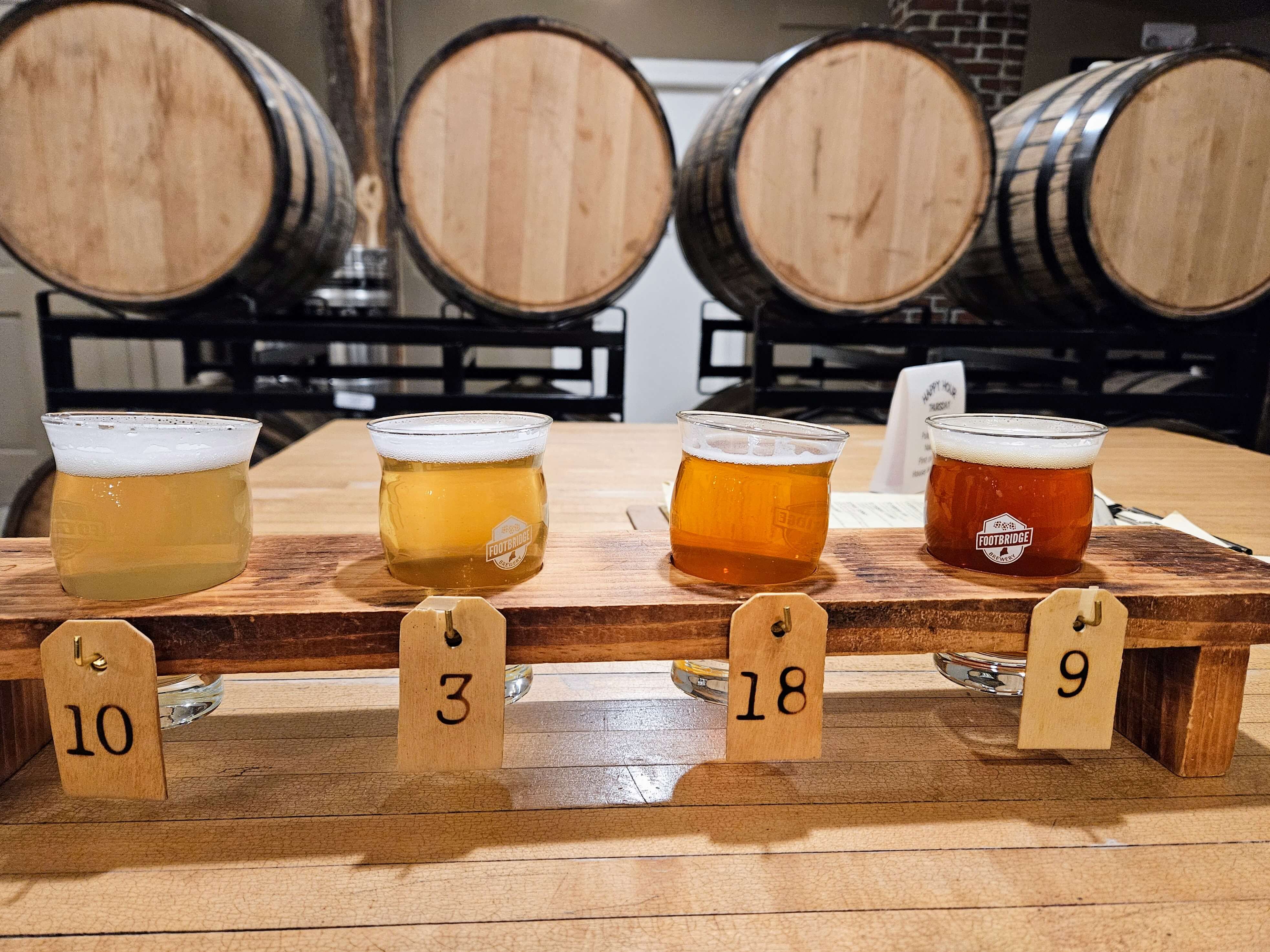
A flight of four beers each given a corresponding number. The numbers are from left to right: 10, 3, 18, 9. Behind the beers are wooden beer barrels.
Footbridge Brewery, Boothbay Harbor

Our first night in Boothbay Harbor was on a Sunday. Lucky for us we were able to visit Footbridge Brewery on this night because it was closed for the other two nights we were in town. It was also lucky because the owner offered two hamburger specials at great prices. We each got the specials which were huge burgers with delicious fixings that only cost us a total of $12.00 for both (not including the beers). It is pretty difficult to find any single dish at any restaurant for under $12.00 these days, so it was a treat for both our taste buds, and our pockets. We also enjoyed their in house brewed beers. We opted to share the flight of beers so that we could sample a few of the flavors. We tried the Shrimp Run, a pale ale; The Woodcutter, an American strong ale; the Raw, a Nordic raw brewed in a traditional Norwegian “no boil”; and lastly we tried the rotating tap which was the Tequila Mockingbird; a barrel aged jalapeño habanero pale ale. My favorite was the Tequila Mockingbird, and not just because of the name. Eun’s favorite was the Shrimp Run.

Located at 25 Granary Way

We came here on our first full day in Boothbay Harbor for lunch. We had the Margherita cooked in an Italian brick oven on a thin crust. It was delicious. Perfect sauce, not too sweet not too sharp. Perfectly delicious. Eun enjoyed his pizza with a glass of beer and I had a glass of red wine. A pino noir, I believe.

Located at 28 Union Street

We came here for dinner on our second night and the place got pretty full while we were there. It was one of the few restaurants open after 7:00 p.m. on a Monday night in the winter. A family came in near closing time, but the server sat them anyway stating that there was “no where else to eat in town, so take a seat“. The service was very friendly, and the crowed seemed local. February’s menu is limited, but it still had plenty of good food to choose. We shared the crab cakes tapas, which if I’m being honest, I’ve had better. The breading was too salty for me personally. For dinner, Eun ordered the Bistro Chicken Parm served over fettuccine, and I had the Haddock Risotto. I was told by the cashier at Sherman’s bookstore that the Haddock Risotto was the best thing to order there, and he was right. It was scrumptious. If you like fish and risotto, I recommend that dish.

Located at 12 The By-Way

  • Southport General Store

On our second day, we drove out to Southport to check out the general store and eat lunch. I write a bit more about Southport later in the post.

Tuesday was Eun’s birthday, and he really wanted to have lobster for his birthday dinner, but we had trouble finding a place that was open, so we decided to find some lobster to take home. We went to Pinkham’s Gourmet Market, which has really earned the moniker gourmet. We picked up some shelled lobster at the market cost of $75.00 (for two servings), fresh clams, linguine noodles, a white sauce, coleslaw and a couple of local beers. Then we went back to the Coal Shack to cook it all up. On the way to Boothbay Harbor, we picked up some cheesecake (Eun’s favorite) at Momo’s an amazing cheesecake place that has the best cheesecake I have ever eaten. We had all the fixin’s for a wonderful birthday dinner.

295 Townsend Ave

On our way out of town we stopped at Baker’s Way, a Vietnamese restaurant, but with fresh donuts and coffee. This place was crowded in the morning, and definitely populated with locals judging by the overheard conversations of fishing and someone’s attempt at selling their house. I picked up a gigantic apple fritter for us to split and two black coffees to start us out for our 3 and a half hour drive back to East Machias.

Located 89 Townsend Ave

We didn’t get a chance to eat here as we were too late. The owner told us that he bakes the bread fresh in the morning and then closes when he sells out. He did however direct us to Ports Pizzeria, and Baker’s Way. He also took us back to the bar that he had just opened in a room in back of the Sub-shop. A little speak-easy that he named NEAT. As you may have guessed by the name it is a whiskey and cocktail bar. We didn’t have the opportunity to imbibe in the drinks, but we both really like the woody rustic atmosphere, and if we make it back to Boothbay Harbor we will definitely come early enough for a sandwich and come later for a cocktail.

Located 25 Townsend Ave

Two deck chairs facing a view of a winter harbor scene.
View of the harbor from Union Street

Aside from eating, we also explored the town a bit. We explored as much as the cold weather allowed. We went out every morning and evening to walk Penny down to Pier 1 to the small dog park. The first morning out boots crunched over the snow, and slide on the ice, but by the next day the temperature has increased just enough to melt the snow to where we could see some of the pier’s wood planks.

A wooden footbridge that crosses Boothbay Harbor.
Boothbay Harbor Footbridge
  • Walked around the piers

I noted three piers on the on the westside of the harbor where we were staying. In the winter there isn’t a lot to see since most places are closed for the season, but also places were closed due to damages occurred from the storm.

  • The Footbridge

The Boothbay Harbor footbridge is the longest wooden foot bridge in the country. The bridge connects the west to the east. Before the footbridge was built in 1901, people would have to either walk around the head of the harbor, which could be quite a walk, or they could take the ferry which cost a nickel. It’s a pleasant walk and right in the middle of the bridge is what looks like a house. I’d never seen a house on a bridge before and it made me think of something you would find in a children’s story. The house was built in 1902, and had been many things over the 200 plus years. On the day we crossed it was closed.

  • The BoothBay Harbor Region Sculpture Trail

Originally, I had thought this sculpture trail would be connected to the Maine Sculpture trail, but apparently it is not. After a little research, I read that this trail was modeled after a sculpture trail in New Hampshire. It appears as if Maine, may be a great place for sculptures. It certainly has the atmosphere of natural influence. We didn’t follow the entire trail of 33 sculptures, but we did see a few. It is not possible to walk the entire trail as there are sculpture in both Southport, East Boothbay, and Ocean Point, but you can see a lot of them in the downtown area.

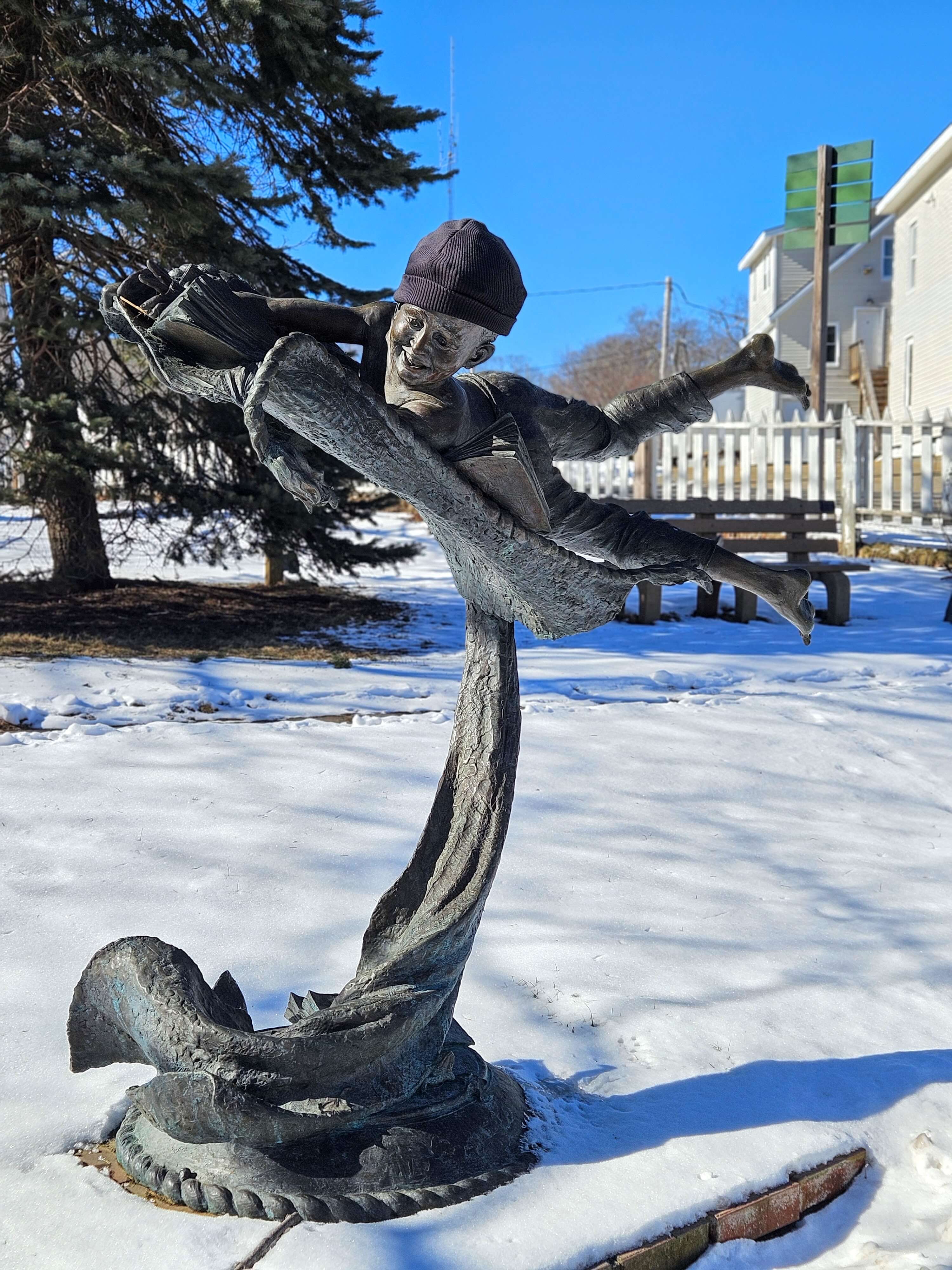
Sculpture of a young boy sledding.
My Story by Mitch S. Billis

More restaurants than stores open

This is the oldest bookstore in Maine. Well, not this location, the very first Sherman’s Bookstore was opened in Bar Harbor in 1886. The one in Boothbay open a little over 100 years later in 1989. The person who worked in the bookstore was extremely helpful. In fact, if it wasn’t for him we wouldn’t have know what restaurants were open. If you visits Sherman’s here you’ll find a great gift store downstairs and the bookstore upstairs

A typical small town clothing store with cute finds along with nice quality souvenirs

Like walking into an old hippie store that you would find in Northern California in the 1970s and 80s. It was like I was in high school again and looking for tarot cards and crystals during my my very short lived, “maybe I’ll be a Wiccan phase.” I did see a deck of Gypsy Witch Fortune Telling cards that brought me back to age 16 or 17 when my friend, who was much more dedicated to witchcraft and D&D then I, had the very same cards. You don’t see stores like this much anymore, especially a store of this size.

The orange and black deck case of Gypsy Witch fortune telling cards.

Linekin peninsula that juts out into the Atlantic Ocean and lies between Linekin Bay to the west and the Damariscotta river estuary to the east. There are two nature preserves, the Linekin Preserve and the Ocean Point Preserve. East Boothbay is a village about 3 miles northeast of Boothbay Harbor and it is located on the northern part of Linekin peninsula.

A house that is built in the Queen Anne style with a mansard roof. The house is a lemon yellow and has a red front door. The sign on the house says, East Boothbay General Store. Under the sign is a giant wreath. In front of the house is a stone sculpture.
East Boothbay General Store

We drove to East Boothbay and stopped briefly in the East Boothbay General Store during our excursion on Ocean Point Road. The East Boothbay General Store in a rustic three story house with a mansard roof and a triangular turret that appears to rise above an old barn. The store was founded in 1883 as a general store. We stepped inside and looked at the beautiful pottery and other crafts, along with the food, but we passed on eating since we already ate, but definitely next time.

One of the highlights of our trip to the Boothbay region was a drive along the coastal headland Linekin peninsula. HWY 96 takes you out to Ocean Point Scenic Drive.

The view of the Atlantic ocean with islands in the distance.
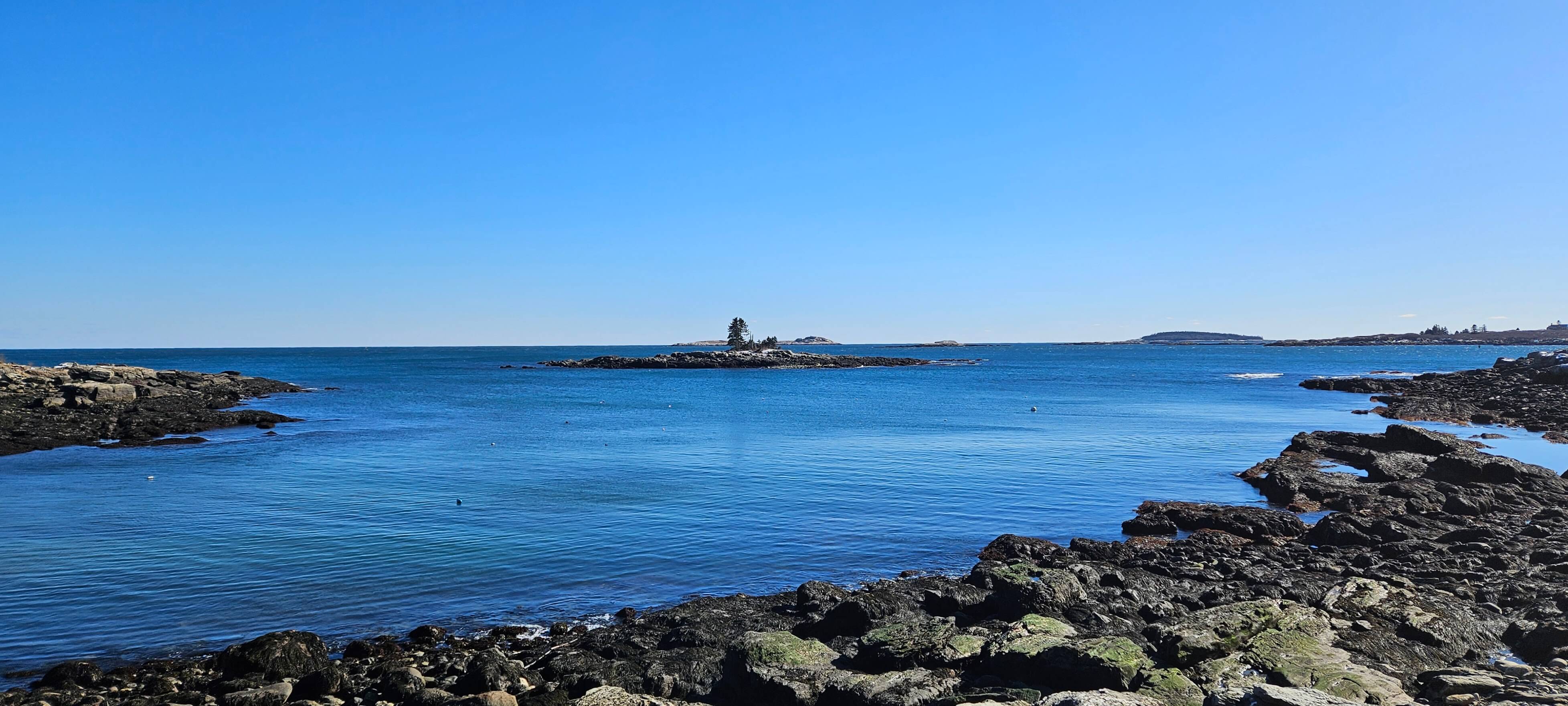
A view of the Atlantic ocean from Grimes Cove

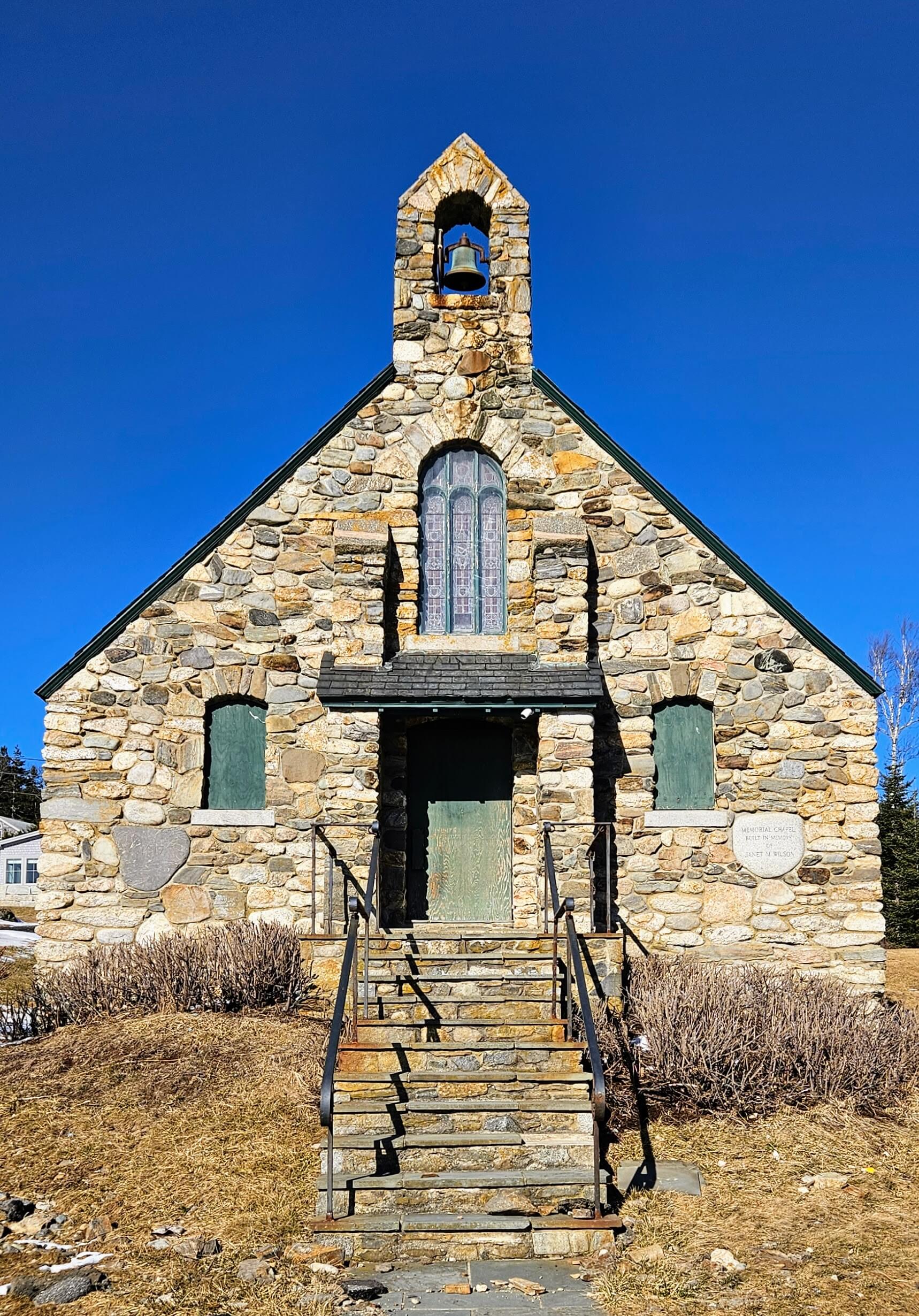
Ocean Point Drive is a loop around the southern point of the peninsula and it offers expansive views of the Atlantic ocean. From Grimes Cove you can see Ram Island and the Ram Island lighthouse, and behind that you can see Firsherman’s Island. Aside the lighthouse you are able to make out a single house. The drive gives you views of the Atlantic to the east and the west and then circles around inland toward Linekin Bay. There are beautiful Queen Anne style homes built all along the road, and even a chapel built out of stones gathered from the surrounding area. Janet Wilson’s Memorial Chapel was built in 1917 by Minister Lewis G. Wilson in memory of his wife.

A chapel with a small bell tower and copper bell made from stones and rocks.
Janet Wilson Memorial Chapel, 1917, Ocean Point Drive

Coastal Maine was hit by two big storms this winter, we felt the impact of those storms in East Machias, but the midcoast and southern coastlines of Maine were hit harder. The damage from those was clearly evident when we drove along Ocean Point. Large portions of the road were cracked, crumbling and uplifted with parts of the road in broken pieces on the rack below. The road is already narrow and winding, so the cracked and broken edges only made the road narrower. There were only one or maybe two other cars on the road, so it wasn’t too stressful or a problem. I was even able to get out of the car to take a picture of the Wilson Memorial Chapel, which looked to have sustained some damage from the storms. I don’t think this drive would be as pleasant in the summer with traffic, especially if the road is still damaged. The views would be amazing, but there isn’t anywhere to pull over to take a look because the parking spaces have crumbled into the rocks and ocean below.

A white a-frame house with the sign: Southport General Store.
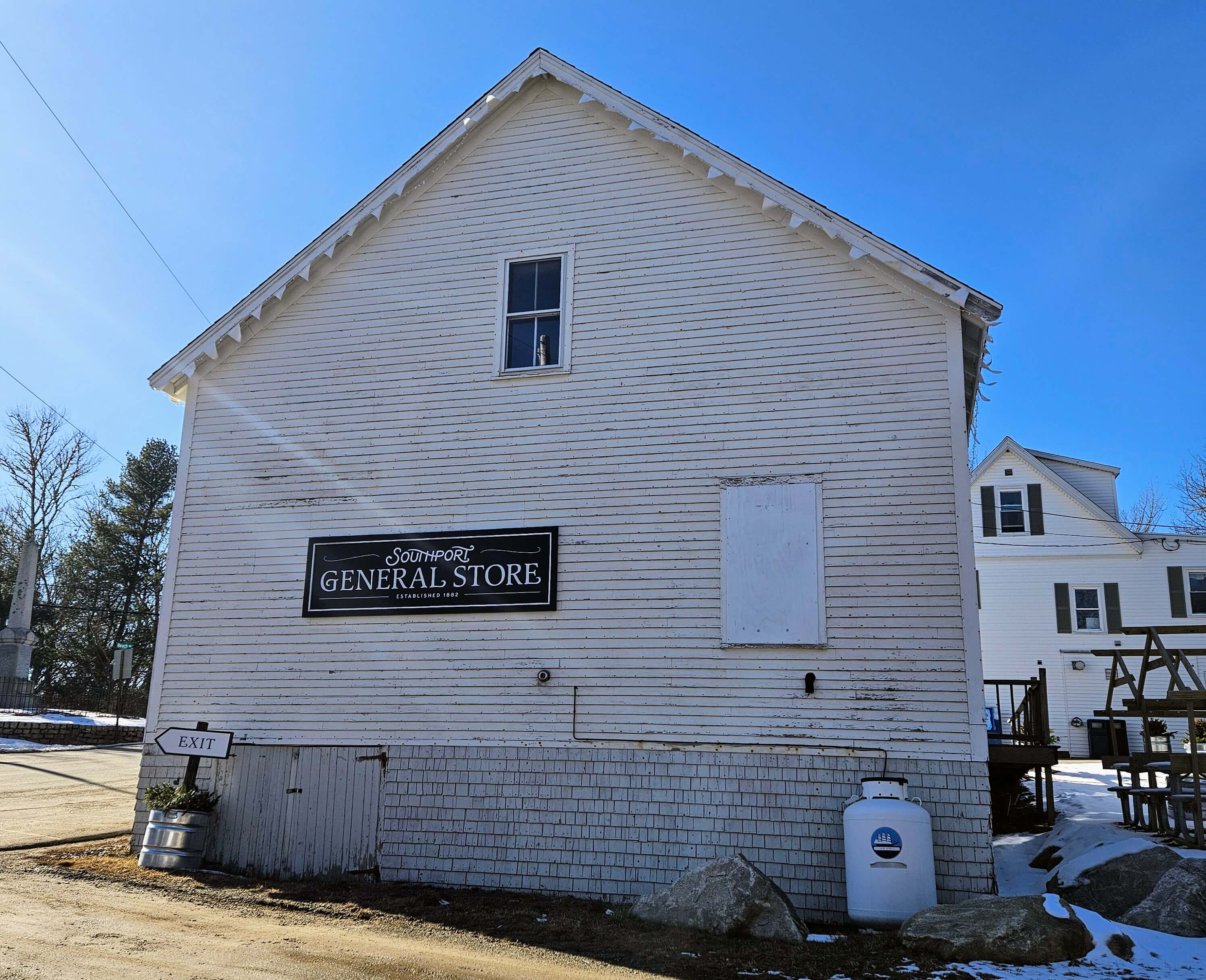
Southport General Store

The Southport General Store was established in 1882. It is a small general store with groceries, made to order food and a little eating nook in the back. We had a couple of sandwiches for some sustenance to keep us going during out day of exploration. The Barn is a small retail shop and creative workshop space that sells local made and crafted products. The space is a literal barn renovated into a shop space. We came out to Southport specifically to see what they had in The Barn, but alas it was closed.

Headstones from a 19th century graveyard lean toward a highway. A white work shed is  seen in the distance.
19th century graveyard, Southport

One personally interesting thing to note is the ancient graveyard next door to the General Store and Barn. The graves date back to the 19th century, although there may be some 18th century headstones as well. The grave yard is over grown and sinking into the earth with the small forest swallowing the edges. What fascinates me about the graveyard is its proximity to the road. The grave reach out to the very edge of the roadway. This is something I have notice whenever we drive around these coastal peninsular part of Maine. There are many graveyards that go right to the edge of the road, and it makes me wonder, did they pave over other parts of the graveyards? Are we driving over those graves?

Rachel Carson who wrote the groundbreaking environmental alarm call, Silent Spring, was in love with Southport and she spent the last 11 years of her life summering here. Her presence and overwhelming love for Southport permeated into the community and today you can hike through evergreens on the Rachel Carson Greenway Memorial trail.

There are not a lot of places open in the winter, especially in February, but we did get to see a lot of what was open. However there were still a couple of places open that we didn’t get the opportunity to check out that we had wanted to visit. I’ve listed them below and with links.

Farm23 not only has some great looking pastries, but they also sell some products from Salty Raven in Oregon. Salty Raven has a lot of great designs that show a love for sea life. If you can’t get to the west coast you can find her work on the east coast. Also, the owner happens to be a friend of mine.

Several stone sculptures in snow in front of a harbor with house in the distance.
Sculpture Garden near Townsend Ave

Things get started in late May, but all restaurants open by April. The boating, boat tours and all the accommodations are in full swing by June. Things remain open til October when people begin to close up for the coming winter months. Some places remain open with winter hours during the months of November and December, but January and especially February (our birthday month) most of Booth Bay harbor and their surrounding neighbors are in hibernation.

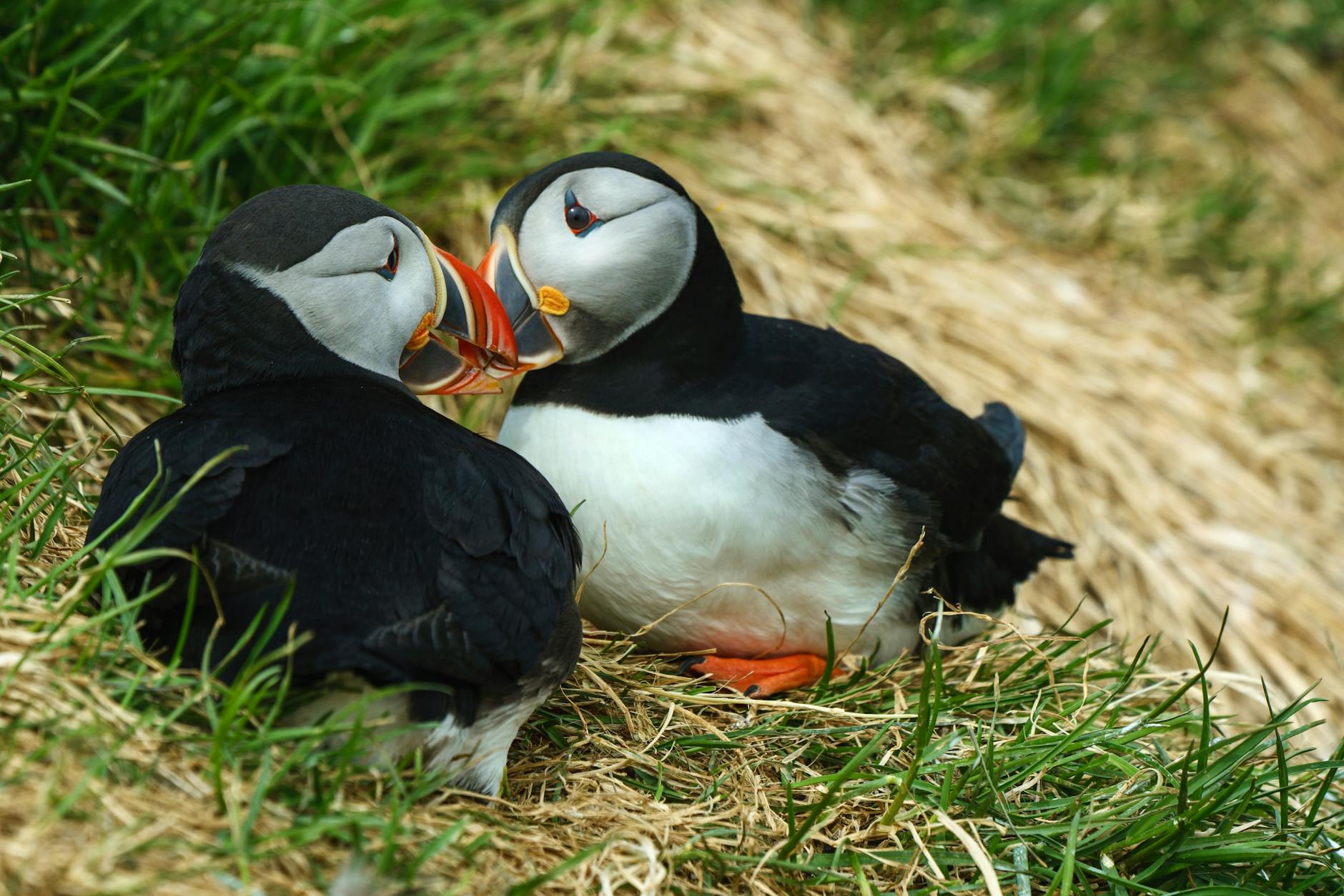
Two adorable Puffin birds sitting in the grass.
Photo by Susanne Jutzeler, suju-foto on Pexels.com
Sources:

Memories of HuaShan

The sunlight woke me. I remained still on the cot where I had fallen asleep the night before. I was afraid to move because I strongly suspected that my body would react in pain from the damage I had inadvertently put it through the previous day.

I heard the men shifting on the two cots beside mine, and knew my inevitable pain was only seconds away. I would not be able to remain on a cot for the full month of recuperation I felt I was going to need. We had hiked HuaShan the day before, and we did it the Chinese way, as my friend Sho Boa recommended. I use the word recommend loosely as I could never feel like Sho Boa was recommending as much as insisting. The “Chinese way” according to Sho Boa, who is Chinese and from Dengfeng, was to take the slow night train to Huayin City, and then from there take a taxi to the base of the mountain. The ride would be eight hours, but Sho Boa insisted that we could sleep on the train and would be refreshed to begin our hike as soon as we arrived. I was hesitant about this choice as I lacked the amazing Chinese gift of sleeping anywhere, anytime, and in any kind of environment. Sho Boa insisted this would be the best way, and that this was how he did it a couple of years before when hiked with a group of his classmates during his college years.

“It’s a very Chinese way to experience it.” He said.

CIMG3718

In retrospect, as I felt the fluid eek around my knees and heard audible cracking sounds that had not been there before, and as I felt searing hot pain when I tried to bend them, I thought, he must have meant to say the cheap ass Chinese way to experience it. I mumbled cheap ass in my mind out of irritation, but I knew that it was half about having “the real experience” and half about not having the money. The bullet train would have taken us two hours and been much more comfortable, but neither Sho Boa or his friend Xiang Kai could afford the bullet train. I knew my salary as a foreign teacher was much higher than the salary that Xiang Kai made, even though we did the same job, afforded me not only enough to pay for my own ticket, but Sho Boa and Xiang Kai’s too. Sho Boa wouldn’t hear of it. It was a waste of money to spend, he said, and that I didn’t want to insult Xiang Kai with the offer. However, I vowed to myself that painful morning, that if I were ever to take another trip with Sho Boa I would rudely push aside his Chinese sensibilities and practicalities in favor of the imperialist American desire for comfort (which I knew many of the middle and upperclass Chinese were taking advantage.)

“Xiang Kai,” Sean said as he rose from his bed, “You were speaking in English in your sleep.”

“Was I?” Xiang Kai replied.

“Yes.” I said. “You screamed out in English in your sleep. Maybe you were still on the hike.”

“I have not spoke English to an English person in so long. I had spoke it all day with you it must have been in my dreams.” He said.

“They say that’s a good thing.” I said. “It means the language is in your subconscious.”

CIMG3715

The night before Sho Boa met me at my apartment with Xiang Kai, and we all took a bus to the central train station in Zhengzhou. We arrived near Erqi Square (pronounced Archie square) around 11:00 p.m. Our train was scheduled to leave at 1:00 am so we used the time before departure to shop for snacks for the trip and the hike.

To say that Chinese do things differently than Americans do things is an understatement, but it is in the small actions of  life, the things we don’t really think about on a daily basis, when one discovers how even our thought processes and approaches to “the way to go about something” can be very different. For example, what you should eat when on a hike. My American mind immediately goes to foods with complex carbohydrates with sustainable energy, things like trail mixes with nuts, crackers, pretzels, and protein like beef jerky and maybe some dried fruit, and definitely water. Sho Boa’s thinking which I can only identify as Chinese thinking (not that I speak for all Americans and Sho Boa does not speak for all Chinese) was to get dried noodles, chicken feet, and some other dehydrated things I could not identify. We did agree that a hardboiled egg would be good, and of course water. We argued a lot in the store as to what would be the best to eat, but I acquiesced telling myself I was having the true Chinese experience. My gut was telling me this food was not going to be enough fuel for me.

I did not sleep on the train, for multiple reasons. In China once all the seats are sold on the train they continue to sell tickets (not on the bullet train) and the prices for standing are the same as the prices for seats. People crowed in the aisles leaning over the people in the seats all waiting for the moment when someone gets up so they can take the open seat. There is no space, and no fresh air, and if you do get up to use the bathroom you have to climb over people crumpled in the aisle way. When you return you have to argue with the person who took your seat to give your seat back which they will do, but they certainly don’t want to give it back, and I can understand why. There are three people to a row that face another row so you have six people in one section. I was the only foreigner and only white woman in the car, and quite possibly the train. In these situations I would often encounter staring and some people would sneak or blatantly take my photo, but at 1:00 in the morning on a crowded warm train no one cared about me other than the fact that I was sitting and when would I get up. I shared my section with five men who man-spread better than any men I have ever encountered leaving me with barely enough space to fit my ass. I mentioned that Chinese can sleep anywhere and in any environment and that is not an exaggeration. They can even sleep standing up. When the train reached Louyang it became more crowded and people were nearly sitting on top of each other. One man slept arched over me precariously balanced on the top of my seat.

At one point, the people in the section across from us who all seemed to be traveling together had people sitting on the top of the backrest. They were laughing and loud and playing a game, and watching programs on their phones at full volume. Sean who was sitting across from and facing me leaned forward.  Thumbing his hand in their direction he said, “Look at them. What do they think they are in their house?” He gave them a brief scowl and then quickly feel asleep. I watched him slumber with envious anger and an incredible urge to kick him awake so he could suffer like I was suffering. Xiang Kai was in a separate car, but had mentioned he had managed to sleep. When we arrived in Huayin City at 7:00 in the morning I had not slept one wink and with exhaustion I followed the two rested men to hike, unknown to me at the time, 7,000 ft.

arch

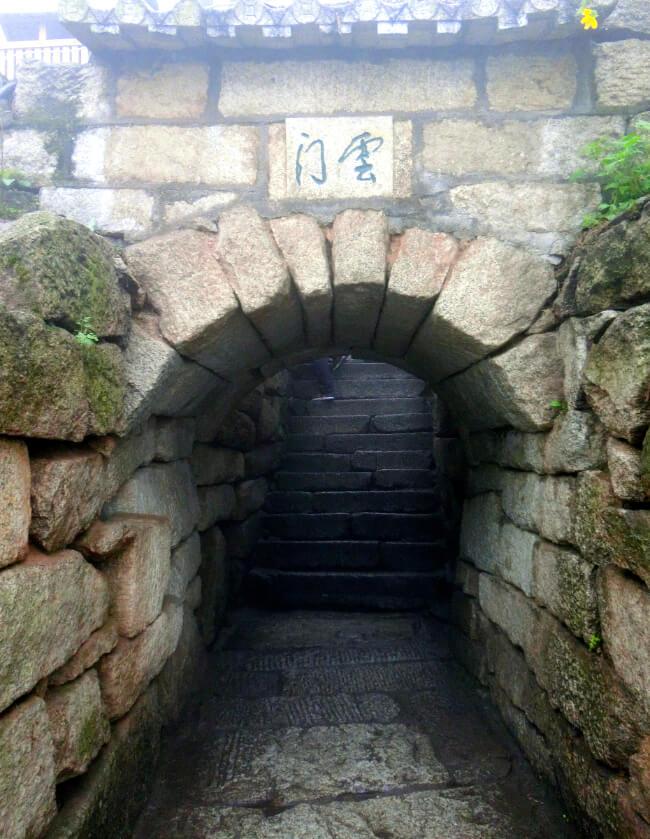
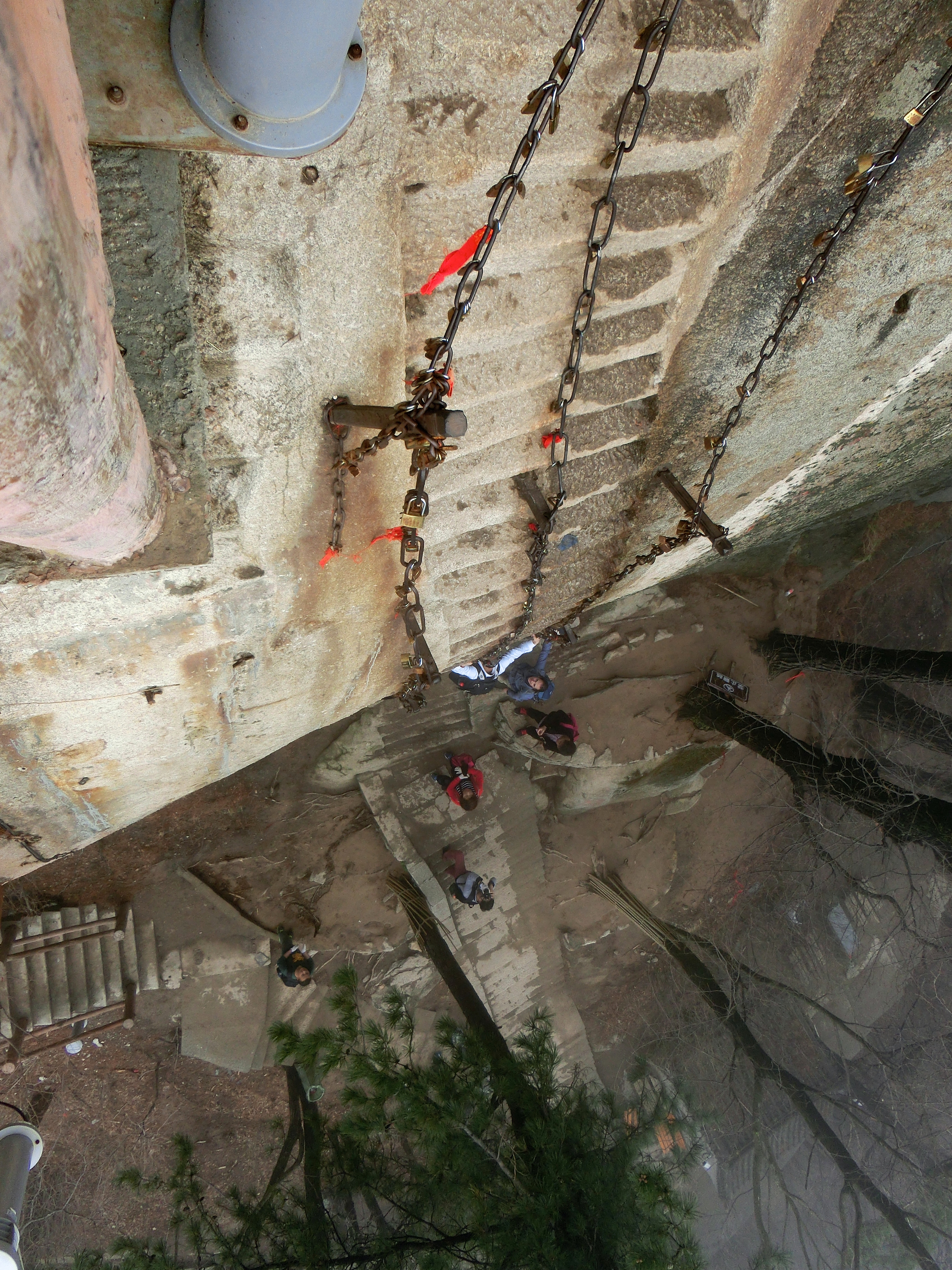
The hike had taken us nearly 14 hours. During that time we had managed to reach two of the three peaks  and four summits. We reached the south peak and the highest summit (the Landing Goose summit) as the sun set. It was beautiful, but also terrifying because I knew we had to hike back down in the darkness. I’ve read many foreign accounts of hiking Mt. Hua, and how it is not as dangerous to hike as they were lead to believe except for the west peak where there is the famous plank walk. Here you are strapped into a single belt and you walk a plank that is about three feet wide and attached to the side of the mountain with iron nails and chains, and it is a two way path but there is only room for going one way so you have to climb over people while you are thousands of feet above the ground. There are also tunnels built through the rock that fit the size of an average Chinese person. A larger person of girth would find themselves struggling to fit through the tunnel that runs vertical with chains on either side to pull yourself up as you find footing in carved steps that are almost two thousand plus years old. The day we had hiked a storm came through so the chains and the steps were wet and slippery. As Sean recommended us to take the dangerous way down, I began to feel genuine fear. I was running on very little energy having eaten nothing but chicken feet, and eggs, and not sleeping the night before. Already I had felt my arms give on me on the way up. The only thing that kept me holding on was the knowledge that if I fell I was going to take at least fifty people with me since we were climbing, in the words of my students, nose to ass. I told Sean that I didn’t think I could go the dangerous way in the dark.

“It isn’t dark. There are lights.” He said pointing below us.
“Tea lights do not count as lights.” I had said.

CIMG3798

I could not stop thinking of the tunnel that I knew we would pass through because it is the same way up as it is down. If people believe that the hike is dangerous in the day time it is exponentially more dangerous in the dark. Mt. Hua has become a huge tourist attraction for Chinese especially Chinese University students, and this once sacred buddhist pilgrimage has now become a kind of adventurous right of passage for young Chinese. Sean’s approach to the hike was to go at breakneck speed. I was absolutely apposed to this approach and thankfully Xiang Kai was on my side of thinking. Sean nagged us both to hurry up during the hike. Often Xiang Kai would sit and rest, and Sean would complain that we were too slow and we would miss the sunset.

“Ignore him.” Xiang Kai muttered to me. “He’s crazy.”

Thousands of Chinese and foreigners a year visit Mt. Hua, and because of the numbers, and of course the dangers involved the Chinese government had built stairs that were safer to climb and descend. I opted for these stairs for part of the way down not knowing that once on the stairs we couldn’t get back to the original path. This was also something Sean nagged me about during the decent. I knew I did not have the strength to hold my body through the tunnel, but I was also not prepared for over 50,000 steps that began to siphon all the fluid from my knees.

Step after step after step my knees began to stiffen until there were moments when I didn’t know if I could bend them. I became terrified that I was doing permanent damage to them. I kept my pain to myself so as to not have to hear Sean chastise me. I moved in silence until I could not longer hold in the pain. Tears swelled to my eyes as I felt my body break out into a sweat and my heart raced from pain and the anxiety of pain. I began thinking about people in concentration camps, and people sent on marches, and people tortured- if they could survive such unbearable suffering I could make it down this damn mountain. Then my knee froze for a second. If I were the tin man this would be the moment when I could not move because all my joints had rusted stuck.

“Sean.” I cried out. “We have to slow down. I am hurting so bad right now. We have to move slower or I will not make it down this mountain.”

He reluctantly slowed, but quickly began in his assessment of why it was that I was not able to move faster and why I was in pain.

“American’s are not as healthy as Chinese. Even when we are very old we can do this. I think it is because we begin exercising very young. And exercise is important and so we stay healthy.”

“I exercise.” I mumbled, “I’ve just never hiked 8,000 feet before- or 500 feet.”

“I think you are too old for this.” He said. “I should have thought about your age.”

Sean and Xiang Kai were 23 and I was 41. This was the final straw in my tolerance for his ongoing commentary and I stop walking.

“Sean.” I said glaring at him. “If you want to continue living, and make to my age, you really should stop talking right now.”

He looked at me knowingly and walked for the majority of the decent in silence.

Xiang Kai shuffled up along side me.

“I am in quite a lot of pain too, Adrienna. My shins and calves are hurting so badly I think they may tear. Try walking backward, I think it is helping me.”

Xiang Kai and I hiked the remaining way down the mountain backward which as he had suggested did alleviate the pain in my knees. At first Sean was far ahead of us, but at some point near the base of the mountain he began to slow down, and we eventually passed him.

“My feet are really hurting.” He called down to us. “Slow down for me.”

“No.” I said. “And good!”

Once we had reached the bottom Sean recommended we find a place to sleep and take the train in the morning. We all agreed, and he flagged down a motorcycle taxi. We sat Xiang Kai and myself and the driver all squeezed onto a single small motorcycle seat. He drove us to a restaurant where we waited for Sean who had walked. We rented a small single room with three cots and ascended more stairs under the watchful eye of the proprietor and proprietress who looked me over and probably wonder which of the Chinese boys was my boyfriend because how else could we all be sleeping together in the same room.

In the morning once we got moving and I had managed to get some fluid and circulation into my legs we climbed down the stairs to the small family owned and run restaurant.

“We must eat before we catch the train.” Sean recommended, and again Xiang Kai and I agreed with him.

We sat alone in the restaurant and ate large bowls of noodle soup as the owners watched me eat, and asked Sean and Xian Kai questions about me. I was so hungry from the hike I ate every last morsel of food in the bowl, and could have eaten more. Afterward, Sean flagged down a taxi and we took it to the train station where we awaited the next train to Zhengzhou.

During the ride back to Zhengzhou it was less crowded and we all were able to sit in the same section.

“It is the peony festival in Louyang.” Sean mentioned excitedly. “We should go. Do you want to go Adrienna?”

“I can not go.” Lamented Xiang Kai who had to go to a school meeting that evening, “but, you should go Adrienna. It is a very big thing in China.”

“Okay.” I agreed even though exhaustion was overtaking my body.

When the train stopped in Louyang, Sean and I said our good-byes to Xiang Kai and then watched the train leave the station as we waved to him.

“I think you will like the peonies.” Sean said, “They are very important part of China. And, there are no stairs.”

“That’s good.” I said as I hobbled behind him nursing my well earned broken knees.

It is been little over two years since I had gone on that hike with my friend Sean and Xiang Kai, but still I am reminded of the experience every time I climb a step since my knees are still feeling the pain. Although it was exhausting, and ill prepared and left me with bad knees, I’d go again. It’s a really beautiful mountain and there are many parts we didn’t make it to. I’d go again, but differently this time. I’d go with some sleep, take a fast train, and bring better food, and hike at a slower pace, maybe stay the night like many other Chinese do, and then hike down slowly in the morning. I’d invite Sean along too, and I’d tell him now we’ll do it with the American experience, because I’m old and Americans are out of shape, and we have to do it the old person way and not your cheap ass way of saving money on the slow train. And, of course, I’d get some support for my old lady knees.

CIMG3839

A Hike on Huashan China’s most Dangerous Mountain

Not too long after my mother died, my friend Wu Shao bo who calls himself Shawn, (many Chinese people will pick an English name when they are young) suggested that we should go to Huashan together. I agreed and he invited his friend Liu Xiang Kai, who I call Xiang Kai (Xiang sounds like Shee-ang) to join us.

The trip to the mountain although considered a sacred mountain was not meant to be a spiritual trip. After my visit to Shaolin, I had let go of the idea of China’s sacred places as being sacred. This was modern China, and much of the spiritual part of the journeys to places like the five sacred mountains, and Shaolin, along with any of the many buddhists temples were now commodities bought and sold to tourists. You could still find the faithful buddhist burning incense and saying prayers, but for what seemed like the majority of Chinese tourists prayers involved a camera of some sort. You could think that nature itself was some kind of spiritual experience, but the crowds and the litter that they brought with them, was too overwhelming to be able to absorb the majesty of the mountains. Eco- tourism is also huge in China and thousands of Chinese are flocking to mountain hikes, and gorges, and valleys for adventure and for photo ops.

Not to tear apart modern China, but up until about twenty years ago these mountains were hiked by monks, pilgrims, and occasionally hiking enthusiasts Chinese or otherwise who new or the secrets of the mountain. Today with the budding commerce of tourism and eco-tourism, and the fact that more and more Chinese have some leisure time, nature has become a literal stomping ground. China calls itself a communist society, but it has also embraced capitalism. I often saw many parallels between American capitalism and Chinese capitalism. I fully believe if Americans had the same population size as China that we too would destroy our own national forests. There are of course many, many, conscientious Chinese people who honor the earth, and do not like to see their beautiful country littered and polluted and they take measures to not add to the destruction , but for every 5 conscientious Chinese you have about 20 who don’t give a shit or think someone else will clean up the litter. In America our numbers are smaller, but the fact that there is an almost daily battle to preserve the land, it would not surprise me that if we had a population as large as China’s that we too would have an uneven balance of entitlement versus preservation. There are other factors involved of course, but the reality is that this once sacred and very dangerous mountain is not that sacred, but still very dangerous.

CIMG3912

There are five sacred mountains in China, Taishan the East mountain in the Shangdong province, Hengshan the South mountain in the Hunan province, Hengshan the North mountain in the Shanxi province, Song Shan the Center mountain in Henan province, and Huashan the West mountain in the Shaanxi province. I had been to Song Shan when I had visited the Shaolin Temple. Hua Shan was close enough to travel to in a day, but it’s reputation was that of the five sacred mountains it was China’s most dangerous. It’s difficult to find numbers as to how many casualties have occurred on Mount Hua. My friend had told me that you can’t find any numbers because they don’t want to decrease the numbers of tourists, but with the sketchy conditions, and the large, large hiking populations by inexperienced climbers, and days of bad weather I’m sure the number is not small. I fit into a number of the above categories, and had a few moments where I felt like I couldn’t hold on, but my life literally depended on my keeping my grip. My life and the lives of about 50 people nose to ass beneath me.

As an outsider to China it is easy to attach myself to the romantic connotations associated with ancient Chinese traditions, Daoist beliefs and Buddhist rights of passage. Like some scene from Seven Year’s in Tibet or The Rivers Edge, I pictured myself reaching the peak of the mountain, and when in a moment of reverie the sunlight would break through the clouds or rise over the crest, and I would be filled with a sense of peace and gratitude and a higher understanding of what life is about or why we are here, why I am here, and then I’d feel a dawning acceptance of my mother’s death, and I’d understand- no- not understand but I’d know that it is beautiful. That death like life is beautiful. Sadly, but not surprisingly to say, I did not reach my zenith, I was not awash in enlightenment; I was achy and irritable. In retrospect, I’m a little disappointed I’m not writing a post about my spiritual awakening, but then again, perhaps my journey was to feel exactly what I felt; achy, despondent, irritable, depressed, and still, always still, grieving, and wanting my mother to be alive.

Although, as I mentioned above, that I did not view it as a spiritual exploration I still grabbed some of my mom’s ashes and put them in my back pack. I decided to take her with me. She never got to travel in her life and I thought I could take her with me now. If I made it to the peak then I would leave that little part of her there on that mountain top. It would be the closest I’d ever get to the stars (Everest is not in my future). If I made it.

CIMG3785

Shawn didn’t have a lot of money so he insisted that we take the cheapest slowest train. Although, knowing Shawn I think even if we had money he would insist we take the slowest and the cheapest. On the fast train we could have made it to HuaShan in about three or four hours, but on the very slow train it took us about 8 to 9 hours. We did the overnight train. The idea was to sleep on the train and then to start our hike in the morning. If you have ever traveled on a Chinese train in a non-sleeping compartment you’ll know sleeping on the train is not that easy unless of course you are Chinese. I’ve discovered that Chinese people in China can sleep anywhere. On the sidewalk, on their e-bikes, bent over or smooshed between seats. They are like cats able to find any place as a suitable place for sleep. I had often been overcome with jealousy at this ability since I find it so difficult to sleep sometimes even when I am in a bed in a dark room. The train was packed. On these trains once the seats are all sold they continue to sell seats so sometimes there are people standing in the isles for up to eight hours. People are constantly switching seats around every time someone leaves in the hopes that they can sit for a couple of minutes. When you are sitting you have people leaning against you or over you. It is a crowded that most Americans in America will not ever experience. We were in a section of six seats. Two rows of three facing each other. Shawn and I were able to sit across from each other but Xiang Kai had to find a seat somewhere else on the train. I am bigger in size than your average Chinese woman, but I am also smaller in size and sometimes width of your average Chinese man. All the seats were occupied by men, sleeping men who had spread out as much as they could in the spaces available leaving me with very little room, and since I did not have the Chinese power of sleeping I was awake for the entire 8 to 9 hour train ride. This is not the way I would recommend prepping for hiking the most dangerous of the five sacred mountains.

A photograph of Erqi Tower in Erqi Square in Zhenzhou, China.
Erqi Tower in Erqi Square, Zhengzhou, Henan, China.
Two friends in China posing in front of Erqi Tower in Zhengzhou.
Xiang Kai and Shawn in front of Erqi Tower, Zhengzhou.
A bag of Chinese snacks on a chair in the Zhengzhou train station.
Snacks for the hike.
The interior of the Zhengzhou train station after midnight.
Zhengzhou Central Station after midnight.

We boarded the train around 1:00 am and arrived around 8:30. We took a taxi from the station to the town at the base of the mountain, and began our hike around 9:00 a.m. We had three large bottles of water, some strange meat paste, a few bready bits of snack food, and a bag of spicy chicken feet. I kept thinking shouldn’t we have some trail-mix or something?

chicken feet in packaging
Chicken feet

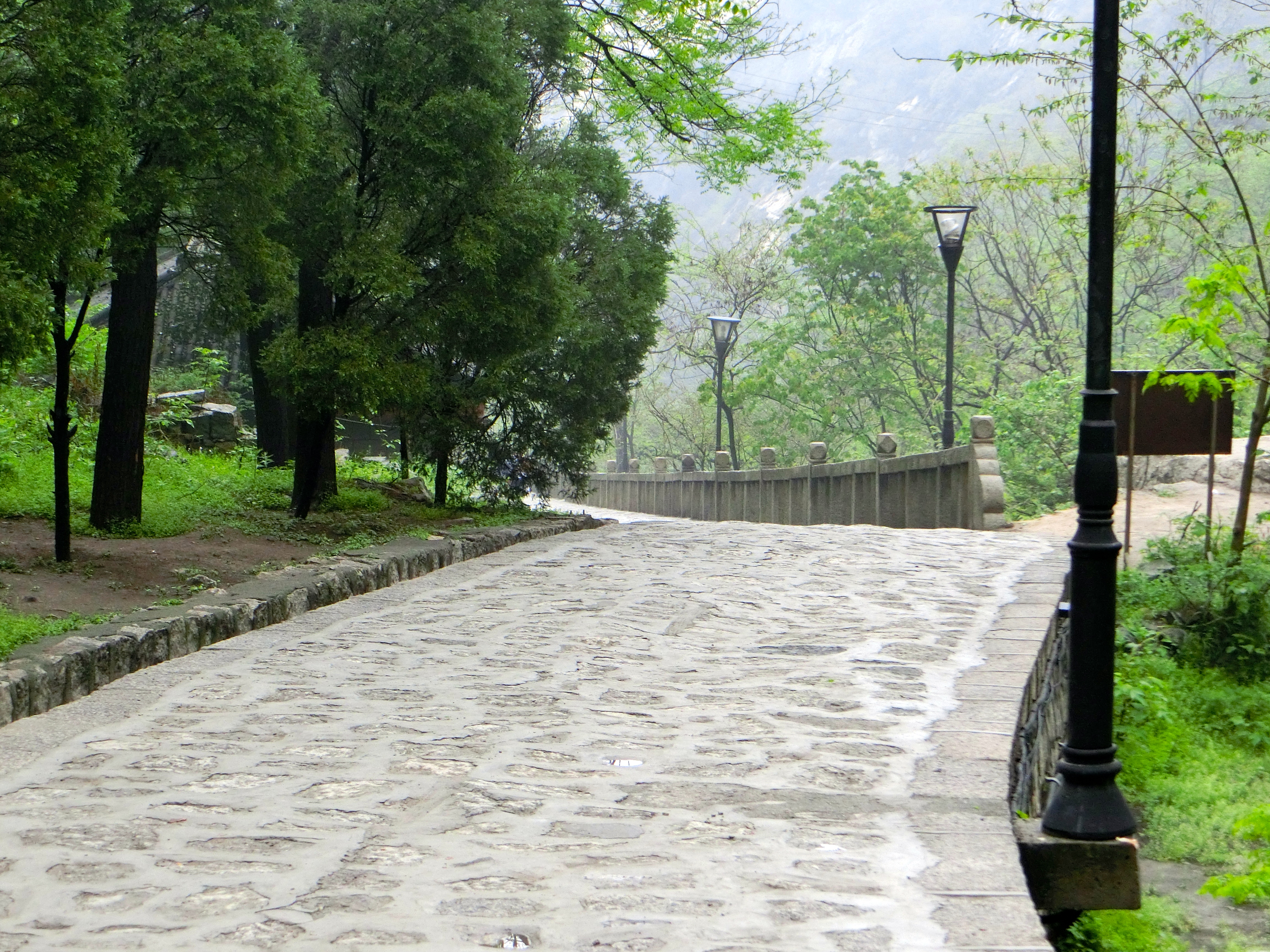
For hard core hikers the beginning of HuaShan is not much of a hike in the sense that it is paved for a large portion of the lower part. You do not disappear into the mountains you stick to the path. Once you ascend deeper into the mountain the hike becomes more of a challenge and more of a climb and sticking to the path becomes necessary to keeping yourself alive.

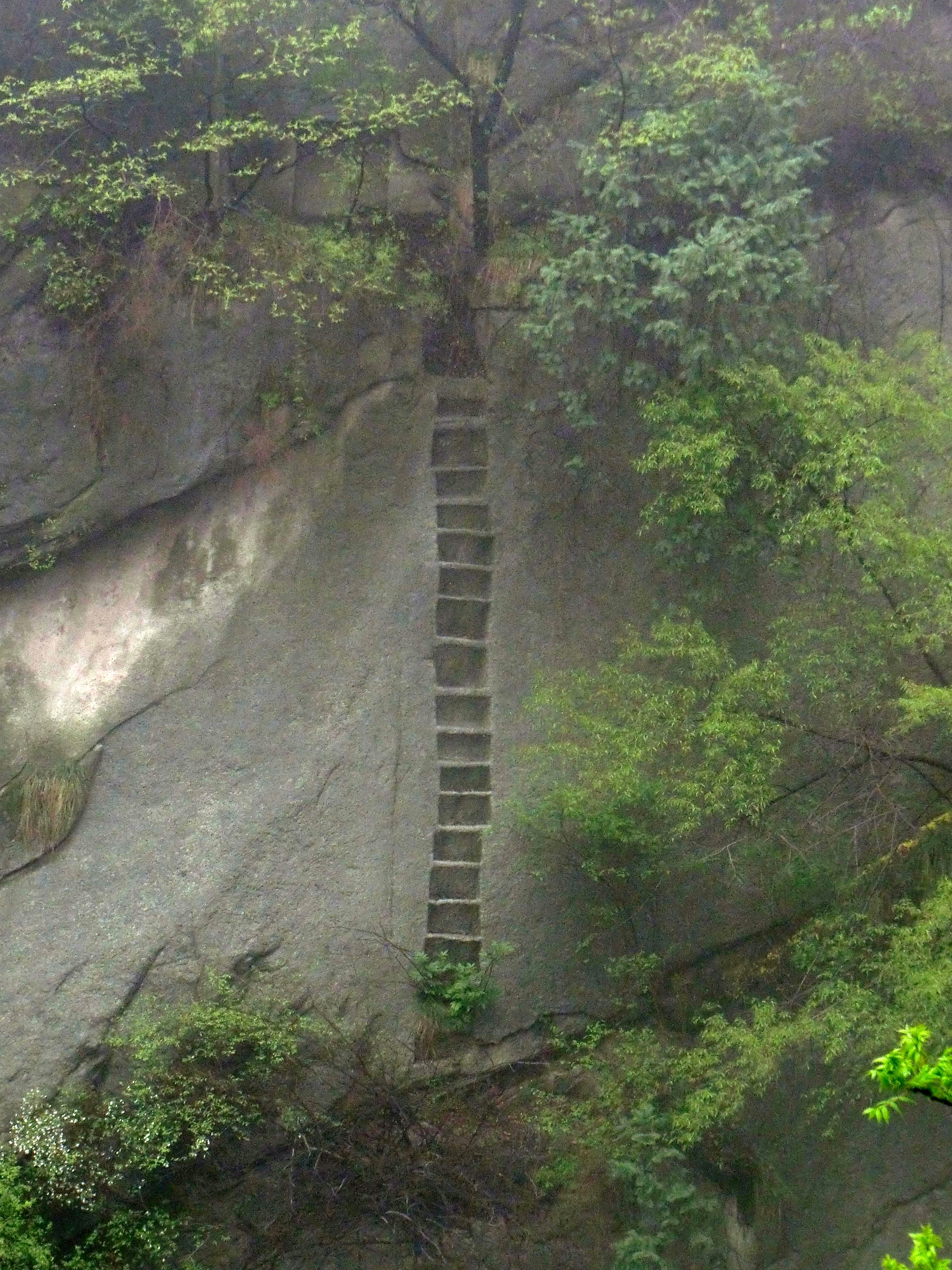
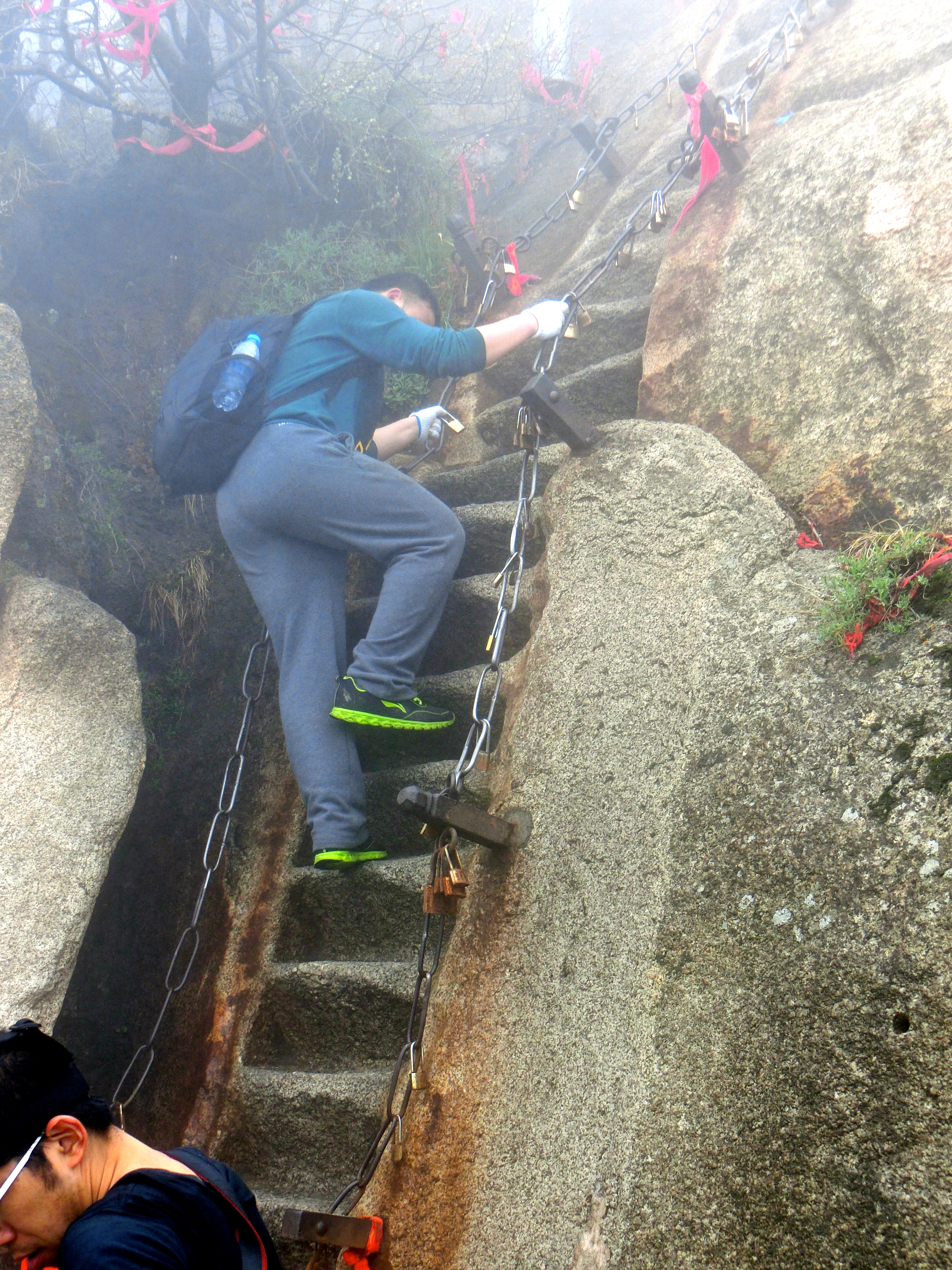
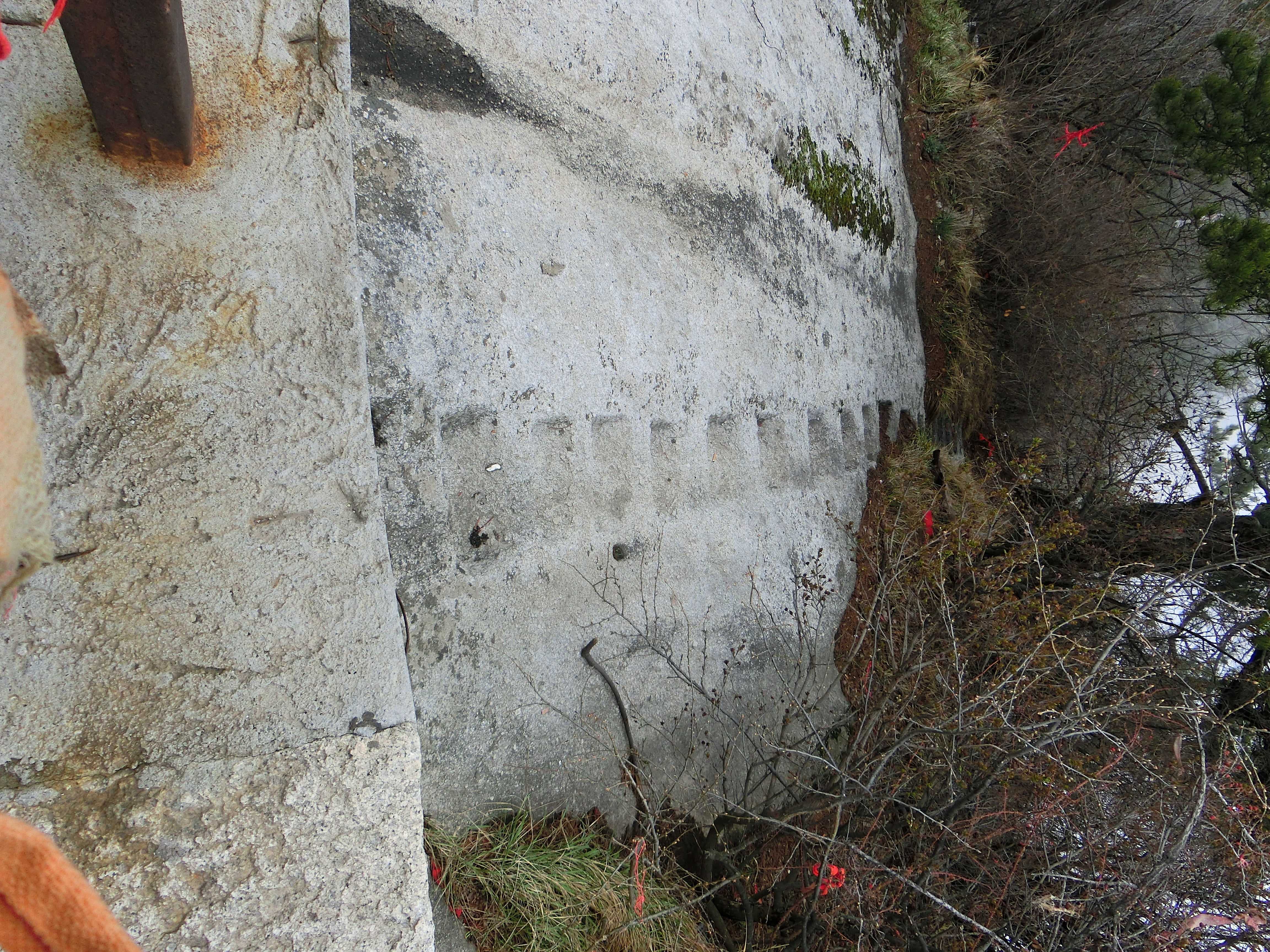
There are steps on Hua Shan. These steps were carved deep into the mountain’s side thousands of years ago, all by hand, and by the monks that would make their pilgrimages to the top where they could meditate. On the side of the steps chains have been drilled into the mountain for you to hold as you pull yourself up. You need upper body strength to help you on the climb. Upper body strength that at times I thought I might not have.

CIMG3640
ancient carved steps

Compared to most saturdays it was not very crowded by Chinese standards of crowds. It had been a rainy night and it was cloudy and grey. On one hand it was nice because you had a small bit of breathing space (to me it was still very crowded but I was aware of what a real crowd in China was) perhaps during our climb there were about 200-300 people climbing Hua Shan that day but at night during our descend hundreds of new climbers were making the midnight treck. In total maybe 800 people were on the mountain. Oh, and the thing of Hua Shan: there is only one path up and one path down. When you are coming down and they are coming up you literally have to crawl over one another− crawl over one another 1,000 meters high on a steep mountain side with wet steps and cold thick metal chains, and you are climbing backward. You get the picture. The downside of the rainy day was that the steps were wet and slippery and at times the dark clouds dropped so low around the mountain that you could not see two feet in front of you. Then you had to climb over someone, I need to add, without any safety harnesses or safeties of any kind.

CIMG3550
A lying Buddhist
CIMG3587
The base of the mountain
A view of the craggy mountains of china's Huashan
Mountain base
CIMG3556
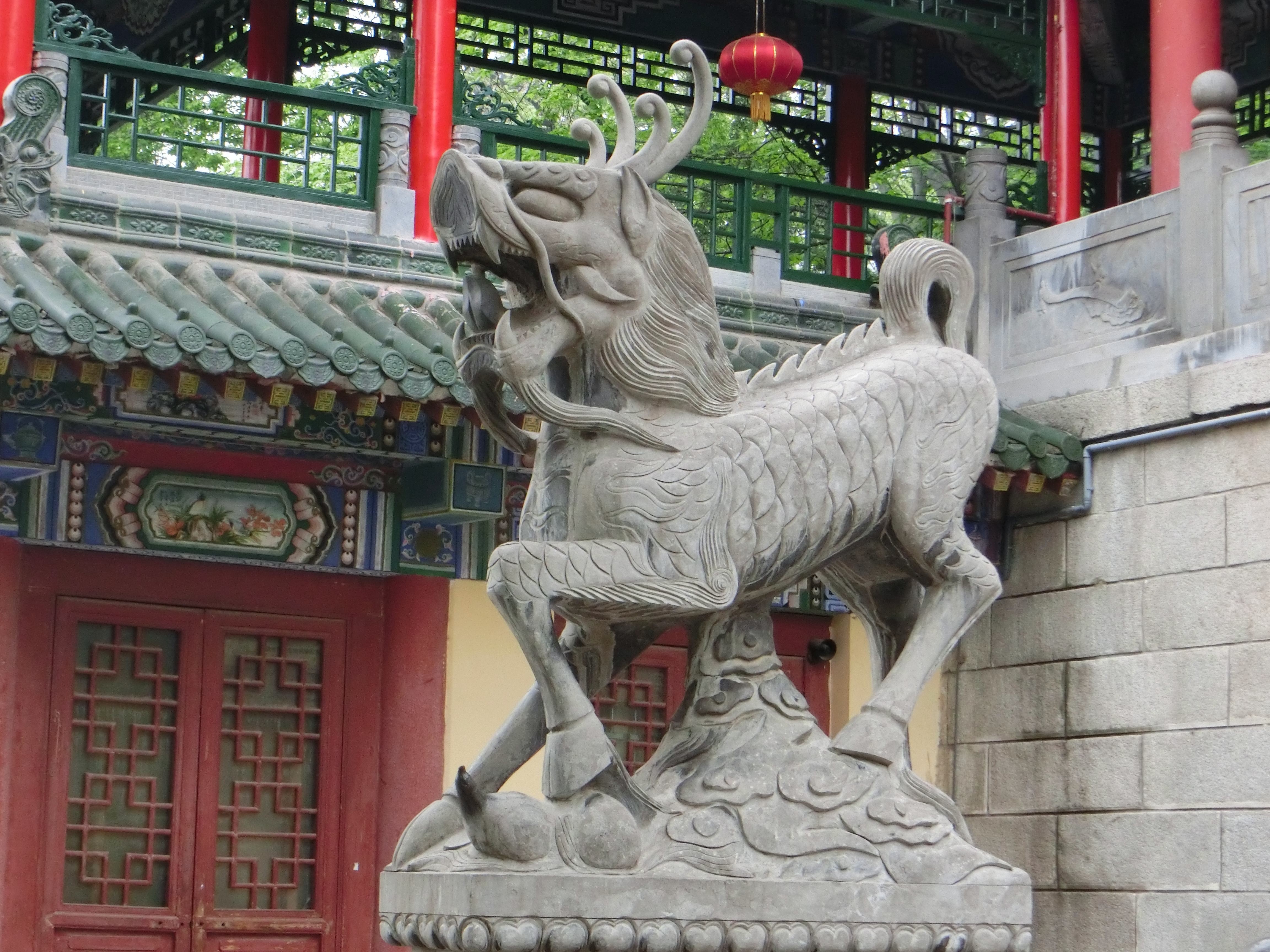
A Chinese mythical creature
CIMG3574
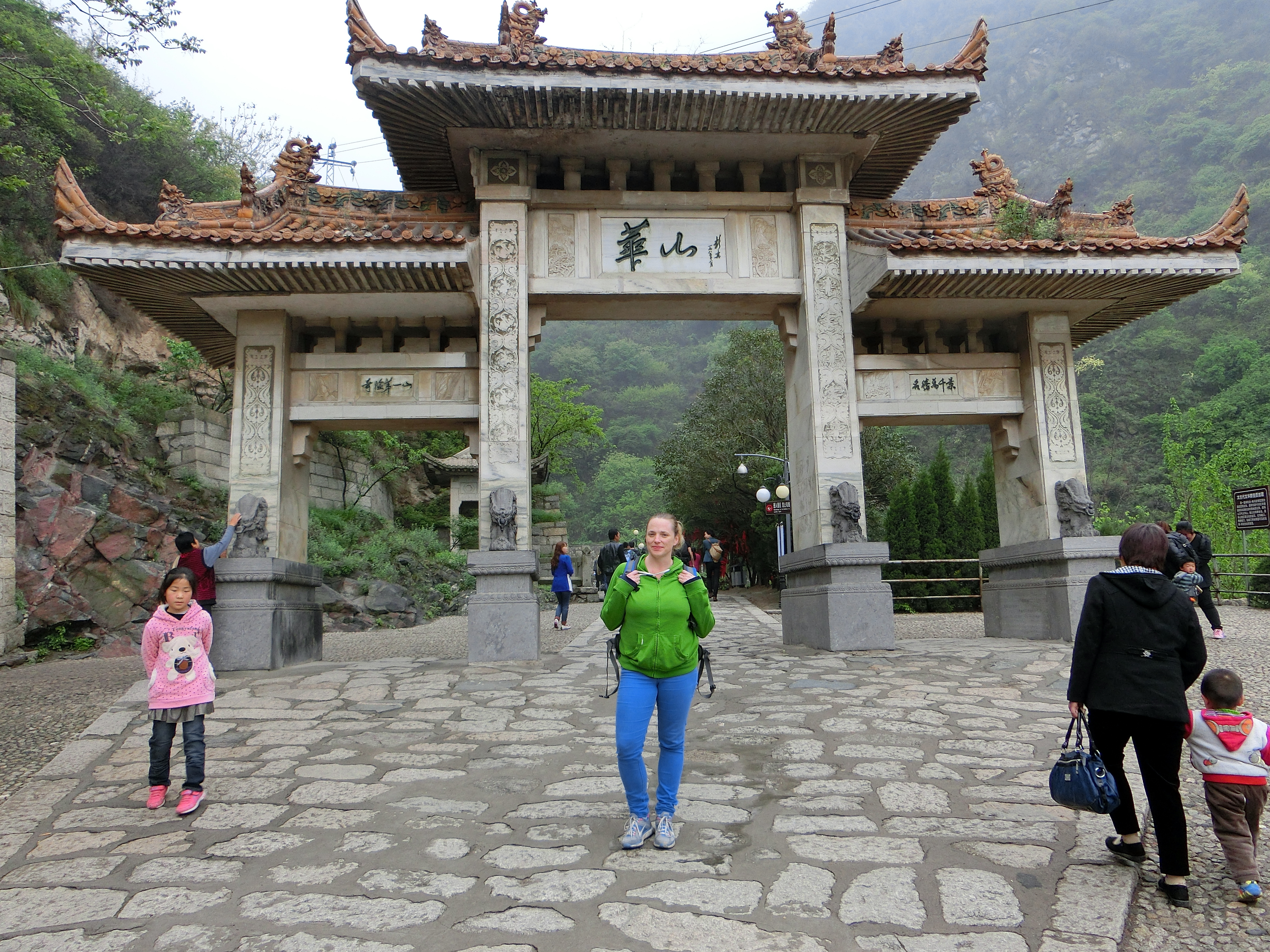
The gate to the mountain
CIMG3557
The park before the hike
CIMG3581
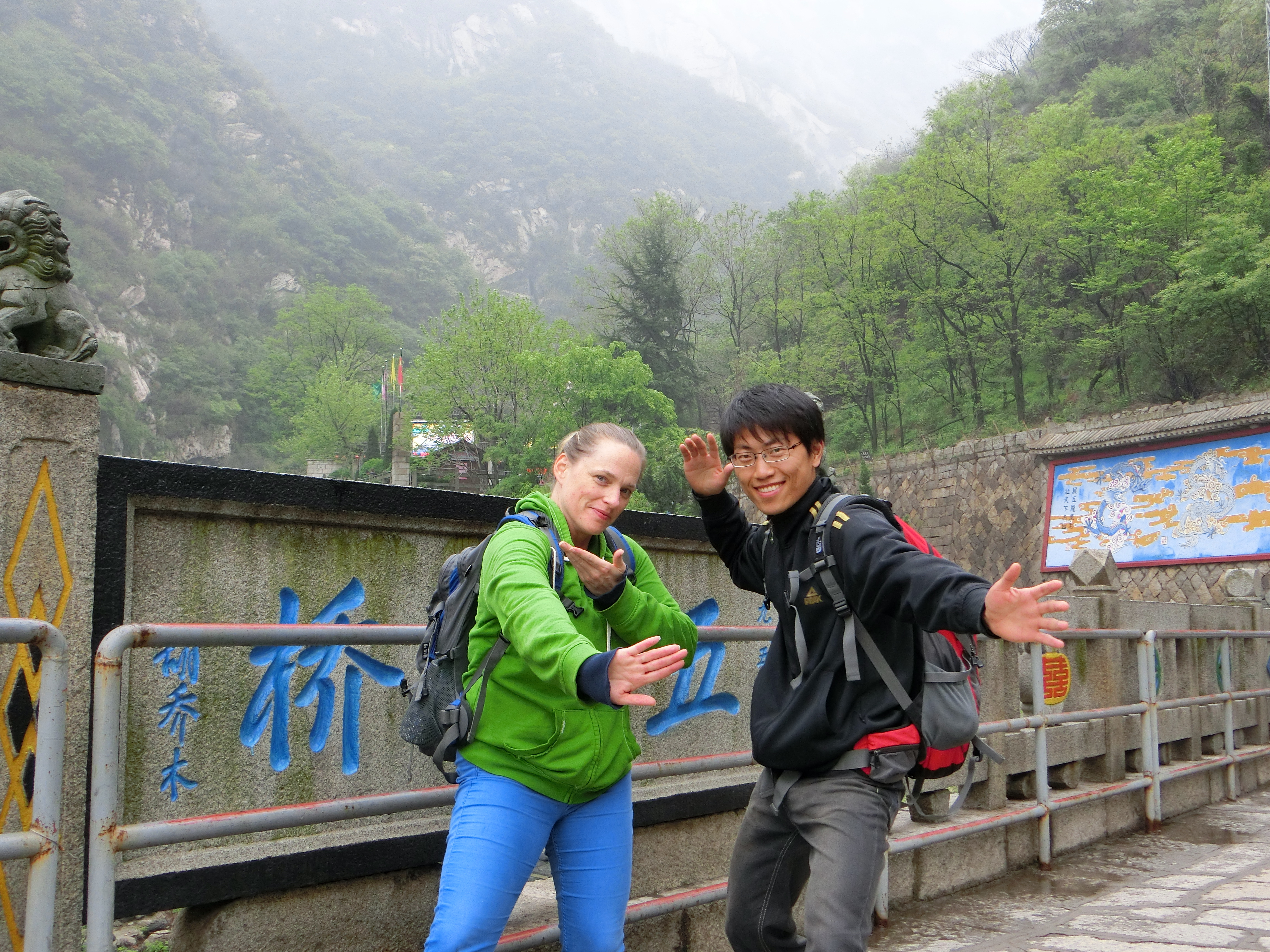
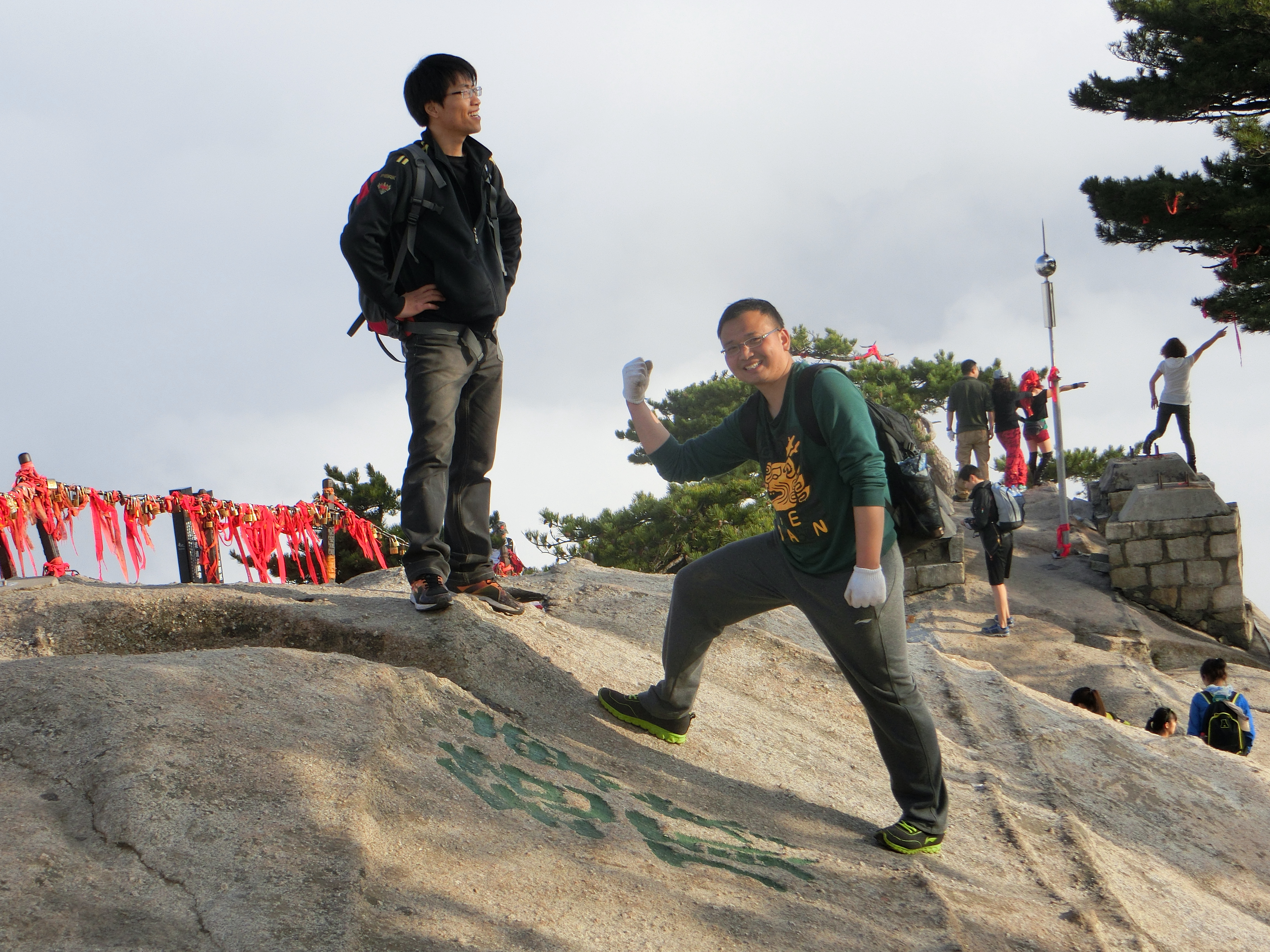
Xiang Kai and I preparing to fight the mountain spirits
An ancient stone tablet from Huashan in China against a bright red wall.

It took us another eight hours climbing vertical steps, sometimes through wet caves and on the edges of steep cliff sides. Shawn was our guide and he wanted to race to the top of the mountain. Often criticizing Xiang Kai and I if we wanted to sit for a moment or if we were moving too slow. I was grateful to have Xiang Kai on my side. Shawn was the adventurer climbing the mountain to defeat it, to reach the top a conquerer, and to reach the bottom in the fastest time possible. I’m not this person. I wanted to sit and reflect and bask in the nature, and the multitudes of people, around me. I did want to meditate, and reflect. I did want to absorb, but between the crowds and Shawn’s constant pushing us hiking Hua Shan felt more like a simulated virtual wii game than an actual hike and journey. I didn’t know what was in Xiang Kai’s mind except that he wanted to stop and sit as much as I did, and he would shoot me looks of disdain and irritation. Ignore him, he’d say from time to time, let’s sit, make him wait.

CIMG3560
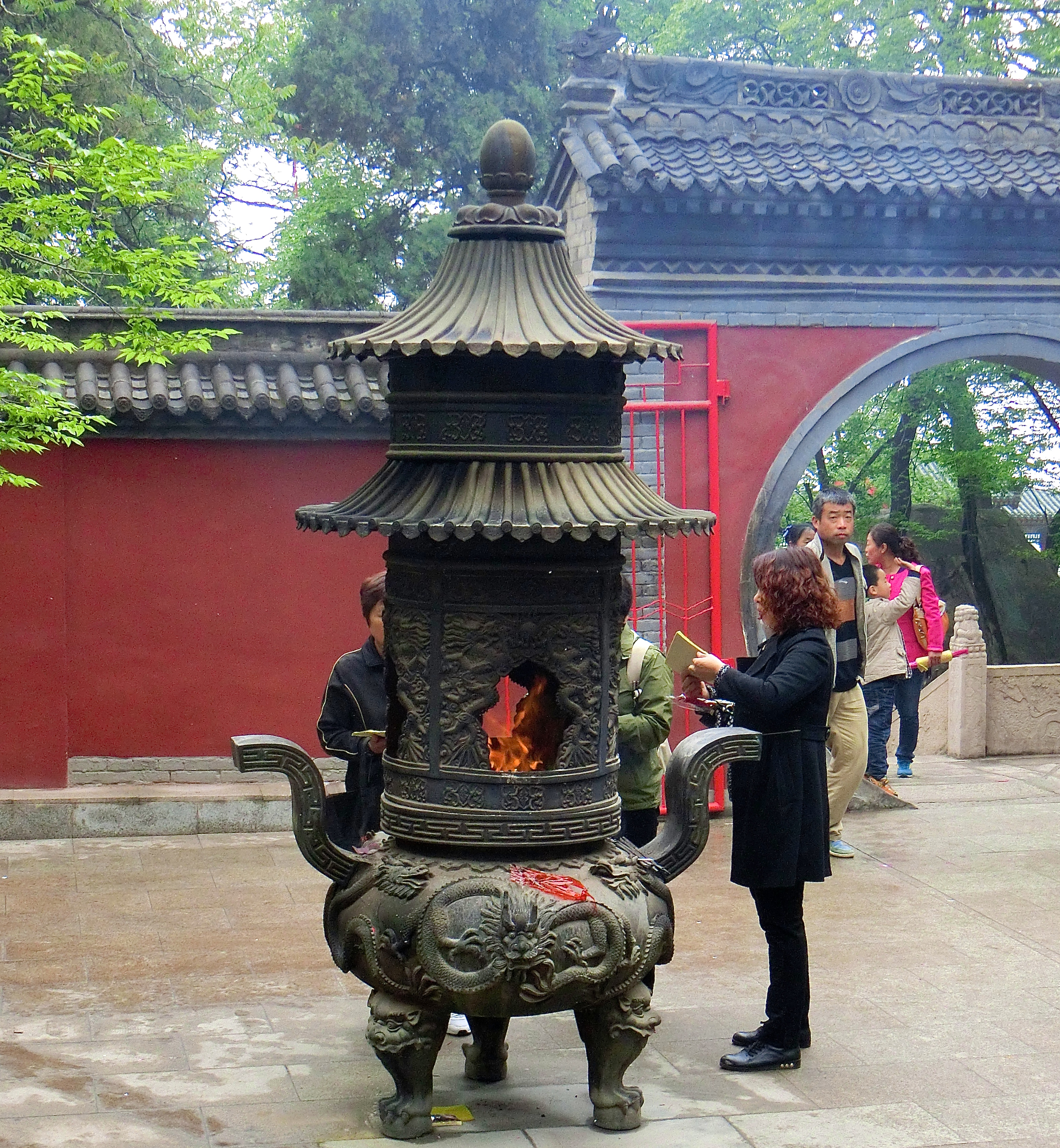
Burning incense and prayers
CIMG3563
Prayers
CIMG3778
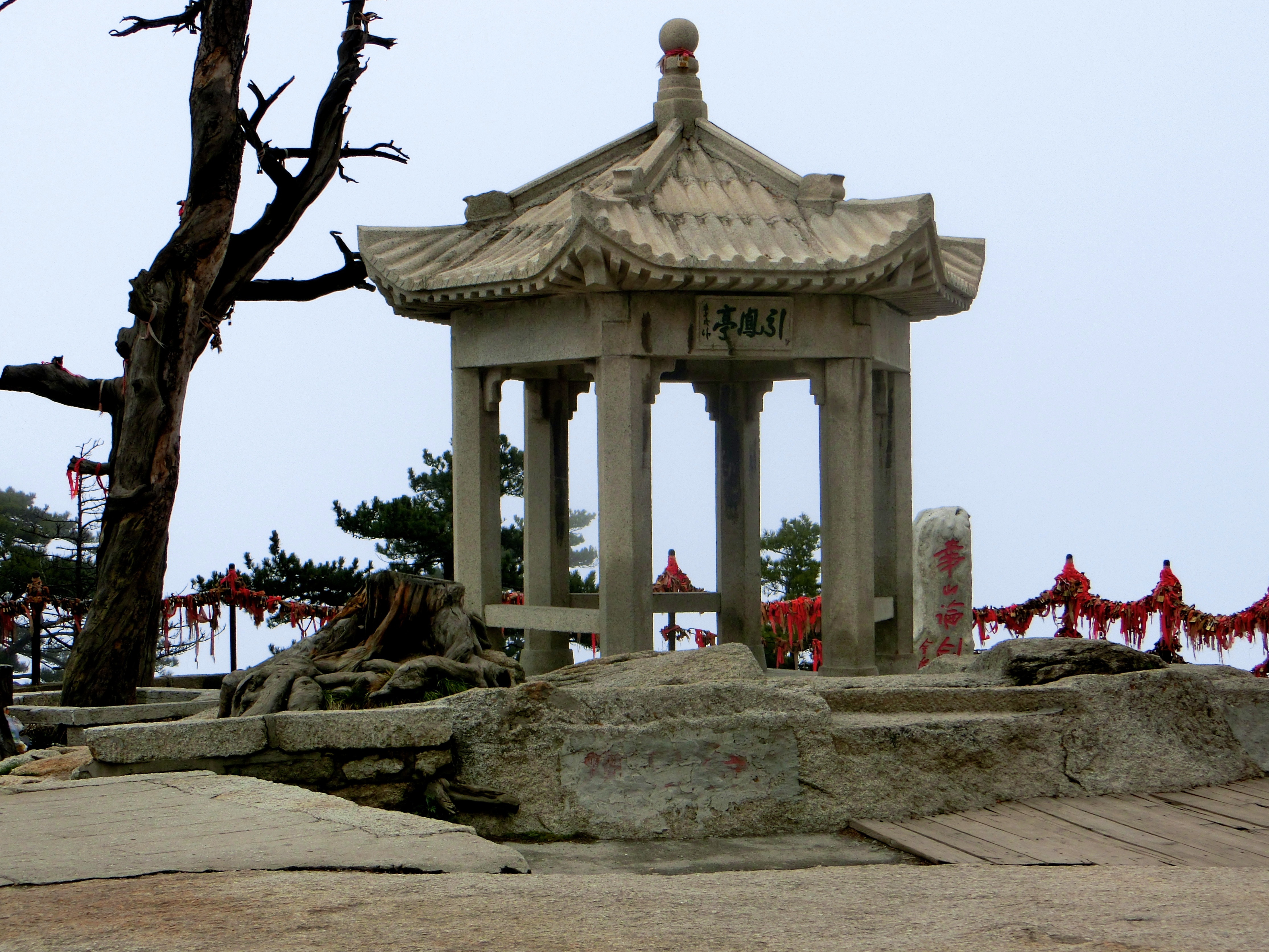
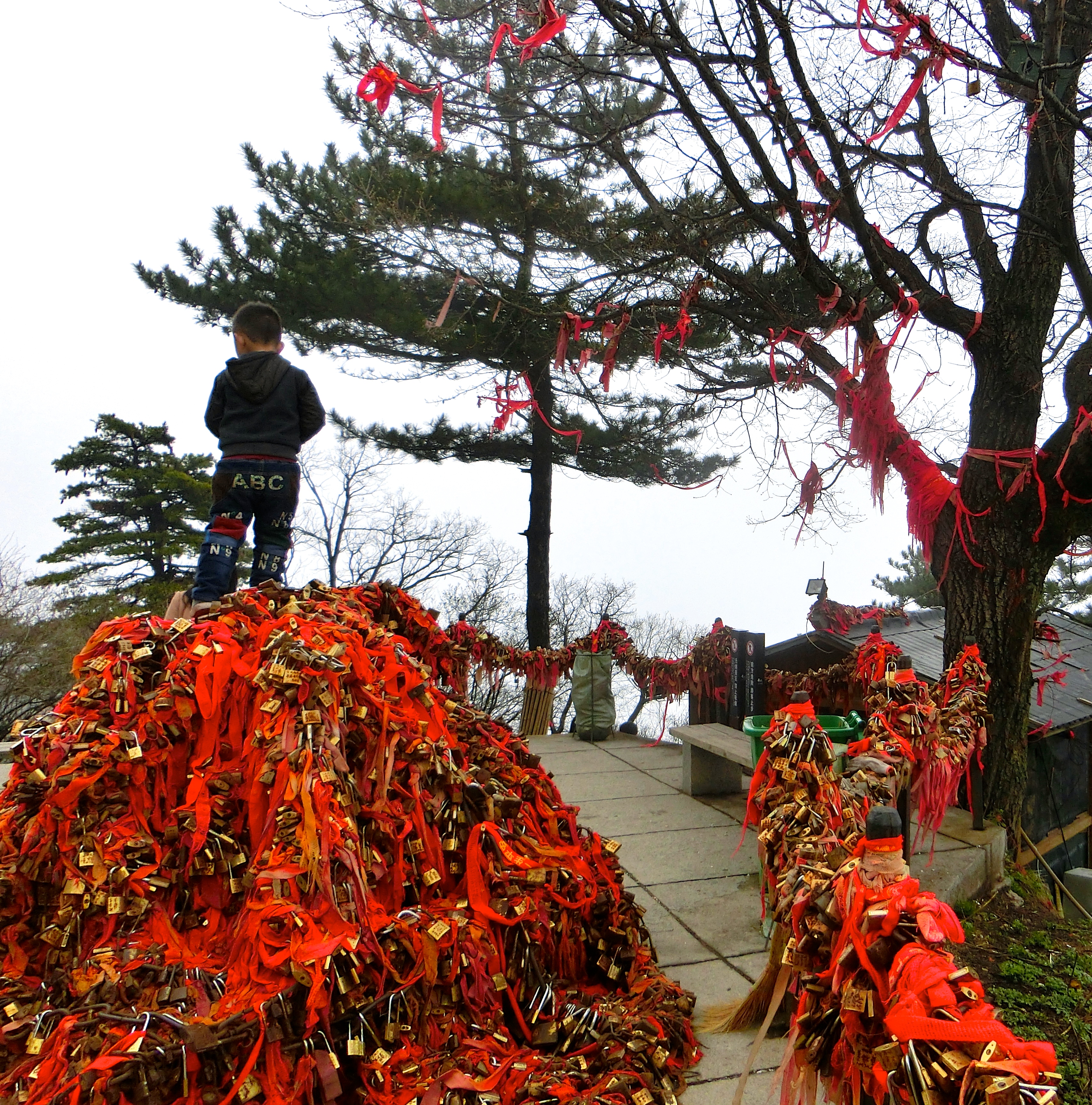
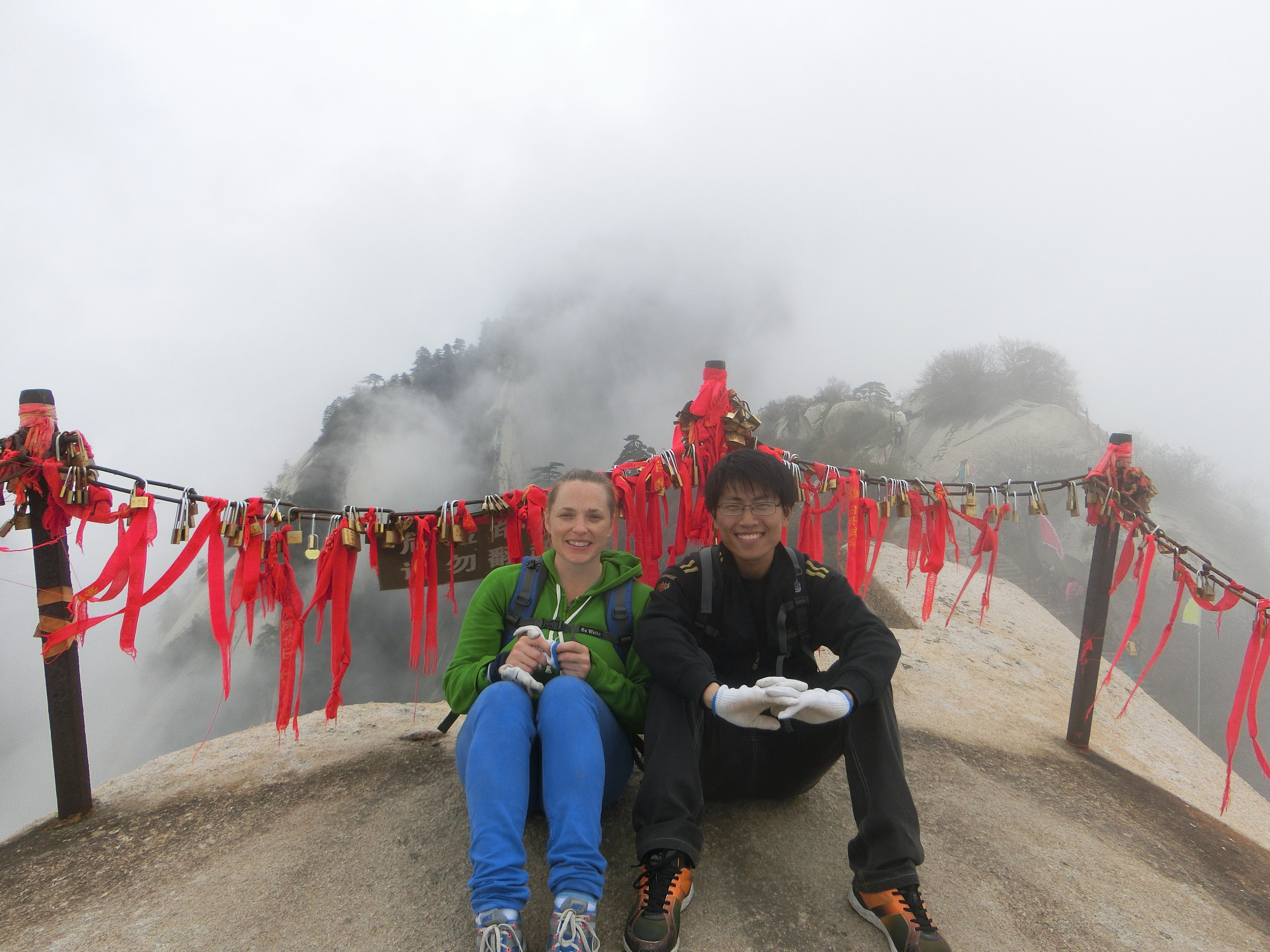
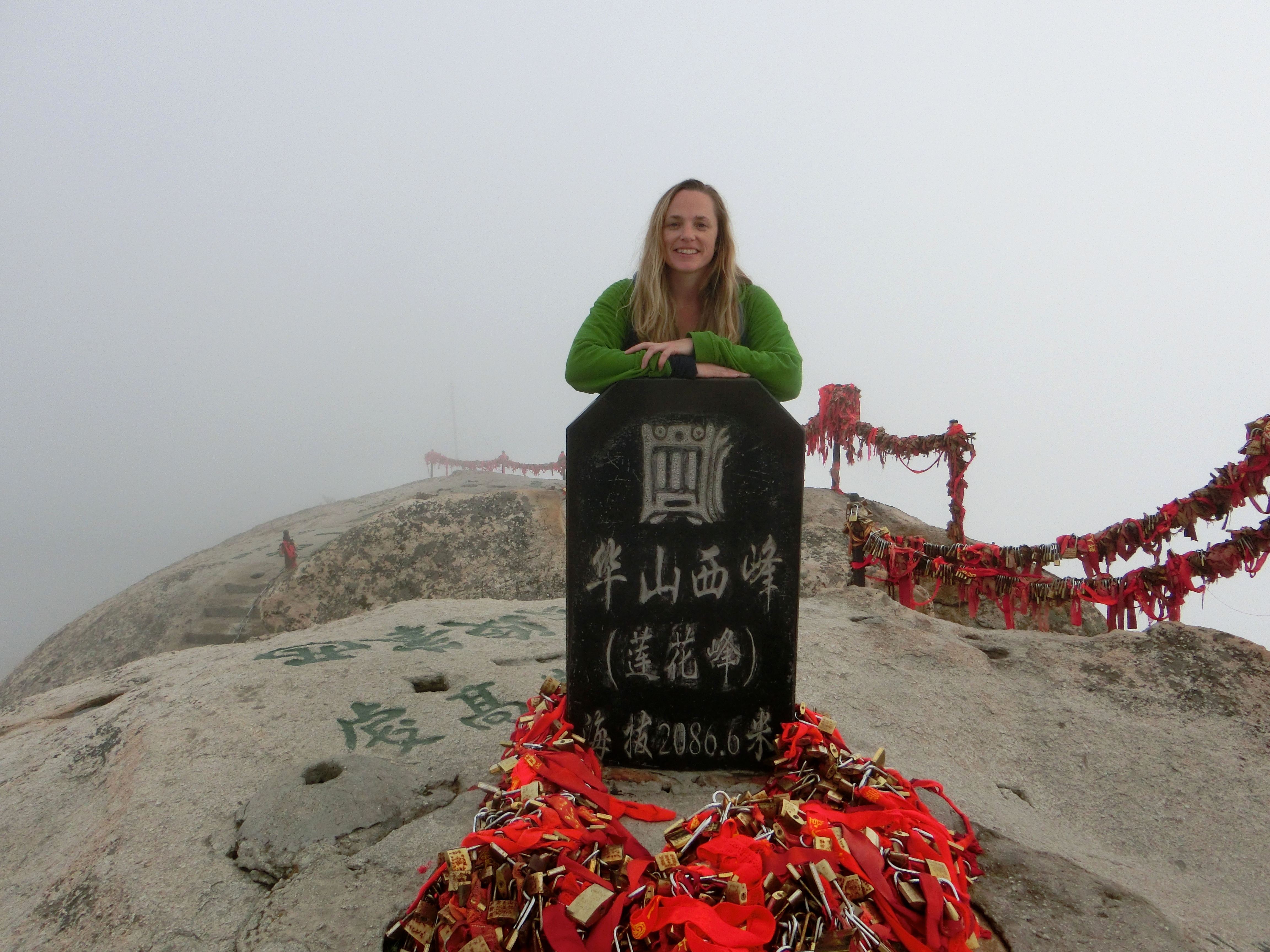
A mountain of ribbons and locks for luck.
CIMG3615
These men hike daily back and forth up to part of the mountains to deliver food and water to the shops and hotel.
A gateway to the western peak on Huashan.
The gate to the beginning of the real climb

When we reached a peak we did take a moment to take a million photos, but also to just sit and be. It wasn’t easy to reach the peaks (unless you took the tram that I didn’t know about but explained how some Chinese girls were able to hike in flats and skirts) and when we would reach a peak the crowds would disperse and only 20 to 30 people were able to reach certain points. We went from the north peak to the west peak and to the south peak reaching 2,080 meters.

CIMG3664
The first set of stairs.
CIMG3680
The top of the first set of many stairs
CIMG3793
The stairway to heaven
CIMG3798
This was a crazy vertical climb and took a lot of upper body strength and courage. This was after climbing many other steep and long stairs carve into the mountain’s rock walls.
CIMG3788
Ancient step carvings possibly thousands of years old.

By the time we reached the top the sun was beginning to set and only five other people had made it to the top at the same time as us. It was cloudy but beautiful. Hiking to the north peak at 1,000 meters was the highest I had ever hiked, 2,000 meters had never happened in my life. I still thought the entire hike was absolutely crazy and badly planned, but I had survived the ascent and was now 2,080 meters above the sea level. Here I took a moment to pull out mom’s ashes and let her small bits of dust and bones catch onto the breeze and float away. It was actually more like that scene in The Big Lebowksi when they throw Danny’s ashes into the ocean and the wind blows the ashes all over them.

CIMG3967
Shawn and I at the South Peak
CIMG3951
Me and my mother’s ashes

As I dusted mom’s ashes of my sweatshirt I giggled because of course that would happen, and with my mom’s dark humor she would have been laughing. In fact we laughed so hard during that scene that she started coughing. This memory made me feel sad once again. Shawn asked me why I would bring some of my mother’s ashes to the mountain. “She’s not Chinese,” he said. I shrugged. “I don’t know,” I said. “She’s never been able to come here before, I wanted her to get the chance to travel.” I didn’t really know. Part of her was in the California Feather river, part of her was in the Trinity National forest, and the Pacific ocean, part of her was in the San Francisco bay, I didn’t know why. In death she had already been to more places than she ever went to in her life.

CIMG3704
Xiang Kai and I at the North Peak
CIMG3700
Shawn and I
A view of the narrow paths on the top of the western peak of Huashan in China.
If you look carefully you can see all the people walking on the blade of a mountain pass. This is 1,000 meters up.
CIMG3838
Success
CIMG3841
A small spot for meditation
CIMG3852
But, not an easy space to get to.
CIMG3839

It was seven when we reached the top and the sun had set. It was now dark on a steep dangerous mountain and we needed to reach the bottom. There were some lights, but not many. Shawn informed me that this mountain was a really popular hike for college students, but most of them liked to hike up at midnight and then stay the night on the north peak in order to see the sun rise. He said we should do it the next time. As romantic and as peaceful as that sounded in words the reality sounded terrible. Hundreds of flashing camera’s trying to simultaneously get the perfect shot of the sunrise.

“Maybe off off season,” I said.

CIMG3923
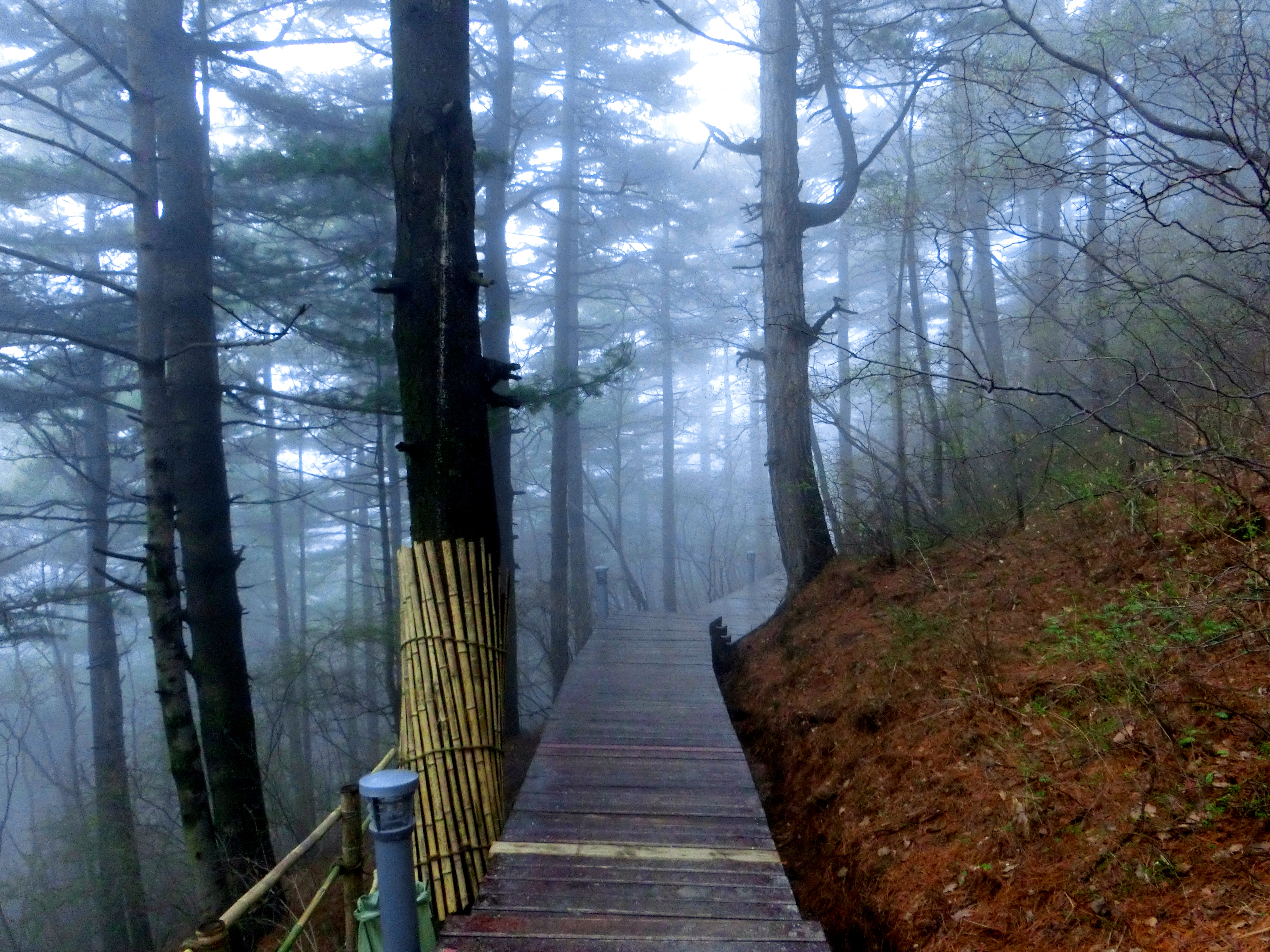
Through foggy woods
CIMG3896
Wishes thousands of meters high.
Bright red prayer ribbons tied to stems on Huashan in China.
A wish for peace
CIMG3998
The only lights to guide us back down from 2,000 meters
CIMG3935
Huashan 2,080 meters