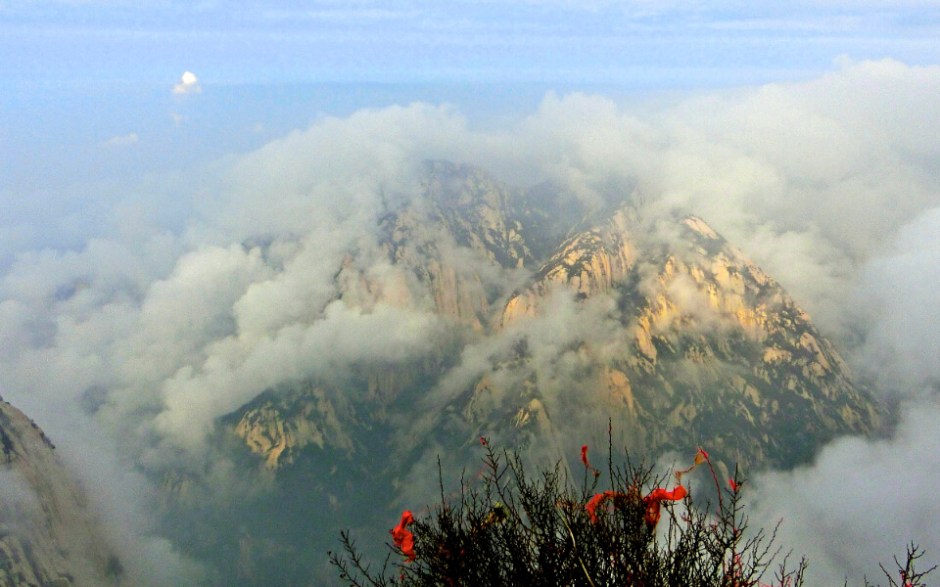

It took us another eight hours of climbing vertical steps through damp vertical caves and along precarious edges of steep cliff sides. Sho Boa was our guide. He wanted to race to the top of the mountain, often criticizing Xiang Kai and me if we wanted to sit for a moment, or if we were moving too slowly. I was grateful to have Xiang Kai on my side.

Sho Boa claimed he was the true hiker among us. He was climbing the mountain to defeat it. His desire to reach the peak and reach the bottom in the fastest time possible meant he was a conqueror. I’m not this person. I wanted to sit and reflect and bask in nature and observe the multitudes of people around me. I wanted to meditate and reflect. Mt. Hua was one of China's 5 sacred mountains. I wasn't from China, and when would I ever be back? I wanted to absorb it all in, but between the enormous crowds and Sho Boa's constant  insistent pushing, hiking Hua Shan felt more like a military drill than a joyous hike. I didn’t know what was going on in Xiang Kai’s mind except that he wanted to stop and sit as much as I did. From time to time, Xiang Kai would shoot me look of irritation and disdain. "Ignore him," he’d say, "let’s sit, make him wait."
My Mother Died While I Was Teaching in China
It isn’t easy to lose a parent under any circumstance. Whether you lose them when you are young, or when they are very old. Whether you lose them to a long lingering illness or to a sudden accident. Each type of death results in the same thing. Your parent is dead and death is for the living to deal with. If I could have chosen how my mom died, I would have picked that she lived at least to her 80’s, and that she had a full joyful life, and that old age had finally decided that it was time for her to go. I would have sat beside her, holding her hand, telling her that I was going to be fine and that she could let go. That’s what I would have chosen. We don’t get to choose.
My mother was found dead on the floor of her bedroom. I wasn’t at her bedside. I was in China getting ready for my classes when I checked a Facebook message telling me to Skype a friend of hers: “that it was important”. Her life had been difficult and full of heartbreak, loss, grief, and addiction. Her greatest fear was to die alone and that is exactly how she died. The death certificate said it was a methamphetamine overdose. My only sliver of consolation regarding her death is that it may have been quick and painless. I hope she didn’t have a moment to know she was dying, so that she didn’t know she was alone at her death. We don’t get to choose. We get what we get.
Invited to Hike Huashan
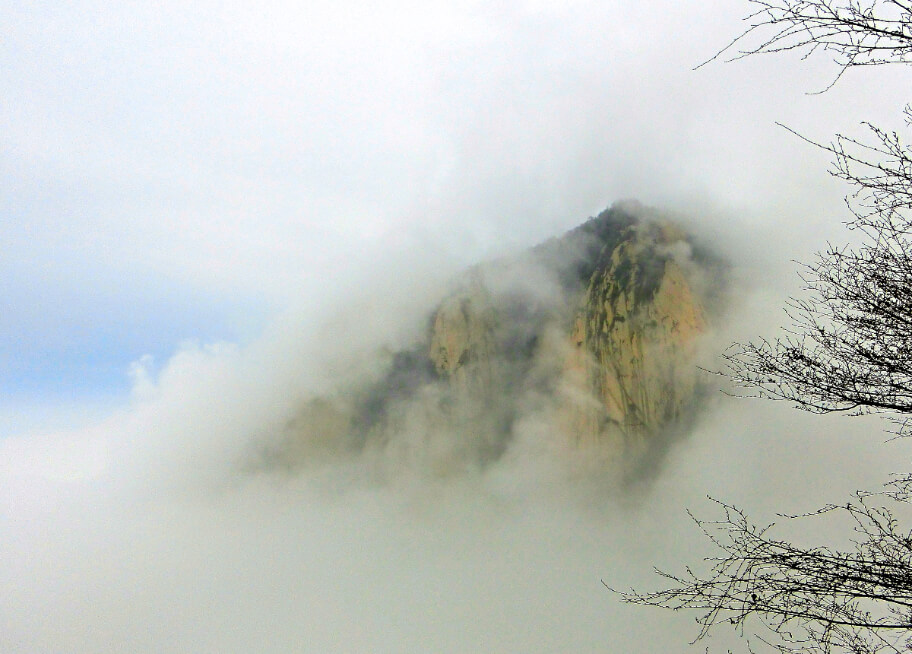
Three or four months after my mom died, my friend and co-worker, Wu Sho Boa, suggested that we should go to Huashan together. Huashan is one of the 5 sacred mountains of China. It sounded like a great opportunity, so I agreed to go. He invited his friend Liu Xiang Kai, who I called Xiang Kai (Xiang sounds like Shee-ang) to join us. I decided that I would bring some of my mother’s ashes and scatter them at the top. Sho Boa asked me why I would want to do such a strange thing, after all, my mother was not Chinese. I told him it was because she never got to travel anywhere in her life, and now in her death I could take her to a spiritual mountain peak in China and scatter her ashes to winds that would eventually take her around the world. Sho Boa still thought it was silly, but he let it go.
The Five Sacred Mountains
Located in Shaanxi Province, not too far from Xi’an (place of the terra cotta warriors), Huashan is the Western Mountain of the 5 sacred mountains of China. The five mountains are Taishan (泰山), the East mountain in the Shangdong province; Hengshan (衡山), the South mountain in the Hunan province; Hengshan (恒山), ( not a mistake it has the same name in pinyin, but is different in Chinese) the North mountain in the Shanxi province; Songshan (嵩山) the Center mountain in Henan province; and Huashan (華山) the West mountain in the Shaanxi province. During my first month in China, I went to Sōng Shān while visiting the Shaolin Temple, but at the time I was not aware of the mountain’s sacred significance.
There are many sacred mountains in China for example Buddhism has four of its own sacred mountains, and Taoism also has four of its own sacred mountains. All of these mountains have been places of pilgrimages throughout Chinese history, and are the subjects of many paintings and poems. The Five Sacred Mountains, also called The Five Great Mountains, have been connected to imperial pilgrimages performed by Chinese emperors. The mountains are connected to the Supreme God of Heaven and the Five Highest Deities. Which may explain many of the stunning temples and hermitages built on the side of Mt. Hua.
HuaShan
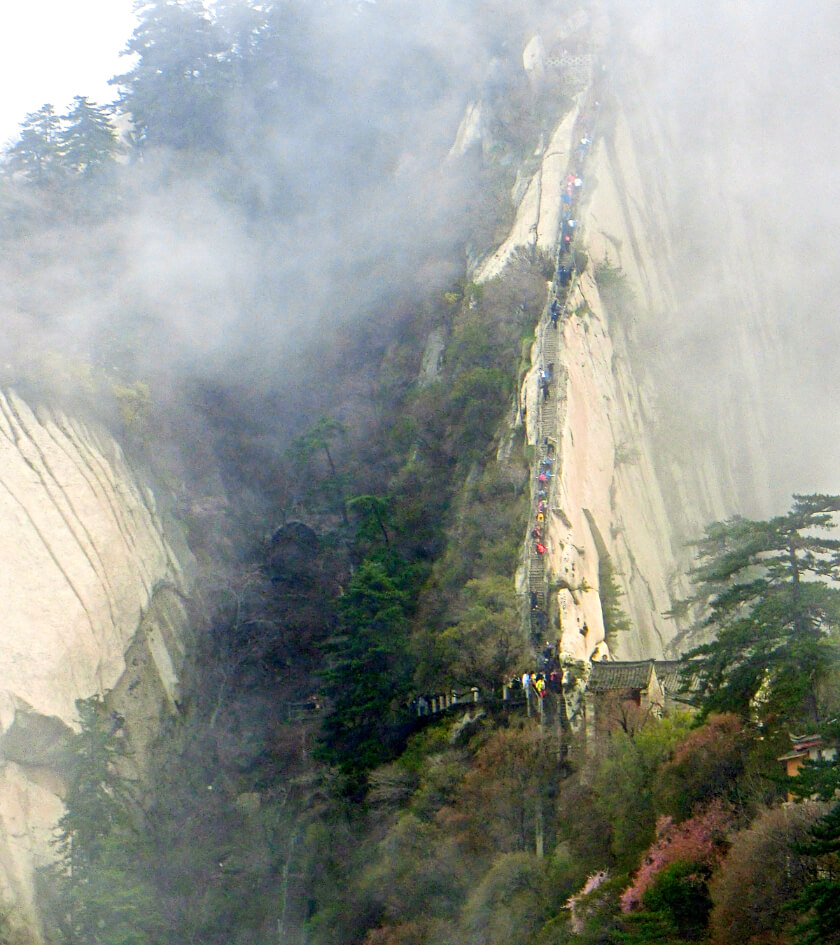
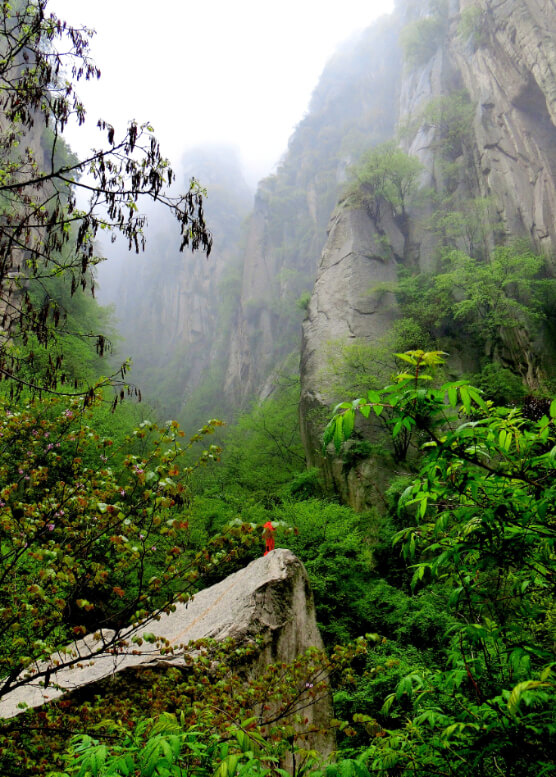
Huashan, Huà Shān, Hua Mountain, Mount Hua, and “number one steepest mountain under heaven”, however you say the name, it is all the same glorious mountain. Huà in Chinese means flower and shān means mountain, so the literal translation is flower mountain or 華山 flowery mountain. It is said to get its name from the five mountain peaks that look like a lotus flower.
Huashan was close enough to travel to in a day, but proximity does not equal facilely. Its reputation as one of the five sacred mountains is “China’s most dangerous”. It’s difficult to find exact numbers as to how many casualties and deaths may have occurred on Mount Hua, but after my own experience hiking it, I can assume that the number could be relatively high. Sho Boa said that you can’t find any numbers because the government doesn’t want the public to know the casualty rate because they don’t want to deter tourism. I don’t know if he meant city, provincial, or country government, but with the sketchy conditions, and population of inexperienced climbers (myself include), and the trash left behind, a little negative advertisement might be a good thing.
My Own Sacred Pilgrimage
As an outsider to China, it was easy to attach myself to the romantic connotations associated with ancient Chinese traditions. Taoist beliefs and Buddhist rites of passage have a mystic allure to a foreigner like myself. It was easy to imagine myself like the female version of Brad Pitt in Seven Years in Tibet or Bill Murray’s, Larry Darrell in The Razor’s Edge.
I envisioned myself reaching the peak of the mountain. In a moment of reverie sunlight breaks through the clouds or rises over the crest. I am filled with a sense of peace, gratitude, and a higher understanding of what life is about. Questions as to why we are here, and why I am here are answered. Then I feel a dawning acceptance of my mother’s death. I understand why she died like she did, and why I wasn’t able to save her. I know that death like life is beautiful.
Sadly, but not surprisingly, I did not reach this zenith of enlightenment. I was not awash in answers. I was achy and irritable. In fact, in retrospect, the entire journey from the city to the peak and back was farcical. I was more like John Goodman in the Big Lebowski than anything else, or The Dude maybe. Perhaps my journey was to feel exactly what I felt; achy, despondent, irritable, depressed, frightened, exhausted, in pain, befuddled, grieving, and longing for my mother to be alive. Of course, before the hike I didn’t know I was going to feel anyway other than joyful; and whatever enlightenment feels like.

The evening we were to leave, I poured some of my mom’s ashes (that I had brought with me from America) into a small box and put them in my backpack. If I made it to the peak then I would leave that little part of her there on that mountain top. It would be the closest I’d ever get to the stars. If I made it.
I read that it was a dangerous and steep hike. The highest mountain I’ve ever hiked. At least up to that point. I wasn’t sure which peak were were going to tackle, but Sho Boa insisted he had it all figured out, so I packed my bag, and waited for Sho Boa and Xiang Kai to meet me at my apartment. Our overnight train was at 1:00 a.m., but Sho Boa wanted us to get there around 11:00 p.m. so that we could pick up some snacks for the trip.
I had no idea what I was in for, but again, in retrospect, if I had a better idea of what was ahead of me, I would have taken a nap.
I lived in Zhengzhou, China in the Henan Province from the year 2013-2014. My mother died February 19th, 2014, 24 days after her 64th birthday, and five days before my 41st.
This post was created from two previous posts I wrote back in 2015 and 2016. You're welcome to follow the links, but honestly I think this post is the better one.
 An Accidental Vagabond