Table of Contents
- What are the 5 Grand Palaces
- Construction Timeline
- Gyeongbokgung Palace (경복궁):
- Established in 1395.
- Changdeokgung Palace (창덕궁):
- Originally constructed in 1405.
- Changgyeonggung Palace (창경궁):
- Originating in the Goryeo Dynasty and transformed during the Joseon era.
- Deoksugung Palace (덕수궁):
- Originally constructed in the late 16th century and completed in 1595.
- Gyeonghuigung Palace (경희궁):
- Established in 1617.
- Conclusion
- Donation love
Sources are listed below. If you’d like more information on a certain subject click on the bold text and it will take you to a source. There are hundreds of blog posts on The 5 Grand Palaces, anyone of them will tell you about each palace, including this one. However, this blog is pretty selfish, since I talk about me.
What are the 5 Grand Palaces of Seoul?
I lived in Seoul from 2018 to 2023, and during that time I visited three of the 5 grand palaces. Two questions that may arise from this statement may be, “What are the 5 grand palaces”, and “you were in Seoul for five years, why only three palaces?”
I’m glad you asked.
What are the 5 Grand Palaces?
The Joseon Dynasty, also seen written in English as Chosŏn, was the longest and last imperial dynasty of Korea. It was founded in 1392, (100 years before Christopher Columbus took credit for discovering America) by King Taejo, who was previously known as the general Yi Seong-gye. Yi Seong-gye declared himself the ruler of the new dynasty after overthrowing, exiling and then secretly killing, the king of the Goryeo Dynasty, which had been around for 475 years. Not a bad run, Goryeo. He ascended to the throne as King Taejo, marking the start of the Joseon Dynasty, which would last for approximately five centuries until 1910, about 40 years longer than Goryeo. Put into some context of time, as of writing this post in 2023 the United States isn’t even 250 years old. We haven’t even made it halfway. Yet we act like we know it all. The capital was initially established in Hanyang, which is present-day Seoul. During the 500 plus year reign 5 palaces were built between 1395 and 1617. However all 5 palaces have been subjected to destruction through invasions, wars, uprisings, and occupations, so new buildings and expansions had been constructed over the course of the 500 years. There have also been many renovations and later reconstructions that have continued up until today.
Why Only Visit 3 palaces in 5 years?
Although all 5 palaces are relatively close to each other, and not too far from where I lived, living in a place and visiting/vacationing in a place are two different things. Just like living anywhere your days are consumed by work and daily tasks and dull responsibilities and desperate moments of escape through Netflix and other streaming services. When it came to vacation time we often would leave Seoul to explore other places. I did try to see all the palaces, but due to confusion, I ended up visiting Gyeonbok palace multiple times, when I probably could have been visiting the remaining 2, more on this later.

The construction timeline for the major palaces in Seoul is as follows:
- Gyeongbokgung Palace:
- Constructed in 1395, Gyeongbokgung was the first palace built during the Joseon Dynasty and served as the main royal palace.
- Changdeokgung Palace:
- Initially constructed in 1405, Changdeokgung was later expanded and became one of the main palaces in Seoul. It served as a secondary palace to Gyeongbokgung.
- Changgyeonggung Palace:
- Originating in the Goryeo Dynasty (built in 1104) and transformed during the Joseon era. Changgyeong was built on the site of and renovated from parts of the summer palace “Suganggung” of the Goryeo Dynasty. Changgyeonggung underwent a name change and several reconstructions. It served various purposes over the centuries, including as a residence for queens and concubines, and as a temporary residence for the Japanese governor-general during the colonial period.
- Deoksugung Palace (Gyeongungung):
- Initially constructed in the late 16th century, Deoksugung served different roles throughout its history, including as a residence for King Seonjo and later as a temporary royal residence during the late 19th and early 20th centuries.
- Gyeonghuigung Palace:
- Established in 1617, Gyeonghuigung served as a secondary palace and underwent multiple reconstructions. It was the last of the Five Grand Palaces to be built. Although, not the last to be completed.
The Palaces and My Visits
14th Century
Gyeongbokgung (경복궁)
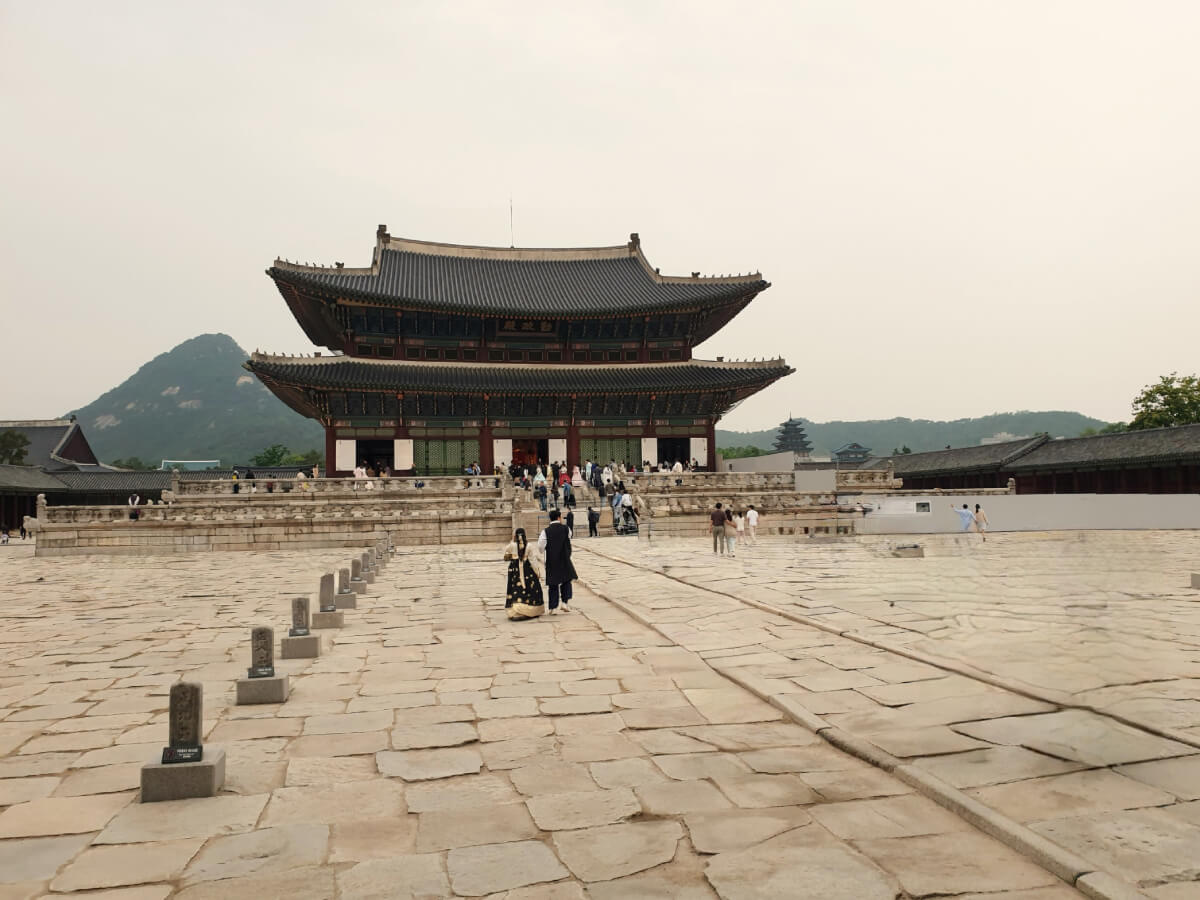
Gyeongbokgung (Gyeongbok Palace) was the first of the five Grand Palaces of Seoul to be built during the long 500 plus years’ reign. Gyeongbokgung was built in 1395, and it is the largest of all five. Its architecture and design is magnificent and bold. The wood structures are bright reds and blues and the fired clay tiled rooftops sweep like the upturned wings of birds of prey. Small intricate carvings adorn the tiles, and each end beam is painted with colorful patterns.
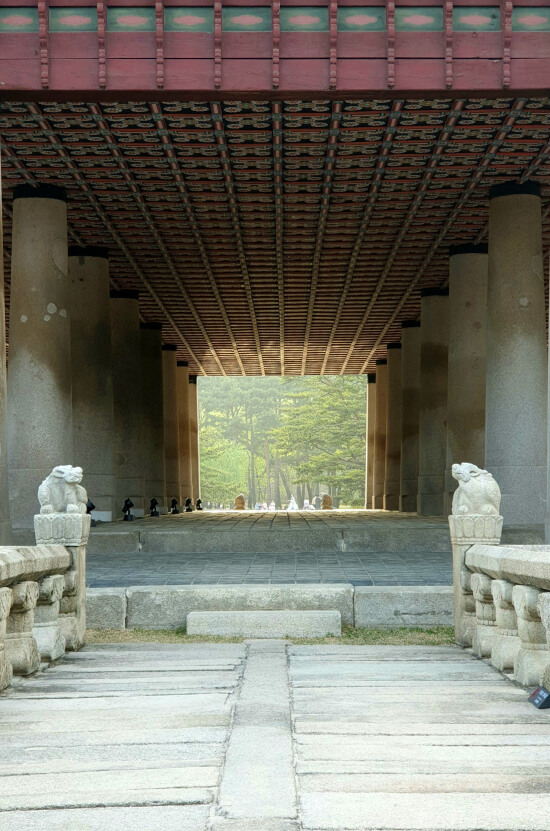
There is a lot to Korean architecture much like the Chinese and Japanese there is a purpose and meaning behind the building. In Korea it has a lot to do with nature and something called geomancy which I plan to write about at a later time. The structure is conspicuous with its impressive gates, halls, and tall beams and beautiful gardens. It is the largest of all five of the Grand Palaces, and every website and blog that I visited claimed it to be “arguably the most beautiful”. I do believe one can argue this remark as beauty is subjective. I don’t know if it’s the most beautiful overall, but it is large and has some beautiful parts, nothing is ugly, but most beautiful is as I said, subjective. However, I do believe it is one of the most popular of the five and most visited.
As mentioned, the palace was originally built in 1395, that’s almost 100 years before Columbus stumbled onto an already inhabited land and claimed it for Spain. In the 16th century (1592 to be more exact) the palace was demolished and destroyed by the Japanese, and not reconstructed until 1867, the same year that Alaska was purchased from Russia.
During the Japanese occupation of the 20th century, the Japanese destroyed or dismantled all but 10 of the original buildings, and then to add insult to injury they built the Imperial Government building on the site of the palace and directly in front of Geunjeongjeon Hall the former throne room of the Kings of the Joseon Dynasty. In this way the Korean’s not only lost their independence and didn’t know if they had a future they also were denied a view of their past. Why would the Japanese not destroy all evidence of the palace? One could argue that they kept what they thought was the most beautiful for themselves, like the pavilion and the surrounding garden. During the occupation the throne room was often used as an exhibition hall taking away all sense of authority and reducing it to a commercial space. Long after the occupation, which ended with WW2 for obvious reasons, and the devastation of the Korean war; restoration of Gyeongbuk began in 1989. The Japanese General Government building was demolished in 1995.
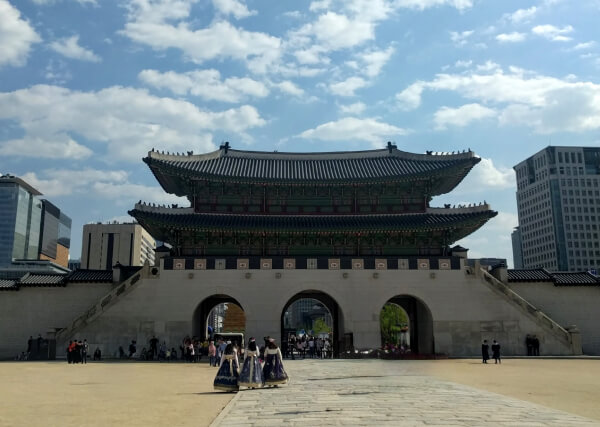
I’ve visited this palace at least seven times.
- My first visit to Gyeonbokgung was in the spring of 2017. At the time, I was living in Gwanggyo, which is a city in Gyeonggi, a neighboring province. It is about an hour away from Seoul by subway. During my first visit, I didn’t enter the gate but wandered about the East side of the palace near the National Folk Museum.
- My second visit was in the summer of 2017. I was still living in Gwanggyo, and during this visit I went with a friend of mine who had been living in Dongcheon, another small city in Gyeonggi-do. On the weekends we would often meet up on the subway and then take the Shinbundang line into Seoul. On this particular visit we entered through the East side but only took a few pictures inside the outer courtyard or oejeon where you can see the inside of the Gwanghwamun Gate (southern and main gate) and the outside of Heungnyemun Gate which is the second gate of the palace that will lead you into the inner court or naejeon.
- On my third visit to Gyeonbukgung, also in the summer of 2017, I finally went inside the second gate (Heungnyemun) and onto the palace grounds. Visit three was also with a friend of mine that was visiting from Masan, a small city in the southern part of South Korea. Aside from seeing more of the palace during this visit we also partook in a tea ceremony.
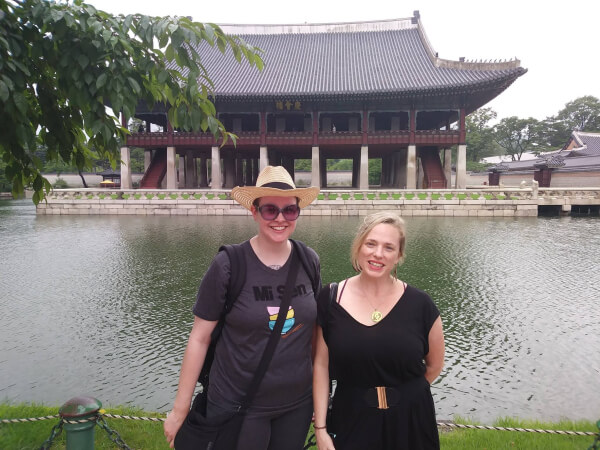

- My fourth visit was in the fall of 2018. At this time I had moved to Seoul and lived about a 30 minute bus ride from Gyeonbukgung. A friend of mine had come to visit from China, and we visited the palace, but only the outer courtyard.
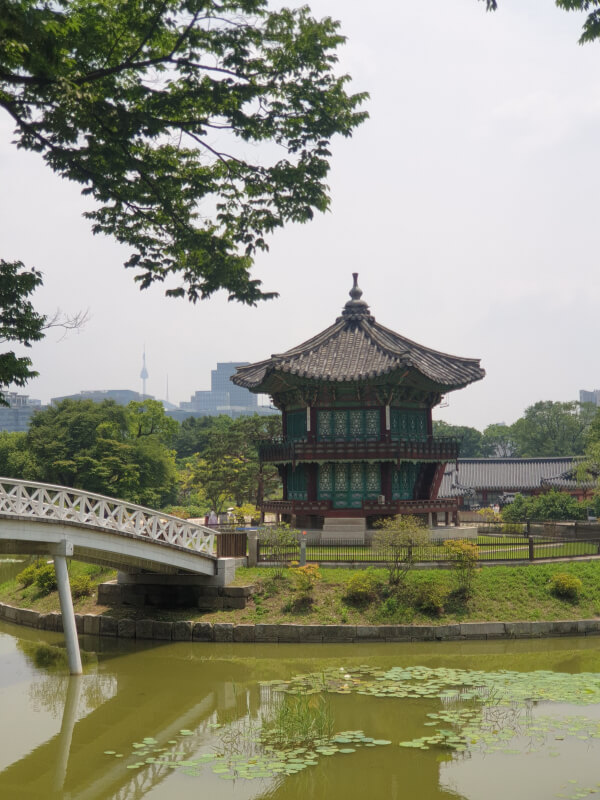
- My fifth visit was in the spring of 2019 when some friends from Prague (Czechia) came to visit. Now, on this visit I selfishly tried to take them to Changdeokgung because I wanted to see the secret garden, but I got the Hyangwonjeong Pavilion confused with the Huwon or Biwon also known as “the secret garden”.
The reason for my confusion was because during my 2017 visit the pavilion was under construction, and my brain had decided that this was the secret garden. I never bothered to look it up. I also just never remembered which palace it was that I kept visiting, so when I arrived for the fifth time, I remember thinking, “ah damn, I always come to the same palace.” My friends of course had never been to any of the palaces so it was fine. The pavilion was still under construction.
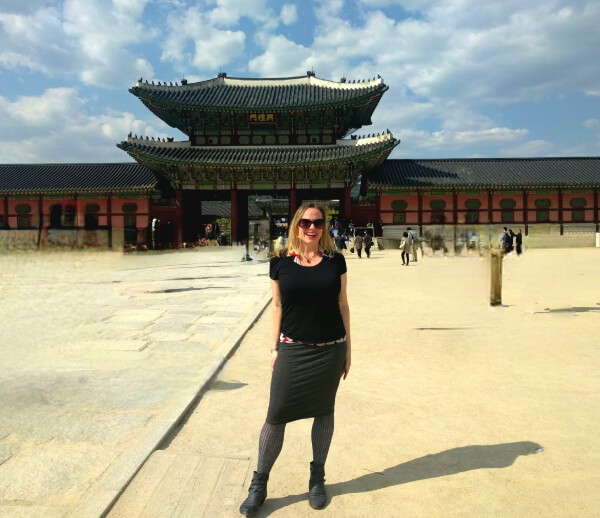
- My sixth visit took place in the spring of 2023. Probably, for the first time in my many visits to Gyeonbukgung, I went intentionally. The unknown and fear of the pandemic was in the rearview mirror, and more and more things had opened up. For the first time since I had moved to Seoul Gyeonbukgung was open in the evening. Eun and I went together for this summer event.
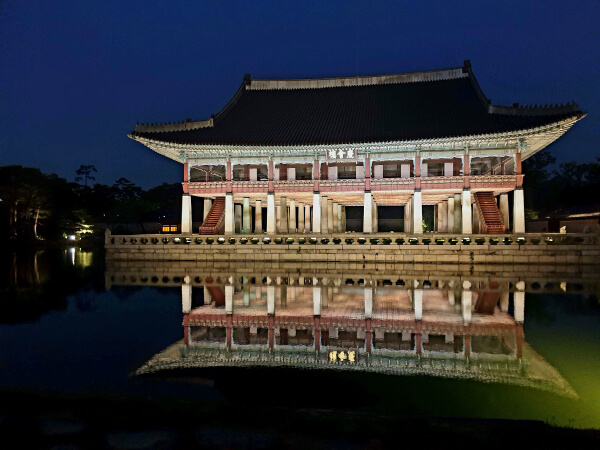
- My seventh and final visit was in the summer of 2023. I again went intentionally, this time to finally see the Hyangwonjeong Pavilion which had been under construction since my first visit inside the palace in 2017.

15th Century
Changdeokgung (창덕궁)
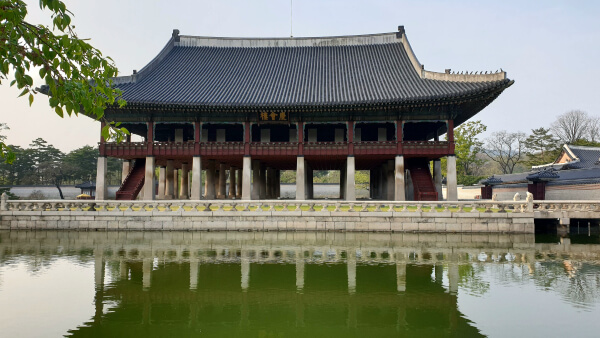
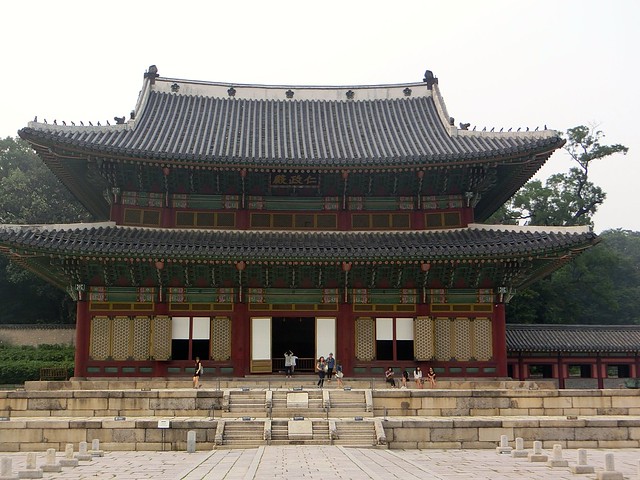
Changdeok palace was constructed in 1405, as a secondary palace to Gyeongbokgung, nearly 90 years before Columbus crashed into the Bahamas. After its initial construction the palace complex was expanded and it became the most favored by Korean kings from the late 15th century onwards. Known for its beautiful rear garden blending with the natural landscape which is part of geomancy. It is also the location of the famous Secret Garden, Biwon (비원) in Korean. This garden was built as a place for the royal family and women of the palace to relax and enjoy. Changdeokgung was badly damaged during the Imjin War the 1592-1596, and 1597-1598 a series of invasions by the Japanese. If you recall, Gyeongbokgung was destroyed in 1592, which would make Changdeokgung the primary palace by default. Although, Changdeokgung was also badly damaged in the wars which would mean that the main palace would have to be moved yet again to Changgyeongung which it’s lucky they already had the palace built; more on that next. Changdeokgung was rebuilt in 1609 (two years after Jamestown had been settled), but was damaged again when it was burnt down in 1623 by a military coup. Changedeokgung has been damaged multiple times over the centuries, however during each reconstruction it has remained true to its original form and because of this authenticity it was added to the list of UNESCO world heritage sites in 1997.
- This is one of the palaces I never had the chance to visit. In fact, part of the reason I visited Gyeongbukgung so many times is because I kept trying to visit Changdeokgung, but got confused. They are not that far from each other and when looking on a map they look quite close. In fact, you use the same subway line to get there. It is possible to walk from Gyeongbukgung to Changdeokgung. In actuality all 5 of the palaces are in relative walking distance, but if you are short on time or don’t want to walk 45 minutes (I said relative as in meaning possible) the buses are a great way to go from palace to palace.
- I regret not seeing this palace as its reputation for beauty is high. Plus the famous secret garden which you have to purchase a second ticket to enter, so you need to time your purchase and entrance right, especially during the crowded summers. This timing thing has never been a forte of mine. A friend and I did try to make it to Changdeokgung in my last month of living in Seoul, but it was during the Royal Cultural Festival and all the tickets to Changdeokgung and Gyeonbokgung had been sold out. Alas.
15th Century
Changgyeonggung (창경궁)
Named Changgyeongung in 1483 (still before Columbus, and his invasion of the already populated land we now call America) this palace has gone through many reconstructions. I have read that it was built by a king for a king. I have also read that it was built as a residential place for queens and concubines. Once, I overheard a person in line for a ticket say that it was built for some King’s mother. The last one was not a reliable resource.
It was first called Suganggung and was built in 1104 during the Goryeo reign as a summer palace for King Sukjong of the Goryeo dynasty. After Yi Seong-gye defeated Goryeo he resided in Suganggung until Gyeongbukgung was built. A side note, Kaesong also seen written as Gaegyeong was the capital of the Goryeo dynasty which is in what we now call North Korea. It can be difficult to picture it with our modern maps and politics, but Goryeo once controlled all of the land that we now call North and South Korea. Later in the mid-1400’s under the fourth ruler of the Joseon Dynasty, King Sejong (the Great King who invented Hungul the Korean alphabet) built the palace as a gift for his father, the third Joseon King, King Taejong; more like a resting place than a gift. I found one site that stated that King Sejong built Changgyeonggung in 1418, whereas most sites including Wikipedia state mid-1400’s. I’m not great at math, but 1418 seems to me to be a lot closer to early 1400’s than mid-1400’s. Since King Taejong died in 1422, I’m going to go with Go!Go! Hanguk’s date until I get my hands on some printed text. Another side note, when it comes to dates on construction or establishment which just means that they decided that on this particular property they are planning to build a palace, Changgyeonggung is the most confusing to get the dates clear. My guess is that there hasn’t been a lot of English write ups on the Goryeo Dynasty because there isn’t much left to see of this dynasty, and the top sites are travel sites, so its a lot of regurgitation of the same information. I have my own deduction as to why it is difficult to tact down an exact date. My thoughts are that in 1104 there was already a palace in the same location. King Sukjong’s summer palace that may or may not have been called Suganggung. Then in 1392 after the fall of the Goryeo Dynasty, King Taejo the first of the King’s of the Joseon Dynasty moved into the former summer palace while Gyeongbukgung was being built. So, obviously some structure had to already be in place, and the man’s a king so it can’t be a shabby shack, and it was a royal summer palace, so I imagine it was beautiful in its own right. Then presumably, in 1418ish, King Sejong either added on or renovated or expanded the former Goryeo structure. I suppose he could have had it all torn down, but I don’t know, I’m just tossing this idea around trying to elucidate for myself when this palace was actually built. During the time that King Sejong built the palace and King Taejong resided there it was called Suganggung, this is for certain. Then in 1483, it was renovated and enlarged by King Seonjong the ninth King of the Joseon Dynasty. Perhaps it was during this time that the intention of its construction was to be a residential home for the queen, and the king’s concubines. Okay back to the main focus:

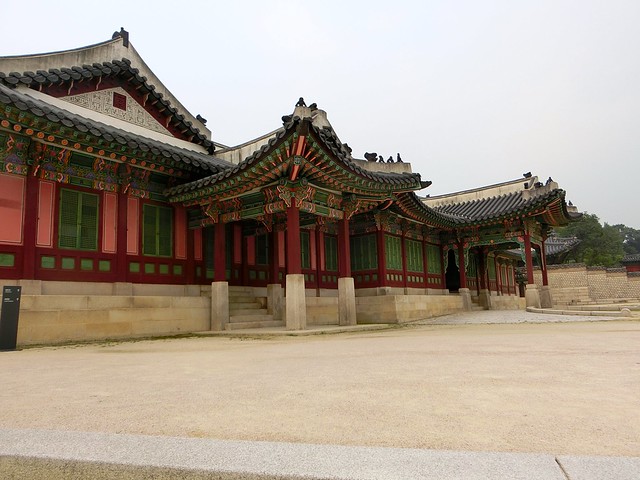
There was a lot of upheaval and destruction at Changgyeonggung through multiple Japanese invasions and during Japanese colonialism. Due to the multiple damages, destruction, rebuilding, and renovations over the centuries, Changgyeongung features a mix of architectural styles, including traditional Korean and Western influences. The palace grounds include gardens and a victorian style greenhouse designed by the famous Japanese horticulturist Hayato Fukuba, and built by a French architectural company, whose name I haven’t yet located. Changgyeonggung features a large botanical garden with many indigenous Korean plant species. During the Japanese occupation that began in 1910, Changgyeonggung was turned into a zoo. The zoo was Korea’s first, and built in 1909, which date wise informs you that Japan was already planning to occupy Korea. I also saw a source that said the Daeonsil, the greenhouse, was built in 1907 which if true shows that the Japanese were planning their occupation at least 3 years in advance of the “official date.” I imagine all occupations take a bit of planning. After the end of the Japanese occupation the palace was restored to much of its original design, and many of the Japanese buildings were torn down, however the greenhouse, which is quite lovely, remains. When I say original I mean either the 1418 design, but more likely the 1483 design when it was given the name Changgyeongung.

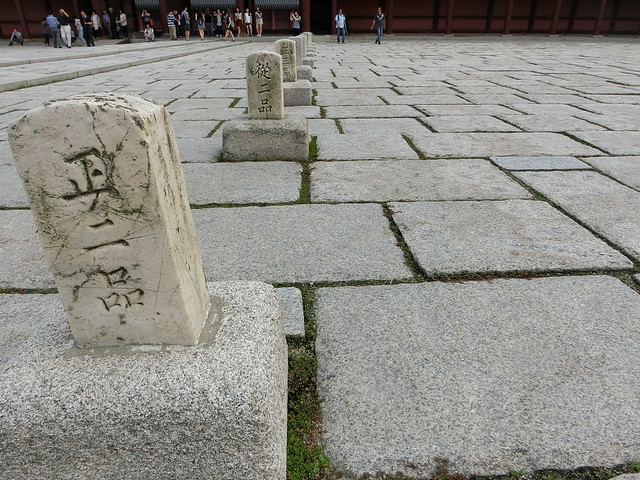
- The first time I came to Changgyeongung, was the very first time I ever came to South Korea. I first visited Seoul in 2014, during a 24 hour layover on a trip from China to the Czech Republic (Czechia). I had stayed in a hostel with the word “Banana” in its name. During my layover I wandered the neighborhood which was a multitude of connecting alleyways; ate in a small little high quality hole in in the wall restaurant; and I visited a palace. At the time, I never imagined that I would, not only return to Korea, but that I would live there for 7 years. I didn’t know the name of the palace I had visited as I didn’t speak to anyone other than the hostel receptionist during check in, and with a sales girl at Tony Moly (토니모리) as I bought my first Korean beauty product of snail cream, not even knowing that the Korean beauty industry was a multi-billion dollar business; nor that I just bought a cream made of snails. I only saw a very tiny part of it, as I didn’t see the greenhouse or the beautiful pond surrounded by lush green trees and bushes, yet it stuck with me. I was so in awe of the outer stone courtyard and the standing tiles that looked like grave stones, that I now know are rank stones which marked where members of the royal court were permitted to stand during ceremonies. I moved to Seoul in 2018, and since I had arrived in the major metropolitan city, I had been searching for the palace I had first visited 3 years prior. Hence, another reason why I had visited Gyeongbokgung so many times. Each time I would go to Gyeongbokgung, I knew I was not at the right place, but I could not recall which palace was my first.
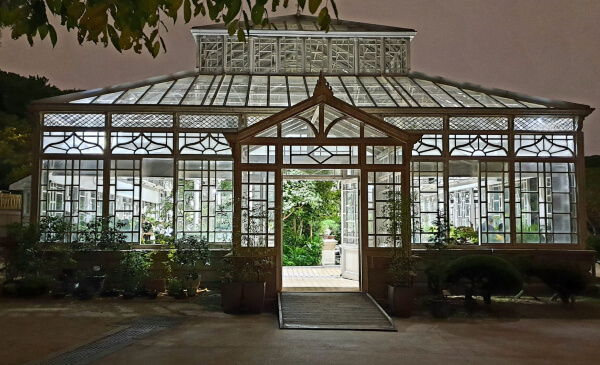
- It wasn’t until my last month in Seoul when a friend and I walked from Gyeongbokgung in the direction of what we thought would be Changdeokgung. It was a 45 minute walk to Changgyeongung. The palace was open for the summer nights, and my friend and I were able to enjoy a light show that played on a tree that grew on a small island in the manmade pond. Once inside the courtyard, I recognized it immediately as the palace I had visited in 2015. It felt like I had come full circle. Changgyeongung and Changdeokgung are practically connected, so it is easy to confuse one for the other.

16th Century
Deoksugung (덕수궁)
Deoksugung Palace, originally known as Gyeongungung, was established in the late 16th century during the reign of King Seonjo the 14th king of the Joseon Dynasty. This palace like Changgyeonggung has a complicated and confusing history, hence the “late 16th century” date. Before it became a palace it was the home of Grand Prince Wolsan, the older brother of King Seongjong the 9th Joseon king. Prince Wolsan died in 1488 a solid 100 years before the Imjin Wars, so either his residence remained intact and lived in by other family members or it was empty. The plan to actually turn it into a royal palace came about in 1592, coincidentally around the same time that Gyeongbukgung was destroyed. Construction on Deoksugung (it wouldn’t get this name until 1907) or Gyeongungung began in 1592 (two years after the Roanoke Colony had disappeared), but due to the Japanese invasions of Korea (1592-1596 & 1597-1598, Imjin Wars), it was interrupted. Because of the war, many structures of Gyeongungung were damaged or left incomplete during the initial construction phase in 1592. I am not sure what parts of Gyeongungung were from Grand Prince Wolsan’s residence is any part was, but the palace wasn’t completed until 1595 or 1958. Meanwhile, in the America’s during the same time we were having our own colonial invasions. In 1598, the same year that Gyeongungung was completed Juan de Oñate attacked and massacred the Ácoma Pueblo in what is now New Mexico.
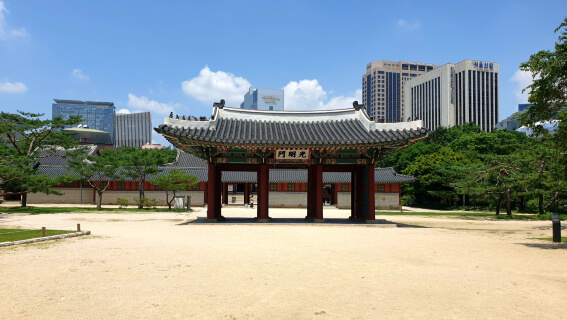
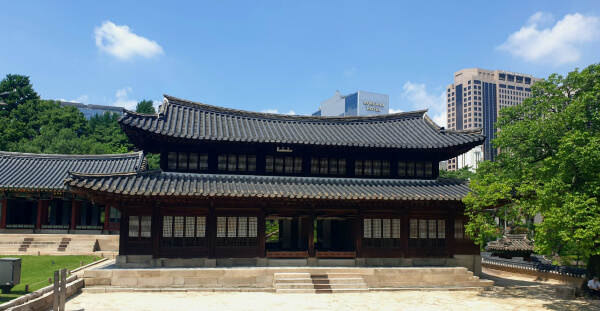
Gyeongungung was meant to be an auxiliary palace, but it became a temporary royal residence after the Japanese destroyed Gyeongbokgung in 1592, along with badly damaging Changdeokgung and Changgyeonggung. It became an official royal palace in 1611 when the King Gwanghaegun, the 15th ruler, finally decided to give it the name Gyeongungung. Prior to 1611, I don’t know what they called it. Uncle Wolsan’s place? The palace was completed in 1595, but it has a unique fusion of traditional Korean and Western architecture after a Western-style wing was added in 1897. This Western-style building, Jeonggwanheon, was designed by a Russian architect. It was turned into a cafeteria during the Japanese occupation. In 1907, the year the greenhouse at Changgyeonggung was built, Gyeongungung’s name was changed to Deoksugung. The name which means longevity was chosen in hopes that it would save the dynasty (at the time declared and Empire) and the Korean peoples, but unfortunately, as history shows, the Joseon family dynasty would fall, and Korea would be occupied for 35 years. As for Deoksugung, much of the original palace was destroyed or dismantled and the palace that you can see and visit today is only 1/3 its original size.


- Although I have passed this palace multiple times since I had lived in Seoul, it wasn’t until 2023, my last days in Seoul, that I finally made a visit. The main gate of Deoksugung is often overcrowded with protesters, often of the older generation, and there are large banners, that at times, over shadow the main gate. The protestors often deterred me from entering the palace. In the beginning, I thought maybe they were protesting the actual palace, but after years of living in Seoul, I had learned that on the weekends there is always a protest, and all this political activity takes place in the square across from City Hall and Seoul Plaza. Protests will extend down the length of Sejong road leading to Gwanghwamun square as this is where many of the embassies are located including the U.S. Embassy.
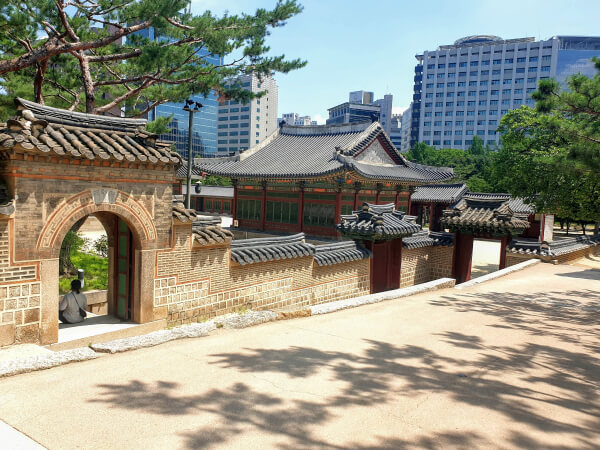
The day my friend and I went to the palace was Pride week and it was meant to be the day of the Pride parade which we both would have loved to have seen, but a far-right religious and anti-LGBTQ+ group had managed to snag the space for their Youth for Christ march. Although the Pride Organization had applied well in advance as they do each year since they have held the parade, Korea’s new and very conservative President granted the day to the church, as he said “events for children and teenagers get a priority when requests are filed for a same date”. (I must say though, as someone who was there, that was the angriest children’s event I’ve ever been forced to listen to.) As we passed through the gate and onto the palace grounds, we could hear the angry screams and shouts from the church group, and like a dome of verbiage the screams followed us to nearly every part of the palace grounds. It was an incredibly hot day and all that hellfire, damnation, and brimstone gave our tour of the grounds an unpleasant vibe. I would have preferred fun music of Pride over the screams or better yet silence, but we did our best to enjoy the palace grounds. Once the marching started the angry group took their yells on the road, it left leaving only the sounds of the city which blended into a dull hum, hiss and honks.
17th Century
Gyeonghuigung (경희궁)
Established in 1617 (the year that Pocahontas died), it was the last of the Five Grand Palaces to be built. Although the foundation for the palace was in 1617, Gyeonghuigung wasn’t constructed until 1623 and underwent multiple reconstructions. Gyeonghuigung served as a secondary palace to Gyeongbokgung, but later served as the main palace during the 19th century. It was remodeled in 1855 with an architectural style integrating tradition and innovation. It was the setting for major political events such as King Gojong‘s return from the Russian legation where he sought refuge in 1896, and Korea’s independence proclamation from Imperial China’s rule in 1897. It was also the site of where the Korean Empire was proclaimed in 1897. Much of the palace was destroyed by fires, and during the Japanese occupation many of the buildings had been dissmantaled. Restoration efforts have been ongoing, however, because the reconstruction didn’t begin until the 1990’s and the city had already been built up, a lot of what was lost can’t be restored. As of today, only 33% of the palace exists.
- I never made it to Gyeonhuigung. During my last month in Seoul it was my intention to visit all five of the palaces, but unfortunately due to time constraints and schedule conflicts I was not able to reach this goal. In truth, I don’t even know exactly where this palace is located. I know it is either in Jongno or Insadong where the other four palaces are located and it is also located on the west side of what was the old city capital Hanseong.
Conclusion
Thank you for reliving this palace journey with me. I feel fortunate to have been able to see 3 of the 5 and I hope that I make it back to Seoul in the near future in order to finally see Changdeokgung and Gyeonhuigung, and of course, The Secret Garden.
Come back for future posts on greater details of each palace. I will also have write ups on other fortresses and buddhist temples, along with a two part story on our walk around the Seoul City Wall; the ancient former wall of the Hanseong Capital which was built during the Joseon Dynasty.
Till next time.
Accidental Vagabond
Help Keep this blog going. Any and all donations go to keeping this blog up.
Choose an amount
Or enter a custom amount
Your contribution is beyond appreciated.
Donate* Wikipedia provided the first step to basic information with links that lead to further resources. Please, if you can, donate to Wikipedia to keep it open for all people to use. Privatization can lead to abuse of information. If we collectively support it will help to keep the flow of information open and more accountable. I make a small monthly donation, and would love to donate more, which one day if profits come, I will. It's a great starting point when looking for information.
Other sources were Britannica, Korea.net, Go!Go!Hanguk, and many travel blogs.
There She Goes Again is a good blog for information if you wish to travel to South Korea. I used her blog a lot before visiting places in South Korea. I'd also like to recommend Korea By Me, as I have a soft spot for them for giving me a chance, plus they have a lot of information about Korea from a diverse group of people who are currently living in South Korea.







 An Accidental Vagabond