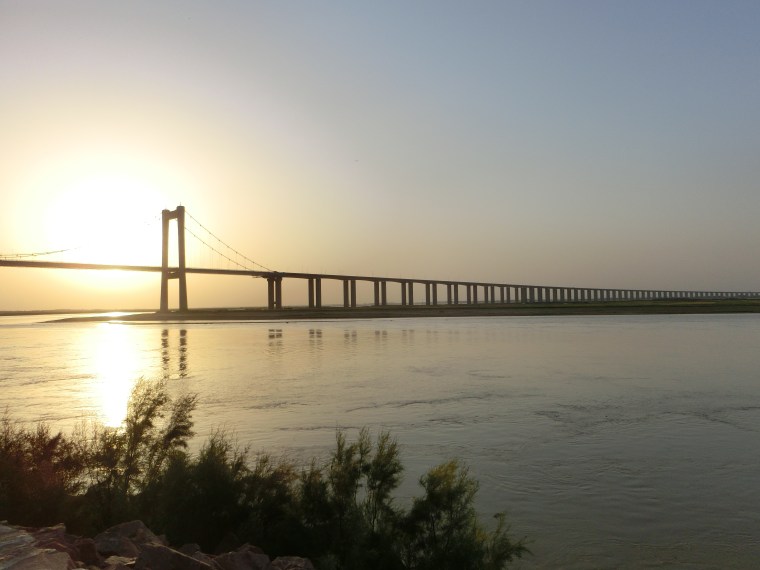
The Yellow River Park in Zhengzhou

CIMG4400

The Yellow River is called “The cradle of Chinese civilization”. Chinese dynasties were built along this river, and in the early periods of Chinese history the regions around the Yellow river were the most prosperous. It is the 3rd longest river in Asia, and the 6th in the world. It is a life giver and referred to in Chinese as the mother river, but it has also earned the name, “China’s sorrow.” This river has has taken well over a million lives. The river’s flooding from it’s constant changing of course from erosion has earned it the world reputation of being the only natural disaster in recorded history to kill more than a million people.

In the years between 1332 and 1333, seven million people were killed from theYellow river flooding, and the subsequent famine and disease that followed after. In 1887, 900,000 to 2 million people died, and in 1931, 1 to 4 million people died. The most interesting of floods happened in 1938 during the second Sino-Japanese war. The Chinese military decided to break the levees and flood the valley on purpose as a way to prevent the advancing Japanese army from reaching their goal of capturing Wuhan where at the time the temporary Chinese Government was set. The idea was to have “the water be a substitute for soldiers”.  5,000 to 9,000, Chinese civilians were killed in the floods, and an unknown number (but most likely not as many Chinese) of Japanese soldiers. The flood stopped the Japanese from capturing the city of Zhengzhou, but they still reached their goal of overtaking and capturing Wuhan.

A river that has birthed a civilization and taken away such a multitude of life is not going to  continue in modern China with out a park dedicated to it. The Yellow river park is located in the northern part of Zhengzhou, and can be long trip on a bus, but we were lucky to have a friend with a car, and he drove his family, and my friend’s family, and myself to the park for the day. This happened near the end of our stay in Zhengzhou so it was a nice way to end a year in this Chinese city of Northern China.

It’s a huge park with five sections. At the time of the visit, we were not informed of where we were or the significance of any of what we were looking at so much of it was just interesting for the sake of its existence, and carried little historical reference for any of us foreigners. Aside from the massive statue of Mao, I had to look up the names of other statues and buildings on the internet, and I wasn’t able to find the names of everything, but I was able to find some bits here and there.

CIMG4278

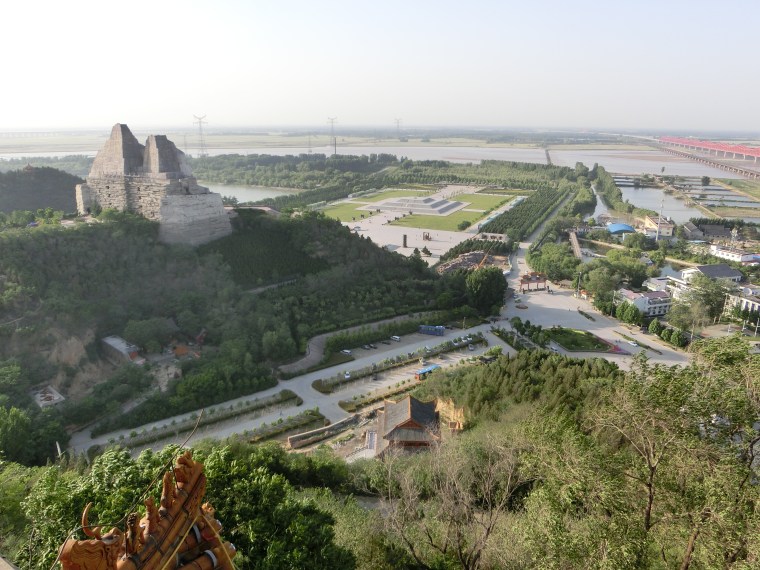
We first ascended a small mountain, and that is where we found the giant statue of Mao. The children quickly preceded to climb him in order to race to the top to see who could tag Mao’s mole first.  It is considered good luck to rub the hands of Mao. The infamous leader  is known for saying, “We must control the river,” which resulted in building dams and levees. The view from the statue of Moa looked down on the the wide and literally yellowish brown river. Looking down from the mountain we could see areas for rice paddies but most of the area is now used for the purpose of the park, and transferring the water from the river to Zhengzhou.

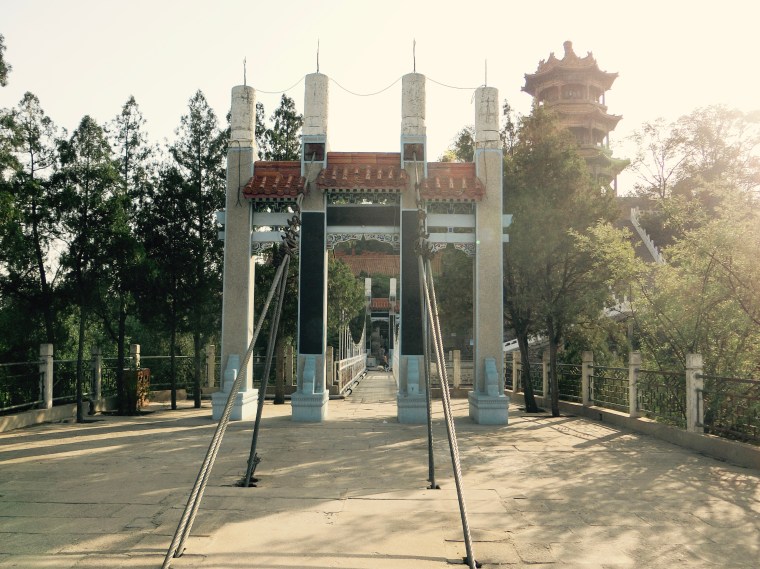
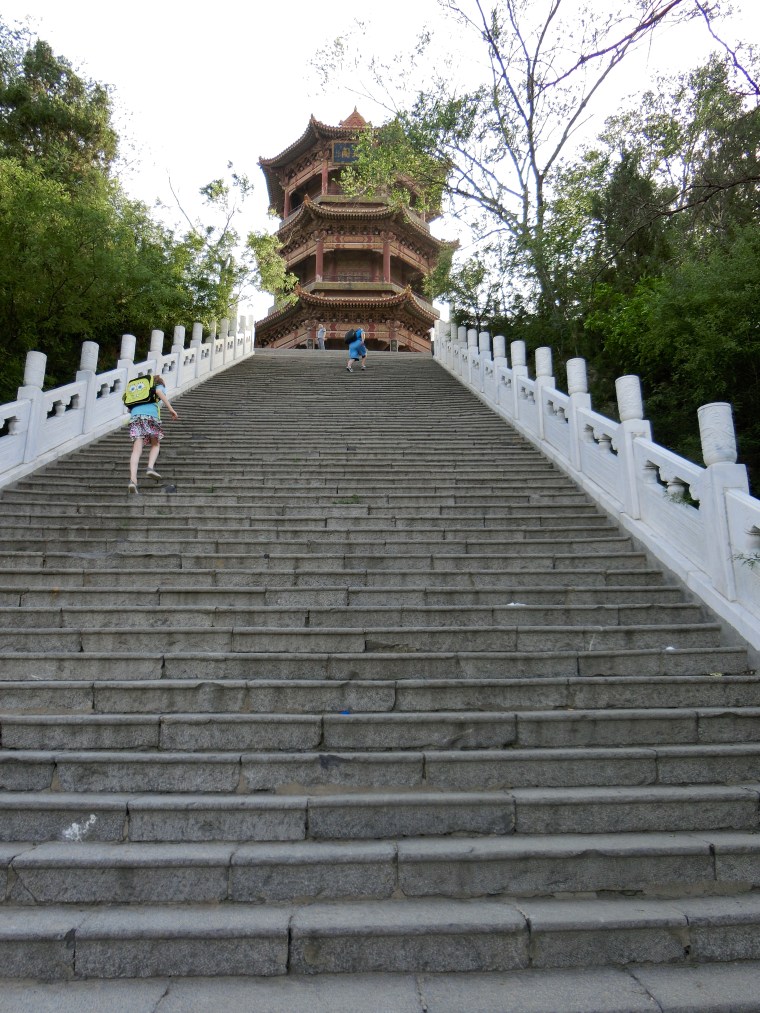
We crossed over a bridge called the Luotuo (camel) bridge which led to the Yueshan temple on Yue Mountain. There is a great view of the statues and the monument that they built below. I didn’t know the significance of much of what I was looking at, unfortunately, but what I’ve gleaned from the internet is that the giant statue on the mountain measuring 59ft high is the connected heads of Yandi and Huangdi the great ancestors of China, and they face the river in a symbolic reverence for this giver and taker of life. Information pretty much dies out from there.
CIMG4281CIMG4285CIMG4293CIMG4319

At the base of the part of the park that is called the Five Dragon Peak there is a statue of a Mother cradling her son. This statue is to represent the mother river and China, and their harmonious relationship (they’ve yet to build the statue of the mother dropping and shaking the baby to represent the times not so harmonious). The park also has statues of very famous calligraphy writers- non of whom I knew of, but calligraphy is an art form in China, and to be called a writer in China means that you do calligraphy. It was in this area of the park were we found a man who painted a quick drawing for each of us (for a cost) and then wrote a poem. I had asked my Chinese friends what the poem said, and they all replied, “It’s too hard to translate,” which I found to be the common response when asking for the translations of certain things.

CIMG4356

CIMG4389

Our tour guides drove us around to parts of the park where not all tourist were allowed to go which is the advantage of having your driver being a Zhengzhou cop, and he took us to a quiet area near a sharp curve in the river where there seemed to be people disgusting the construction of something. A woman rode out on horse back to deliver a message to people working, and then she quickly rode away as if riding back into the past. We were warned not to stand too close to the river, not because it can jump up and pull you in, but because the soil and silt is very soft and can suddenly crumble under your feet. It is this soft earth that causes the rapid erosion and the continuous changing of the river. Although, the river has not changed much since Moa exclaimed that it must be controlled.

CIMG4397CIMG4409CIMG4411

We ended at the base of the figure heads of Yandi and Huangdi where many Chinese were ringing giant bells, taking pictures and a couple of men were swinging whips over their heads to make giant cracking sounds that reminded me of firecrackers or gunshots. We watched the sun set behind wires and trees, and took the long traffic flooded drive back into Zhengzhou.

Faking China: A Theme Park

If you find yourself in Zhengzhou, China, which is in the Henan Province, which is in the north, and to the west of Beijing, and find yourself wanting to visit other parts of China too, but can’t for one reason or another, that’s okay because you can go to fake China in Zhengzhou. You never have to leave.

It’s been two years’ since I have lived in China, and even now certain memories return to me. Memories of me thinking, “What the hell is this?” and not knowing how to quite register the wonder and multitude of questions that China can at times offer. I had started saying to myself, “stopping asking why, there is no answer to why, it only is as it is. There is no why, and no answer, it’s just China.”

CIMG4930

China is naturally a geological and geographical land of amazing beauty (I won’t focus on the horrible pollution that is destroying that beauty, but I’ll still mention it as an aside because it’s important to be reminded that there is a lot to lose). There are landscapes that steal your breath away and fill your heart with awe, but China is also the land of manufactured worlds, and that too is…well…it can leave you speechless. There is as much natural beauty as there is… shall we call it–imitation.It is a matter of opinion on whether you think this is an eyesore and a waste or if you think it’s a brilliant oddity of manmade accidental art, but when you are standing in the middle of one these pretend places you can’t help but be…well…speechless, and oddly admirable of the juxtaposition of China and China’s imitation of other counties and itself. There are ghost cities, and copycat cities: the fake Paris and the fake Venice, for example which are also ghost cities, and there are amusement and theme parks that are just devoted to imitating cities; like Las Vegas in a park with no gambling or strippers or alcohol.

In Zhengzhou, where I had spent one year of my life, the school where I had been working at the time took our classes- the English Language school, No. 42-to a park on the outskirts of the city as part of a class excursion. In the past, I had heard that the school used to offer two class trips a year, and that they had visited actual famous sights and landmarks, but I guess by the time I had arrived they must have lost the budget or decided not to spend so much on the teachers and students- so we got fake China. I never learned the name of the park in Chinese or translated into English, and believe me I had tried. I searched the internet but couldn’t find any information on this mystery park visited by Chinese students and couples having their wedding pictures taken. The closest I found was the Century Park where all the students excitedly thought we were going until our bus passed it by and took us to a second tier theme park. There were audible groans of disappointment.

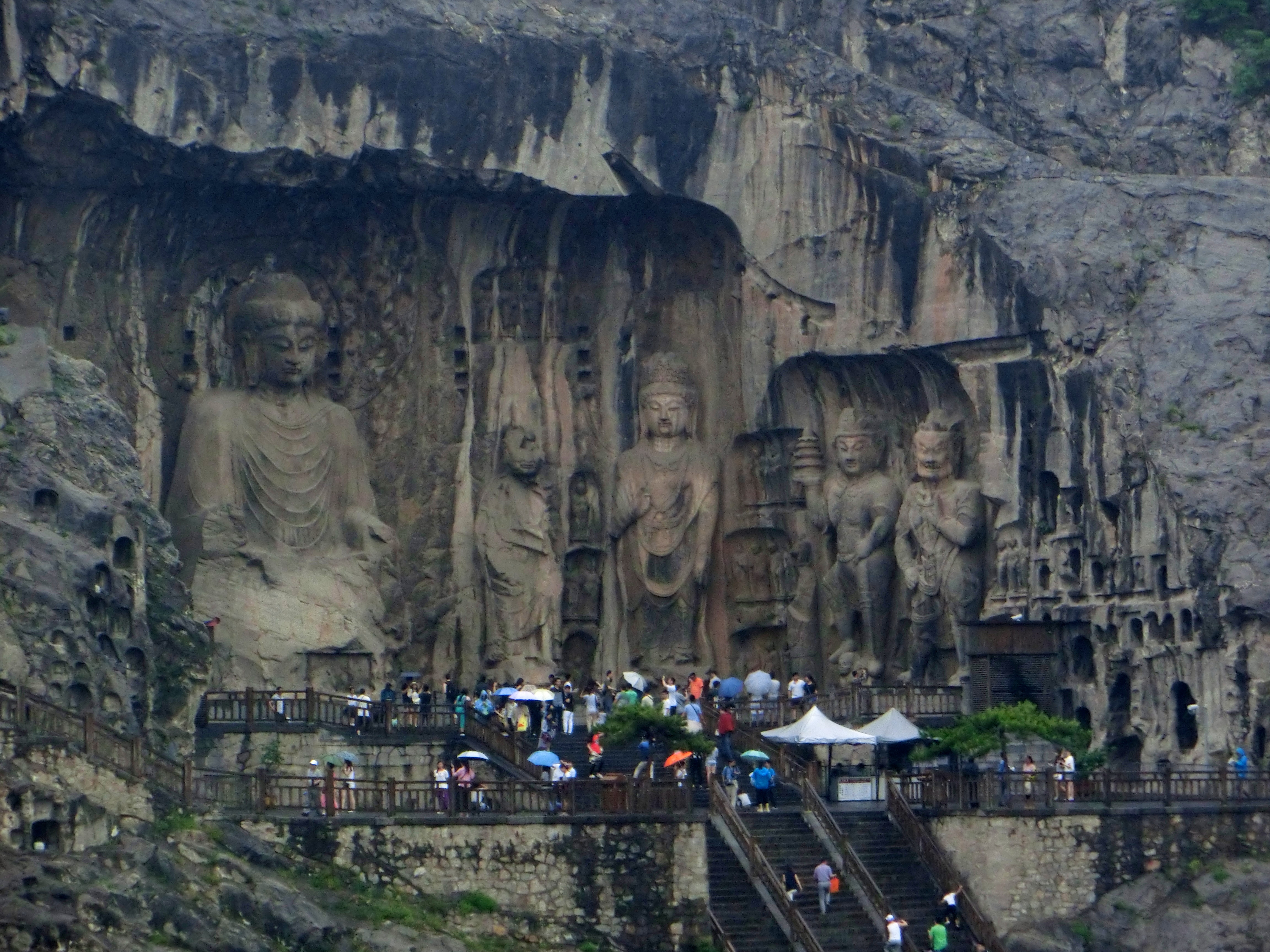
A picture of the Longmen Grottos from across the river.

Henan, the province of Zhengzhou, is a very important province in the history and the civilization of China. In fact, out of the eight ancient capitals of China four of them have been located in Henan. Zhengzhou was recently added to that list due to the discovery of an ancient dynasty perhaps the oldest of all the dynasties, the Shang dynasty (1558 b.c.- 1046 b.c.). When in Zhengzhou there is no remanence of the Shang’s presence except for a portion of an ancient settlement wall that looks today like a giant wall of dirt. You can find this wall in the eastern part of the city. The other Capital cities were once located in Luoyang, Kaifeng, and Anyang (where the oldest collection of Chinese writing was found written on ox bones and turtle shells. Evidence of the Shang dynasty had also been found in Anyang). Henan is not only the birthplace of the great Chinese dynasties,  but also Zen Buddhism, and Kung Fu. In this one province you can visit the oldest civilizations of China, and the explore the historical birthplaces of China’s societal foundations many of which still hold today, even many events leading to China’s communism were formed in Henan. In Luoyang there are the grottos an amazing religious site with over 100,000 carvings and status of Buddhist images. In Dengfeng and Shaolin are the schools of Kung Fu, and in Kaifeng the most famous judge in the history of China, Boa Zheng, had once resided. He was also called justice Bao because he was honest and upright, and even today he is the symbol of justice. A living history lesson at can be at your finger tips, but if you can’t get out of the city you can visit these ancient landmarks in one city park in Zhengzhou.

The area where the ancient wall from the Shang Dynasty was over 3,000 years ago.
Where there were once ancient ruins discovered in the 70's and 80's now families plant urban gardens.
Where there were once ancient ruins discovered in the 70’s and 80’s now families plant urban gardens.

I wasn’t really certain what to expect, and since at this point I had already lived in China for close to a year, I knew to expect the unexpected. All that could really be explained to me was that we were going to a park. I’ve decided to name it The Park of Great Things In Henan and Beyond, because every city and historical monument was represented in replica, not to size, for the Chinese tourists to enjoy. I say Chinese because this isn’t a park that many foreigner travelers may find themselves. Not many foreign travelers will even find themselves in Zhengzhou for more than a day. Most people come to Zhengzhou only to change trains unless they are actually living in the city. I remember a person once saying to me, “Zhengzhou? Oh yeah, I think I was there, in fact I got my wallet stolen in the Zhengzhou train station.”

CIMG3431
Not real
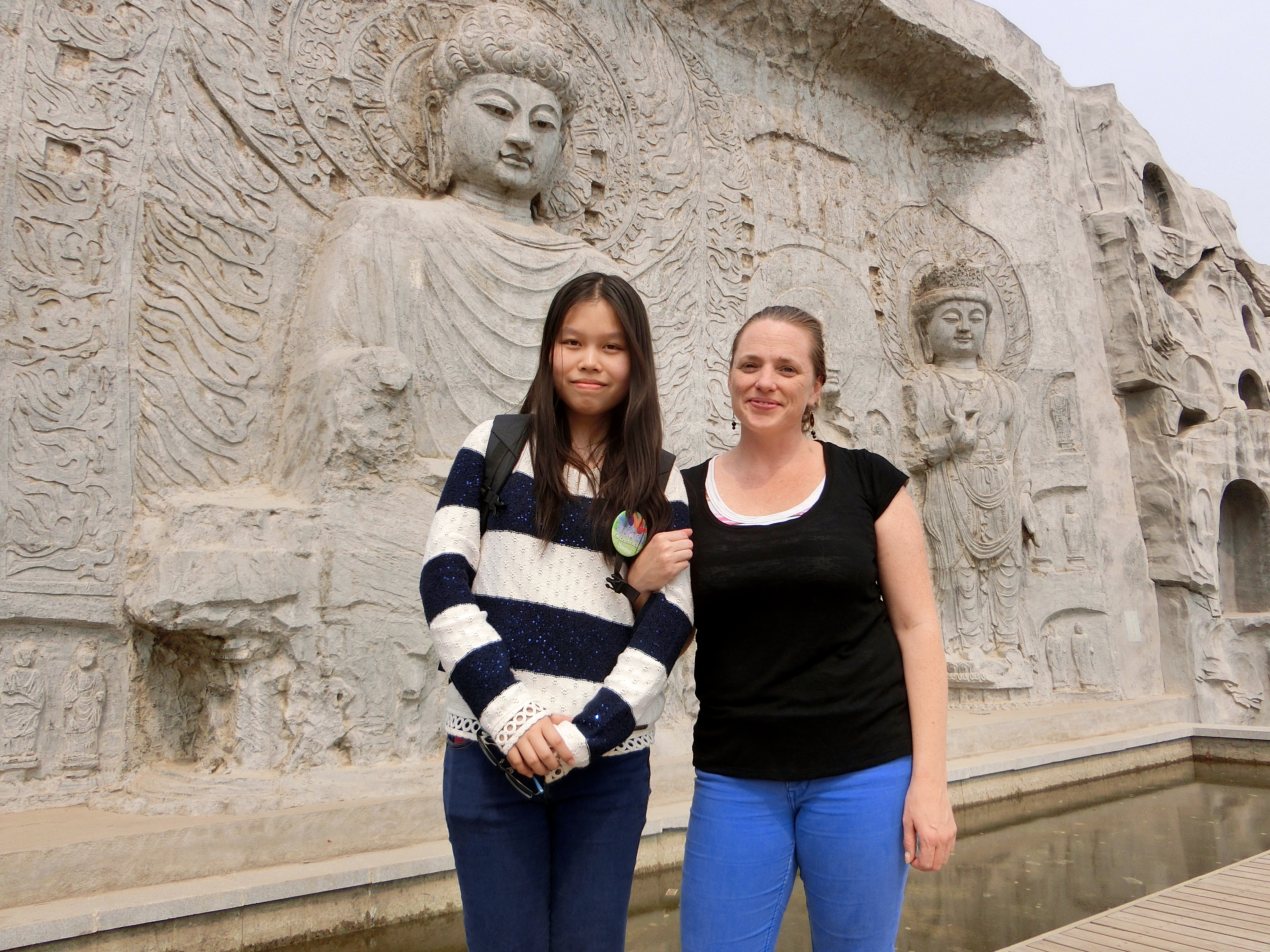
My student and I at the fake Longman grotto.
My student and I at the fake Longmen grotto.

Can’t visit Luoyang? No matter you can find the Grottoes here. Don’t have time to see the Iron Pagoda in Kaifeng? It’s here. You’ll never find yourself in Anyang? You guessed it, it’s here too. In fact, if you want you can see a part of the Great Wall here too. If you get tired of China you don’t ever have to leave the park because around the corner you will find Egypt right next to Greece, (of course) and all of Africa encompassed in two statues, and right next to Africa you’ll find Australia, exactly where you’d imagine it to be. The main highlights of the park were physically being there and kind of wondering why; discovering the pretty offensive perceptions of Africa (or maybe some island places?), the aged look of the park when it was only a couple of years old, having a water gun war on paddle boats, a Chinese man assuming I was a Christian because I am white/foreign and handing me his Bible to hold as he bowed to me several times, watching the multitude of wedding photography, skipping rocks with my students on a fake lake that had a water show, and spending time with students and teachers in a place that would and can only be experienced once in my entire life.

Fake Africa
Africa? The Polynesian Islands?

Fake Australia

Greece is only a pathway away from Egypt.
Wedding Shot
One of many couples getting their wedding shots which are a huge part of the marriage.
She hadn’t yet learned to skip stones.

If you want to see a few more photos from this theme park you can find them on my blog Simple.