Hiking Hàushān China’s Sacred Mountain: Taking the Train to Shaanxi Province Part. 2

This is part. 2. If you’d like to start at the beginning follow this link here.

No Joke, China is Crowded

There are things that I experienced in China that I will never experience anywhere else, except perhaps India, and much of this has to do with the sheer numbers of people. At every event, walk, exploration, eating and imbibing, every experience beyond the doors of your home or your work is shaped by the size of the crowd.

Americans have no idea how much space we have. We do not really know crowded. When I had moved to South Korea, other Americans would complain to me about how crowded it was in Seoul. I would think to myself, “sure its crowded“, but it isn’t China crowded. Of course, a place in America can be crowded, or the roads can be busy, and one may think that there are too many people, but imagine never getting away from the crowd. Every public space is a music festival without the music or the celebrity. I’d never experienced anything like China before or since ( I’ve never been to India) and time has faded much of my daily memories, but when I think back on my time there, I mean really think back, I can remember that I had experienced culture shock.

It was too much. Too many lights, too much pollution, too many cars, too much sound, too many people. Sometimes, I didn’t want to go outside even though I needed food. It felt otherworldly at times. As much as Chinese people would look at me as being an outsider and perhaps think I was odd in how I went about my life, I sometimes looked at them like they were mad. I would witness things that seemed beyond my comprehension. Like a man on an e-bike stacked with bricks driving against one way traffic, or fifty-plus people all scrambling to get onto a bus that was still moving. I would argue that much of the “madness” which was only my perception, was due to overcrowding. However, near the end of my time in China, my culture shock had turned into a phrase; “only in China.”
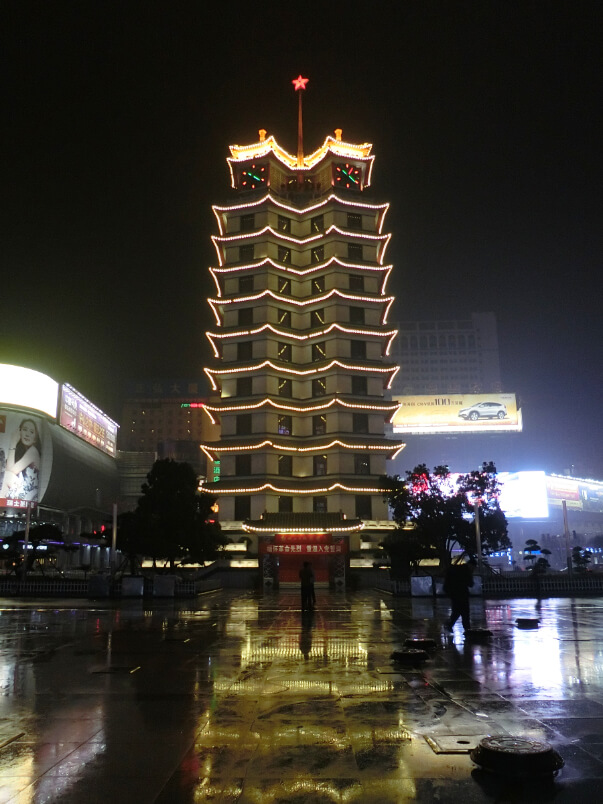
A photograph of Erqi Tower in Erqi Square in Zhenzhou, China.
Erqi Tower in Erqi Square, Zhengzhou, Henan, China.

Erqi Square

The night before the hike, Sho Boa and Xiang Kai met me at my apartment around 10:30 p.m., and from there we caught a bus to the central train station in Zhengzhou. We arrived near Erqi Square (pronounced Archie) around 11:00 p.m. Our train was scheduled to leave at 1:00 am, so we used the time before departure to shop for snacks for the trip and the hike.

Erqi Square buzzes with people all hours of the day and night. In the center of the square is Erqi Tower or Erqi Memorial Tower. Erqi means February 7th, and the square, district, and tower are all named after the Erqi (Feb. 7th) strike that occurred in 1923. The tower is two conjoined fourteen stories pentagon shaped towers that look like thin pagodas with a five pointed red star at the top. It stands out as the only building of Chinese architecture with sweeping eaves that curve up at the corners. At night the tower is lit up and competes with all the other lit up buildings. Zhengzhou is never dark at night. We wandered around the square posing in front of the tower and taking pictures in the light rain to memorialize our upcoming adventure. After taking photos we wandered into the station.

Two friends in China posing in front of Erqi Tower in Zhengzhou.
Xiang Kai and Sho Boa in front of Erqi Tower, Zhengzhou.

Zhengzhou Central Train Station

Zhengzhou’s Central train station is a national hub and considered the busiest station in China, which is saying a lot. To put it mildly, the place is crazy. The station is part of the Beijing-Guangzhou Railway and Longhai Railway, which means that if you are taking the train to anywhere in China, you will most likely transfer in Zhengzhou. The place is a nightmare, especially during the day. Aside from the overwhelming throngs of people pushing, shoving, and running through the station, and the difficulty of the language there’s the bathrooms. On this particular visit I was with two Chinese friends who took care of the language obstacles, and it was 1:00 p.m. when our train was to arrive, so the crowds were less in between arrival and departure times. However, the bathroom, I had to contend with on my own. It’s been nearly ten years since I have been there so chances are things have changed, but I wouldn’t be surprised if the bathroom was the same.

The Bathroom

China (at the time) still uses pit toilets and squat toilets. There are places with sitting toilets, but many, many places use squat toilets. This in and of itself isn’t too much of an issue. You can get used to it, but the toilets in the train station were something else. The station has what is called long-drop toilets, and they are communal troughs meaning no doors. They did have dividing walls, so I didn’t have to squat right next to a person, but there were no doors, so there was no privacy.

To use the toilet I had to stand with my feet on either side of the trough as a river of piss and shit flowed under me toward what I assumed to be an exit into a sewer system. I absolutely hated using this bathroom, not only because it was dirty, and I was never good at squatting, but the lack of privacy was my biggest issue. Since I was a foreigner in China, I experienced a lot of staring and this did not stop when I was using the toilet. There were times I felt like I was an animal in a zoo, and my experience in the Zhengzhou station was one of those times.

Not every person that walked by would stare, but the few that did would strain to look at how I actually peed, as if they were wondering if I had the same parts as them. It may have been only two women that did this to me as they walked by, but one was enough. Why would the bathrooms be like this? My guess is that it is easier to clean. Bring in some power washers and spray the whole place down. But when squatting over a trough, trying to keep balance without touching the dividing walls and straining to hold my knees together so that a stranger walking by can’t stare at my vagina as I peed was just the beginning of this trip. A trip that I thought was going to be a spiritual grief healing experience.
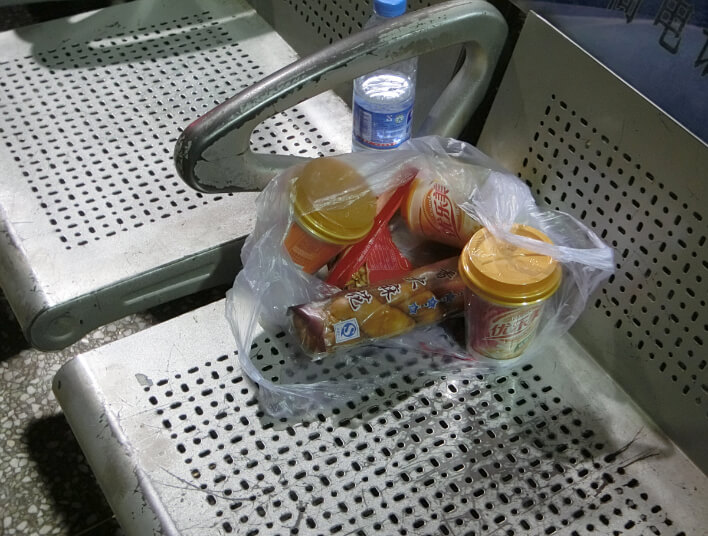
A bag of Chinese snacks on a chair in the Zhengzhou train station.
Snacks for the hike.

Differences in Thought Process

At the mini market Sho Boa picked up some dried noodles, chicken feet, and some hardboiled eggs. We also grabbed some instant porridge and instant coffee along with some water. I wanted some trail mix but wasn’t able to find any. I was concerned that the food we had wasn’t going to be enough sustenance for such a huge hike, but Sho Boa insisted that this was what him and his college friends ate when going on hikes.

“In China this is what we bring to eat on a hike.” He said.

I had to take him at his word. We argued a lot in the store as to what would be the best to eat, but I acquiesced telling myself I was having a Chinese experience and I needed to embrace it. Although my gut was telling me this food was not going to be enough to fuel me. It isn’t always easy to have an authentic experience of a culture that is new and foreign to you, no matter how easy it looks in the movies. So, Chicken feet it was.

The Cheapest Train

As I had said before: Every event, walk, exploration, eating and imbibing, every experience beyond the doors of your home or your work is shaped by the size of the crowd. Every national monument, museum, park, train, pilgrimage, and hike is shaped by the size of the crowd. Money will buy you space, but you need a lot of money, and we didn’t have a lot of money, especially Sho Boa.

Since Sho Boa didn’t have a lot of money he insisted that we take the cheapest slowest train. Xiang Kai and I were teachers, and we had a livable salary, but Sho Boa worked as an office assistant; a runner. The bosses were always telling him to run and get this, run and get that, run and go there, run and go here, and they did not pay him well. I could understand that lack of money would prompt him to choose the cheapest train. However, I suspected that even if he had money, he would still have insisted we take the cheapest train.

What makes the cheapest train cheap are its number of stops and rate of speed. At the time, I was clueless about exactly how slow a slow train was. I knew it was an overnight train and that it would take 8 to 9 hours to get to Huàshān, but I was not aware that a faster train would get us there in 3 to 4 hours. I also was not aware of what the traveling conditions on the train would be like. The idea was to sleep on the train and then to start our hike in the morning. I was fine with an overnight train, but Sho Boa bought regular seats not sleeping compartments, again to save money.

The interior of the Zhengzhou train station after midnight.
Zhengzhou Central Station after midnight.

A Crowded Train

I did not sleep on the train for multiple reasons. Number one, the train was packed. On the cheap trains, once all the seats are sold, they continue to sell tickets, and the prices for standing are the same as the prices for seats. So there are people standing in the aisles for up to eight hours. People are crowded in the aisles leaning over the people in the seats all waiting for the moment when someone gets up so they can take the open seat. There is no space, and no fresh air, and if you do get up to use the bathroom you have to climb over people crumpled in the aisle way. When you return you have to argue with the person who took your seat to give you your seat back, which they will do, but they certainly don’t want to give it back, and I can understand why. They paid the exact same amount as you. People are constantly switching seats around every time someone leaves in the hopes that they can sit for a couple of minutes. When you are sitting you have people leaning against you or over you.

We were in a section of six seats. Two rows of three facing each other. Shawn and I were able to sit across from each other but Xiang Kai had to find a seat somewhere else on the train. I am bigger in size than your average Chinese woman, but I am also smaller in size and sometimes width of your average Chinese man. All the seats were occupied by men, sleeping men who were man spreading like cheerleaders doing the splits. These men took every inch of space available leaving me with very little room, and since I did not have the Chinese power of sleeping in impossible places, I was awake for the entire 8 to 9 hour train ride. I was the only foreigner and only white woman in the car, and quite possibly the train. In these situations I would often encounter staring and some people would sneak or blatantly take my photo, but at 1:00 in the morning on a crowded warm train, no one cared about me, other than the fact that I was sitting and my seat was valuable.

When we left Zhengzhou it was crowded with all the seats occupied and some people sleep-standing in the aisles. Once we reached Luoyang, it became more crowded and people were nearly sitting on top of each other. One man slept precariously balanced on the top of my seat and draped over me like a throw blanket.

At one point, a group in the section across from us, who all seemed to be traveling together, had people sitting on top of the backrest. They were laughing, and loudly playing a game, and watching programs on their phones at full volume. Sho Boa who was sitting across from me leaned forward.  Thumbing his hand in their direction he said, “Look at them. What do they think they are in? Their house?” He gave them a brief scowl and then quickly feel asleep. I watched him slumber with an envious anger and an incredible urge to kick him awake so he could suffer like I was suffering. Xiang Kai was in a separate car, but had mentioned he had managed to sleep.

Packaged chicken feet in a convenient store in China.
Packaged chicken feet.

Huanyin City, 7:00 a.m.

When we arrived in Huayin City at 7:00 in the morning, I had not slept one wink. Exhausted, I followed the two rested men to hike a mountain peak, that unknown to me at the time, was 7,000 ft.

We had boarded the train around 1:00 am and arrived around 8:30 a.m. We took a taxi from the Huayin station to the village at the base of the mountain, and finally began our hike around 9:00 a.m. We had three large bottles of water, some strange meat paste, a few bready bits of snack food, and a bag of spicy chicken feet.

I was hungry, exhausted, and irritable due to lack of sleep, but I was also very excited. I was about to hike Mt. Hua, China’s most dangerous mountain. Did I know it was considered the most dangerous mountain to hike? Kind of. Word to the wise from the foolish: Do your own research.

Check back for part 3.

Hiking China’s Sacred Mountain Hàushān: A Journey to Healing Grief, Part. 1

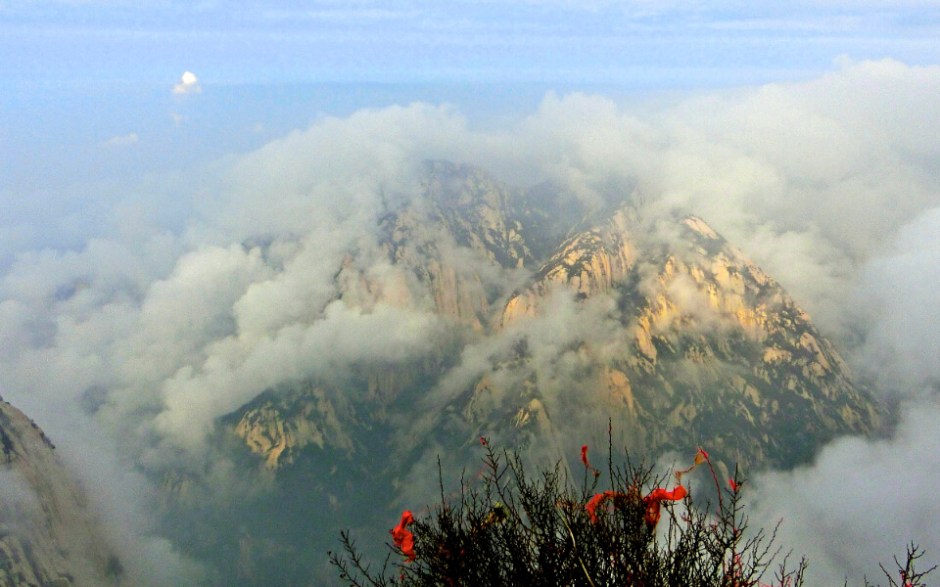
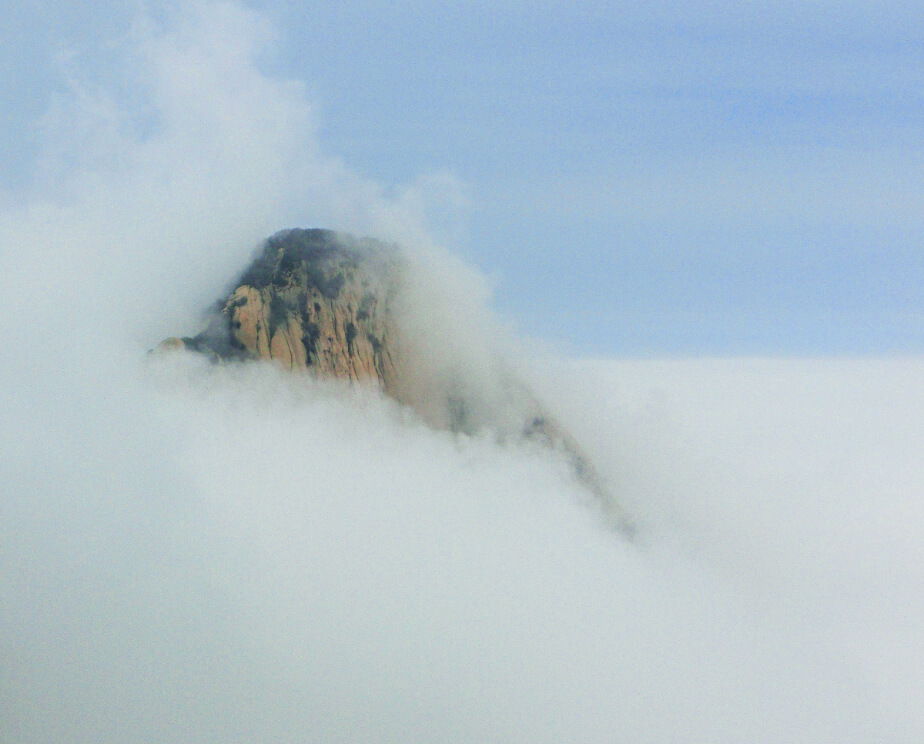
Huashan mountains viewed through the clouds.
Hiking above the clouds
It took us another eight hours of climbing vertical steps through damp vertical caves and along precarious edges of steep cliff sides. Sho Boa was our guide. He wanted to race to the top of the mountain, often criticizing Xiang Kai and me if we wanted to sit for a moment, or if we were moving too slowly. I was grateful to have Xiang Kai on my side. 

Sho Boa claimed he was the true hiker among us. He was climbing the mountain to defeat it. His desire to reach the peak and reach the bottom in the fastest time possible meant he was a conqueror. I’m not this person. I wanted to sit and reflect and bask in nature and observe the multitudes of people around me. I wanted to meditate and reflect. Mt. Hua was one of China's 5 sacred mountains. I wasn't from China, and when would I ever be back? I wanted to absorb it all in, but between the enormous crowds and Sho Boa's constant insistent pushing, hiking Hua Shan felt more like a military drill than a joyous hike. I didn’t know what was going on in Xiang Kai’s mind except that he wanted to stop and sit as much as I did. From time to time, Xiang Kai would shoot me look of irritation and disdain. "Ignore him," he’d say, "let’s sit, make him wait."

My Mother Died While I Was Teaching in China

It isn’t easy to lose a parent under any circumstance. Whether you lose them when you are young, or when they are very old. Whether you lose them to a long lingering illness or to a sudden accident. Each type of death results in the same thing. Your parent is dead and death is for the living to deal with. If I could have chosen how my mom died, I would have picked that she lived at least to her 80’s, and that she had a full joyful life, and that old age had finally decided that it was time for her to go. I would have sat beside her, holding her hand, telling her that I was going to be fine and that she could let go. That’s what I would have chosen. We don’t get to choose.

My mother was found dead on the floor of her bedroom. I wasn’t at her bedside. I was in China getting ready for my classes when I checked a Facebook message telling me to Skype a friend of hers: “that it was important”. Her life had been difficult and full of heartbreak, loss, grief, and addiction. Her greatest fear was to die alone and that is exactly how she died. The death certificate said it was a methamphetamine overdose. My only sliver of consolation regarding her death is that it may have been quick and painless. I hope she didn’t have a moment to know she was dying, so that she didn’t know she was alone at her death. We don’t get to choose. We get what we get.

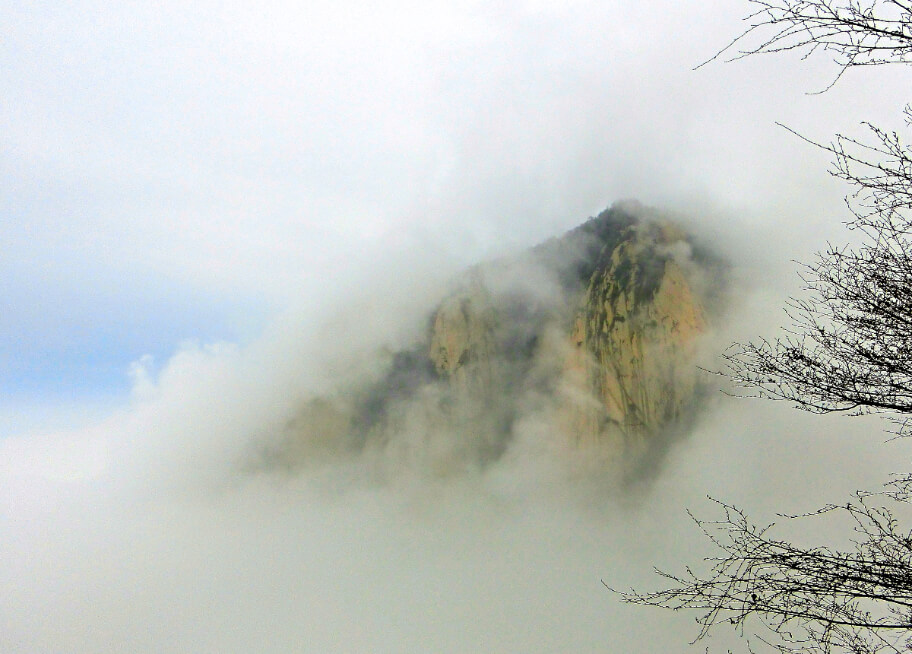
A peek of a mountain top through the clouds from 1,000 meters up.
1,000 meters halfway point to the peak.

Invited to Hike Huashan

The Five Sacred Mountains

Located in Shaanxi Province, not too far from Xi’an (place of the terra cotta warriors), Huashan is the Western Mountain of the 5 sacred mountains of China. The five mountains are Taishan (泰山), the East mountain in the Shangdong province; Hengshan (衡山), the South mountain in the Hunan province; Hengshan (恒山), ( not a mistake it has the same name in pinyin, but is different in Chinese) the North mountain in the Shanxi province; Songshan (嵩山) the Center mountain in Henan province; and Huashan (華山) the West mountain in the Shaanxi province. During my first month in China, I went to Sōng Shān while visiting the Shaolin Temple, but at the time I was not aware of the mountain’s sacred significance.

There are many sacred mountains in China for example Buddhism has four of its own sacred mountains, and Taoism also has four of its own sacred mountains. All of these mountains have been places of pilgrimages throughout Chinese history, and are the subjects of many paintings and poems. The Five Sacred Mountains, also called The Five Great Mountains, have been connected to imperial pilgrimages performed by Chinese emperors. The mountains are connected to the Supreme God of Heaven and the Five Highest Deities. Which may explain many of the stunning temples and hermitages built on the side of Mt. Hua.

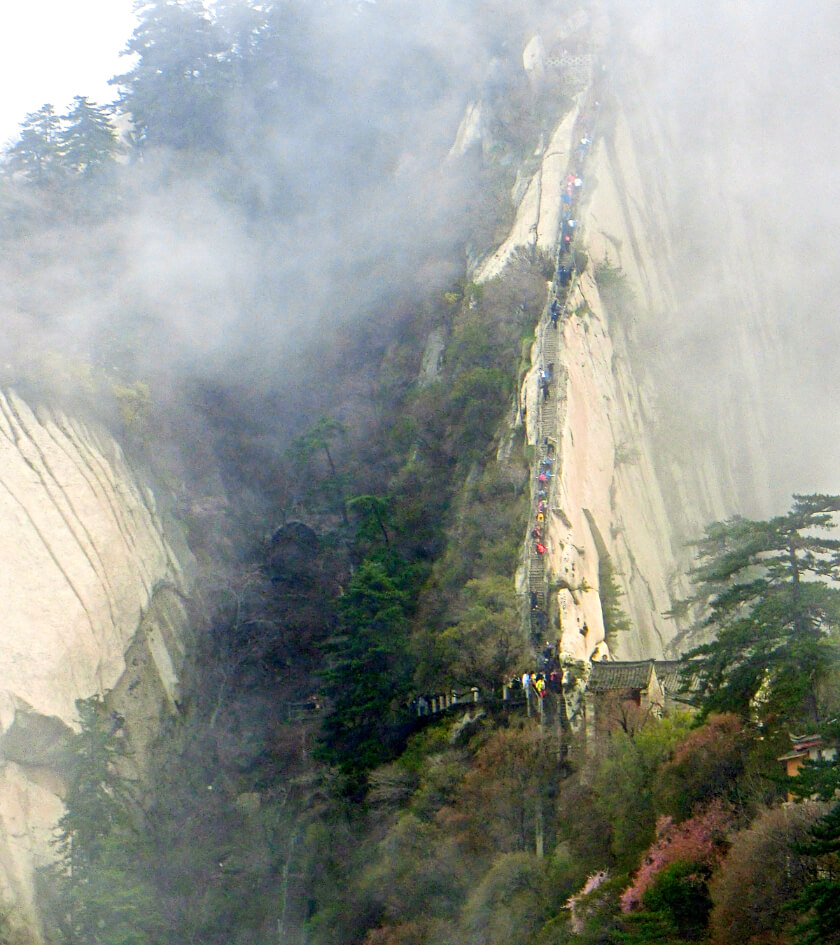
A view of the path on the western mountain of Huashan.
At 1,000 meters. If you look carefully you can see people walking on the blade of a mountain pass.

HuaShan

Huashan, Huà Shān, Hua Mountain, Mount Hua, and “number one steepest mountain under heaven”, however you say the name, it is all the same glorious mountain. Huà in Chinese means flower and shān means mountain, so the literal translation is flower mountain or 華山 flowery mountain. It is said to get its name from the five mountain peaks that look like a lotus flower.

Huashan was close enough to travel to in a day, but proximity does not equal facilely. Its reputation as one of the five sacred mountains is “China’s most dangerous”. It’s difficult to find exact numbers as to how many casualties and deaths may have occurred on Mount Hua, but after my own experience hiking it, I can assume that the number could be relatively high. Sho Boa said that you can’t find any numbers because the government doesn’t want the public to know the casualty rate because they don’t want to deter tourism. I don’t know if he meant city, provincial, or country government, but with the sketchy conditions, and population of inexperienced climbers (myself include), and the trash left behind, a little negative advertisement might be a good thing.

My Own Sacred Pilgrimage

As an outsider to China, it was easy to attach myself to the romantic connotations associated with ancient Chinese traditions. Taoist beliefs and Buddhist rites of passage have a mystic allure to a foreigner like myself. It was easy to imagine myself like the female version of Brad Pitt in Seven Years in Tibet or Bill Murray’s, Larry Darrell in The Razor’s Edge.

I envisioned myself reaching the peak of the mountain. In a moment of reverie sunlight breaks through the clouds or rises over the crest. I am filled with a sense of peace, gratitude, and a higher understanding of what life is about. Questions as to why we are here, and why I am here are answered. Then I feel a dawning acceptance of my mother’s death. I understand why she died like she did, and why I wasn’t able to save her. I know that death like life is beautiful.

Sadly, but not surprisingly, I did not reach this zenith of enlightenment. I was not awash in answers. I was achy and irritable. In fact, in retrospect, the entire journey from the city to the peak and back was farcical. I was more like John Goodman in the Big Lebowski than anything else, or The Dude maybe. Perhaps my journey was to feel exactly what I felt; achy, despondent, irritable, depressed, frightened, exhausted, in pain, befuddled, grieving, and longing for my mother to be alive. Of course, before the hike I didn’t know I was going to feel anyway other than joyful; and whatever enlightenment feels like.

A bright red prayer ribbon tied to budding blossoms on trees.
A wish for peace

The evening we were to leave, I poured some of my mom’s ashes (that I had brought with me from America) into a small box and put them in my backpack. If I made it to the peak then I would leave that little part of her there on that mountain top. It would be the closest I’d ever get to the stars. If I made it.

I read that it was a dangerous and steep hike. The highest mountain I’ve ever hiked. At least up to that point. I wasn’t sure which peak were were going to tackle, but Sho Boa insisted he had it all figured out, so I packed my bag, and waited for Sho Boa and Xiang Kai to meet me at my apartment. Our overnight train was at 1:00 a.m., but Sho Boa wanted us to get there around 11:00 p.m. so that we could pick up some snacks for the trip.

I had no idea what I was in for, but again, in retrospect, if I had a better idea of what was ahead of me, I would have taken a nap.

Continued…

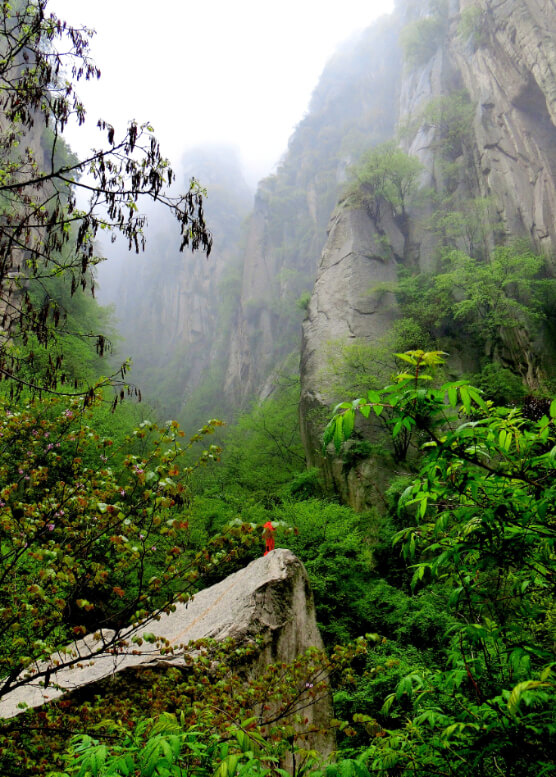
Sharp mountains reach toward a gray sky. Bright green foliage grow around stones.
Base of Huashan

Transitions -This Title is Not for Your Algorithm

Sunrise behind the trees in East Machias, Maine.
East Machias Sunrise

Change is hard. They say. The great “THEY” say that it is even harder as you get older. When it comes to changing a physical location, you can say, I’m an expert at it. Only the physical move, though, everything else does seem to be getting harder.

In the past year my husband and I have moved from South Korea to Maine and then to Portland. It wasn’t that streamlined though. It went more like this: We moved from our place in Itaewon, Seoul in July of 2023, and spent two weeks driving around South Korea visiting places like Gyeongju, Namhae, and Incheon.

We had some confidence at this time. My husband had a job waiting for him in Maine, we had a savings, and I had my pension. The evidence of 7 years of teaching English in South Korea.

I am the reason we left South Korea. I had been ready to leave Korea since 2017. My first few months of teaching had been a bad experience with a bad company and a terrible school principle. The Korean staff was great, the other teachers were great, but the “boss” was terrible. A dishonest and manipulative person who treated her Korean staff far worse than the foreign staff. I heard she had finally been fired for embezzlement. It may have been a rumor how she was fired, but she was fired. However this was a few years after I had left. As a foreign teacher in South Korea you are housed which is part of the draw, but the type of housing you get has a lot to do with who employs you. My housing was abysmal, but I knew of people who had worse. I quit that job, breaking my contract within the first 90 days of my employment which was within my contract, but the “boss” requested I stay for at least 6 months claiming it was that difficult to find a replacement. I agreed, which I should not have done since later it stabbed me in the back. I wont go into the boring detail, but needless to say, I did not receive my final paycheck. Luckily, I did get the coveted Letter of Release allowing me to find work elsewhere. My next job and the job’s after were better, but I had a bitter taste in my mouth. Months before meeting Eun, I had already decided to leave Korea.

Seven Years Later

Things change. You meet people. You fall in love. You get married. You have a pandemic. Your parent gets sick. Your dog almost dies. Things happen.

Once things began to reach a base level once again, Eun and I decided to leave South Korea. Again, a lot of it was me. I never did pick up the language, and my chance of finding a job outside of teaching was low. I did manage to get a writing gig for about two months, but they stopped accepting contract writers. I was disappointed, but that is how it goes. I had hoped maybe to find another writing gig, but nothing so far has panned out. My idea was, “let’s go to Portland, OR. I have friends there.” Yet, Eun didn’t feel comfortable with that. He needed a job first. After all, that’s how normal people do it. Job first. Move second. I never worked that way. Move then figure it out. My way is more difficult and scarier.

He got the job in Maine. So we left Itaewon and did our road trip. Flew to Washington state on July 17. Spent two days in Seattle. Two weeks in Portland. Got a car loan. Bought a car using the loan and some of my pension money. We took a trip to California to see my dad. Then back up to Oregon to visit the gravesite of Sue and then we drove across the country passing through Idaho, Wyoming, Montana, Wyoming, South Dakota, Minnesota, Iowa, Illinois, Indiana, Ohio, Pennsylvania, New York, Vermont, New Hampshire, and finally Maine. We even stayed the night in some of those states.

For ten months we lived in a dorm with international students. We lived in downeast Maine in a rural little town named East Machias. Eun worked as a Health and Wellness teacher, a Freshman Basketball coach, and a dorm parent while I tried to reinvent myself. I took online courses through coursera trying to learn UX design. I went back to my novel that I wrote over 10 years ago, but never published. I looked for remote work online. No one wanted to hire me except online tutors. I had no transferable skills. I started teaching in 2013 as a means to travel, but it now identified me as a teacher with no other career potential. If I were younger would it be better? I don’t know. The nearest grocery store was always hiring, but it was 5 miles away. I didn’t have a license, Eun worked full time, and there was no public transportation. It took me 8 months to get my license due to logistics. I loved the beauty and nature of Maine, but I wanted to leave for a similar reason as to why I wanted to leave South Korea. I wanted opportunity to grow.

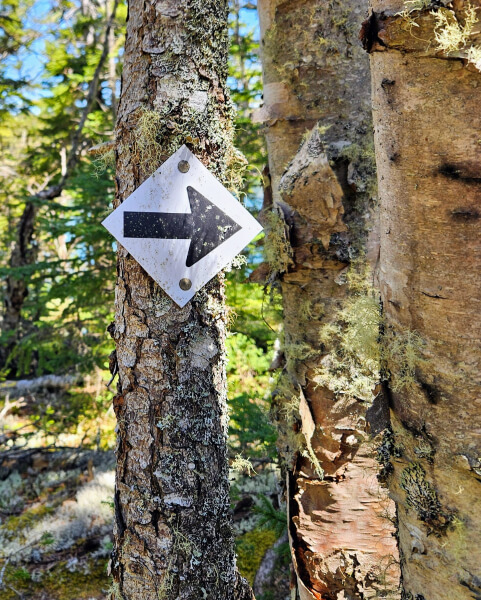
An arrow sign nailed to a tree.

Why is it that I couldn’t find some way to be creative while I had all that freedom and time?

Poor mentality. I wasn’t lazy. I worked daily. Keeping the apartment clean. Making every meal. Laundry- the daily duties. I was writing, drawing, learning, reading and attempting to educate myself in every way possible. I was also looking for remote jobs. I even restarted my YouTube channel (which has grown a bit) but I have a poor mentality. I was never fully able to just do art or learn or be committed to being creative because I wasn’t contributing financially. I never sent my work out (writing) because I never believed I could be paid as a writer. I could never be paid for anything creative. It wasn’t for me. I was not meant for that world.

I still suffer from this thinking. I assume I will die with this mentality. It is tough to unlearn.

10 Months Later

We left East Machias on June 18th, not even a full year since we left South Korea. We packed our life into the car once again only this time we had no savings, no jobs, no home, no prospects. Eun trusted me this time, but this time I felt unsure. Very unsure. Once again we drove across America. We passed through many of the same states minus Indiana, Illinois and Iowa, and we added Michigan and Wisconsin. We had less money and more time. You could say we were foolish. If things fail you can say, “you deserve it.” If we succeed you could say we were adventurous. It is all determined by the outcome even though it shouldn’t be.

Eun is a basketball player and a coach and he found an opportunity to grow as a player and a trainer, so we spent a week in Michigan so that he could participate in this program. While in Michigan a violent windstorm passed through and a large branch broke from a tree and flew into our car damaging the passenger side. I was distraught since we hadn’t even paid for the car yet. Eun, who is more positive, reminded me that we have insurance. Still, the cost of the program, the cost of staying a week in Michigan and now the cost of the car was weighing on me. If things fail it’s my fault. That’s what played through my mind. Still we continued to make what some people may call bad choices. We kept moving forward with our travels. Staying in South Dakota to visit the Badlands and Deadwood. You can watch our journey on Youtube if you are so inclined.

We moved forward with our plan to stay in Cody, Wyoming as we visited Yellowstone, and then stayed in Montana to see Yellowstone for a few more days. We lost money having to change places to stay. One we had to change because of floods that hit Minnesota and South Dakota. We had to cancel camping stays that were meant to save money because we finally accepted the fact that our dog can’t camp. We spent more money on airbnbs because our dog needs space away from strangers and other dogs. We continued on to stay in La Grande so I could once again visit the grave of my friend Sue and to see her sister whom I hadn’t seen since the funeral 16 years ago.

Portland, OR

At the moment of writing this we have been in America for 1 year and 1 week. We have been in Portland for nearly 3 weeks. We don’t have jobs. We don’t have much money. Our car is in the shop. We have a place to stay for about two more weeks, and Eun has two more paychecks before we have nothing. We are in debt, too. We began applying for jobs our first full day in Portland. The first week was silent. Then the second week rejection e-mails and automatic rejection responses came in. Then at the end of the second week, we began to get phone interviews. Eun had some in person interviews. Our emotions which are tied to our fears and anxieties ebb and flow like the ocean tides. We celebrate an interview, we try to shrug away the rejections, and we try to ignore the silence. Eun is applying for jobs as a teacher. He is moving forward with this career. Digging into his role as a P.E. teacher and a basketball coach. This next job is going to be the one for the next few years. We want it to be a good place. As for me, it is more difficult. I am trying to transition out of being a teacher. I want to work in an office with benefits. I want to create content. To be what the digital age calls “a creative.” But, it is difficult. I am having trouble breaking in and proving I can be worthy. The place I had volunteered for 7 years didn’t give me an interview after hanging onto my resume and communicating with me for a month, and I got rejected by Barnes & Nobles. Both, writing adjacent jobs.

Will this be a story of throw caution-to-the wind-adventure with a happy ending or will it be a cautionary tale? Only time will tell. Time will tell soon as the clock is ticking. As I line this final paragraph with cliches, I want to return to the introduction that change is hard. It is very difficult to change your career especially in a rapidly changing world. 10 years ago I worked in an office, I was an office administrator, but today I am no longer an ideal candidate. It is hard not to feel dejected when you have a poor mentality. This blog drips with pathos, but it is also held together with a tenacious web of hope and perseverance. I am making progress. Pages have been written. They may not fit the timeline of the meta masses but they fit my time line which is the duration of my life. So, we will see where this path takes me.

I haven’t forgotten part three of the Huashan hike it will be posted. One day. Till then enjoy these mushrooms. They are pretty, but not the kind to open your mind. You have to do that yourself. Advise to me from me. You can use it too if you want.

Four beautiful mushrooms growing in Maine.

An Uneven Homecoming: Reacclimating to America in a Maine Town

The Drive to East Machias

As we drove along the Maine coastline, passing all the quaint coastal towns with their Victorian homes and buildings, most of which were painted white, my excitement grew. Although I prefer more color in my communities, I imagined that we would be living in one of these little towns, perhaps a fishing village. During the interview, we were told that the school was near the ocean. However, there was a hint of reality, something we didn’t focus on or consider enough—the mention of a food desert. I think I had convinced myself that this bit of information meant that the school was not in a large town; maybe it was a village, similar to the villages we had passed on the way. It’s funny the things we tell ourselves. A food desert does not mean a quaint Victorian fishing village popular with tourists. It means scarcity.

At some point, a few miles past Rockland, we began to turn inland, away from the coastline and the old Colonial and Victorian houses. The road wound deeper into the woods, with birch trees lining the lone highway. Houses became few and far between, and after driving for another hour, we passed through the small town of Ellsworth. Despite its size, Ellsworth seemed to have all the essentials for a thriving community, yet it wasn’t our destination, so we kept driving.

As we meandered through the landscape, lakes shimmered beside us, reflecting the dappled sunlight. Each lake emerged like a glistening mirror, signaling coded messages through the trees. The subdued sunlight from the late-day sun cast shadows over the winding roads as we turned through sharp curves following many lakeside shorelines. What neither of us realized on our journey up Highway 1 was that we weren’t passing just lakes but inlets, estuaries, and coastal lagoons. DownEast Maine, where we were to settle for a year, is a series of glacial peninsulas stretching out like fingers reaching into the Atlantic. Occasionally, we would pass a lonely silent house, a solitary gas station reminiscent of an Edward Hopper painting, a tucked-away township with a church, and then, like a recurring motif, we would slip back into the woods, the warm fragrant pine filling the car with its scent. The rhythm of the journey slowly became predictable; after each glimpse of civilization, we’d dip back into the solitude of the woods, the quiet embrace of nature, and the hum of the car’s engine. My fantasies of a quaint seaside town with artisan shops and a tight-knit community began to fade, and I realized that I had dreamt of moving into a TV show, something like Schitt’s Creek. I had been daydreaming of a sitcom and not reality. However, reality was coming into clear view.

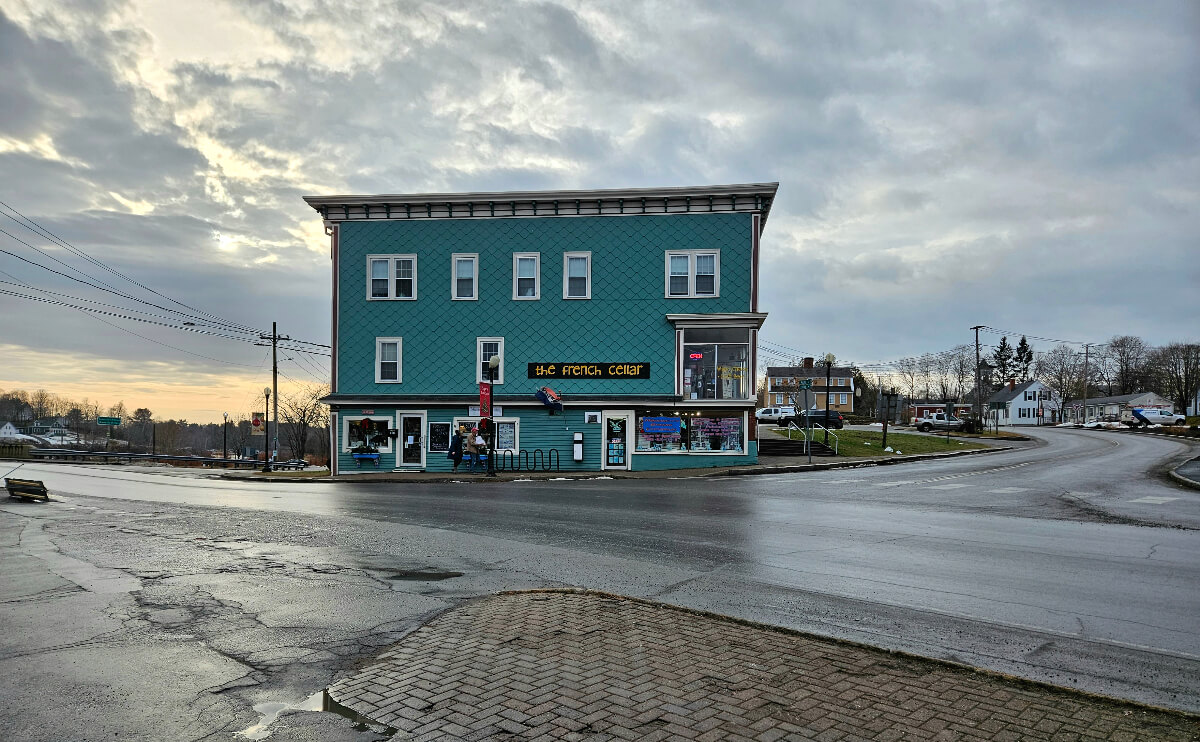
A single parrot green buiding sits on a four corner road. A cloud filled sky stretches out behind the building.

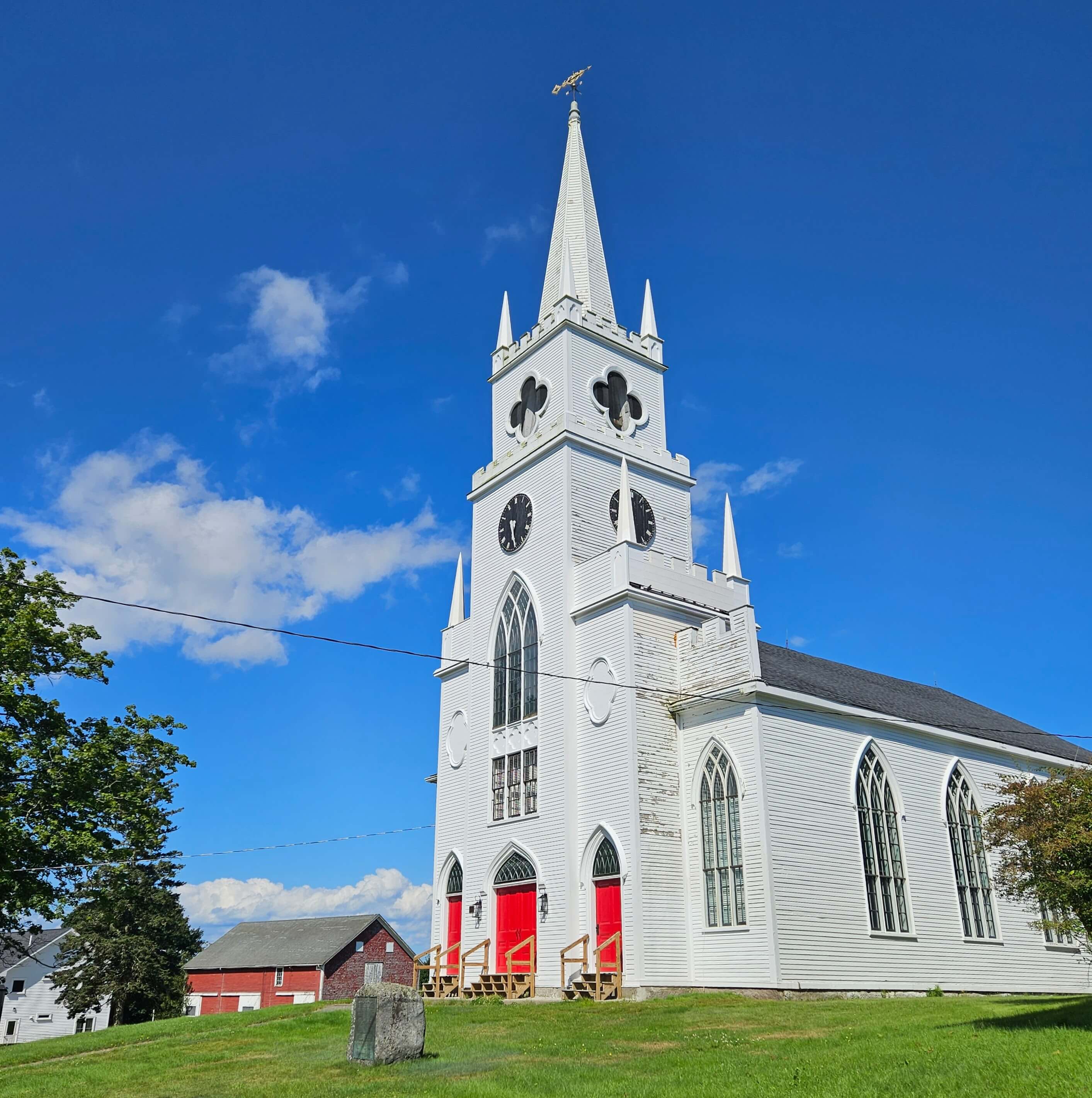
Upon entering Machias, we passed a weathered trailer park—a stark contrast to the captivating coastal imaginings—and I began to worry, not about safety, but about the economy. Was there enough affordable housing? What about jobs? Continuing our journey, sights unfolded before us: first a Dollar Store, followed by a Walgreens, a local grocery store, and the familiar golden arches of McDonald’s. Next, we passed a Family Dollar and other unassuming buildings nestled in a small parking center behind McDonald’s. As we continued over a hill, a dilapidated gun store with a large Trump 2024 flag came into view, followed by Machias University—a small beacon of education on a hill. However, Machias did not have the feel of a university town. Where were the restaurants, the cafes, the movie theater? We crossed a short concrete bridge built over a wide river with small falls, and then we drove through a downtown that was barely half a block, with two very cute buildings—one painted canary yellow and the other parrot green. To our left was a Federal-style bank, a church with a Gothic Revival steeple, and two gas stations. The hills to our right fanned out into the distance as the wide foamy river moved alongside us. To the left, we passed a Dunkin’ Donuts and a pizza place before slipping back into a sparse silence of space. Again, a house here, a small building there, until we were back into the woods with nothing but trees and warning signs about deer crossings. We drove on for another 30 minutes, the river remaining to our right and woods to our left, until we finally made it to the tiny town of East Machias. Not much of a town, really. It had some houses, a church with a graveyard behind it, a town hall, a post office, and a Salmon Federation Building. Some old colonial and craftsman houses lined the street where we were about to live, next to the school where Eun was to work.

A wide river with swirls of foam moves past a series of small house on lush green land.

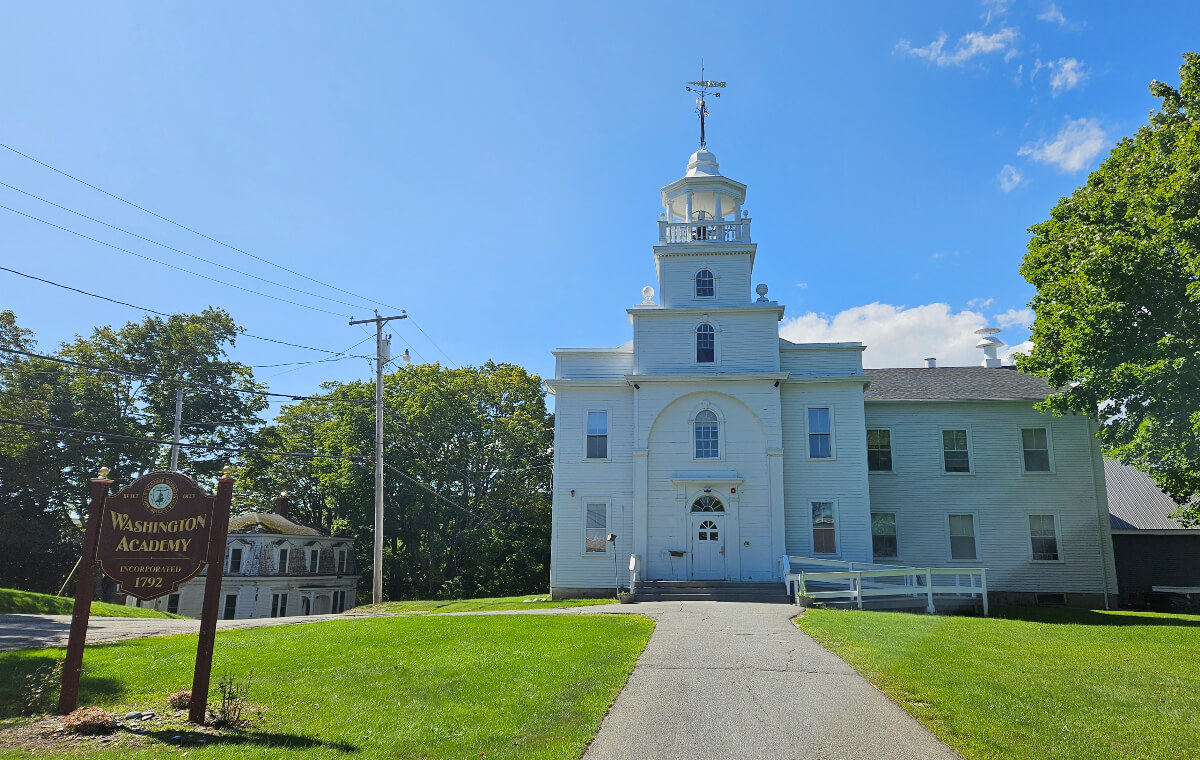
When captured in a photograph, parts of the town appear charming, especially along the East Machias River that runs through the center. In late summer, when we first arrived, eagles and hawks soared low in the sky or perched atop Eastern White Pine trees. If life were a photograph, East Machias would be a picturesque village along a rapid river with wildlife, fresh air, and a private academy built in 1792 featuring Greek Revival and Victorian buildings (plus a modern-looking high school). However, a photo is just an image, and what isn’t captured is the high unemployment and lack of opportunities.

As we settled into East Machias, statistics revealed a stark reality. This tiny town of 1,364 people is nestled in Washington County which ranks as the poorest county in Maine. The unemployment rate of 4.6% is a shocking contrast to the 3.2% statewide average, casting shadows on our newfound surroundings. It adds an undercurrent of economic challenges that we did not foresee. There aren’t many services, and, as one woman told me, ‘people move out here to get away from everything, but what they find out is that they have moved away from everything.’ It can be challenging in the case of a disaster like a severe storm. ‘Help comes late,’ as another local told me, ‘it’s as if they forget about us out here.’ The main industry is education; the second is health, and the third is public service. The top job is the school where Eun works, and this private academy employs and educates students from many surrounding townships. For a person, like myself, trying to get out of the education sector, especially the for-profit education sector, I did not come to the right place. However, Eun has found some opportunity, and in fact, it is the opportunity for him to teach and coach basketball that brought us here. I, on the other hand, am one of the 4.6%. Although, not in a census. As far as returning to America and starting over, we may have chosen one of the worst spots for dual opportunity and growth. I see no American dream here, but then again, does that exist anywhere in the U.S.? It isn’t what we had expected or hoped for, but for now, we have a modest roof over our heads, food in our bellies, and a backdrop of uncertainty. We thought our road was paved, but it seems that we turned down a dirt road filled with obstructions. At least one of us is employed. Eun’s dedication and resilience contribute to maintaining our stability as we drive this rough road of financial bumps.

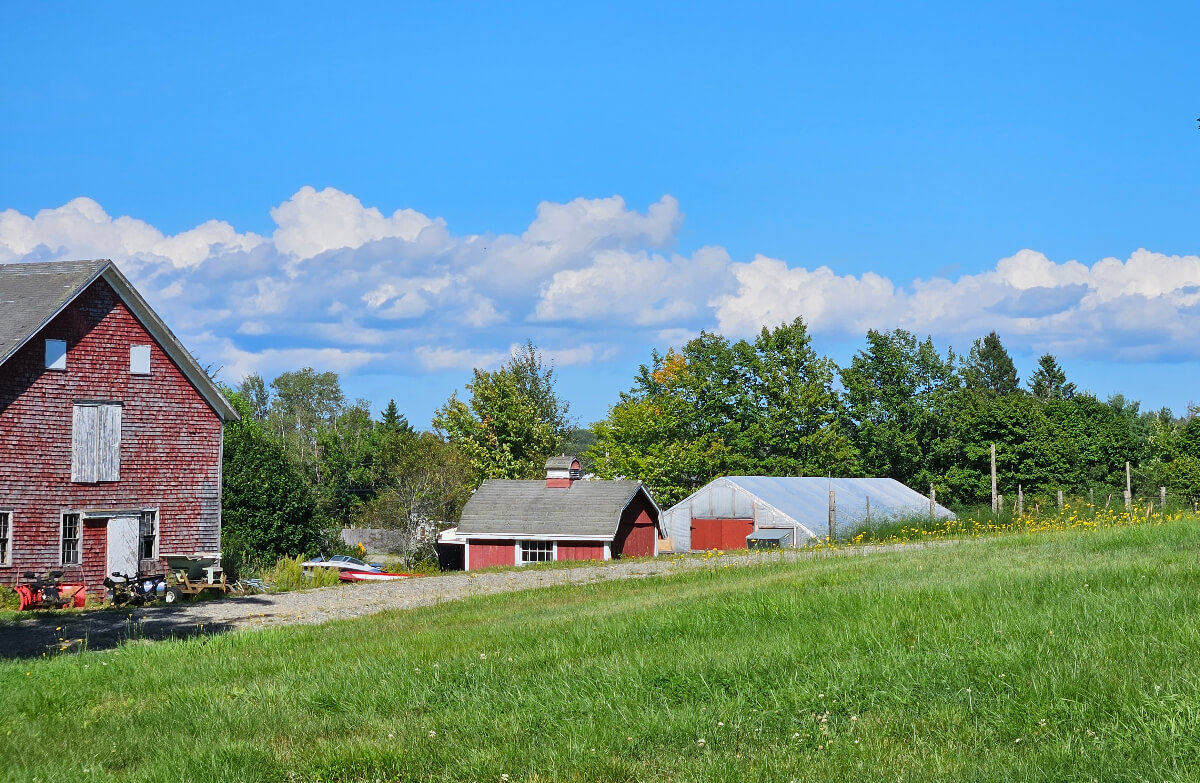
A weather burgandy farm house next to a small red barn style chicken coop. The sky is a vibrant blue with fluffy white clouds that contrast the bright green grass.

Returning to America after seven years has shown me that it is unexpectedly challenging to live here. In South Korea, the language barrier confined me to private education, and I sought to change this by returning to the U.S. Yet, in the U.S., the cost of living, along with lower benefits, and the exorbitantly high cost of health insurance, quietly undermined our expectations. It was foolish for us to think we would adapt with ease, even though we had considered the U.S. home. Still, I must have gratitude for the things I have in the present. It may be a mantra for the present, a protective shield masking an underlying fear of becoming trapped in ever-present poverty, but gratitude is necessary. We have housing, food, and internet, and for me, time has become a space for digital skill development—a journey into writing improvement, SEO, and content strategy growth. I find my own resilience and a renewed sense of purpose. This time will not be wasted.

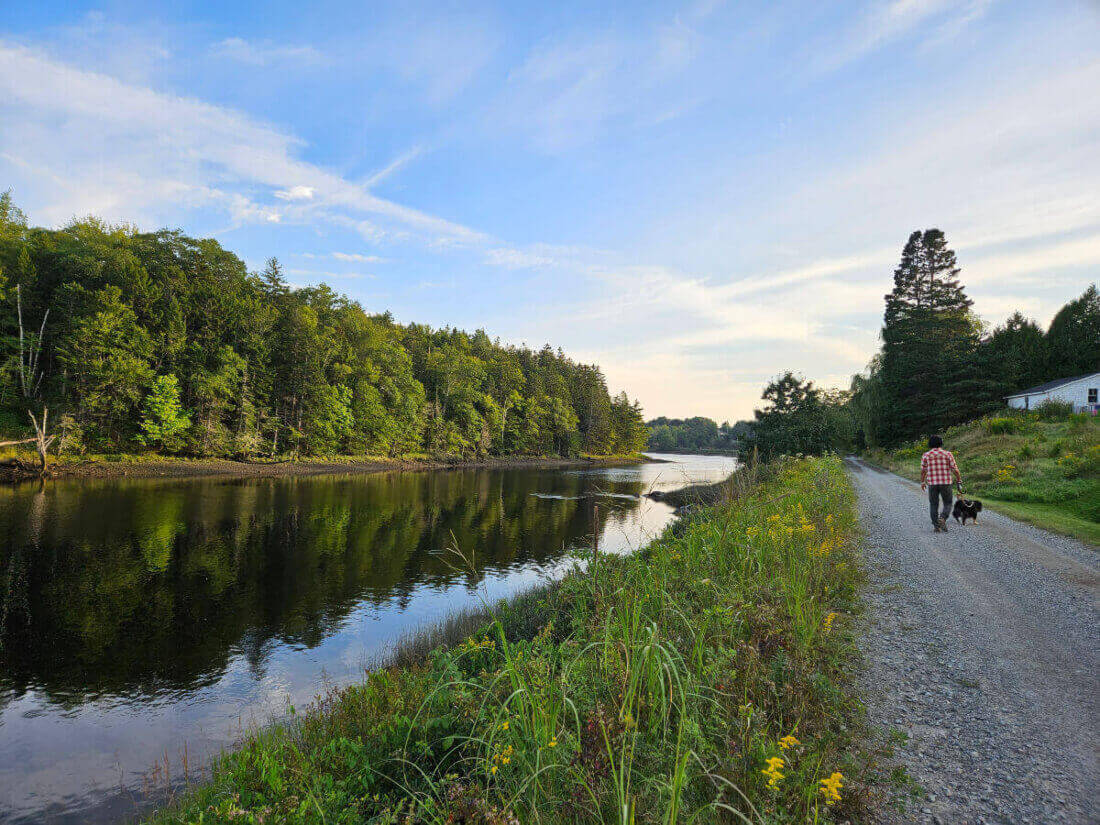
A man in a red and white gingham checkered shirt and dark jeans is walking a dog down a gravel trail beside a wide river. A small white house is to his right, and lush thick Balsam Firs, Eastern White pine, and Red Pine trees line the river.

There is a trail below the school, the Sunrise Coast Trail, that traces the river’s edge. This trail serves as our retreat; nature unfolds its tapestry of birds and trees, with inspiring views of the tiny town of East Machias. The river flows into Machias Bay that opens into the Gulf of Maine, where the Battle of Machias, the first naval battle of the Revolutionary War, took place. Yet, even before 1777, the Passamaquoddy people fished along this river, maybe paddling birch canoes in the neighboring lakes or bay. We are surrounded by natural habitat and history. Habitat that we can see and a history hidden in the motions of the present. While we take walks along this trail, we can see eagles, hawks, ducks, and plump little chickadees. The river and the pines frame East Machias like a photograph; a scenic bridge, the square white Albee—Richardson Hall with its small bell tower, and the Gothic revival steeple from the church rising above the pine and birch. It is lovely to look at, like a postcard sent from a friend. It is a reminder of the beauty that graces us.

A church steeple points up high above snow covered trees and a frothy river.

Every little bit helps

Choose an amount

$5.00
$10.00
$20.00

Or enter a custom amount

$

Your contribution is greatly appreciated.

Donate

Travel to Suwon City and Hwaseong Fortress

Suwon is south of Seoul, South Korea. It is about 45 minutes to an hour away depending on your choice of travel. It is the capitol city of Gyeonggi-do (경기도) or Gyeonggi province. 도 (pronounced Doh) in this context means province. South Korea has 8 provinces, 6 metropolitan cities that act as their own entities, a self-governing province which is an island-Jeju-do (here 도 means both province and island) and special cities like Seoul and Sejong. Sejong is a special autonomous city in South Korea which I don’t really understand, but its meant to be a second capital, or something like that. I never had the chance to travel there while I had lived in South Korea.

It took me about 4 years to figure out that Seoul is surrounded by Gyeonggi-do. This is because I used to live in Suwon, which is south of Seoul. I assumed Seoul was north of Gyeonggi province. Then while living in Seoul we took a trip to see the 5 Royal Tombs in Goyang in Gyeonggi-do which is north of Seoul. Suwon is south of Seoul and Goyang is north, yet both Suwon and Goyang are in Gyeonggi-do. It was very confusing until I finally just looked at a map. Basically, if Seoul and Inchon weren’t considered special cities they’d be a part of Gyeonggi-do.

When I lived in Gwanggyo, a city within Suwon, within Gyeonggi-do, it took about 40 minutes to reach Gangnam via the subway. During the weekends, I would often travel to Seoul to explore, so it wasn’t until a year after we moved to Seoul that we finally made it to the Suwon Fortress also called Hwaseong Fortress (Brilliant Fortress), also called Suwon Hwaseong Fortress. Why so many names? It could be because there is a city in Gyeonggi-do that is right next to Suwon named Hwaseong, and both cities which used to be farmland have grown so much over the years, and where the fortress was originally built has gone through name changes. It’s confusing, but to clarify, Hwaseong Fortress is in Suwon city not Hwaseong city.

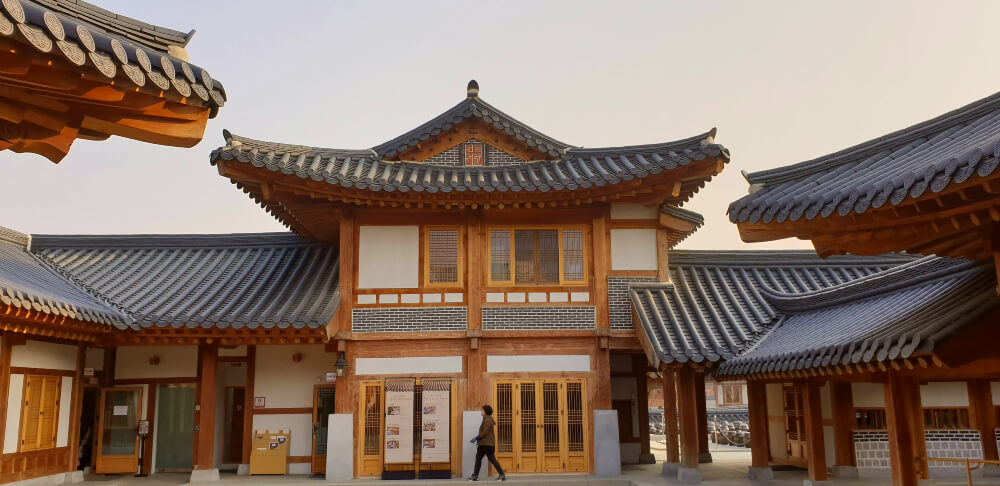
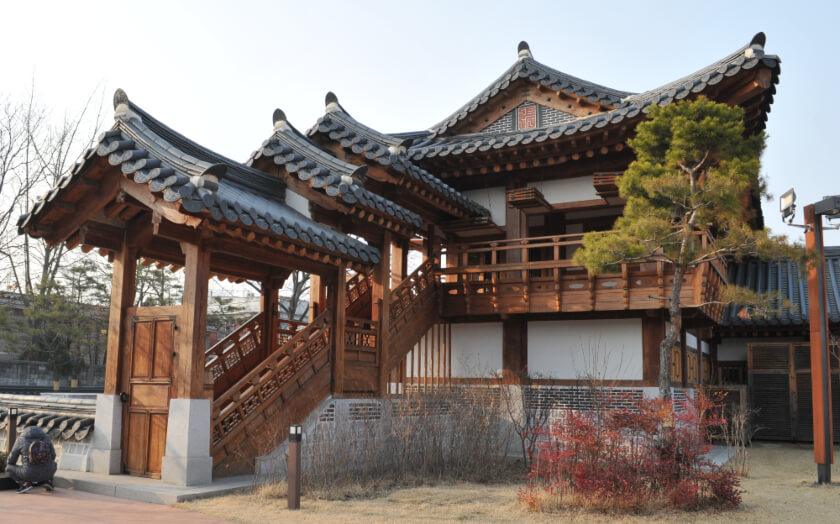
Our first stop was to look at a Hanok building at the Suwon Technology Exhibition hall and the Suwon Center for Traditional Culture. Eun had been taking some carpentry classes, and was interested in learning about the design and architecture behind these traditional Korean homes. So we decided to spend a little time learning about hanoks before exploring the fortress.

According to information given at Suwon Technology Exhibition hall hanoks were first designed during the Joseon Dynasty in the 14th century. The home or building is designed with the elements and the seasons in mind. This kind of planning is called baesanimsu. It brings to mind Feng Shui which would make sense given China’s influence over ancient Korea. Similar to Feng Shui, it is about the perfect harmony between the elements. It’s all about building the good energy. The houses were (and are as the tradition is still alive) different depending on in what part of Korea they were built. In the south, the layout of a house is different from ones in the north. The north is colder, so the design is square with a courtyard in the middle in order to keep the heat in (You can see an example of this style in my post from visiting a tea house in the Hanok village in Bukchon,) whereas if you travel to the south where it is warmer, the design is created to allow more airflow, so they are open and often L shaped. The most ideal elemental design is to have a mountain in the back and a river in the front, which is really close to my dream home of a mountain in the back and an ocean in the front; Pacific Northwest style. The hanok that we visited, before exploring the fortress, was a modern hanok built as a museum to educate people on the history and craftsmanship of these homes.

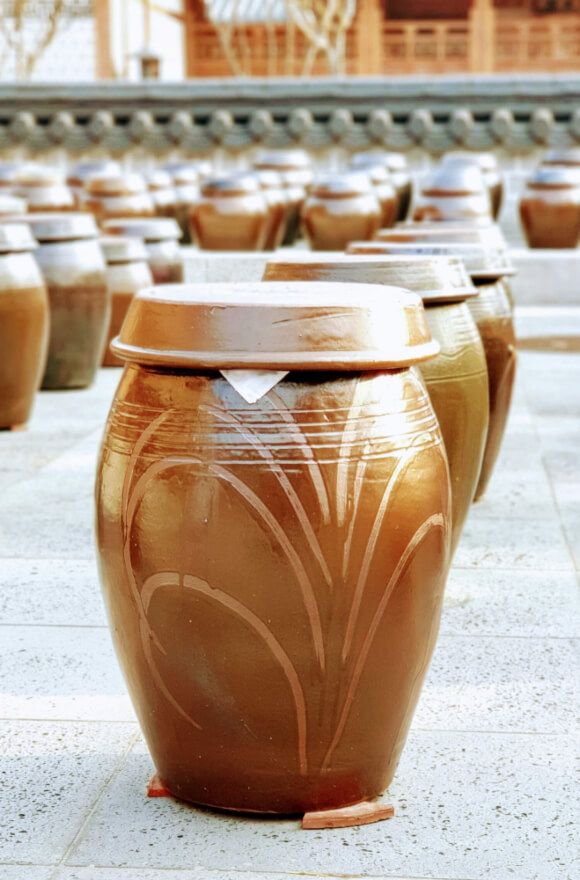
We wandered around this hanok, picking up literature on the history, and took photos of the onggi pots, where kimchee is traditionally fermented, then afterwards we walked toward the wall of the fortress.

It was meant to be the new capital when the fortress was built over 200 years ago. Long before Seoul was officially called Seoul it was Hanyang or Hanseong. King Jeongjo the 22nd king of the Joseon dynasty wanted to move the capital from Hanyang to Suwon. The reason being that the proximity to the Yellow Sea and China was better for commerce, and the King believed he could make changes to better the Dynasty, and moving to Suwon was a step in this direction of his reforms.

The Hwaseong Fortress was not only the beginning of a new capital, but it was a military complex and a burial place for his father Prince Sado. It was built between 1794 and 1796 (when John Adams became the 2nd U.S. president) by King Jeongjo of the Joseon Dynasty to remember his father who was executed by his grandfather, King Yeongjo. If you’re interested in more information on the history of this execution by rice, you can search Prince Sado and begin the descent into the rabbit hole of Joseon history. There are also many Korean dramas that tell the story like The Throne and The Secret Door.

The location of the fortress although a strategic choice also fulfills the baesanimsu with a mountain in the back and a river in the front.  It has been designated as a UNESCO world heritage site because according to UNESCO, “It is an outstanding example of early modern military architecture.” It’s pretty fun to think of how many UNESCO sites Eun and I have visited here in South Korea.

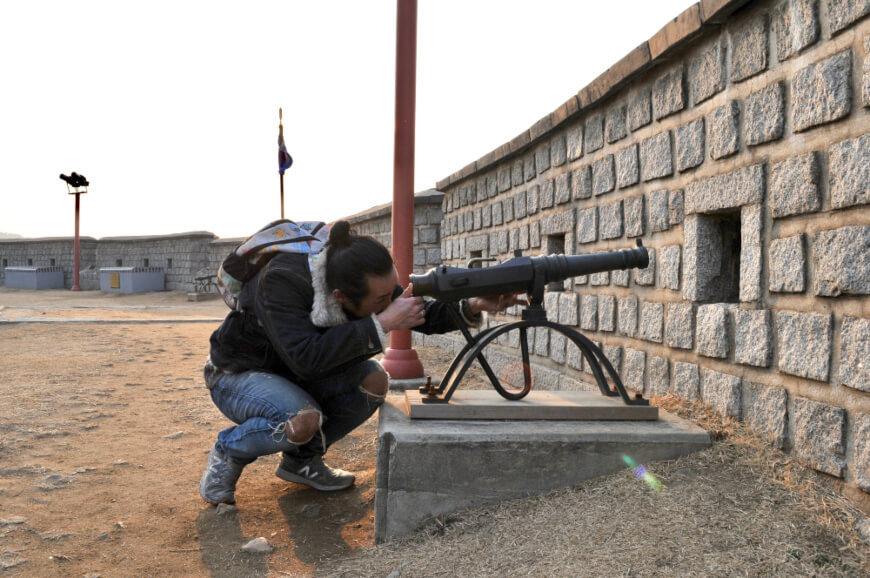
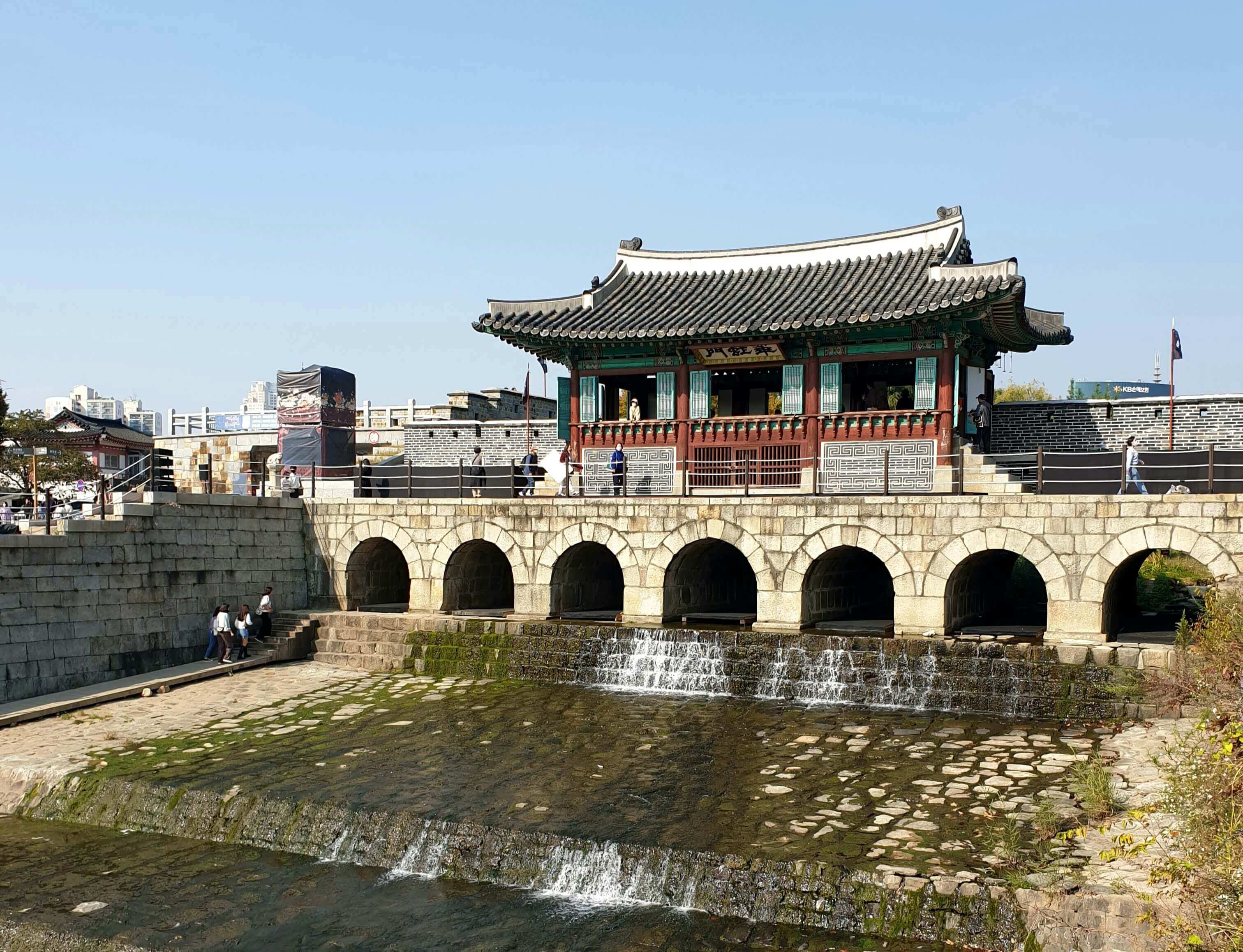
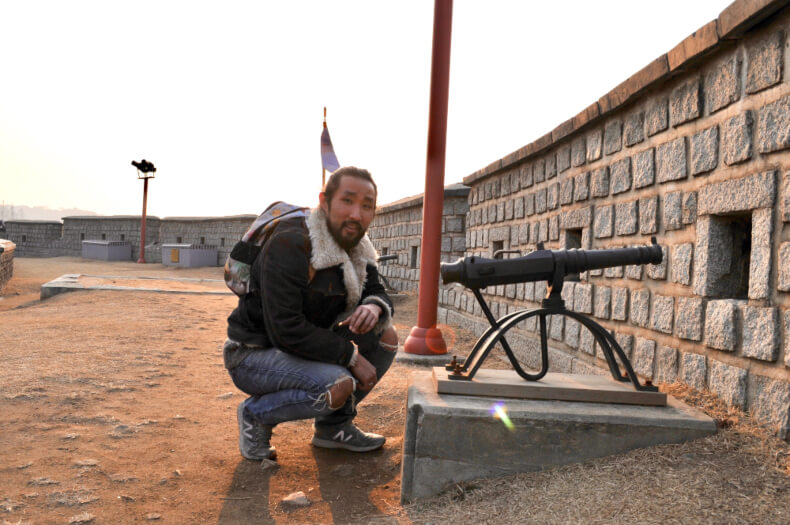
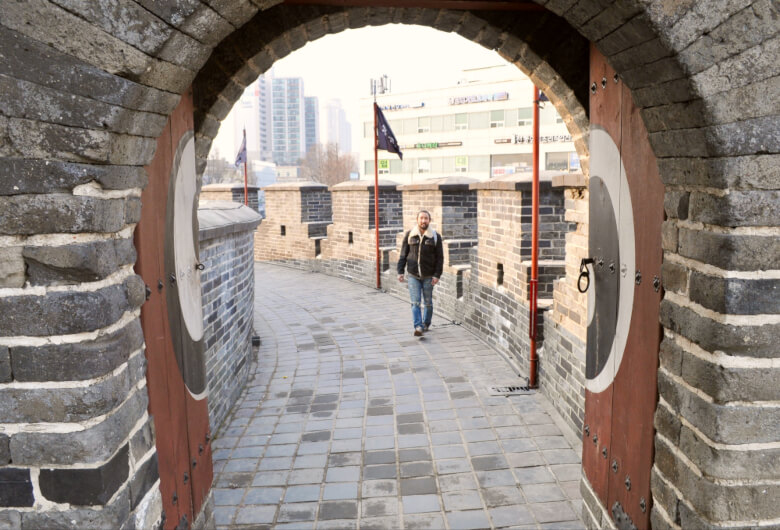
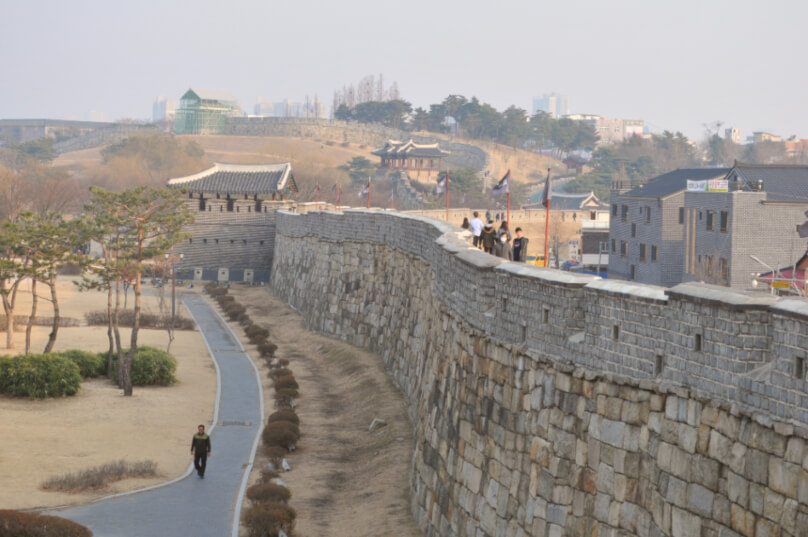
It has many defensive features and was almost impenetrable except for the part facing the river. Due to this possible exposure to enemies the King had watergates with iron bars built along the parts of the wall that cross the river. What you can see today are canons, and towers with windows where soldiers could shoot arrows, along with beacon towers that would have been lit to warn about a coming enemy.

It took three years to build Hwaseong, and was built with the latest technology of the times, and it incorporated eastern and western architectural design elements. Two other aspects that make it unique and a part of UNESCO’s heritage list is its military and commercial functions along with it being built over mountains and a river. It influenced Korean architecture for years to come.  It never did become the new capital though, because soon after it was completed the King died.  If you are interested in architecture, in particular military architecture, I recommend starting with this wikipedia page and continuing on from there. The page gives a lot of detail on all parts of the fortress. It was built to withstand war and invaders, but of course King Jeongjo and those who designed it had no idea of the violence, weaponry, and destruction that would come from the 20th century wars.

The view along the walk toward the NE side of the fortress.
Hwahongmun the Northern Floodgate

A Devastating History

During the Korean War up to 60% of the fortress had been damaged. It was reconstructed in the 1970’s using the “Records of Hwaseong Fortress Construction” that were written in 1801 not long after the king had died. It is not visible to the untrained eye as to what parts had been rebuilt and which are authentic. Having learned about this destruction while visiting the Hwaseong Fortress, reminded me of visiting parts of Germany and Poland. Cities like Nuremberg and Warsaw, that were 85% to 95% destroyed yet recreated to such historical accuracy that one would never know that bombs had been dropped on the streets where you stood. Suwon, like Seoul had been taken by the North Korean army very early into the war. What many people outside of Korea don’t know is that 5 million people lost their lives, more than half of whom were civilians. Much of the fighting was around Suwon which is only 45 kilometers away from the capital where the first invasion took place. Yet, today, walking the battlements of this ancient wall that was built over 200 years ago, and is still standing after multiple Japanese invasions; destruction during Japanese colonization; attacks during WWII; and then lastly the Korean War, if you didn’t know the history, you would never know what had happened here. You cannot tell that these walls had ever fallen nor that in 2006 an arsonist tried to burn one of the towers down.

I know that we didn’t walk the nearly 4 miles around the fortress, but we spent about four hours out there that day. I did much of my research after the visit which is too bad since knowing a history of a place while visiting makes it all the more interesting. We started our exploration at Janganmun Gate which is the north gate of the city. Unfortunately, the air was not that good on the day we visited. The pollution levels were a bit high and the photos have that reflective glare that one gets when the sunlight is filtered through smog.

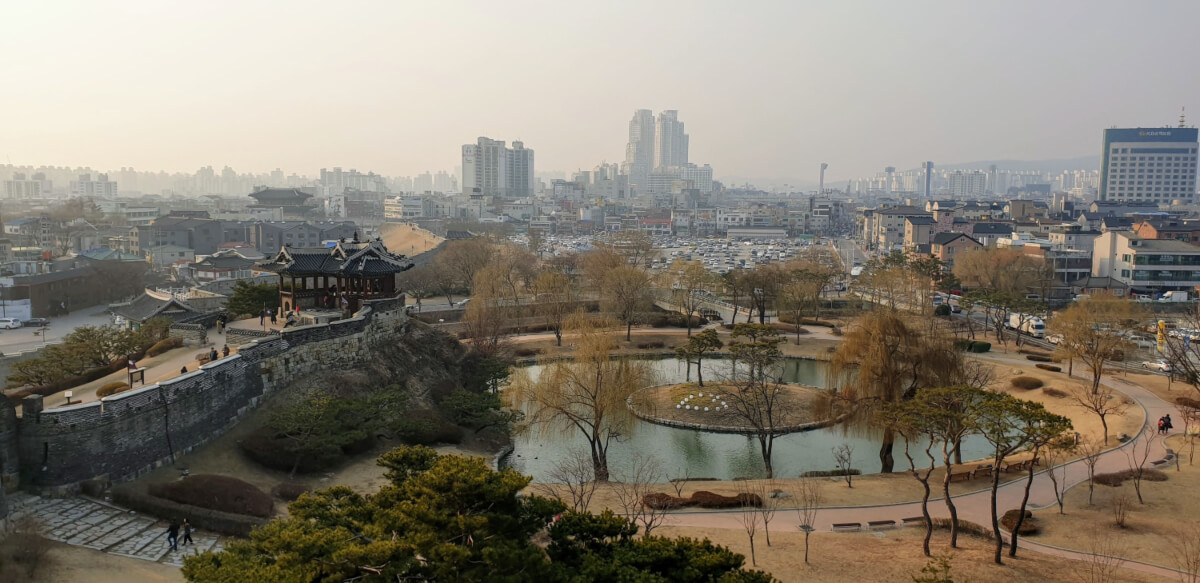
Yongyeon pond and Dongbukgakru command post.

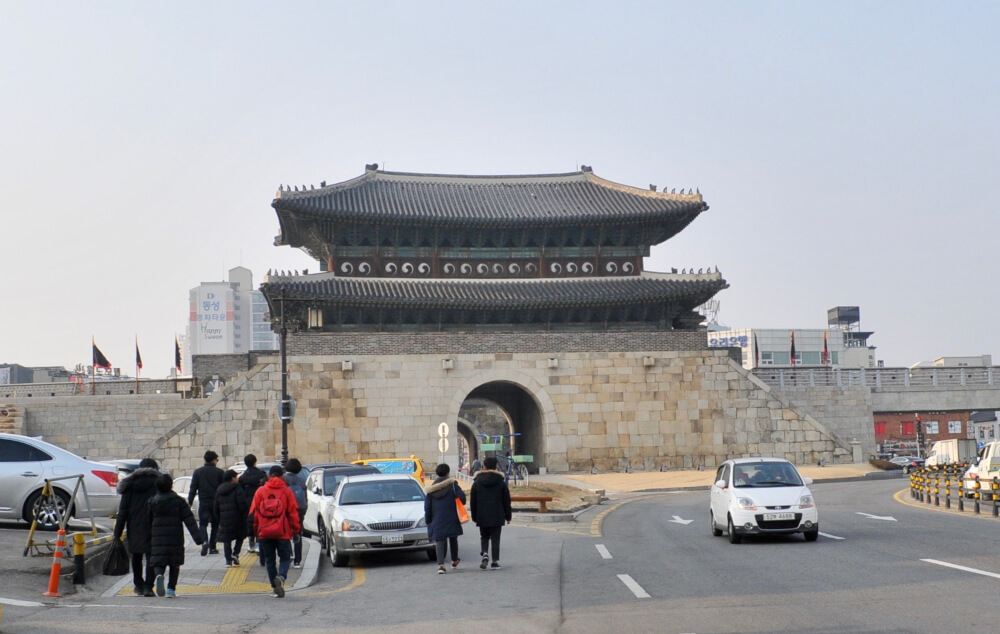
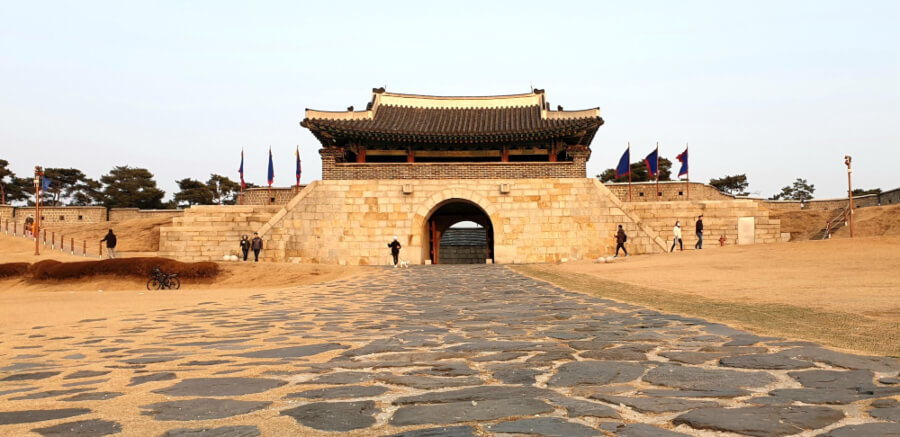
At the time of our visit Janganmun Gate was under some reconstruction, so we were not able to see the interior of the gate, but we were able to go inside the pavillon on the top of the gate where the gaurds would have rested in between sentry duty. From the north gate we headed toward the east.

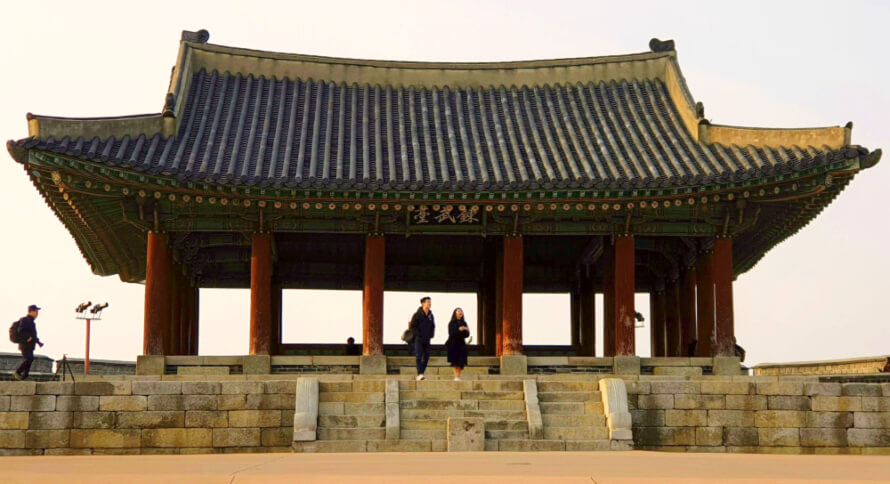
Yeonmudae also named Dongjangdae. This is the eastern command post.

We walked half-way around the wall, mainly sticking to the wall itself and not going into the interior parts of the city. We will have to make another trip out to explore more extensively; especially now, knowing more about the fortress and its history.

Yeonmudae stone steps
Posing in front of Yeonmudae
East gate of Dongjangdae the command post.
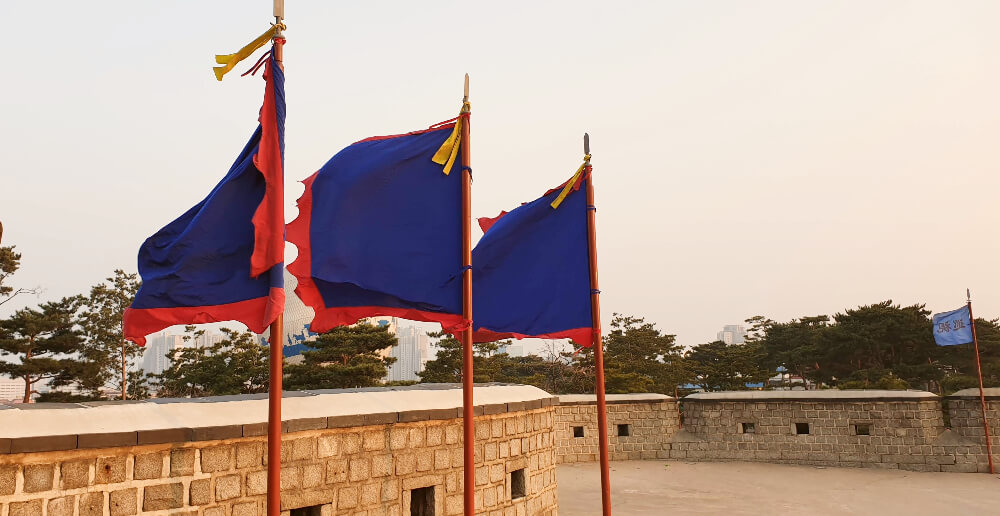
Flags at Changnyongmun the east gate.

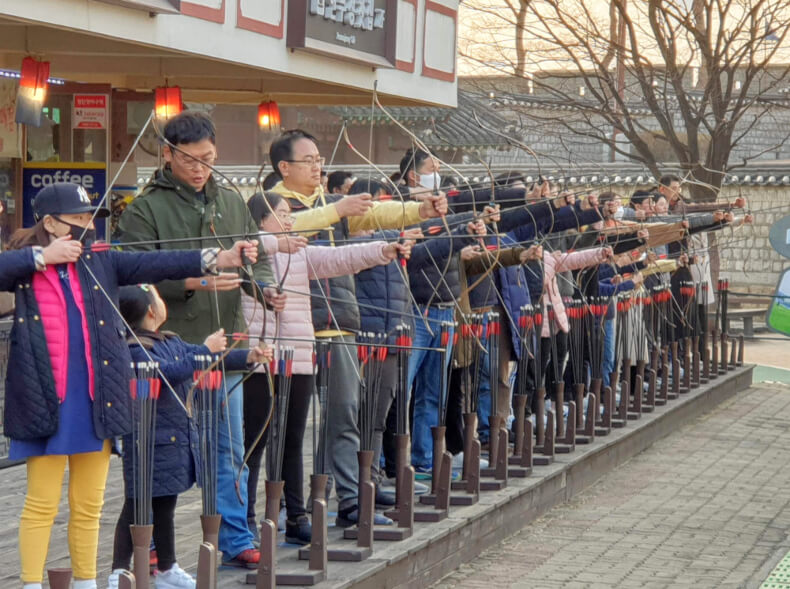
We made it a little past the east gate also called Changnyongmun, (also called Dongmun) before we started to get hungry and also before it got too dark. Our visit to the fortress was in the late fall and night began early. On the way we passed an archery field called Dongbuknodae where soldiers were intended to practice their archery. Today, for 2,000 won (about $1.75) you can try to shoot an arrow and step into the ghostly shoes of Joseon soldiers.

We reached the east gate and wandered along this portion of the wall and explored towers and crossbow platforms. We rested in a pavilion called Dongilporu, and watched the sun set behind the mountain.

Changnyongmun Gate, also known as Dongmun, is the eastern gate of Hwaseong.

As soon as the sun dropped out of view the air quickly dipped from comfortable to chilly, and we decided to end our exploration due to the chill, the dark, and we were both hungry. We headed back toward the North gate and cut away from the wall. We were not certain as to which side of the wall were were on at one point, but we allowed our noses to guide us toward food. What we could smell was fried chicken. Which made sense since Suwon has a street called Chicken Street that is famous for fried chicken.

Bongdon signal beacons

By way of back roads we walked past dilapidated homes and empty lots. We wandered through small markets and then found our way back toward the wall. Using GPS we found our way to Chicken Street which was also part of this trip’s visit. I wrote a post on chicken street here.

We saw less than half of the fortress. If you want to see everything in a day you’ll need to come early as there is much to see. Along with the many features on the wall itself there are also the places within the walled city, including the tomb of Prince Sado, the palaces, and the shrines. It is our intention to return, and of course if you make your way out to the Fortress you must also visit Chicken Street for some excellent fried chicken.

Sunset in Suwon

If you are looking for day trips to take outside of Seoul this is a good one. Depending on where you are staying it is 45 minutes to an hour subway/bus ride outside of Seoul. Seoul is a fun city to visit and travel to, but if you make it as far as South Korea, it is in your best interest to see what is also offered outside of Seoul.
Till next time.

Accidental Vagabond

Help keep this Blog Going. If you enjoy the content please donate. All donations go to keeping the blog up and running.

Choose an amount

$3.00
$8.00
$15.00

Or enter a custom amount

$

Your contribution is incredibly appreciated.

Donate

What Are the Five Grand Palaces of Seoul?

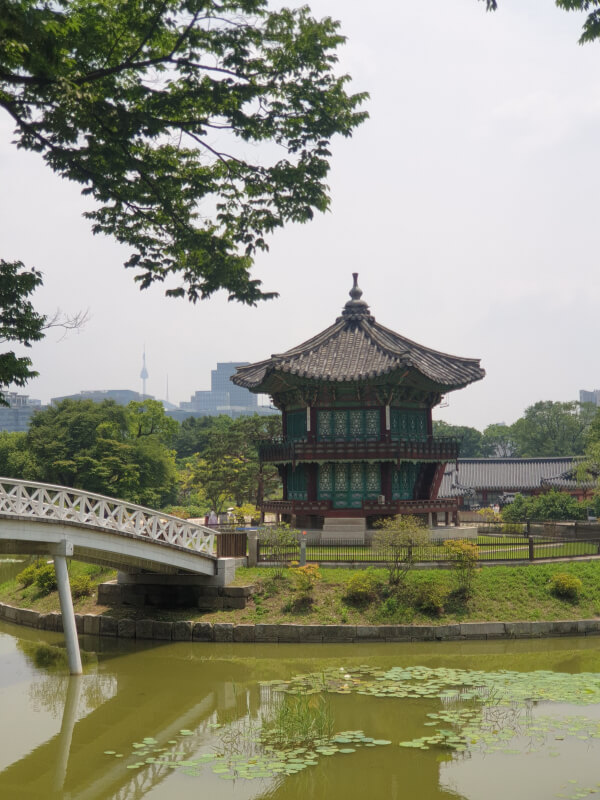
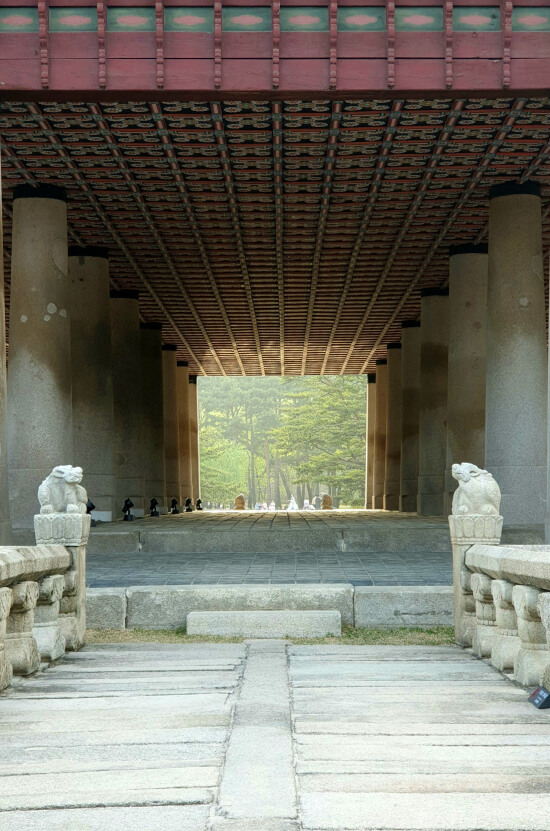
Hyangwonjeong Pavilion

Sources are listed below. If you’d like more information on a certain subject click on the bold text and it will take you to a source. There are hundreds of blog posts on The 5 Grand Palaces, anyone of them will tell you about each palace, including this one. However, this blog is pretty selfish, since I talk about me.
I lived in Seoul from 2018 to 2023, and during that time I visited three of the 5 grand palaces. Two questions that may arise from this statement may be, “What are the 5 grand palaces”, and “you were in Seoul for five years, why only three palaces?”

I’m glad you asked.

What are the 5 Grand Palaces? 

The Joseon Dynasty, also seen written in English as Chosŏn, was the longest and last imperial dynasty of Korea. It was founded in 1392, (100 years before Christopher Columbus took credit for discovering America) by King Taejo, who was previously known as the general Yi Seong-gye. Yi Seong-gye declared himself the ruler of the new dynasty after overthrowing, exiling and then secretly killing, the king of the Goryeo Dynasty, which had been around for 475 years. Not a bad run, Goryeo. He ascended to the throne as King Taejo, marking the start of the Joseon Dynasty, which would last for approximately five centuries until 1910, about 40 years longer than Goryeo. Put into some context of time, as of writing this post in 2023 the United States isn’t even 250 years old. We haven’t even made it halfway. Yet we act like we know it all. The capital was initially established in Hanyang, which is present-day Seoul. During the 500 plus year reign 5 palaces were built between 1395 and 1617. However all 5 palaces have been subjected to destruction through invasions, wars, uprisings, and occupations, so new buildings and expansions had been constructed over the course of the 500 years. There have also been many renovations and later reconstructions that have continued up until today.

Why Only Visit 3 palaces in 5 years?

Although all 5 palaces are relatively close to each other, and not too far from where I lived, living in a place and visiting/vacationing in a place are two different things. Just like living anywhere your days are consumed by work and daily tasks and dull responsibilities and desperate moments of escape through Netflix and other streaming services. When it came to vacation time we often would leave Seoul to explore other places. I did try to see all the palaces, but due to confusion, I ended up visiting Gyeonbok palace multiple times, when I probably could have been visiting the remaining 2, more on this later.

Korean chimneys at Amisan garden in Gyeonbuk palace.
Amisan garden with Chimneys. Built in 1869. Korean National treasure No. 811
  • Gyeongbokgung Palace:
    • Constructed in 1395, Gyeongbokgung was the first palace built during the Joseon Dynasty and served as the main royal palace.
  • Changdeokgung Palace:
    • Initially constructed in 1405, Changdeokgung was later expanded and became one of the main palaces in Seoul. It served as a secondary palace to Gyeongbokgung.
  • Changgyeonggung Palace:
    • Originating in the Goryeo Dynasty (built in 1104) and transformed during the Joseon era. Changgyeong was built on the site of and renovated from parts of the summer palace “Suganggung” of the Goryeo Dynasty. Changgyeonggung underwent a name change and several reconstructions. It served various purposes over the centuries, including as a residence for queens and concubines, and as a temporary residence for the Japanese governor-general during the colonial period.
  • Deoksugung Palace (Gyeongungung):
    • Initially constructed in the late 16th century, Deoksugung served different roles throughout its history, including as a residence for King Seonjo and later as a temporary royal residence during the late 19th and early 20th centuries.
  • Gyeonghuigung Palace:
    • Established in 1617, Gyeonghuigung served as a secondary palace and underwent multiple reconstructions. It was the last of the Five Grand Palaces to be built. Although, not the last to be completed.
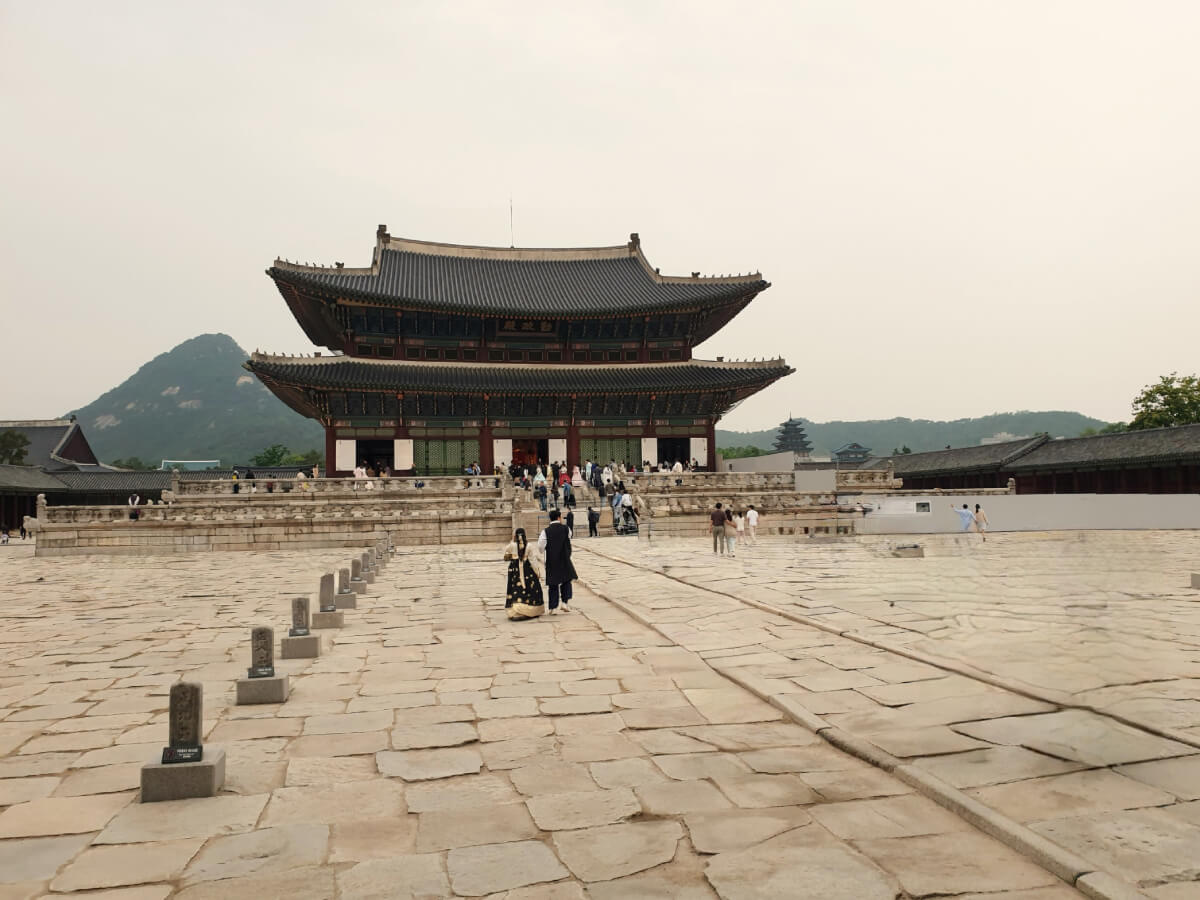
Geunjeongjeon Hall or the Throne Hall of Gyeongbok palace in Seoul, South Korea.
Geunjeongjeon Hall

The Palaces and My Visits

14th Century

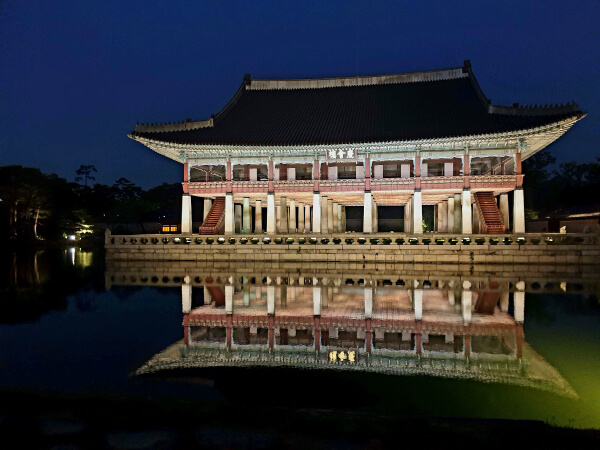
Gyeongbokgung (Gyeongbok Palace) was the first of the five Grand Palaces of Seoul to be built during the long 500 plus years’ reign. Gyeongbokgung was built in 1395, and it is the largest of all five. Its architecture and design is magnificent and bold. The wood structures are bright reds and blues and the fired clay tiled rooftops sweep like the upturned wings of birds of prey. Small intricate carvings adorn the tiles, and each end beam is painted with colorful patterns.

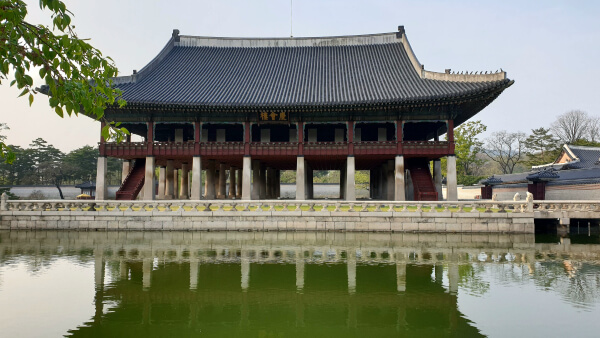
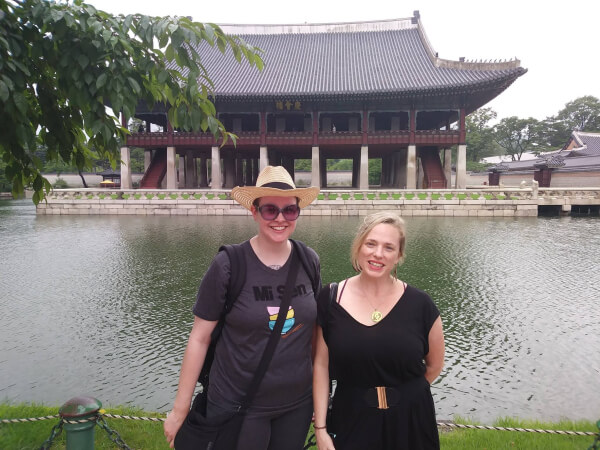
 bridge to the Royal Banquet Hall Gyeonghoeru

There is a lot to Korean architecture much like the Chinese and Japanese there is a purpose and meaning behind the building. In Korea it has a lot to do with nature and something called geomancy which I plan to write about at a later time. The structure is conspicuous with its impressive gates, halls, and tall beams and beautiful gardens. It is the largest of all five of the Grand Palaces, and every website and blog that I visited claimed it to be “arguably the most beautiful”. I do believe one can argue this remark as beauty is subjective. I don’t know if it’s the most beautiful overall, but it is large and has some beautiful parts, nothing is ugly, but most beautiful is as I said, subjective. However, I do believe it is one of the most popular of the five and most visited. 

As mentioned, the palace was originally built in 1395, that’s almost 100 years before Columbus stumbled onto an already inhabited land and claimed it for Spain. In the 16th century (1592 to be more exact) the palace was demolished and destroyed by the Japanese, and not reconstructed until 1867, the same year that Alaska was purchased from Russia. 

During the Japanese occupation of the 20th century, the Japanese destroyed or dismantled all but 10 of the original buildings, and then to add insult to injury they built the Imperial Government building on the site of the palace and directly in front of Geunjeongjeon Hall the former throne room of the Kings of the Joseon Dynasty. In this way the Korean’s not only lost their independence and didn’t know if they had a future they also were denied a view of their past. Why would the Japanese not destroy all evidence of the palace? One could argue that they kept what they thought was the most beautiful for themselves, like the pavilion and the surrounding garden. During the occupation the throne room was often used as an exhibition hall taking away all sense of authority and reducing it to a commercial space. Long after the occupation, which ended with WW2 for obvious reasons, and the devastation of the Korean war; restoration of Gyeongbuk began in 1989. The Japanese General Government building was demolished in 1995.

I’ve visited this palace at least seven times.
  • My first visit to Gyeonbokgung was in the spring of 2017. At the time, I was living in Gwanggyo, which is a city in Gyeonggi, a neighboring province. It is about an hour away from Seoul by subway. During my first visit, I didn’t enter the gate but wandered about the East side of the palace near the National Folk Museum
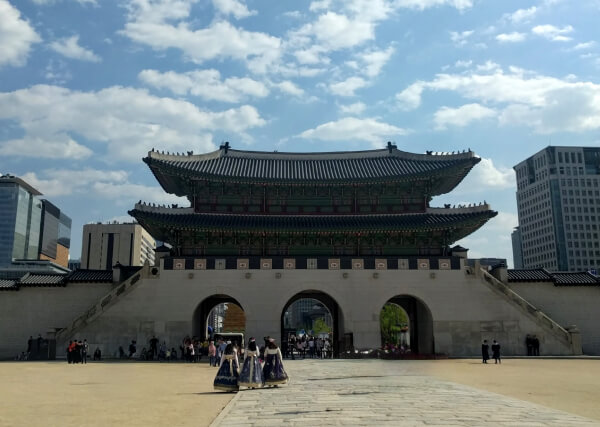
  • My second visit was in the summer of 2017. I was still living in Gwanggyo, and during this visit I went with a friend of mine who had been living in Dongcheon, another small city in Gyeonggi-do. On the weekends we would often meet up on the subway and then take the Shinbundang line into Seoul. On this particular visit we entered through the East side but only took a few pictures inside the outer courtyard or oejeon where you can see the inside of the Gwanghwamun Gate (southern and main gate) and the outside of Heungnyemun Gate which is the second gate of the palace that will lead you into the inner court or naejeon.  
  • On my third visit to Gyeonbukgung, also in the summer of 2017, I finally went inside the second gate (Heungnyemun) and onto the palace grounds. Visit three was also with a friend of mine that was visiting from Masan, a small city in the southern part of South Korea. Aside from seeing more of the palace during this visit we also partook in a tea ceremony. 
  • My fourth visit was in the fall of 2018. At this time I had moved to Seoul and lived about a 30 minute bus ride from Gyeonbukgung. A friend of mine had come to visit from China, and we visited the palace, but only the outer courtyard.
  • My fifth visit was in the spring of 2019 when some friends from Prague (Czechia) came to visit. Now, on this visit I selfishly tried to take them to Changdeokgung because I wanted to see the secret garden, but I got the Hyangwonjeong Pavilion confused with the Huwon or Biwon also known as “the secret garden”.

The reason for my confusion was because during my 2017 visit the pavilion was under construction, and my brain had decided that this was the secret garden. I never bothered to look it up. I also just never remembered which palace it was that I kept visiting, so when I arrived for the fifth time, I remember thinking, “ah damn, I always come to the same palace.” My friends of course had never been to any of the palaces so it was fine. The pavilion was still under construction.

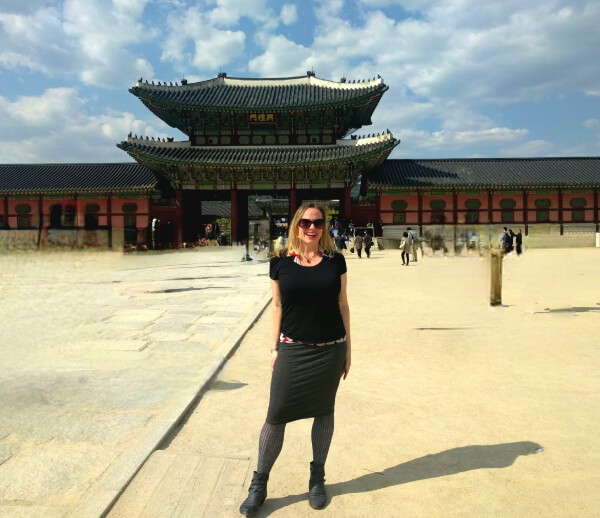
A woman poses in front of Heungnyemun the second Gate of Gyeongbokgung in Seoul, South Korea.
  • My sixth visit took place in the spring of 2023. Probably, for the first time in my many visits to Gyeonbukgung, I went intentionally. The unknown and fear of the pandemic was in the rearview mirror, and more and more things had opened up. For the first time since I had moved to Seoul Gyeonbukgung was open in the evening. Eun and I went together for this summer event. 
A night photograph of Gyeonghoeru the Royal banquet hall or Gyeongbok palace, Seoul, South Korea.
Gyeonghoeru, The Royal Banquet Hall lit up at night
  • My seventh and final visit was in the summer of 2023. I again went intentionally, this time to finally see the Hyangwonjeong Pavilion which had been under construction since my first visit inside the palace in 2017.
The Hyangwonjeong Pavilion in the background, March 2023

15th Century

Changdeok palace was constructed in 1405, as a secondary palace to Gyeongbokgung, nearly 90 years before Columbus crashed into the Bahamas. After its initial construction the palace complex was expanded and it became the most favored by Korean kings from the late 15th century onwards. Known for its beautiful rear garden blending with the natural landscape which is part of geomancy. It is also the location of the famous Secret Garden, Biwon (비원) in Korean. This garden was built as a place for the royal family and women of the palace to relax and enjoy. Changdeokgung was badly damaged during the Imjin War the 1592-1596, and 1597-1598 a series of invasions by the Japanese. If you recall, Gyeongbokgung was destroyed in 1592, which would make Changdeokgung the primary palace by default. Although, Changdeokgung was also badly damaged in the wars which would mean that the main palace would have to be moved yet again to Changgyeongung which it’s lucky they already had the palace built; more on that next. Changdeokgung was rebuilt in 1609 (two years after Jamestown had been settled), but was damaged again when it was burnt down in 1623 by a military coup. Changedeokgung has been damaged multiple times over the centuries, however during each reconstruction it has remained true to its original form and because of this authenticity it was added to the list of UNESCO world heritage sites in 1997.
  • This is one of the palaces I never had the chance to visit. In fact, part of the reason I visited Gyeongbukgung so many times is because I kept trying to visit Changdeokgung, but got confused. They are not that far from each other and when looking on a map they look quite close. In fact, you use the same subway line to get there. It is possible to walk from Gyeongbukgung to Changdeokgung. In actuality all 5 of the palaces are in relative walking distance, but if you are short on time or don’t want to walk 45 minutes (I said relative as in meaning possible) the buses are a great way to go from palace to palace. 
  • I regret not seeing this palace as its reputation for beauty is high. Plus the famous secret garden which you have to purchase a second ticket to enter, so you need to time your purchase and entrance right, especially during the crowded summers. This timing thing has never been a forte of mine. A friend and I did try to make it to Changdeokgung in my last month of living in Seoul, but it was during the Royal Cultural Festival and all the tickets to Changdeokgung and Gyeonbokgung had been sold out. Alas. 

15th Century

It was first called Suganggung and was built in 1104 during the Goryeo reign as a summer palace for King Sukjong of the Goryeo dynasty. After Yi Seong-gye defeated Goryeo he resided in Suganggung until Gyeongbukgung was built. A side note, Kaesong also seen written as Gaegyeong was the capital of the Goryeo dynasty which is in what we now call North Korea. It can be difficult to picture it with our modern maps and politics, but Goryeo once controlled all of the land that we now call North and South Korea. Later in the mid-1400’s under the fourth ruler of the Joseon Dynasty, King Sejong (the Great King who invented Hungul the Korean alphabet) built the palace as a gift for his father, the third Joseon King, King Taejong; more like a resting place than a gift. I found one site that stated that King Sejong built Changgyeonggung in 1418, whereas most sites including Wikipedia state mid-1400’s. I’m not great at math, but 1418 seems to me to be a lot closer to early 1400’s than mid-1400’s. Since King Taejong died in 1422, I’m going to go with Go!Go! Hanguk’s date until I get my hands on some printed text. Another side note, when it comes to dates on construction or establishment which just means that they decided that on this particular property they are planning to build a palace, Changgyeonggung is the most confusing to get the dates clear. My guess is that there hasn’t been a lot of English write ups on the Goryeo Dynasty because there isn’t much left to see of this dynasty, and the top sites are travel sites, so its a lot of regurgitation of the same information. I have my own deduction as to why it is difficult to tact down an exact date. My thoughts are that in 1104 there was already a palace in the same location. King Sukjong’s summer palace that may or may not have been called Suganggung. Then in 1392 after the fall of the Goryeo Dynasty, King Taejo the first of the King’s of the Joseon Dynasty moved into the former summer palace while Gyeongbukgung was being built. So, obviously some structure had to already be in place, and the man’s a king so it can’t be a shabby shack, and it was a royal summer palace, so I imagine it was beautiful in its own right. Then presumably, in 1418ish, King Sejong either added on or renovated or expanded the former Goryeo structure. I suppose he could have had it all torn down, but I don’t know, I’m just tossing this idea around trying to elucidate for myself when this palace was actually built. During the time that King Sejong built the palace and King Taejong resided there it was called Suganggung, this is for certain. Then in 1483, it was renovated and enlarged by King Seonjong the ninth King of the Joseon Dynasty. Perhaps it was during this time that the intention of its construction was to be a residential home for the queen, and the king’s concubines. Okay back to the main focus:

Myeongjeongjeon

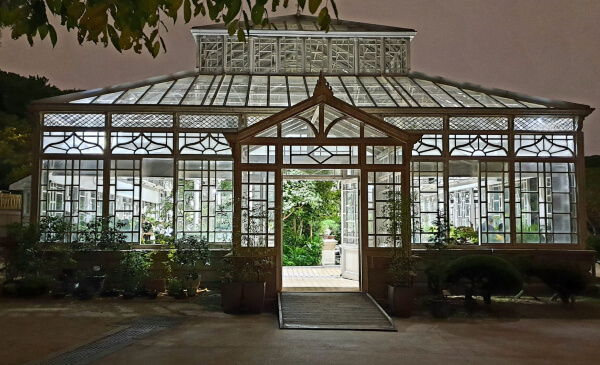
There was a lot of upheaval and destruction at Changgyeonggung through multiple Japanese invasions and during Japanese colonialism. Due to the multiple damages, destruction, rebuilding, and renovations over the centuries, Changgyeongung features a mix of architectural styles, including traditional Korean and Western influences. The palace grounds include gardens and a victorian style greenhouse designed by the famous Japanese horticulturist Hayato Fukuba, and built by a French architectural company, whose name I haven’t yet located. Changgyeonggung features a large botanical garden with many indigenous Korean plant species. During the Japanese occupation that began in 1910, Changgyeonggung was turned into a zoo. The zoo was Korea’s first, and built in 1909, which date wise informs you that Japan was already planning to occupy Korea. I also saw a source that said the Daeonsil, the greenhouse, was built in 1907 which if true shows that the Japanese were planning their occupation at least 3 years in advance of the “official date.” I imagine all occupations take a bit of planning. After the end of the Japanese occupation the palace was restored to much of its original design, and many of the Japanese buildings were torn down, however the greenhouse, which is quite lovely, remains. When I say original I mean either the 1418 design, but more likely the 1483 design when it was given the name Changgyeongung.

A close-up picture of the red and salmon colored Honghwamun, The Outer Gate to Changgyeonggung.
Honghwamun, The Outer Gate to Changgyeonggung
  • The first time I came to Changgyeongung, was the very first time I ever came to South Korea. I first visited Seoul in 2014, during a 24 hour layover on a trip from China to the Czech Republic (Czechia). I had stayed in a hostel with the word “Banana” in its name. During my layover I wandered the neighborhood which was a multitude of connecting alleyways; ate in a small little high quality hole in in the wall restaurant; and I visited a palace. At the time, I never imagined that I would, not only return to Korea, but that I would live there for 7 years. I didn’t know the name of the palace I had visited as I didn’t speak to anyone other than the hostel receptionist during check in, and with a sales girl at Tony Moly (토니모리) as I bought my first Korean beauty product of snail cream, not even knowing that the Korean beauty industry was a multi-billion dollar business; nor that I just bought a cream made of snails. I only saw a very tiny part of it, as I didn’t see the greenhouse or the beautiful pond surrounded by lush green trees and bushes, yet it stuck with me. I was so in awe of the outer stone courtyard and the standing tiles that looked like grave stones, that I now know are rank stones which marked where members of the royal court were permitted to stand during ceremonies. I moved to Seoul in 2018, and since I had arrived in the major metropolitan city, I had been searching for the palace I had first visited 3 years prior. Hence, another reason why I had visited Gyeongbokgung so many times. Each time I would go to Gyeongbokgung, I knew I was not at the right place, but I could not recall which palace was my first. 
The royal greenhouse of Changgyeonggung lit up at night.
Daeonsil Greenhouse
  • It wasn’t until my last month in Seoul when a friend and I walked from Gyeongbokgung in the direction of what we thought would be Changdeokgung. It was a 45 minute walk to Changgyeongung. The palace was open for the summer nights, and my friend and I were able to enjoy a light show that played on a tree that grew on a small island in the manmade pond. Once inside the courtyard, I recognized it immediately as the palace I had visited in 2015. It felt like I had come full circle. Changgyeongung and Changdeokgung are practically connected, so it is easy to confuse one for the other.
a close up of rank stones and flat stone at Changgyeonggung in Seoul, South Korea.
Rank Stones at Changgyeonggung

16th Century

Deoksugung Palace, originally known as Gyeongungung, was established in the late 16th century during the reign of King Seonjo the 14th king of the Joseon Dynasty. This palace like Changgyeonggung has a complicated and confusing history, hence the “late 16th century” date. Before it became a palace it was the home of Grand Prince Wolsan, the older brother of King Seongjong the 9th Joseon king. Prince Wolsan died in 1488 a solid 100 years before the Imjin Wars, so either his residence remained intact and lived in by other family members or it was empty. The plan to actually turn it into a royal palace came about in 1592, coincidentally around the same time that Gyeongbukgung was destroyed. Construction on Deoksugung (it wouldn’t get this name until 1907) or Gyeongungung began in 1592 (two years after the Roanoke Colony had disappeared), but due to the Japanese invasions of Korea (1592-1596 & 1597-1598, Imjin Wars), it was interrupted. Because of the war, many structures of Gyeongungung were damaged or left incomplete during the initial construction phase in 1592. I am not sure what parts of Gyeongungung were from Grand Prince Wolsan’s residence is any part was, but the palace wasn’t completed until 1595 or 1958. Meanwhile, in the America’s during the same time we were having our own colonial invasions. In 1598, the same year that Gyeongungung was completed Juan de Oñate attacked and massacred the Ácoma Pueblo in what is now New Mexico.

Gyeongungung was meant to be an auxiliary palace, but it became a temporary royal residence after the Japanese destroyed Gyeongbokgung in 1592, along with badly damaging Changdeokgung and Changgyeonggung. It became an official royal palace in 1611 when the King Gwanghaegun, the 15th ruler, finally decided to give it the name Gyeongungung. Prior to 1611, I don’t know what they called it. Uncle Wolsan’s place? The palace was completed in 1595, but it has a unique fusion of traditional Korean and Western architecture after a Western-style wing was added in 1897. This Western-style building, Jeonggwanheon, was designed by a Russian architect. It was turned into a cafeteria during the Japanese occupation. In 1907, the year the greenhouse at Changgyeonggung was built, Gyeongungung’s name was changed to Deoksugung. The name which means longevity was chosen in hopes that it would save the dynasty (at the time declared and Empire) and the Korean peoples, but unfortunately, as history shows, the Joseon family dynasty would fall, and Korea would be occupied for 35 years. As for Deoksugung, much of the original palace was destroyed or dismantled and the palace that you can see and visit today is only 1/3 its original size.

  • Although I have passed this palace multiple times since I had lived in Seoul, it wasn’t until 2023, my last days in Seoul, that I finally made a visit. The main gate of Deoksugung is often overcrowded with protesters, often of the older generation, and there are large banners, that at times, over shadow the main gate. The protestors often deterred me from entering the palace. In the beginning, I thought maybe they were protesting the actual palace, but after years of living in Seoul, I had learned that on the weekends there is always a protest, and all this political activity takes place in the square across from City Hall and Seoul Plaza. Protests will extend down the length of Sejong road leading to Gwanghwamun square as this is where many of the embassies are located including the U.S. Embassy.
Indoor walls of Deoksu Palace

The day my friend and I went to the palace was Pride week and it was meant to be the day of the Pride parade which we both would have loved to have seen, but a far-right religious and anti-LGBTQ+ group had managed to snag the space for their Youth for Christ march. Although the Pride Organization had applied well in advance as they do each year since they have held the parade, Korea’s new and very conservative President granted the day to the church, as he said “events for children and teenagers get a priority when requests are filed for a same date”. (I must say though, as someone who was there, that was the angriest children’s event I’ve ever been forced to listen to.) As we passed through the gate and onto the palace grounds, we could hear the angry screams and shouts from the church group, and like a dome of verbiage the screams followed us to nearly every part of the palace grounds.  It was an incredibly hot day and all that hellfire, damnation, and brimstone gave our tour of the grounds an unpleasant vibe. I would have preferred fun music of Pride over the screams or better yet silence, but we did our best to enjoy the palace grounds. Once the marching started the angry group took their yells on the road, it left leaving only the sounds of the city which blended into a dull hum, hiss and honks. 

Established in 1617 (the year that Pocahontas died), it was the last of the Five Grand Palaces to be built. Although the foundation for the palace was in 1617, Gyeonghuigung wasn’t constructed until 1623 and underwent multiple reconstructions. Gyeonghuigung served as a secondary palace to Gyeongbokgung, but later served as the main palace during the 19th century. It was remodeled in 1855 with an architectural style integrating tradition and innovation. It was the setting for major political events such as King Gojong‘s return from the Russian legation where he sought refuge in 1896, and Korea’s independence proclamation from Imperial China’s rule in 1897. It was also the site of where the Korean Empire was proclaimed in 1897. Much of the palace was destroyed by fires, and during the Japanese occupation many of the buildings had been dissmantaled. Restoration efforts have been ongoing, however, because the reconstruction didn’t begin until the 1990’s and the city had already been built up, a lot of what was lost can’t be restored. As of today, only 33% of the palace exists.

  • I never made it to Gyeonhuigung. During my last month in Seoul it was my intention to visit all five of the palaces, but unfortunately due to time constraints and schedule conflicts I was not able to reach this goal. In truth, I don’t even know exactly where this palace is located. I know it is either in Jongno or Insadong where the other four palaces are located and it is also located on the west side of what was the old city capital Hanseong.

Thank you for reliving this palace journey with me. I feel fortunate to have been able to see 3 of the 5 and I hope that I make it back to Seoul in the near future in order to finally see Changdeokgung and Gyeonhuigung, and of course, The Secret Garden.

Come back for future posts on greater details of each palace. I will also have write ups on other fortresses and buddhist temples, along with a two part story on our walk around the Seoul City Wall; the ancient former wall of the Hanseong Capital which was built during the Joseon Dynasty.

Till next time.

Accidental Vagabond

Help Keep this blog going. Any and all donations go to keeping this blog up.

Choose an amount

$3.00
$8.00
$15.00

Or enter a custom amount

$

Your contribution is beyond appreciated.

Donate
* Wikipedia provided the first step to basic information with links that lead to further resources. Please, if you can, donate to Wikipedia to keep it open for all people to use. Privatization can lead to abuse of information. If we collectively support it will help to keep the flow of information open and more accountable. I make a small monthly donation, and would love to donate more, which one day if profits come, I will. It's a great starting point when looking for information.
Other sources were Britannica, Korea.net, Go!Go!Hanguk, and many travel blogs.
There She Goes Again is a good blog for information if you wish to travel to South Korea. I used her blog a lot before visiting places in South Korea. I'd also like to recommend Korea By Me, as I have a soft spot for them for giving me a chance, plus they have a lot of information about Korea from a diverse group of people who are currently living in South Korea.

Back in the U.S. of A

A view of the Sawtooth Mountain range, and a green and golden valley in Idaho taken from the highway
A view of the Sawtooth Mountain range in Idaho

We left South Korea in July, and I have been struggling with what it is that I want to do here. I don’t mean in the U.S., but here on this page, on this post. On future posts. The future of this hit or miss blog.

Is it still travel if you are in your home country? Considering the size of the U.S. I would say yes, but to be honest it was never much of a travel blog. This is more a blog of reflections on travels of the past.

There are so many things I have wanted to tell about the places I have visited, but then days pass, and turn to months then years. Life changes, I age, friends age, wars begin, fires rage, waters dry up, rivers flood, plagues ravage, and places once visited are no longer the same or no longer open.

How do I write in a world that is instant? I have tried to be instant, and I just can’t keep up with the pace. Even my instagram photos are months out of date, and “instant” is in the name. I know, I am behind. I have always been behind, and as the world turns faster and more aggressively, I see myself falling further and further away, like the image of a person standing on the road as seen from the reflection of the sideview mirror visible until swallowed by the horizon. There is nothing I can do to slow things down or to catch up. Isn’t that life, though? Isn’t that aging?

However, I can wander back into the past here on the page and slow things down to the point of freezing. This is possible, yet, I’m not sure how I want to do it.

I once had a writing instructor tell me that it is a writers job to solve a problem of writing. My problem is my voice and my presentation. I can’t write about travels as if they are in the present or as an advertisement of place one should visit. So, what are they, stories?

They must be stories. Yet, how do I present them? In chronological order? In the order of place? In a historical context? How much research is needed? This is the conundrum. In a world full of conundrums mine is rather mild, but mine all the same. My writer’s conundrum.

I left the United States in 2013, and I returned in September of 2015 for about 9 months as I waited for my visa, and then I left again in June of 2016. All totaled up, I was living outside of the U.S. for nearly 10 years. I spent my entire 40’s overseas. Aside from the 9 months. I didn’t intend to be away for so long, but being that I am an Accidental Vagabond, I suppose it’s fitting.

I returned to the U.S. in July of 2023 (which as of writing this post, was 4 months ago). It has been a whirlwind. My partner, Eun, and I flew into Seattle, with our dog Penny, where we stayed for a few days, then we drove with a friend to Port Angeles in Washington, to visit my aunt. We then drove to Portland, Oregon, where we stayed for a few weeks, and we bought a car. Then we drove down the Oregon coast to California, and then southeast toward San Ramon, California to see my father. Afterward, we drove north again, back towards Oregon to visit a friend of Eun’s in La Pine. The next leg of the trip took us to Eastern Oregon to pay respects to my friend Sue Vanschoonhoven, who passed away in 2008. We stayed in Cove a lovely tiny town in the Blue Mountains. Leaving Cove we headed east toward Idaho, and trip continued on from Idaho to Wyoming, Montana, South Dakota, Iowa, Illinois, Ohio, New York and southern Maine. Once in Maine we headed to a region called Downeast Maine, and that is where we have settled, for now.

We are here until June or July. After that… well, hopefully we’ll know soon, but until those summer days arrive, I will be here east of Stephen King and joing him in this little thing we call writing.

Expect reflections on travels of the past and life in rural Maine. Write ya’ll soon.

A Long Pause and A New Return

Prague’s Vltava River, 2015

A friend of mine had asked to interview me for her podcast. I was truly surprised. Why would anyone want to interview me? I haven’t done anything that anyone would want to listen to. Even so, I agreed, because I felt so honored to be asked. During the interview she asked me about where I was currently living (South Korea), and where was it that we had met (Prague); and what brought me to Prague (the death of my mother); and what sparked me to travel (an old high school nemesis and a best friend); all the jobs I’ve had in my life (too many to mention in that podcast); was I in love (yes, happily so); and how do I deal with grief (not very well).

If you want to hear the podcast click here A Colorful Life to listen to my interview and the interviews of other travelers who all intersect in one way or another through my friend, Keiko, the creator of the podcast.

I had a lot of fun doing the interview, but soon after we had finished and said good-bye, I began to feel nervous about it. I worried that I had sounded like an idiot. Who was I to talk about travel? There are so many more people out there who are professional travelers and who can offer advice, wisdom, and know how about traveling, and how to live a full and lush life. My insecurity came rushing in and swallowed me up like Carrie from De Palma’s Carrie when she wanted to go to the prom. “They’re all gonna laugh at you!” I hear Piper Laurie’s voice often in my head whenever I want to do anything artistic and put it out there.

Once my friend texted me that the interview had been uploaded to her podcast, I felt my nervousness rise. I couldn’t share it with my friends until I heard it. I had to judge for myself. Did I sound like an idiot, or pretentious? Was I obnoxious? My worst critic, me, was ready to tear me up. But, it was okay. It was okay. Someone out there will hate it. Some troll will write something terrible in a comment to her about me, yes, that could happen, but it’s okay, because my internal critic who can be so mean was okay with it. In Keiko’s introduction she said the kindest things about me. She called me an inspiration, and said that although I had talked about how much I had wanted to be an artists my whole life, that even though it did not manifest as I had imagined it would, I was an artist. I had made my life the canvas. I thought that was so kind and sweet, and a generous thing to say. I don’t if it’s true, but it is true for her. It is her perspective of me and my life, and I have never lied about my life. I don’t lie because what’s the need to lie? I only have my friends and they know the truths, so I’d be lying to them, and they’d call me out.

I’m in the midst of change. My fiancé and I have decided that this will be our last year in South Korea. I just finished a teaching contract and I am in between jobs. I’m burnt out on teaching and want to do something else. But what? I’ve been teaching in one form or another for over 10 years. Yet, with all those years under my belt I only have a TEFL and working experience, but it wouldn’t be enough to teach in the states. I’d need a teaching certificate or a masters, and that requires more time and money for a job I no longer enjoy. I’ve been feeling useless and worthless. My partner loves me, my friends love me, but I feel that this world, that the societies we live in have no use for someone like me. So, I was feeling low. Then my friend asked to interview me for her podcast. She said, I had inspired her not to give up when she was trying to make a move to South Korea. Other people have told me I inspired them. Inspired them to follow acting, inspired to become a writer, inspired to travel, inspired to create a new business. I’ve inspired people, and yet, I’ve never seen it in myself. So, I thought, maybe I should turn some of that inspiration inside out and shine that golden light on myself for a bit. I said, I wanted to be an artist. I said, I wanted to write. So write. Here’s a platform. I have some content. I haven’t been on the sight for some time, and I was never very good at updating, and I never knew how to gain an audience. I never bothered to learn. I was too nervous for people to see what I wrote because like the podcast I thought; what if I sound like an idiot? What if they hate me and say terrible things? What if they call me out for the fraud I am? Public humiliation and shame. The worst. Yet, is it the worst? I can think of worse things. Still, my fragile little ego is, was, and maybe will still be, frightened.

Maybe it’s time. Maybe it’s time for me to really try. To get this out there. To clean up all my mess of random forgotten blogs and try to make this work. Perhaps, some of what I write can inspire others to do things they’ve dreamed. I have try.

It will take time, and I have to learn somethings, but I’ll be back. I’ll get this little Accidental Vagabond on the road again. I still have some time left to learn.

Stopping to Visit the Peonies of Luoyang

In Luoyang every year from mid-April to mid-May when the peonies are in full bloom the city celebrates the Peony Festival. There are many peony gardens to visit in the ancient city that was once the capital of China. The most famous and main garden is the Luoyang International Peony Garden. It is one of the oldest peony gardens in all of China.

CIMG4052

I did not go to this garden. I couldn’t tell you which garden I visited. All I can say is that I was in Luoyang during the Peony Festival.

It was May of 2014, the morning after I had just hiked Mt. Hua with my friend Sean, and his friend Xiang Kai. We had hiked for 14 hours the night before, ill prepared and with little experience, on one of the most dangerous mountains . I’m talking about myself as far as the experience hiker part goes, but I didn’t think Sean was an expert, and I knew Xiang Kai had not hiked many mountains. Hiking in China is different than hiking in the U.S. In the U.S. hiking is a solitary experience. You climb with one other person maybe a few people and perhaps you cross the path of another hiker or two, but mainly it is you and the wild, and the animals who ignore or watch you. In China (or at least on Mt. Song, and Mt. Hua, and the other mountain I hiked) there are no animals only hoards of people. I never saw any animals, not a squirrel or a lizard only a bird or two. I’d never seen so many people on a mountain at the same time except at a ski resort during a holiday. The day we hiked was rainy and cloudy so it wasn’t nearly as crowded as it could have been. Even on a bad weather weekend there will still be hundreds of people climbing. It doesn’t matter if you go early in the morning or late at night it’s still crowded. The key would be to go off season during the middle of the week and definitely not during any vacations or weekends, but when you’re a teacher you have the same schedule as all of China, so either you don’t go at all, or you experience it like all of China-crowded. I had decided that day that I would one day return to China, but not to work only to travel so that I could plan my visits to ancient sights and geological wonders on the off times, but those were and are daydreams for other days.

CIMG4044

It was Sean’s idea that we stop in Luoyang to attend the Peony festival. Xiang Kai had to work that evening so he would not be able to join us. I was exhausted. My body felt worn and broken and I was irritable and still fuming about Sean’s comment that I was too old to climb a mountain. Ignorant boy, my mind ruminated on his off handed remark about my age that only an ignorant boy would make. I had hoped his feet were still suffering from his badly chosen climbing shoes. The wise thing for me to do would have been to go home, eat something nutritious, and then go to bed, but when Sean made the spontaneous suggestion I felt I needed to go. Life is an unexpected ride and you never know when it will stop and where it will start and many times an opportunity is a one time only opportunity. When would I be in China again for the Peony Festival? I had already decided not to renew my contract. I had already decided to leave China. I could tell myself I would be back, but I didn’t know for certain. Some days I hated China, and would think, never again- never again will I return to this country. It had been a hard year for me, and not all China’s fault, but I was in China when my mother died. It was in China when the most important person in my life left this world. My worst fear had been awakened. How many times had she told me that she would not be able to live without me? How many times had I promised I would never let her die alone? How many times had I told myself I would return and take care of her? China was to be my last experience, my last galavant as an explorer of this world living a life style that I didn’t believe was meant for me. I had never imagined I would ever be able to travel, that I would have lived in foreign countries. I was an accidental traveler and it was time to return to my “real life” whatever that was meant to be. I was going to go back to California and going to care for my mother. I didn’t want to live in Chico because there wasn’t anything for me there, but she was there and she needed me. I had been too slow, and too selfish, and I had failed her. I failed as a daughter. I suffered through that guilt alone in a foreign country, a country so foreign from my own that even our process of grieving was different. My mother died alone, and I had not been there to help her.  My anger, and my guilt, and my pain all manifested into my frustrations about a country that was so incredibly different from my own. I did have Sean though, my friend with his choppy english and his oh- so Chinese ways of thinking. Sean my friend who stayed by my side the best he could and tried to show me the things he loved most about his country. Sean was an impatient Chinese teacher, and impatient about many things, and he expressed much frustration about where he was in his life, but through it all he taught me a lot about patience and how to deal with frustration and how to accept that where you are is where you are, but that change is always around the corner whether you want it or not. Uncertainty is the essential part of this life experience and in the uncertainty lies the choices.

CIMG4046

This was life, and I was still living, and I had to take the opportunities as they came no matter how much my body hurt, and how aggravated I had felt when would I have another chance? I agreed to stop in Luoyang and to see the Peonies.

My body was not in full agreement with my mind or my heart. As we wandered from the train station to the nearest garden my body began to pull rank and my brain switched sides and together they caused me to grumble and slouch and move among the flowers like an impetuous child snapping bored pictures here and there waiting to stop to take a nap. Once in the garden all I really wanted to do was lie down in a bed of purple peonies among all the butterflies and drift off into a deep sleep. I did my best to not unleash my grumpiness on Sean, and I allowed him to tell me stories about the history of China and the symbolism of the flowers. He was gracious enough to understand that I was not feeling my best, yet still seemed to enjoy my company. In the end I knew I was not fully present in the moment, and that my body and exhaustion had won this battle, but simultaneously I was aware of the value that the day, and the weekend held.

CIMG4028

We are gifted moments in life and too often they only come once. Some are large and noticeable, but most are small and subtle and too easily we miss them. We don’t take the chance to strike up a conversation with a stranger or take the path that no one is following. I know no other person from my life, as of yet, that has hiked a sacred mountain with friends from China, and eaten prepackaged chicken feet and teriyaki marinated boiled eggs, and then stopped off at a Peony festival that had been celebrated for two thousand years. When I do meet someone who has experienced this it won’t be the same as I had experienced it. We all experience our lives differently, we are similar, but still we are each unique.

I didn’t get to enjoy the Peonies to the fullest of my capacity, and I wasn’t able to collect the memories of the day here in a nice well packaged form to share with others as to the best way to see the Peonies. I didn’t have to because no matter where I go in the world I am going to be me. That means me in a bad mood, me in a good mood, me irrational and me aware. Me wonderful and me not wonderful. My goal is of course to lean my life more towards the awareness and wonderful, and to be in the presence of my life and embrace the moments. Some days work and some days don’t regardless if I am climbing a sacred mountain in China or washing laundry in a laundry mat in Portland, Oregon. Years later I can think back on my hike and my visit to an ancient garden with my friend from China, and look at the pictures I took of flowers that had been planted and cultivated for two thousand years. I can accept the fact that flowers and gardens are not top on my bucket list, and I can say to myself, I did that, and I went there, and I was in a bitchy, irritable, and grumpy ass mood, but I was there. I took that moment and received all that it offered me even if the gratitude came a week after some solid rest.

CIMG4029 CIMG4101