Let’s Take Teacher to Kaifeng Part 1.

I left Portland in the summer of 2013, to begin a new adventure in China as an English Literature teacher for EFL Chinese students who were prepping to move to the U.S., and Canada to continue their educations. It was really a whim. I had been feeling trapped and stunted, doing my usual, what am I really accomplishing in this life lamentations. This a usual lamentation that I’ve been singing since I first left college in 1997. It’s a familiar song that is on a fairly continuous loop kind of like when a horrible pop song gets stuck in your head. In truth, I’m sick of the song, but at times it can lead me through interesting doors, albeit I’m generally singing the same tune too loud to be able to pay attention to my  immediate surroundings. Surely, more then once I have missed an opportunity to grasp some enlightening notes to help me in the great quest of purposefulness. Regardless, if I had the overwhelming desire to be a great teacher or to experience China, or to be an avid traveller (all of which I have at one time or another felt) I ended up in China. It was more a case of who I knew than what I knew, but the outcome was the same; I was in China.

As I write this post from a coffee shop in Busan, South Korea, the days tick away from my time in China, and four years have past. Since China I have moved to the Czech Republic and traveled to parts of Eastern and Western Europe then returned to Portland, and now I sit in cafe called Coffee Farm in Saha-gu in Busan. This post will remain static on this page, and the days will continue to tick. Perhaps you have stumbled across this blog while looking up something on China, and as you read, five more years have passed since I’ve posted, and who knows what I’m writing and where I’m writing. Will I still be traveling? Will I be writing? Will I be alive?  I haven’t posted much about my experiences because thoughts have been in the way, more personal, more emotional thoughts and feelings that have been an impediment to sharing my general experiences in China, and in the other places that I have been since then. Occasionally, I am able to force myself to the page, but the moments are far and fewer between. Yet, that need to record my life, maybe in some attempt to have some relevance beyond death, is still there; small as a wisp, but still there.

There are moments when my thoughts are drifting and some brief yet strong memory from my year in China resurfaces. I never know what triggers it, but it always brings a smile to my face, and a slight nod to my head, which at times baffles and amuses me because I struggled in China. It goes to show that things can become better when nostalgia sets in. Even though I discount my pleasant experiences there I will state that it wasn’t all a struggle or at least that there weren’t moments of joy in the experience of struggles. I do hope that in the coming years that I can and will devote more time to the practice and art of writing so that one day I can accurately and succinctly convey the emotions, and the experiences that triggered those emotions, in a way that can take my readers to China. Can I reach the ability to tell my history like a poetic story? Can I transport you with my words to this place without sounding sentimental or whiney? I honestly don’t know if I will ever be able to do such a thing, but if it’s true that practice and deliberate practice bring about true growth, then I have to look at each post, be it about an event from the past or this current present, as a step toward learning to create that transportive storytelling.

Here is the beginning of one such deliberate practice of a storytelling:

Once upon a time, I had a complete and total meltdown at school, number 47 middle school, where I taught high schoolers,  in Zhengzhou, China.  I was in the office talking to one of my best and favorite students when one of the staff dropped a little bomb on me. On all of us. In a typical Chinese administration fashion, a set holiday was taken away from the teachers and the students in a very last minute non ticket refundable manner in order to use the school for Gaokoa practice testing space. Gaokao is this brutal future life determining test  that all Chinese students who want to attend higher education have to take in order to have a hopefully prosperous future. It is considered one of the most difficult tests in the world. Post test results are the top students have their photos in the national papers, and a number of suicides which are not reported in the same papers. It is stressful, and also status building. So it means nothing to the administration to forgo much needed and desired vacation time for students and teachers in order to be the poster school for testing. I, of course as can be determined by my current tone, don’t think this test is the be all to life, and at the time pretty much lost my shit at the knowledge that I just lost my vacation-days days before they were to take place. I had no concern for mianzi or guanxi. These are Chinese words for saving face or keeping up appearances and relationships that are far more complex, yet central to Chinese society, then I can effectively explain. Needless to say, my “face” exploded. I lost it in full view of my student and my Chinese co-workers.

When I think back on this 20 minutes of pure fury which I experienced in some bizarre out of body fashion, I wish that I had a camera rolling so I could watch the horror that my co-workers appeared to show on their faces and in their bodies, and the shear madness that I was unable to control. I really went mad. I was a thin line of consciousness from physical destruction. It was this outer body entity of myself that was watching me lose it that was the only thing that managed to keep some small about of sanity about me. I screamed and railed about how this was the very reason why people hated China; and no wonder they don’t return; and how the administration and the bosses treat people like shit even their own citizens; and it just keep going.  I’d grip a desk with a blinding passionate need to over turn it, but this calm voice of reason would wash over me and say, “you look crazy, right now, and this is not their fault, and your student is standing right there. Let go of the table.” So I would release my grip of what ever object I had in my grasp with a rapid snap of force, and scream out, “I’m sorry! I’m sorry! I know it’s not your fault!” And, immediately my wrath would return, “BUT this is bullshit!” and I would frantically pace the room seething and looking for something to destroy. It was truly a moment of madness where my personalities had split. I would even begin laughing at myself at the ridiculous irrationality of my behavior. I would laugh thinking, oh my god you can’t un-do what you are doing right now. The terror on my co-worker’s faces would only mildly pause my raging. It was only my student who was able to calm me. Unlike my adult co-workers who couldn’t move and just stood in shock staring at me, it was my 16 year old student who threw her arms around me and pulled me into an embrace, and held me in her arms. “It’s okay teacher. It’s okay.” I wanted to cry and collapse into her arms, but a new I needed to pull it together and be the adult I was supposed to be. “We won’t let this happen.” She said, and then she ran from the office.

I slumped into my chair, my head drooped forward over my desk, tears heavily forming into the base of my eyes. “I’m sorry.” I whispered to the still stunned Chinese staff. “It’s just…it’s just not fair.” I sighed, and looked at them. “I know it’s not your fault. I know it ruins your vacation too.” The head teacher held her hands up in a calming manner and said, “just, just wait, I will talk to the President, maybe something can be done.” And she left the office.

I don’t remember much else except that my student returned to the office to declare that her and the other students had decided to protest the change and that they would refuse to go to school on that day. “And if that doesn’t work teacher, we’ve decided that we will take you on a vacation after school is over.” I smiled lightly at my student. I had just incited a tiny revolution, which although oddly charming could result in me getting arrested for subversion, but what a story that would make.  This mini-revolt didn’t take place because the President of the school decided to allow our department the day off. I assume that the head teacher painted a very clear description of the foreign teacher’s utter decent into raving madness. It ended up making me a minor hero among my Chinese colleagues because they were able to maintain guanxi yet keep their vacation time. One teacher came in and spoke to the lead teacher in Chinese and after a moment leaned  toward me and whispered, “Thank you.” I may have been permanently marked the unstable one, but I had my uses.  I know that other foreign teachers had had outrages, but based on the frozen fearful faces of my co-workers I was fairly certain they had never seen anything like what came out of me on that day. Hell, I had not experienced that level of a tantrum soberly in a long-long time, and it was more than I had ever released. I knew it stemmed from the pressures of work but more so from the repressed grief that I had been carrying over my mother’s death. Still, I was shocked by my behavior. I didn’t know that I had an actual demon possession lying dormant inside me.

I suppose in all other circumstances I would have been embarrassed, but China had a way of taking bizarre events that would have what you would think to be a predictable outcome and flipping it into an unpredictable result. Everyone went on vacation, and at the end of the school year, six of my rebellious students took me on their mini vacation which was a complete surprise and a contradiction of expectations.

“Teacher.” My student said during the last week of school. “We want to take you with us on our holiday. Will you come. You just pay for your room and we will do the rest.”

It seemed a little unprecedented to me a teacher going on vacation with students–not as a chaperone, but as invited guest on their trip. It would never happen in the states. I said yes. My students took me to Kaifeng. It was me, six teenagers, and three e-bikes.

Stopping to Visit the Peonies of Luoyang

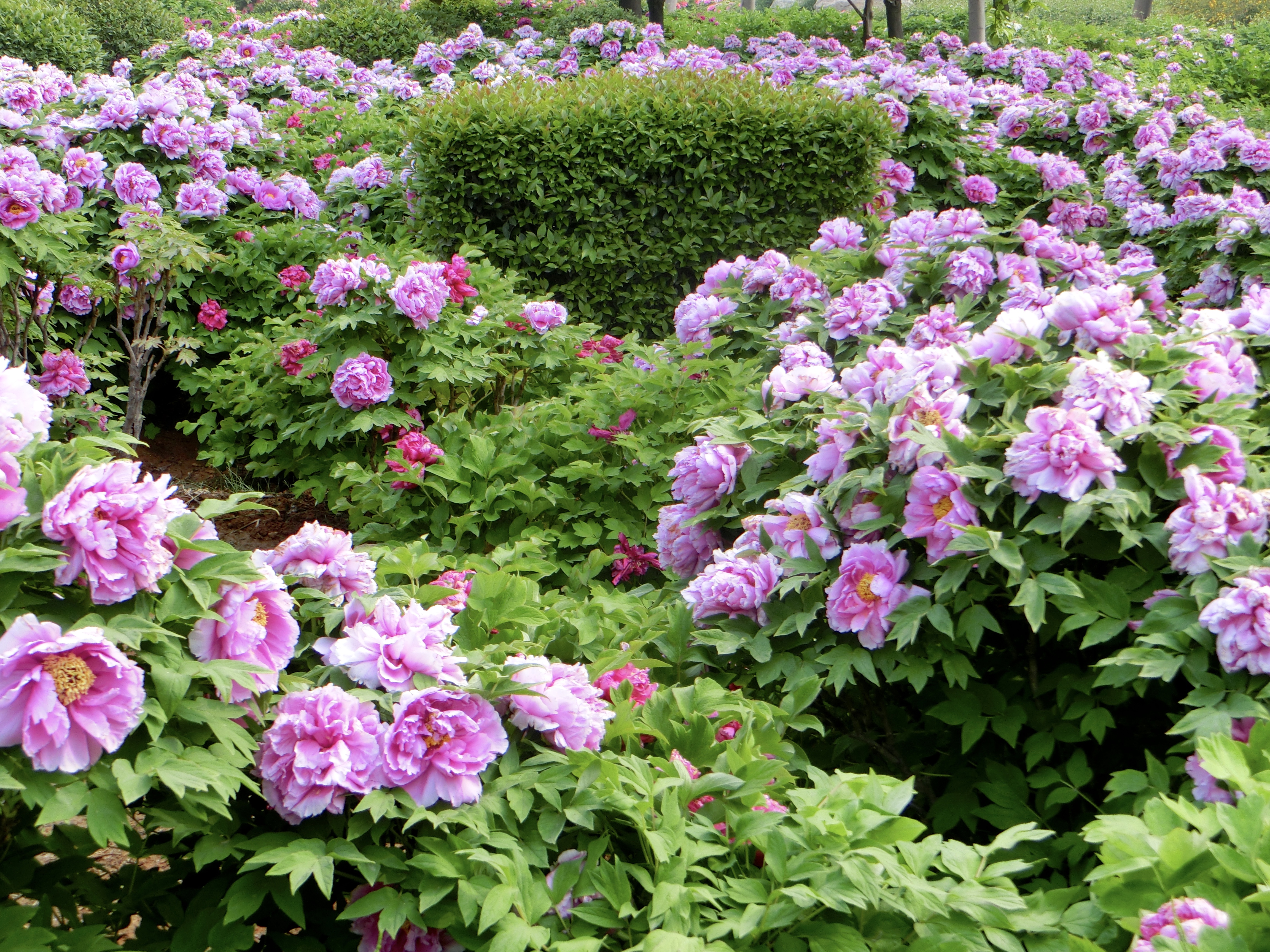
In Luoyang every year from mid-April to mid-May when the peonies are in full bloom the city celebrates the Peony Festival. There are many peony gardens to visit in the ancient city that was once the capital of China. The most famous and main garden is the Luoyang International Peony Garden. It is one of the oldest peony gardens in all of China.

CIMG4052

I did not go to this garden. I couldn’t tell you which garden I visited. All I can say is that I was in Luoyang during the Peony Festival.

It was May of 2014, the morning after I had just hiked Mt. Hua with my friend Sean, and his friend Xiang Kai. We had hiked for 14 hours the night before, ill prepared and with little experience, on one of the most dangerous mountains . I’m talking about myself as far as the experience hiker part goes, but I didn’t think Sean was an expert, and I knew Xiang Kai had not hiked many mountains. Hiking in China is different than hiking in the U.S. In the U.S. hiking is a solitary experience. You climb with one other person maybe a few people and perhaps you cross the path of another hiker or two, but mainly it is you and the wild, and the animals who ignore or watch you. In China (or at least on Mt. Song, and Mt. Hua, and the other mountain I hiked) there are no animals only hoards of people. I never saw any animals, not a squirrel or a lizard only a bird or two. I’d never seen so many people on a mountain at the same time except at a ski resort during a holiday. The day we hiked was rainy and cloudy so it wasn’t nearly as crowded as it could have been. Even on a bad weather weekend there will still be hundreds of people climbing. It doesn’t matter if you go early in the morning or late at night it’s still crowded. The key would be to go off season during the middle of the week and definitely not during any vacations or weekends, but when you’re a teacher you have the same schedule as all of China, so either you don’t go at all, or you experience it like all of China-crowded. I had decided that day that I would one day return to China, but not to work only to travel so that I could plan my visits to ancient sights and geological wonders on the off times, but those were and are daydreams for other days.

CIMG4044

It was Sean’s idea that we stop in Luoyang to attend the Peony festival. Xiang Kai had to work that evening so he would not be able to join us. I was exhausted. My body felt worn and broken and I was irritable and still fuming about Sean’s comment that I was too old to climb a mountain. Ignorant boy, my mind ruminated on his off handed remark about my age that only an ignorant boy would make. I had hoped his feet were still suffering from his badly chosen climbing shoes. The wise thing for me to do would have been to go home, eat something nutritious, and then go to bed, but when Sean made the spontaneous suggestion I felt I needed to go. Life is an unexpected ride and you never know when it will stop and where it will start and many times an opportunity is a one time only opportunity. When would I be in China again for the Peony Festival? I had already decided not to renew my contract. I had already decided to leave China. I could tell myself I would be back, but I didn’t know for certain. Some days I hated China, and would think, never again- never again will I return to this country. It had been a hard year for me, and not all China’s fault, but I was in China when my mother died. It was in China when the most important person in my life left this world. My worst fear had been awakened. How many times had she told me that she would not be able to live without me? How many times had I promised I would never let her die alone? How many times had I told myself I would return and take care of her? China was to be my last experience, my last galavant as an explorer of this world living a life style that I didn’t believe was meant for me. I had never imagined I would ever be able to travel, that I would have lived in foreign countries. I was an accidental traveler and it was time to return to my “real life” whatever that was meant to be. I was going to go back to California and going to care for my mother. I didn’t want to live in Chico because there wasn’t anything for me there, but she was there and she needed me. I had been too slow, and too selfish, and I had failed her. I failed as a daughter. I suffered through that guilt alone in a foreign country, a country so foreign from my own that even our process of grieving was different. My mother died alone, and I had not been there to help her.  My anger, and my guilt, and my pain all manifested into my frustrations about a country that was so incredibly different from my own. I did have Sean though, my friend with his choppy english and his oh- so Chinese ways of thinking. Sean my friend who stayed by my side the best he could and tried to show me the things he loved most about his country. Sean was an impatient Chinese teacher, and impatient about many things, and he expressed much frustration about where he was in his life, but through it all he taught me a lot about patience and how to deal with frustration and how to accept that where you are is where you are, but that change is always around the corner whether you want it or not. Uncertainty is the essential part of this life experience and in the uncertainty lies the choices.

CIMG4046

This was life, and I was still living, and I had to take the opportunities as they came no matter how much my body hurt, and how aggravated I had felt when would I have another chance? I agreed to stop in Luoyang and to see the Peonies.

My body was not in full agreement with my mind or my heart. As we wandered from the train station to the nearest garden my body began to pull rank and my brain switched sides and together they caused me to grumble and slouch and move among the flowers like an impetuous child snapping bored pictures here and there waiting to stop to take a nap. Once in the garden all I really wanted to do was lie down in a bed of purple peonies among all the butterflies and drift off into a deep sleep. I did my best to not unleash my grumpiness on Sean, and I allowed him to tell me stories about the history of China and the symbolism of the flowers. He was gracious enough to understand that I was not feeling my best, yet still seemed to enjoy my company. In the end I knew I was not fully present in the moment, and that my body and exhaustion had won this battle, but simultaneously I was aware of the value that the day, and the weekend held.

CIMG4028

We are gifted moments in life and too often they only come once. Some are large and noticeable, but most are small and subtle and too easily we miss them. We don’t take the chance to strike up a conversation with a stranger or take the path that no one is following. I know no other person from my life, as of yet, that has hiked a sacred mountain with friends from China, and eaten prepackaged chicken feet and teriyaki marinated boiled eggs, and then stopped off at a Peony festival that had been celebrated for two thousand years. When I do meet someone who has experienced this it won’t be the same as I had experienced it. We all experience our lives differently, we are similar, but still we are each unique.

I didn’t get to enjoy the Peonies to the fullest of my capacity, and I wasn’t able to collect the memories of the day here in a nice well packaged form to share with others as to the best way to see the Peonies. I didn’t have to because no matter where I go in the world I am going to be me. That means me in a bad mood, me in a good mood, me irrational and me aware. Me wonderful and me not wonderful. My goal is of course to lean my life more towards the awareness and wonderful, and to be in the presence of my life and embrace the moments. Some days work and some days don’t regardless if I am climbing a sacred mountain in China or washing laundry in a laundry mat in Portland, Oregon. Years later I can think back on my hike and my visit to an ancient garden with my friend from China, and look at the pictures I took of flowers that had been planted and cultivated for two thousand years. I can accept the fact that flowers and gardens are not top on my bucket list, and I can say to myself, I did that, and I went there, and I was in a bitchy, irritable, and grumpy ass mood, but I was there. I took that moment and received all that it offered me even if the gratitude came a week after some solid rest.

CIMG4029 CIMG4101

The Yellow River Park in Zhengzhou

CIMG4400

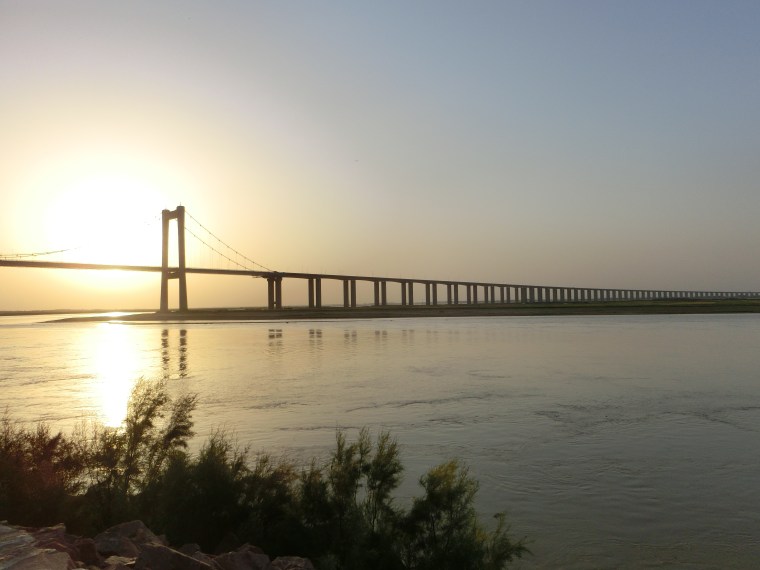
The Yellow River is called “The cradle of Chinese civilization”. Chinese dynasties were built along this river, and in the early periods of Chinese history the regions around the Yellow river were the most prosperous. It is the 3rd longest river in Asia, and the 6th in the world. It is a life giver and referred to in Chinese as the mother river, but it has also earned the name, “China’s sorrow.” This river has has taken well over a million lives. The river’s flooding from it’s constant changing of course from erosion has earned it the world reputation of being the only natural disaster in recorded history to kill more than a million people.

In the years between 1332 and 1333, seven million people were killed from theYellow river flooding, and the subsequent famine and disease that followed after. In 1887, 900,000 to 2 million people died, and in 1931, 1 to 4 million people died. The most interesting of floods happened in 1938 during the second Sino-Japanese war. The Chinese military decided to break the levees and flood the valley on purpose as a way to prevent the advancing Japanese army from reaching their goal of capturing Wuhan where at the time the temporary Chinese Government was set. The idea was to have “the water be a substitute for soldiers”.  5,000 to 9,000, Chinese civilians were killed in the floods, and an unknown number (but most likely not as many Chinese) of Japanese soldiers. The flood stopped the Japanese from capturing the city of Zhengzhou, but they still reached their goal of overtaking and capturing Wuhan.

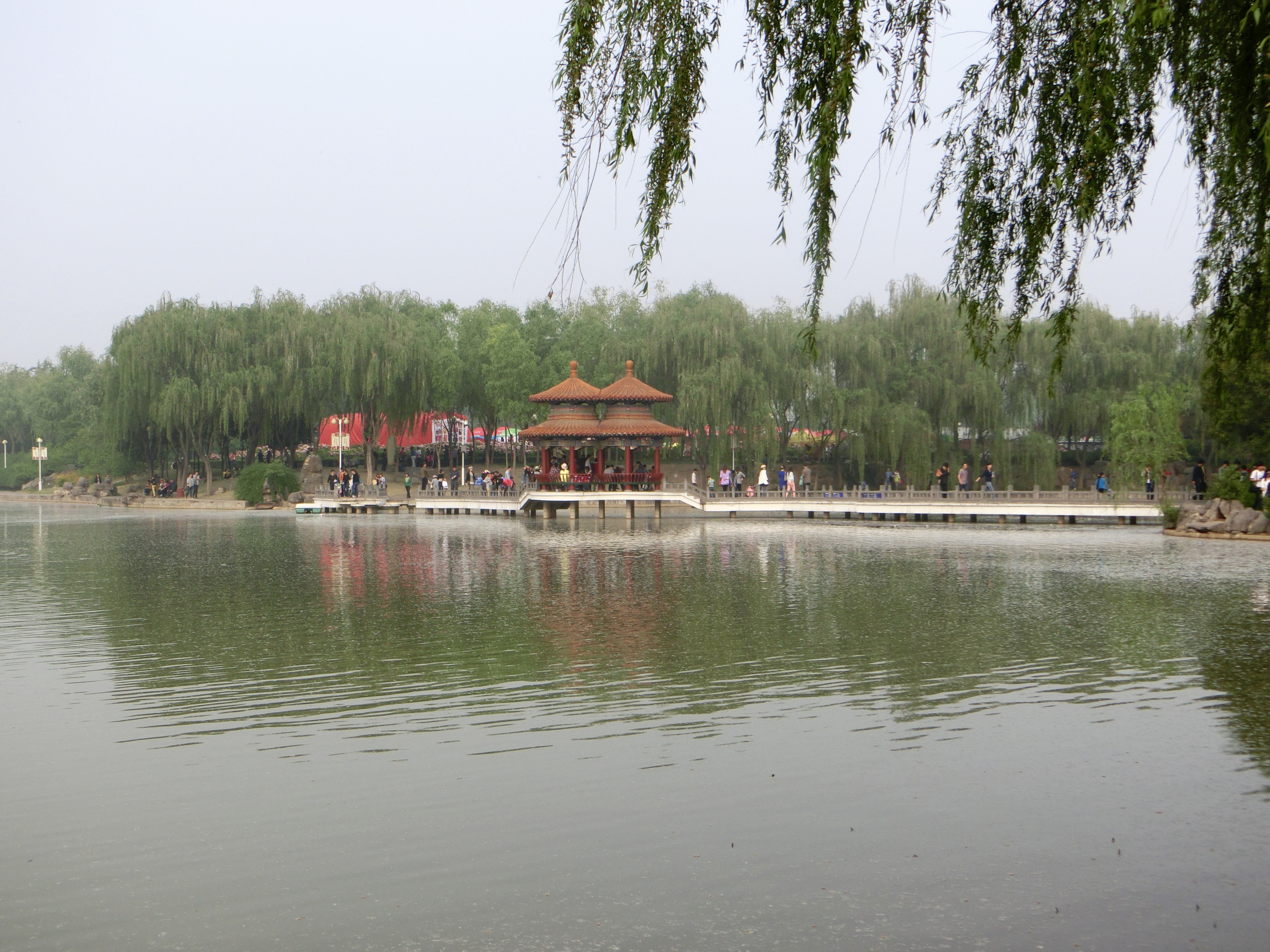
A river that has birthed a civilization and taken away such a multitude of life is not going to  continue in modern China with out a park dedicated to it. The Yellow river park is located in the northern part of Zhengzhou, and can be long trip on a bus, but we were lucky to have a friend with a car, and he drove his family, and my friend’s family, and myself to the park for the day. This happened near the end of our stay in Zhengzhou so it was a nice way to end a year in this Chinese city of Northern China.

It’s a huge park with five sections. At the time of the visit, we were not informed of where we were or the significance of any of what we were looking at so much of it was just interesting for the sake of its existence, and carried little historical reference for any of us foreigners. Aside from the massive statue of Mao, I had to look up the names of other statues and buildings on the internet, and I wasn’t able to find the names of everything, but I was able to find some bits here and there.

CIMG4278

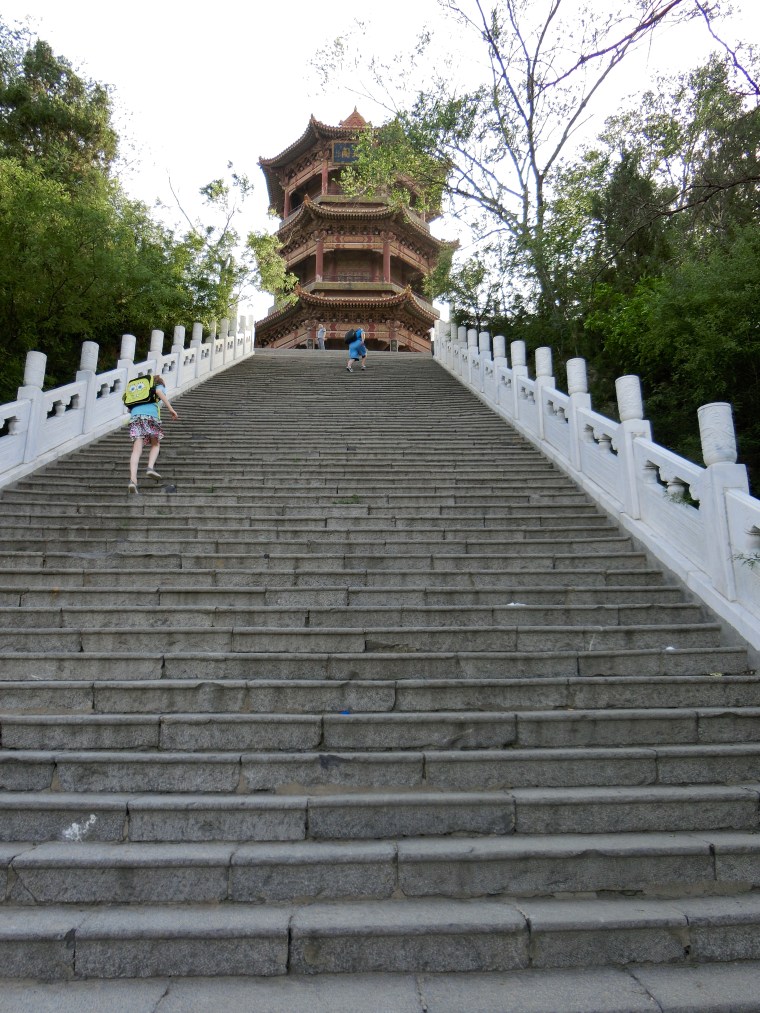
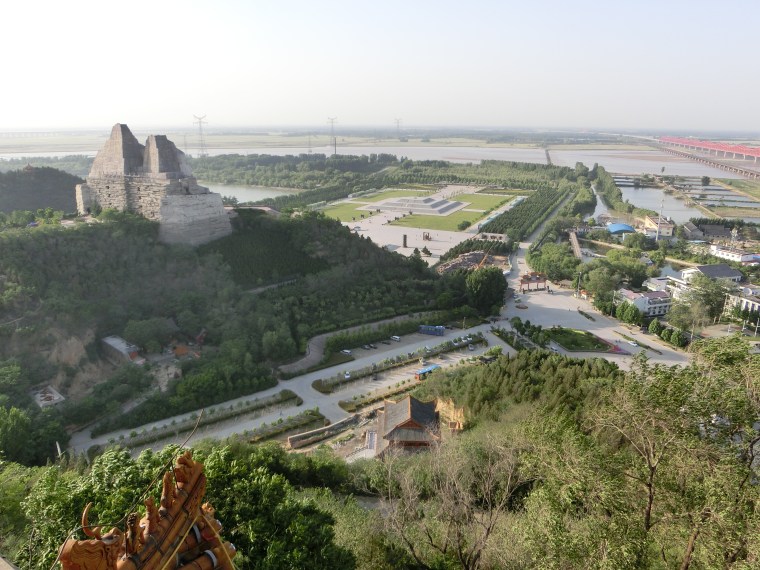
We first ascended a small mountain, and that is where we found the giant statue of Mao. The children quickly preceded to climb him in order to race to the top to see who could tag Mao’s mole first.  It is considered good luck to rub the hands of Mao. The infamous leader  is known for saying, “We must control the river,” which resulted in building dams and levees. The view from the statue of Moa looked down on the the wide and literally yellowish brown river. Looking down from the mountain we could see areas for rice paddies but most of the area is now used for the purpose of the park, and transferring the water from the river to Zhengzhou.

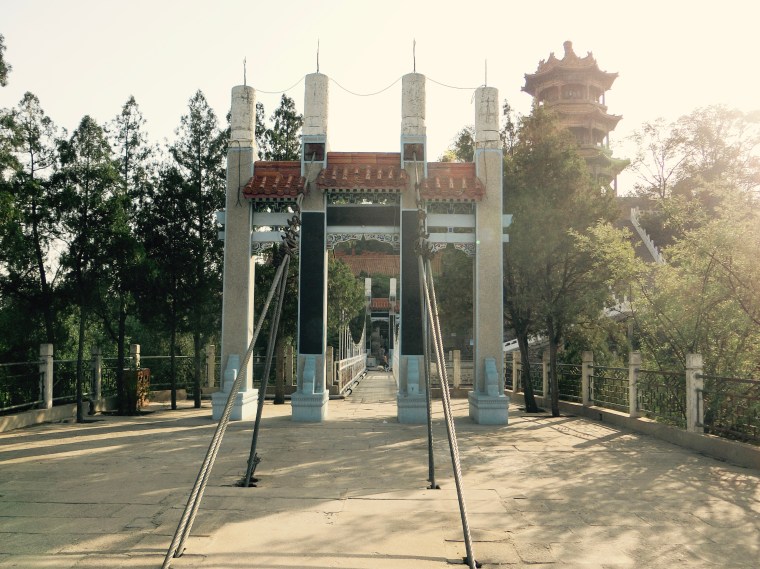
We crossed over a bridge called the Luotuo (camel) bridge which led to the Yueshan temple on Yue Mountain. There is a great view of the statues and the monument that they built below. I didn’t know the significance of much of what I was looking at, unfortunately, but what I’ve gleaned from the internet is that the giant statue on the mountain measuring 59ft high is the connected heads of Yandi and Huangdi the great ancestors of China, and they face the river in a symbolic reverence for this giver and taker of life. Information pretty much dies out from there.

CIMG4281CIMG4285CIMG4293CIMG4319

At the base of the part of the park that is called the Five Dragon Peak there is a statue of a Mother cradling her son. This statue is to represent the mother river and China, and their harmonious relationship (they’ve yet to build the statue of the mother dropping and shaking the baby to represent the times not so harmonious). The park also has statues of very famous calligraphy writers- non of whom I knew of, but calligraphy is an art form in China, and to be called a writer in China means that you do calligraphy. It was in this area of the park were we found a man who painted a quick drawing for each of us (for a cost) and then wrote a poem. I had asked my Chinese friends what the poem said, and they all replied, “It’s too hard to translate,” which I found to be the common response when asking for the translations of certain things.

CIMG4356

CIMG4389

Our tour guides drove us around to parts of the park where not all tourist were allowed to go which is the advantage of having your driver being a Zhengzhou cop, and he took us to a quiet area near a sharp curve in the river where there seemed to be people disgusting the construction of something. A woman rode out on horse back to deliver a message to people working, and then she quickly rode away as if riding back into the past. We were warned not to stand too close to the river, not because it can jump up and pull you in, but because the soil and silt is very soft and can suddenly crumble under your feet. It is this soft earth that causes the rapid erosion and the continuous changing of the river. Although, the river has not changed much since Moa exclaimed that it must be controlled.

CIMG4397CIMG4409CIMG4411

We ended at the base of the figure heads of Yandi and Huangdi where many Chinese were ringing giant bells, taking pictures and a couple of men were swinging whips over their heads to make giant cracking sounds that reminded me of firecrackers or gunshots. We watched the sun set behind wires and trees, and took the long traffic flooded drive back into Zhengzhou.

Faking China: A Theme Park

If you find yourself in Zhengzhou, China, which is in the Henan Province, which is in the north, and to the west of Beijing, and find yourself wanting to visit other parts of China too, but can’t for one reason or another, that’s okay because you can go to fake China in Zhengzhou. You never have to leave.

It’s been two years’ since I have lived in China, and even now certain memories return to me. Memories of me thinking, “What the hell is this?” and not knowing how to quite register the wonder and multitude of questions that China can at times offer. I had started saying to myself, “stopping asking why, there is no answer to why, it only is as it is. There is no why, and no answer, it’s just China.”

CIMG4930

China is naturally a geological and geographical land of amazing beauty (I won’t focus on the horrible pollution that is destroying that beauty, but I’ll still mention it as an aside because it’s important to be reminded that there is a lot to lose). There are landscapes that steal your breath away and fill your heart with awe, but China is also the land of manufactured worlds, and that too is…well…it can leave you speechless. There is as much natural beauty as there is… shall we call it–imitation.It is a matter of opinion on whether you think this is an eyesore and a waste or if you think it’s a brilliant oddity of manmade accidental art, but when you are standing in the middle of one these pretend places you can’t help but be…well…speechless, and oddly admirable of the juxtaposition of China and China’s imitation of other counties and itself. There are ghost cities, and copycat cities: the fake Paris and the fake Venice, for example which are also ghost cities, and there are amusement and theme parks that are just devoted to imitating cities; like Las Vegas in a park with no gambling or strippers or alcohol.

In Zhengzhou, where I had spent one year of my life, the school where I had been working at the time took our classes- the English Language school, No. 42-to a park on the outskirts of the city as part of a class excursion. In the past, I had heard that the school used to offer two class trips a year, and that they had visited actual famous sights and landmarks, but I guess by the time I had arrived they must have lost the budget or decided not to spend so much on the teachers and students- so we got fake China. I never learned the name of the park in Chinese or translated into English, and believe me I had tried. I searched the internet but couldn’t find any information on this mystery park visited by Chinese students and couples having their wedding pictures taken. The closest I found was the Century Park where all the students excitedly thought we were going until our bus passed it by and took us to a second tier theme park. There were audible groans of disappointment.

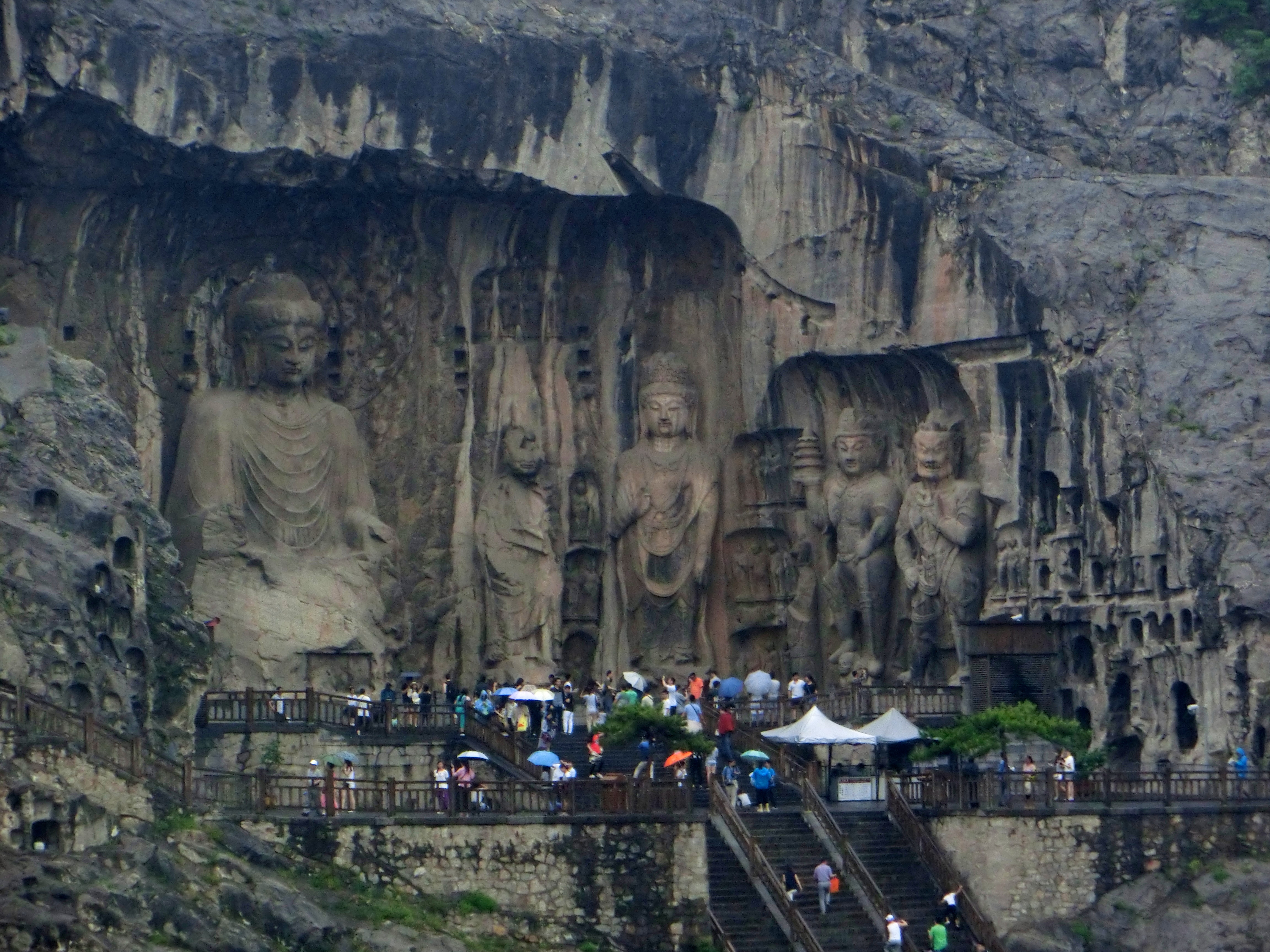
A picture of the Longmen Grottos from across the river.

Henan, the province of Zhengzhou, is a very important province in the history and the civilization of China. In fact, out of the eight ancient capitals of China four of them have been located in Henan. Zhengzhou was recently added to that list due to the discovery of an ancient dynasty perhaps the oldest of all the dynasties, the Shang dynasty (1558 b.c.- 1046 b.c.). When in Zhengzhou there is no remanence of the Shang’s presence except for a portion of an ancient settlement wall that looks today like a giant wall of dirt. You can find this wall in the eastern part of the city. The other Capital cities were once located in Luoyang, Kaifeng, and Anyang (where the oldest collection of Chinese writing was found written on ox bones and turtle shells. Evidence of the Shang dynasty had also been found in Anyang). Henan is not only the birthplace of the great Chinese dynasties,  but also Zen Buddhism, and Kung Fu. In this one province you can visit the oldest civilizations of China, and the explore the historical birthplaces of China’s societal foundations many of which still hold today, even many events leading to China’s communism were formed in Henan. In Luoyang there are the grottos an amazing religious site with over 100,000 carvings and status of Buddhist images. In Dengfeng and Shaolin are the schools of Kung Fu, and in Kaifeng the most famous judge in the history of China, Boa Zheng, had once resided. He was also called justice Bao because he was honest and upright, and even today he is the symbol of justice. A living history lesson at can be at your finger tips, but if you can’t get out of the city you can visit these ancient landmarks in one city park in Zhengzhou.

The area where the ancient wall from the Shang Dynasty was over 3,000 years ago.
Where there were once ancient ruins discovered in the 70's and 80's now families plant urban gardens.
Where there were once ancient ruins discovered in the 70’s and 80’s now families plant urban gardens.

I wasn’t really certain what to expect, and since at this point I had already lived in China for close to a year, I knew to expect the unexpected. All that could really be explained to me was that we were going to a park. I’ve decided to name it The Park of Great Things In Henan and Beyond, because every city and historical monument was represented in replica, not to size, for the Chinese tourists to enjoy. I say Chinese because this isn’t a park that many foreigner travelers may find themselves. Not many foreign travelers will even find themselves in Zhengzhou for more than a day. Most people come to Zhengzhou only to change trains unless they are actually living in the city. I remember a person once saying to me, “Zhengzhou? Oh yeah, I think I was there, in fact I got my wallet stolen in the Zhengzhou train station.”

CIMG3431
Not real
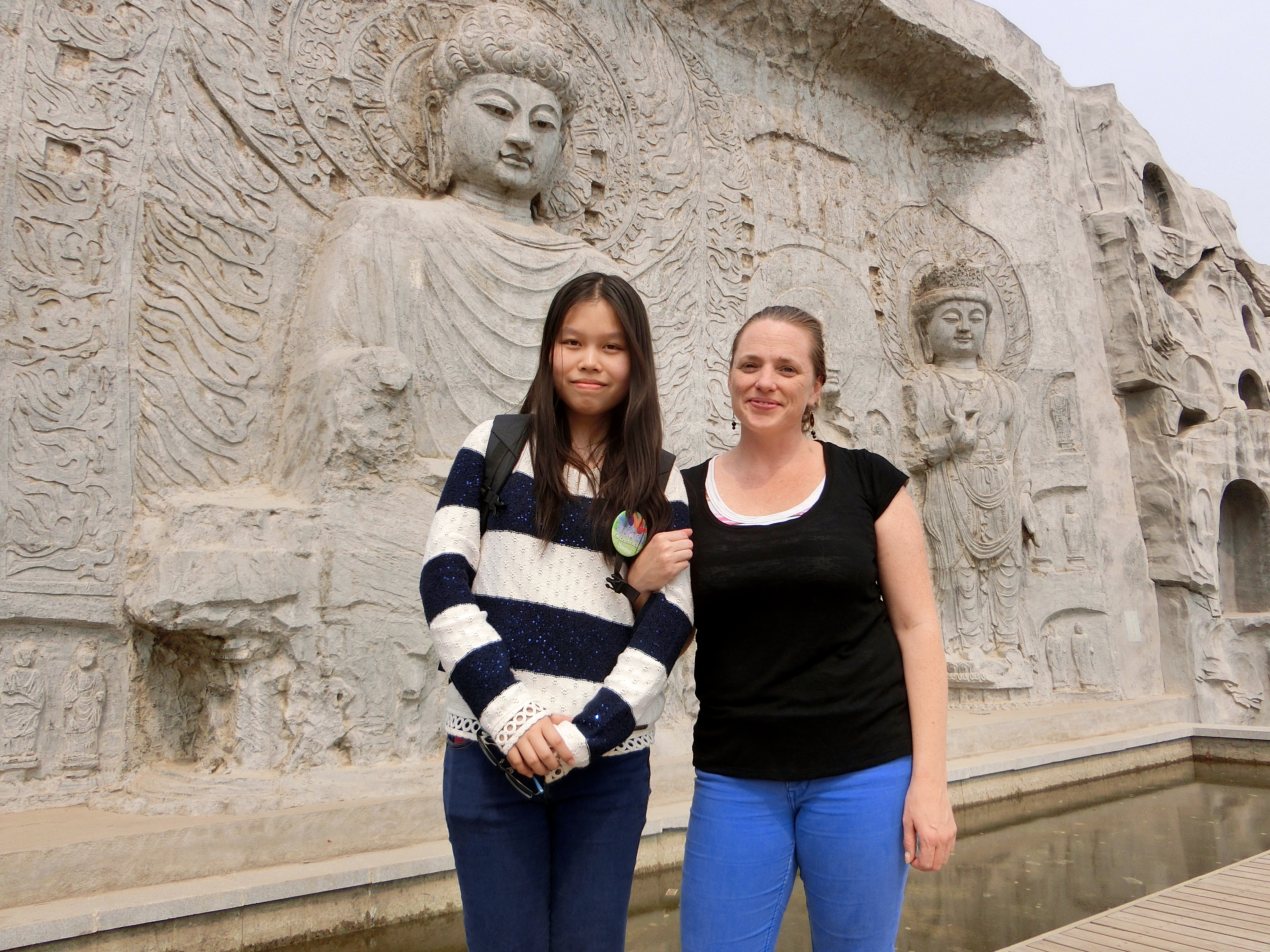
My student and I at the fake Longman grotto.
My student and I at the fake Longmen grotto.

Can’t visit Luoyang? No matter you can find the Grottoes here. Don’t have time to see the Iron Pagoda in Kaifeng? It’s here. You’ll never find yourself in Anyang? You guessed it, it’s here too. In fact, if you want you can see a part of the Great Wall here too. If you get tired of China you don’t ever have to leave the park because around the corner you will find Egypt right next to Greece, (of course) and all of Africa encompassed in two statues, and right next to Africa you’ll find Australia, exactly where you’d imagine it to be. The main highlights of the park were physically being there and kind of wondering why; discovering the pretty offensive perceptions of Africa (or maybe some island places?), the aged look of the park when it was only a couple of years old, having a water gun war on paddle boats, a Chinese man assuming I was a Christian because I am white/foreign and handing me his Bible to hold as he bowed to me several times, watching the multitude of wedding photography, skipping rocks with my students on a fake lake that had a water show, and spending time with students and teachers in a place that would and can only be experienced once in my entire life.

Fake Africa
Africa? The Polynesian Islands?

Fake Australia

Greece is only a pathway away from Egypt.
Wedding Shot
One of many couples getting their wedding shots which are a huge part of the marriage.
She hadn’t yet learned to skip stones.

If you want to see a few more photos from this theme park you can find them on my blog Simple.

Night Clubs, Russian Disco Dancers, and Hot Pot After Midnight in Zhengzhou, China

I had been warned to never eat hot pot from a street tent. At the moment that I was picking out what bit of food on a stick to put in my boiling bowl of soup, I didn’t really think about the warning or even what ‘hot pot in a street tent’ meant. It wasn’t until I was on the bus heading home at 7:00 in the morning, after a ridiculously late evening out, that I remembered that I was warned.

The bus gently rocked and lulled me toward sleep. I had a thirty minute bus ride to get home. I stared at the few Chinese denizens sitting on the bus. A man was asleep in the far  back corner. His head was slumped over his right shoulder. It hung like a loose button on a thin thread, and I wondered if a jolt of the bus would break his neck.  I wondered if he stayed out to late too. It was a Sunday morning, not a work day. What were these people doing on the bus? Shouldn’t they be busying themselves at home? Shouldn’t they be just waking up? I still haven’t grasped China. I’m not clear if it is really a five day work week or if people are working on the weekends. Some do. I was trying to justify why I was so wrecked on this bus at 7:00 in the morning. Trying to find some partners in irresponsible crime. I was concerned about being judged. Which shouldn’t matter, but I’m always stared at and examined. I didn’t want to join the ranks of drunken irresponsible westerner, but like I said, it didn’t matter what anyone thought. My life was only temporarily passing through this place. Temporarily passing through many places it seems.

I ate the hot pot from the street tent. I realized this while my thoughts were on the strangers on the bus. It is because of the gutter oil. The oil that people dredge from the gutters and reuse in order to save money. I figured I would be sick later. I’m sick often after the street food. It can be anything. It took a few months before my stomach toughened up some. I can’t figure out if it’s my age or the food. Maybe, a combination of both.

CIMG1734

I don’t go out much. I’ve turned into a sort of hermit a kind of recluse. It could be culture shock, but I know it’s a combination of many, many things. Things not worth writing about yet. The nights out are rare, but they always end the same- It begins with drinks at one place, and then a move to another place to have too many drinks and then to a club. Drinks are bought together because you can’t have a table unless you buy the bottle or a rack of beers. The crowd is mixed- Chinese, Americans, Mexicans, Arabs, Africans, English, Russians- mostly young, but sometimes there is a range in ages. After a bottle is bought (usually Red Label Whiskey) and the worst sweet tea mixer ever designed, the dancing starts. Dancing on spinning dance floors, raised dance floors, floors that have hydraulics- the works. At times I think the Chinese are absolutely crazy. There seems to be so little concern for personal safety. I’m aware that I grew up in a world of hyper-saftey concerns sometimes over the top, but I was raised in the 70’s and 80’s so I did experience pre-seatbelts and all of that, and I did live in Germany where there is a kind of ‘go at your own risk’ type of safety concern. I really liked Germany’s take on it. It allowed you to take personal responsibility for your own actions, yet you still could take a risk if you wanted because it’s your life, but you better be aware of the consequences. I liked that. I’d say maybe China is like that, but then again it seems like there is no idea of consequences. As if people go about their day never even thinking that anything bad could possibly happen to them even if they are driving on their e-bike at night with no lights driving the wrong way on a one way street while reading a text message. What could possibly happen? There’s never any helmets worn and people drive on the wrong side of the road, never give right of way cut people off. I’ve seen children as young as four standing on the shoulders of the front seat of the car with their heads out of the sun roof. This lack of safety concern is in everything. The way buildings are built, pavements are laid, toys are made, how a person crosses the street. The dance floors reflect this nutty wildness. It seems to me like the worst idea in the world to create a dance floor that spins in a club where people are drunk. I don’t know why we don’t see more Chinese people in extreme sports because they seem fearless.

CIMG1726

The clubs and bars are smokey like America in the early 90’s. It can be hard to breath especially when dancing on the stage. It isn’t really a stage, but more like a runway raised four feet from the floor, and made of metal. I love to dance, but I find it difficult to get into the dance scene here. The  crazy amount of smoke with absolutely no air circulation, the narrow dancing space, and the great noticeable distance from the stage to the floor. There are tables all around the runway dance floor so if you were to fall then you’d fall onto a table. I find it hard to relax even with too much Red label Whiskey mixed with the god awful sweet tea. The music, er, well, I’ll just say the music from one club to the next is not that much different, and in all fairness, to give a bit of perspective, bars and clubs in this part of China are still a new thing. I’m also a secret curmudgeon. I don’t really like clubs. I like dancing, but club scenes are not my thing (even though I continue to find myself in them). Still, in retrospect it is a worthwhile experience mainly because of the fact that I’m living in China. When my mind is in a state of complete discomfort which it has been often while living here, I’ll have this sudden realization that I’m in China on a spinning dance floor with a group of people from all over the world, and that this is just a moment; a rare blip of a moment that will be over in a couple of hours, and how strange that all sounds to me.

The hot pot night was a little different then the usual night out because it was morning with strangers and four different possible languages, but English was the one we all had in common. At five in the morning I could care less about the gutter oil.

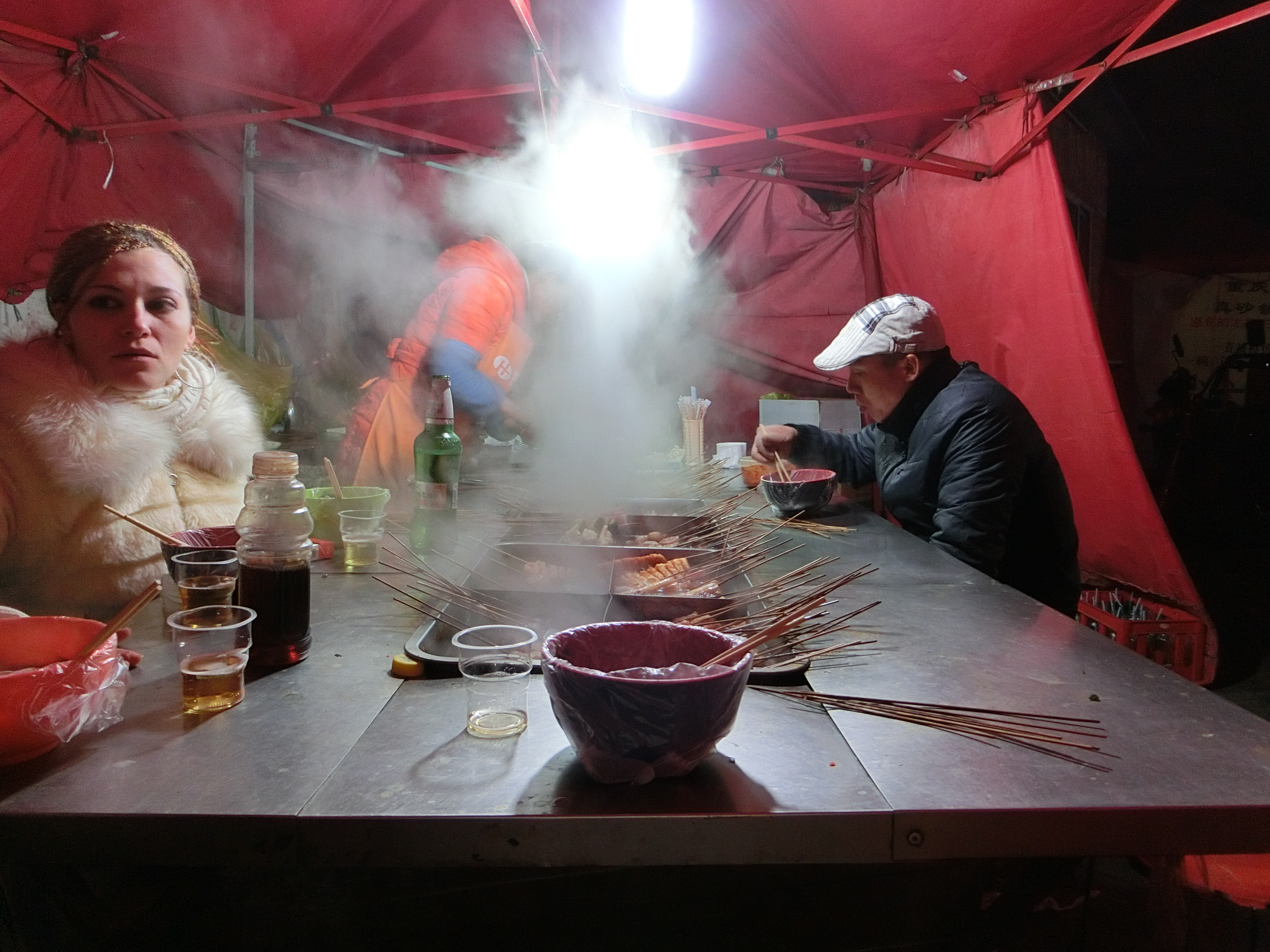
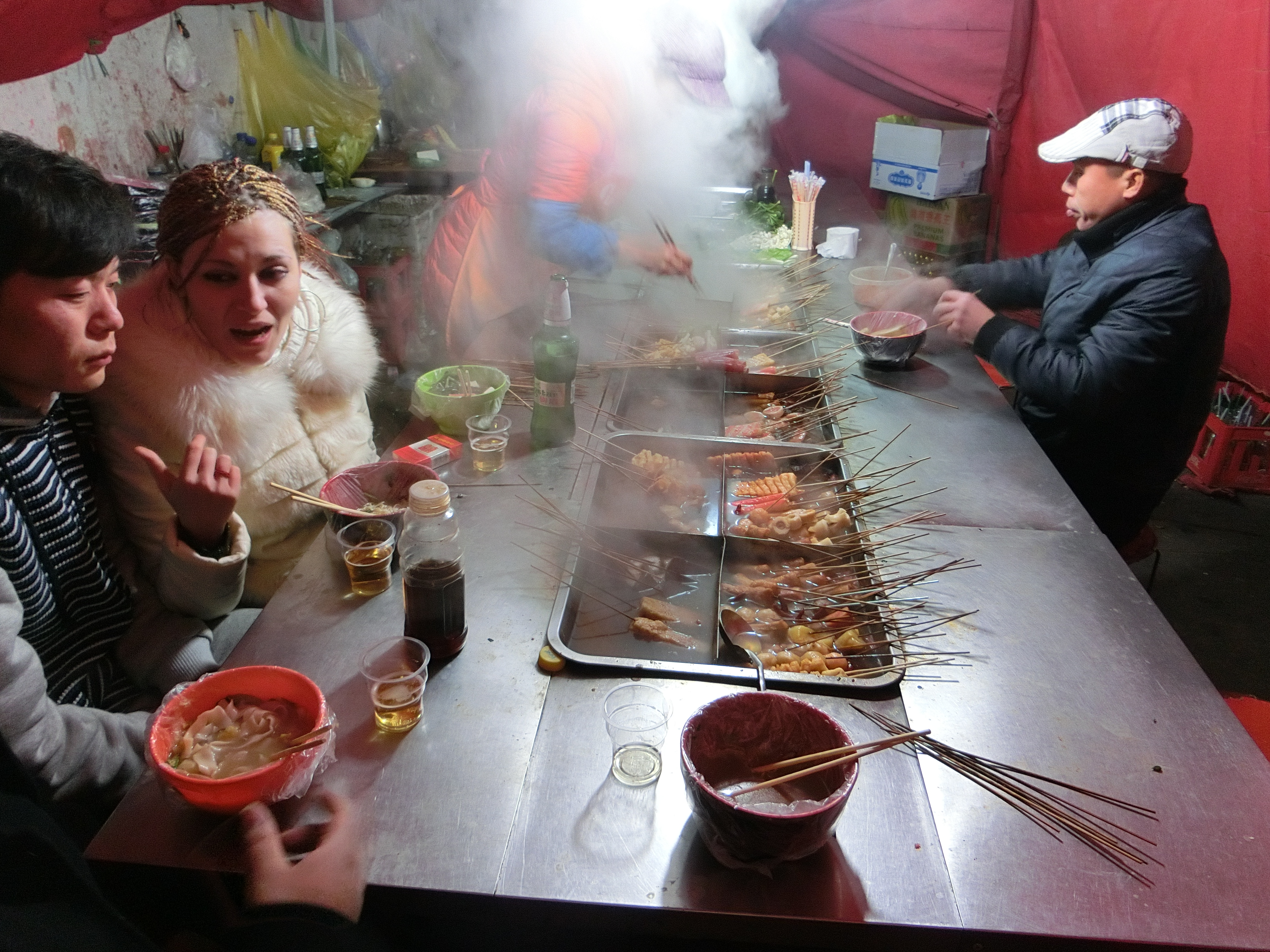
What do you get when a Russian, a Chinese, an American and a Mexican walk down a dark alleyway… food and conversation about love. A red tent with a hot pot eatery. Five am beers are ordered. The soup is ordered. The noodles are ordered and we pick our own food. The soup is in a plastic bag placed inside a bowl. I don’t think of sanitation which is the best way to get sick. I only think of eating and then going home to sleep, but it is so far to where I live (another reason why I am a part-time recluse).

Outside the sun is rising. The smog is rolling into the city like fog off a bay. Pictures are taken and taxis are waved down, and I wait for the number 7 longing for my hard bed. I wonder what the hell compelled me to stay out so late. I give myself a little reprimand then think about how often I stay up till morning at a dance club with people from all over the world, and then stumble down a dark dirty alleyway to a double sized red tent to find a hot pot inside filled with Chinese men that work late or start their day early. Not very often. I forgive myself and look forward to sleep. This is a year in China. It won’t happen again. Not in this city.

China Diaries: Why am I Struggling to Write About Life in China?

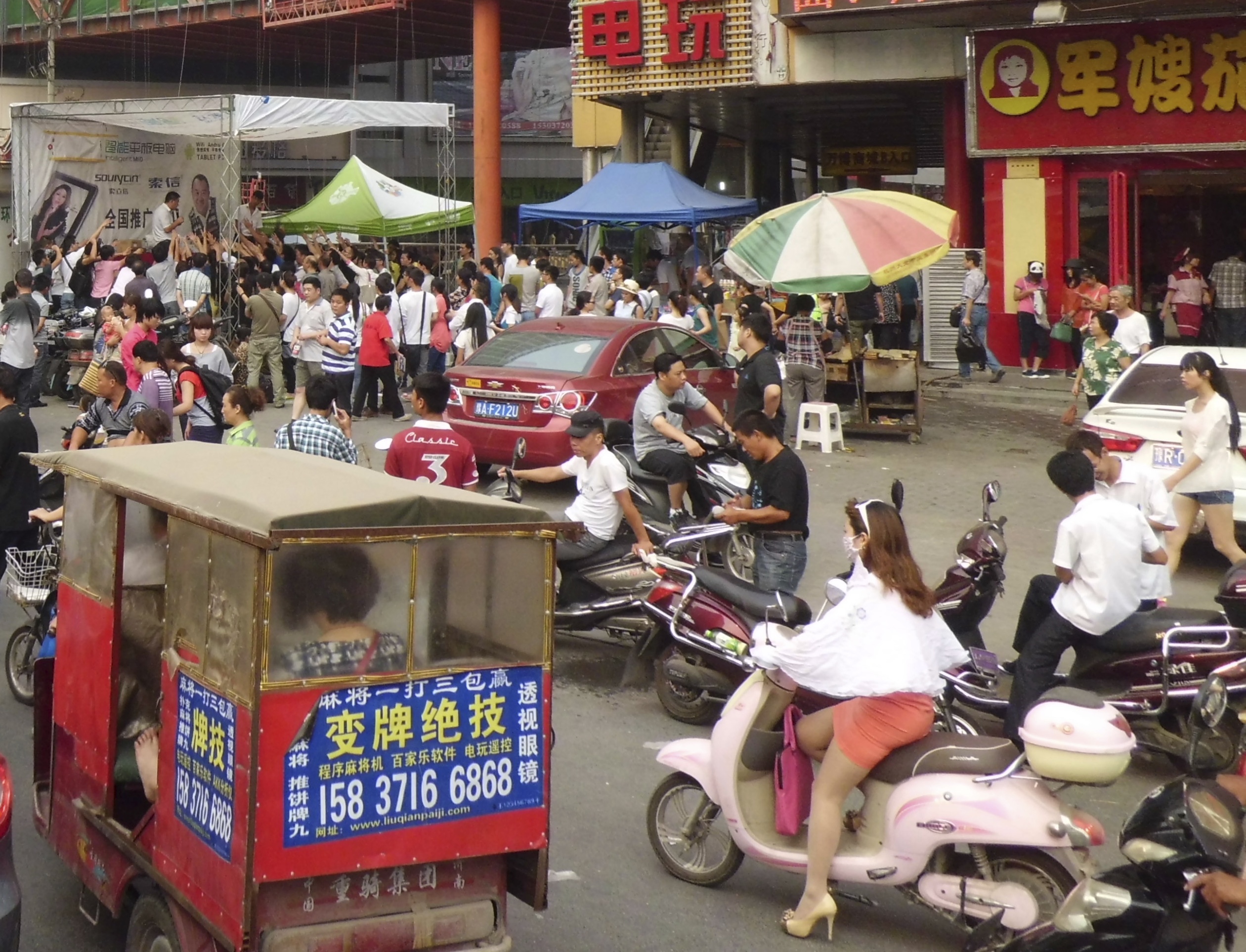
Daylight in Zhengzhou, China. Multiple scooters, cars and electric cargo trikes bottle-neck into crowds of pedestrians.
Crowded streets near the Zhengzhou train station

I have been in China for a little over a month. In fact, I am one week shy of two months, and I don’t know what to say about it.

There are plenty of topics from which I can choose to write a story. I could write about the air pollution. I could write about the traffic and the driving. I could talk about the cultural differences in ideas surrounding education. I could write about visiting Shaolin and what it felt like to have my picture taken as many times as some of the stunningly rebuilt temples. I could talk about what it is like to be a teacher in a program filled with China’s second generation of wealth. There is the food, the water, the toilets, the westerners there are many topics.

Erqi Memorial Tower at night in Erqi Square, Zhengzhou, China.
Erqi ( pronounced Archie) Memorial Tower in Erqi Square

Yet, when I face this computer screen and this blank page or when I hold a pen in my hand and stare down onto the blank sheets of paper in my journal, my mind is empty. I am unable to communicate into written word my experiences thus far. I’m certain I have been experiencing culture shock. There were days in my first week when I couldn’t go outside. I was like an agoraphobic unable to leave my apartment. It wasn’t only about how different it was, but how different I was in a crowd of thousands. I’ve never experienced these feelings before, and I am struggling to find the words to describe what I have been feeling, especially in the moments of paralysis.

Writing is the moment when I, an author, can be like the painter. When words translate impressions, observations, and feelings into verbal expressions. It is the time to recreate inner thoughts and experiences through figurative language in a way that guides others toward understanding those thoughts. Written words allow others to share in those experiences, maybe even pretend that they are the ones living vicariously through the words on the page. This is a particular type of writing. It is the type of writing I want to do. I have these words. I know I have these words. They are in my brain. I know it. I can feel them bubbling and rising to the surface of my mind, resting on the frontal lobe, and like water they soak in between the ropes of my brain. I sit up and grab a pen to write, but when I go to the desk they vanish.

I am left with a feeling of a wanting and an emptiness.

The Zhengzhou international conventaion center lit up at night with glowing purple, pink and blue colored lights.
Zhengzhou International Convention Center at night

“Use your English words.” I say this a lot in my classes.

“What does that mean?” I ask a student that is making a gesture with their hands. I think I know what they mean, by the gesture. I could easily say, “Yes, you are right that is the definition,” and let it go, but instead I say, “Use words. What do you mean by that gesture.” I push them because I have overestimated my understanding before, and communication has been lost. The point of our languages is to communicate. The student looks at me with a pensive look, “ummm… it is very hard. I do not know the words.”

My Chinese students are very good a memorizing. They are very good at taking tests. They are able to read a passage in English out loud, but when I ask them to explain what they have just read, they do not know. Reading skills are strong, but comprehension is low. The tests are not about comprehension, but recognition. They know the words in English, but they do not understand the words.

A class photograph of teachers at a school in China.
Year Book Photo, Teachers at Middle School #47

Language is complicated. It has four parts like a clover, yet within each part of learning a language there are deeper more complex units of understanding. It is beautiful. Multilingual people have a valuable gift. The gift of communication across nations. I don’t have this gift.

Use your English words”. I suppose that is where I need to begin. I can follow the advice of Raymond Carver and write a word, and then another word until I have a sentence, and then when I finish that sentence I will write another one. It’s like walking Carver said, “you put one foot in front of the other.”

And so, I can begin at the beginning.

I moved to Zhengzhou, pronounced Jengjo, China on the 25th of August. It is a large city in the largest province, in China; the Henan province. There are 80 million people living in Henan. There are 9 million people living in Zhengzhou. Those numbers are not exact, but they are close. There are 600 registered westerners living in Zhengzhou. I am one of those 600 westerners. 9 million Chinese citizens and 600 registered foreigners.

In my part of the city, the Central Business District, I have only seen foreigners who work at my school. Most days, I am the only non-Chinese. The only white person, and people stare and point, following me with their eyes. I am a foreigner. I can not hide this. Growing up white in a predominantly white town, and moving to a predominantly white city, I have never stood out. No, that isn’t right. Standing out can be fun, and positive, this is different. I am seen, yet invisible. All eyes are on me, but when I reach out for help eyes either turn away or turn blank, and some eyes scan me from head to toe, but somehow I am not seen, and my words are foreign.

I know other people have experienced this. People of color experience this even in their own country which must add another layer of otherness. You should be a part of the community because you were born there, but you are not, you are an outsider. The thought of that on top of what I currently am feeling wells up within me. I feel an empathy for others that I once only held as a sympathy. It’s lonely. It is a lonely feeling.

Few people speak English in my neighborhood. I do not speak Chinese. I do not even know the words. I am an alien in China. I am different. I am isolated. I am surrounded but alone. I don’t know the words. I don’t understand. I am alone without the language. My students they know my language, but they do not understand my language. So much is lost in the translation of gestures. It is just memorization without comprehension.

I am wrong. It is not lost in translation because there is no translation. I do not have the language to express to English readers these feelings of isolation within crowds. Yet, I teach English. My English fails me. What I wrote here today is the best I have to offer.