Suwon is south of Seoul, South Korea. It is about 45 minutes to an hour away depending on your choice of travel. It is the capitol city of Gyeonggi-do (경기도) or Gyeonggi province. 도 (pronounced Doh) in this context means province. South Korea has 8 provinces, 6 metropolitan cities that act as their own entities, a self-governing province which is an island-Jeju-do (here 도 means both province and island) and special cities like Seoul and Sejong. Sejong is a special autonomous city in South Korea which I don’t really understand, but its meant to be a second capital, or something like that. I never had the chance to travel there while I had lived in South Korea.
It took me about 4 years to figure out that Seoul is surrounded by Gyeonggi-do. This is because I used to live in Suwon, which is south of Seoul. I assumed Seoul was north of Gyeonggi province. Then while living in Seoul we took a trip to see the 5 Royal Tombs in Goyang in Gyeonggi-do which is north of Seoul. Suwon is south of Seoul and Goyang is north, yet both Suwon and Goyang are in Gyeonggi-do. It was very confusing until I finally just looked at a map. Basically, if Seoul and Inchon weren’t considered special cities they’d be a part of Gyeonggi-do.
Suwon City not Hwaseong City
When I lived in Gwanggyo, a city within Suwon, within Gyeonggi-do, it took about 40 minutes to reach Gangnam via the subway. During the weekends, I would often travel to Seoul to explore, so it wasn’t until a year after we moved to Seoul that we finally made it to the Suwon Fortress also called Hwaseong Fortress (Brilliant Fortress), also called Suwon Hwaseong Fortress. Why so many names? It could be because there is a city in Gyeonggi-do that is right next to Suwon named Hwaseong, and both cities which used to be farmland have grown so much over the years, and where the fortress was originally built has gone through name changes. It’s confusing, but to clarify, Hwaseong Fortress is in Suwon city not Hwaseong city.
The Korean Hanok
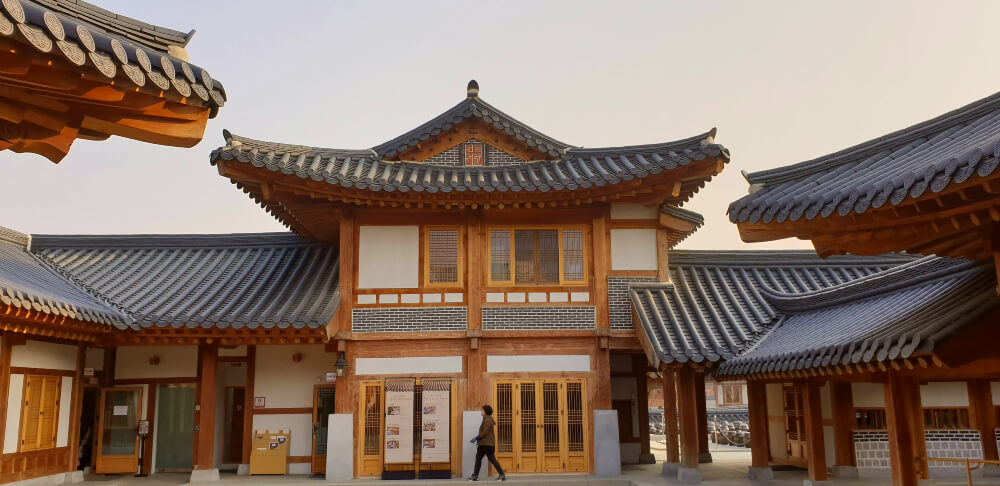
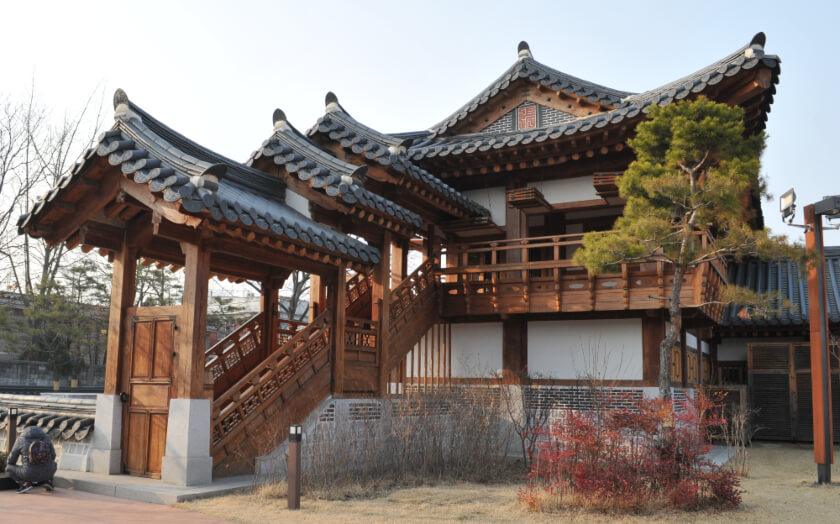
Our first stop was to look at a Hanok building at the Suwon Technology Exhibition hall and the Suwon Center for Traditional Culture. Eun had been taking some carpentry classes, and was interested in learning about the design and architecture behind these traditional Korean homes. So we decided to spend a little time learning about hanoks before exploring the fortress.
Suwon Traditional Cultural Center and Hanok Technology Exhibition HallTraditional Korean Games
According to information given at Suwon Technology Exhibition hall hanoks were first designed during the Joseon Dynasty in the 14th century. The home or building is designed with the elements and the seasons in mind. This kind of planning is called baesanimsu. It brings to mind Feng Shui which would make sense given China’s influence over ancient Korea. Similar to Feng Shui, it is about the perfect harmony between the elements. It’s all about building the good energy. The houses were (and are as the tradition is still alive) different depending on in what part of Korea they were built. In the south, the layout of a house is different from ones in the north. The north is colder, so the design is square with a courtyard in the middle in order to keep the heat in (You can see an example of this style in my post from visiting a tea house in the Hanok village in Bukchon,) whereas if you travel to the south where it is warmer, the design is created to allow more airflow, so they are open and often L shaped. The most ideal elemental design is to have a mountain in the back and a river in the front, which is really close to my dream home of a mountain in the back and an ocean in the front; Pacific Northwest style. The hanok that we visited, before exploring the fortress, was a modern hanok built as a museum to educate people on the history and craftsmanship of these homes.
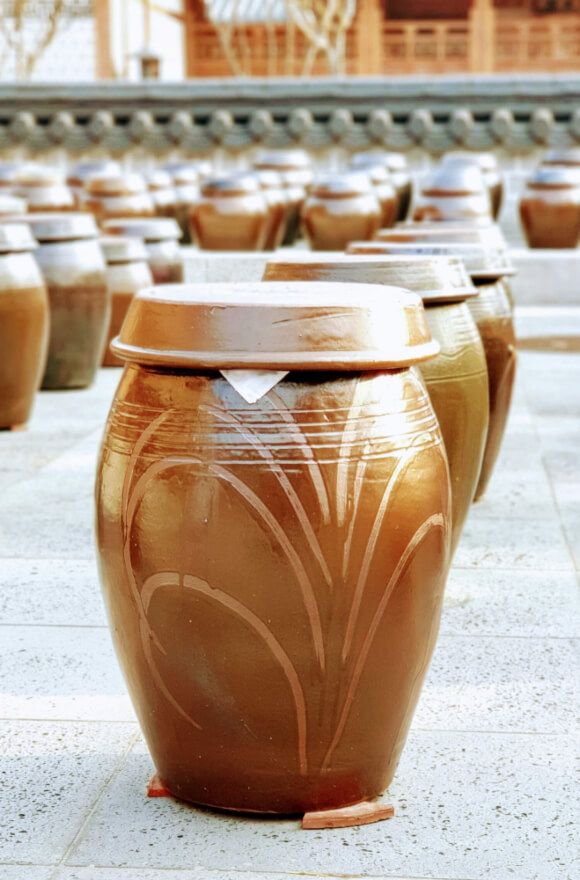
What’s fermenting? Is it soy bean, red bean, kimchi or makgeolli (rice wine)?Onggi pot or Korean earthenware. These pots are either hangari (medium sized) or dok (large).Cooking pots at Suwon Center for Traditional Culture
We wandered around this hanok, picking up literature on the history, and took photos of the onggi pots, where kimchee is traditionally fermented, then afterwards we walked toward the wall of the fortress.
A Fortress of Military Might and Memorial
It was meant to be the new capital when the fortress was built over 200 years ago. Long before Seoul was officially called Seoul it was Hanyang or Hanseong. King Jeongjo the 22nd king of the Joseon dynasty wanted to move the capital from Hanyang to Suwon. The reason being that the proximity to the Yellow Sea and China was better for commerce, and the King believed he could make changes to better the Dynasty, and moving to Suwon was a step in this direction of his reforms.
The Hwaseong Fortress was not only the beginning of a new capital, but it was a military complex and a burial place for his father Prince Sado. It was built between 1794 and 1796 (when John Adams became the 2nd U.S. president) by King Jeongjo of the Joseon Dynasty to remember his father who was executed by his grandfather, King Yeongjo. If you’re interested in more information on the history of this execution by rice, you can search Prince Sado and begin the descent into the rabbit hole of Joseon history. There are also many Korean dramas that tell the story like The Throne and The Secret Door.
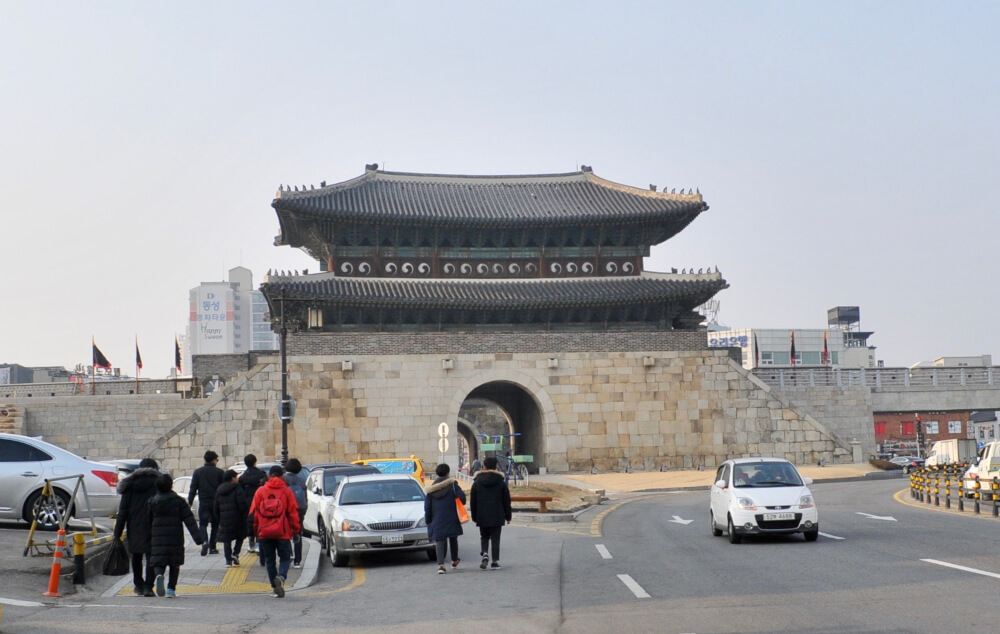
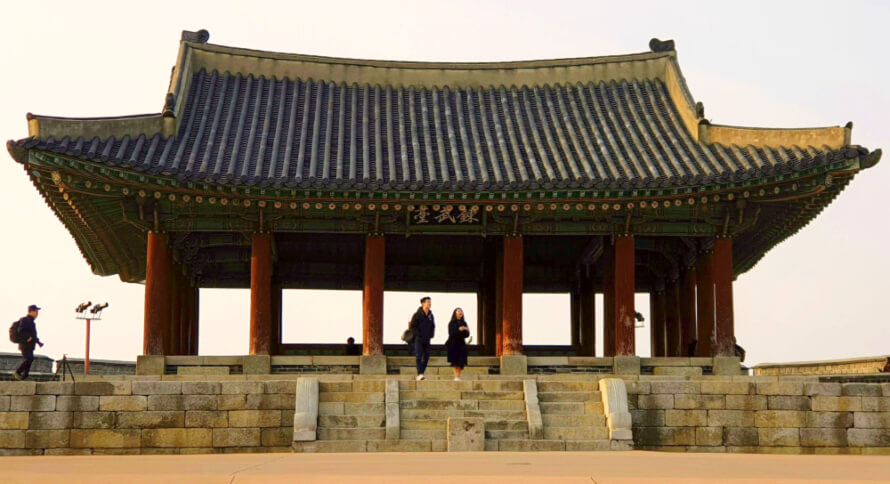
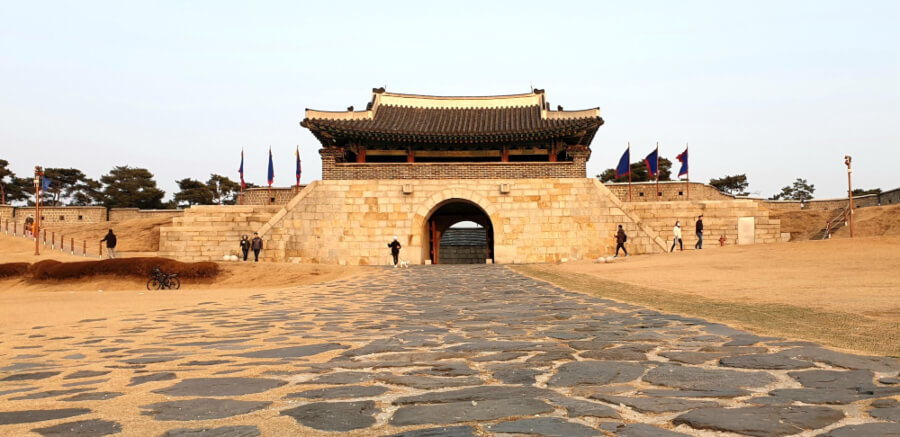
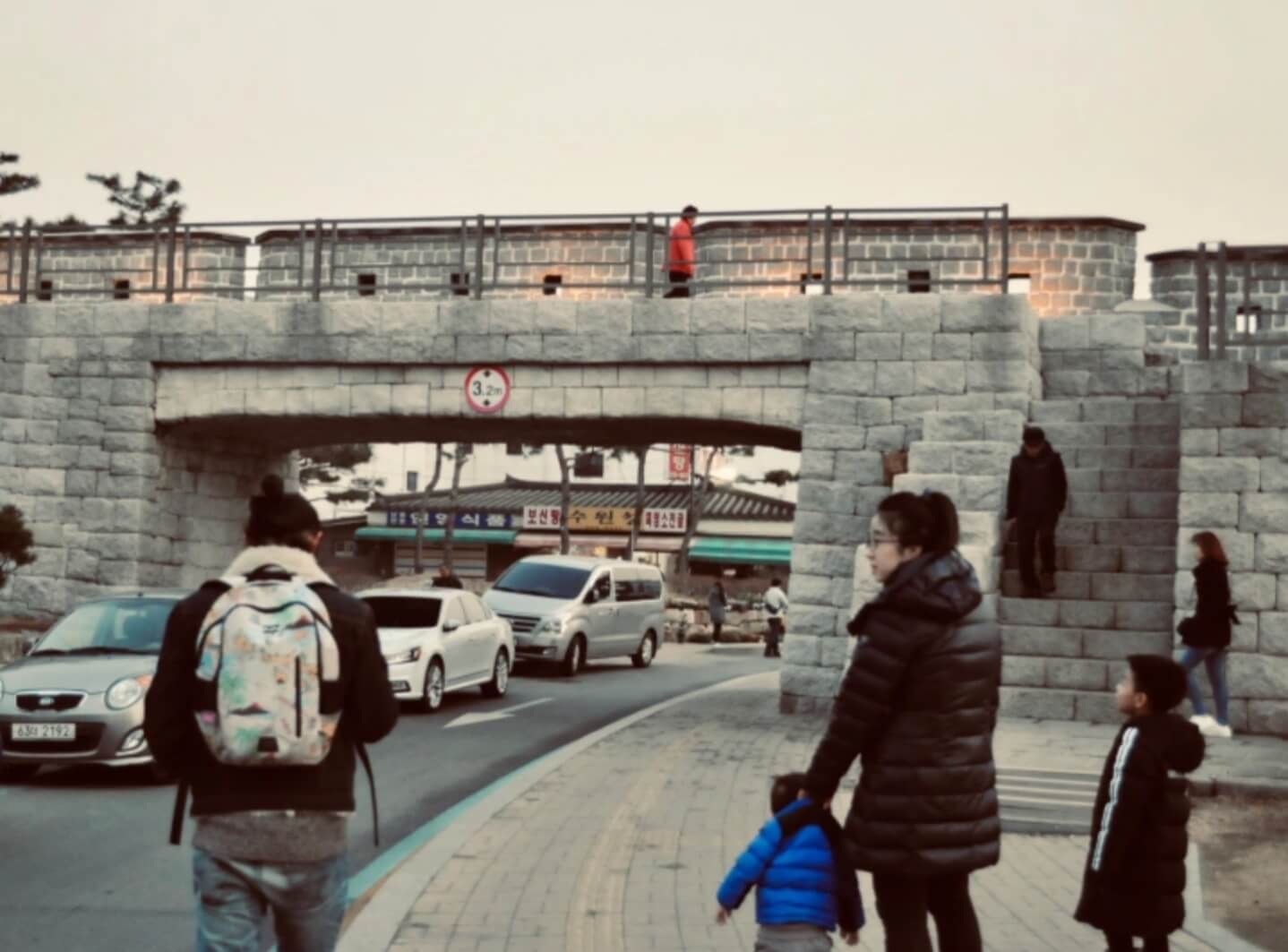
Janganmun Gate Janganmun Gate west side stepsThe North Gate Pavilion interior.
The location of the fortress although a strategic choice also fulfills the baesanimsu with a mountain in the back and a river in the front. It has been designated as a UNESCO world heritage site because according to UNESCO, “It is an outstanding example of early modern military architecture.” It’s pretty fun to think of how many UNESCO sites Eun and I have visited here in South Korea.
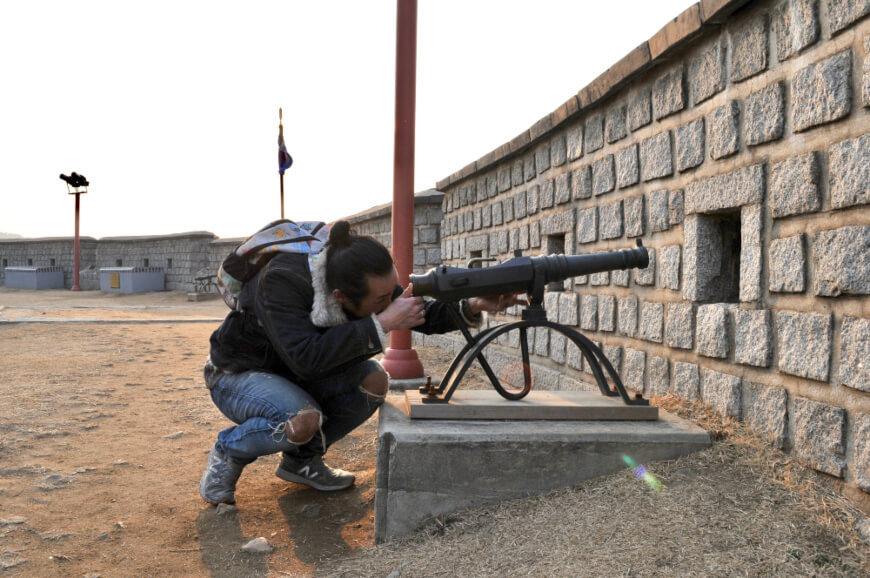
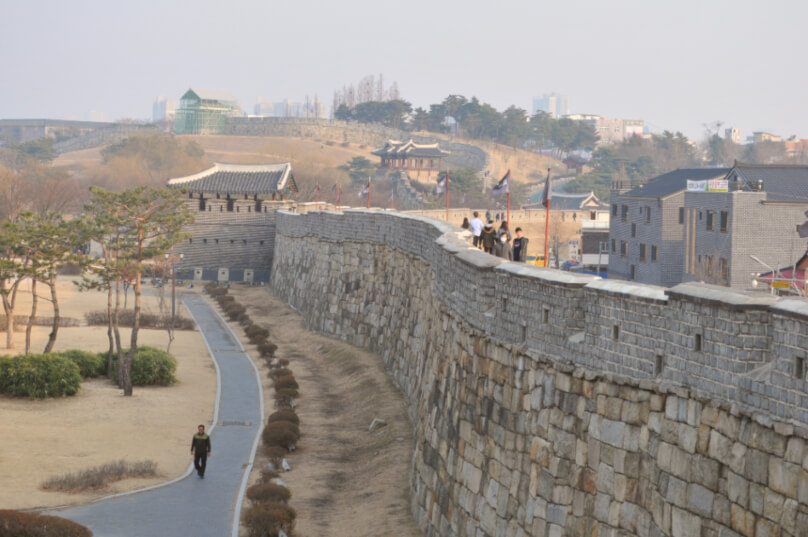
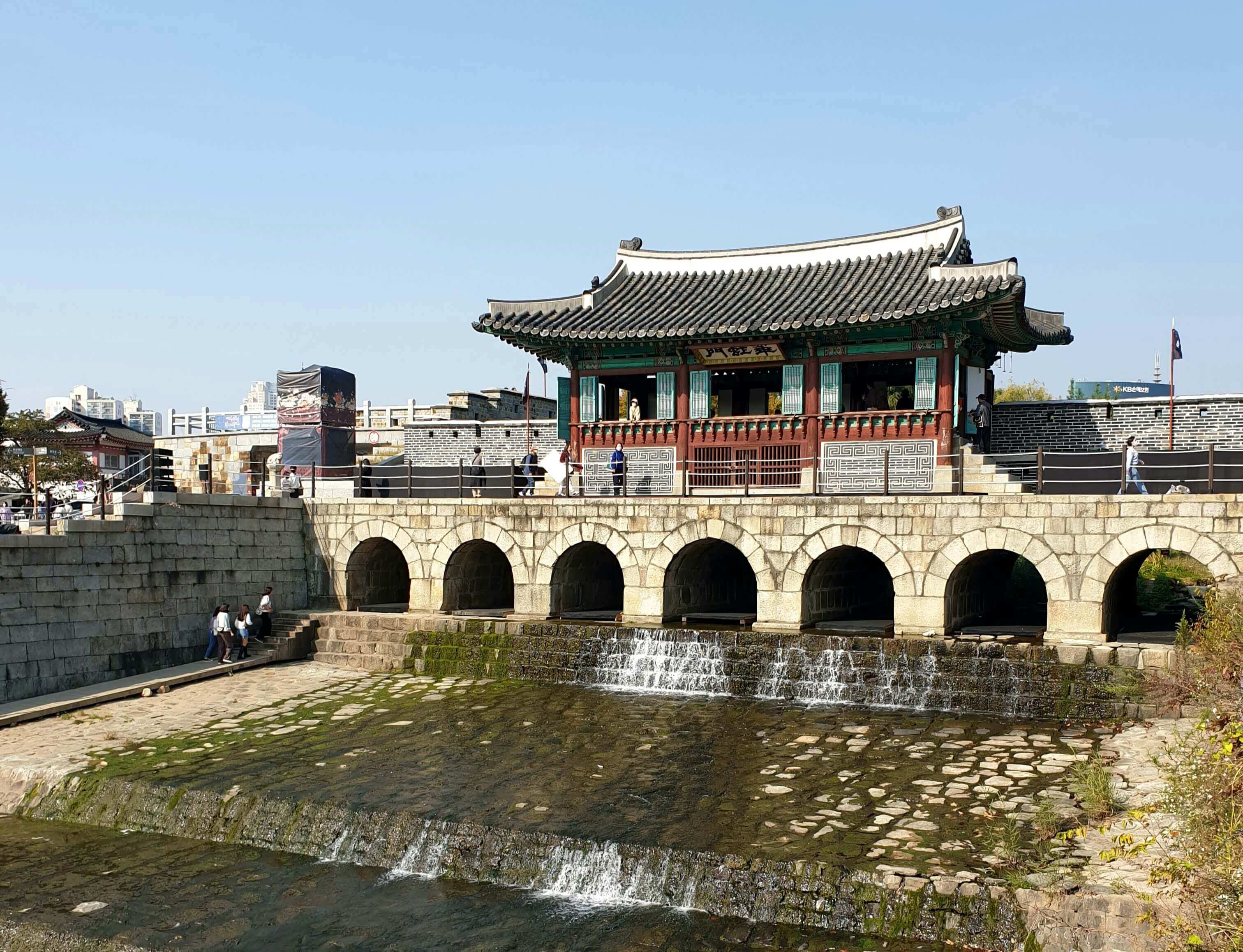
It has many defensive features and was almost impenetrable except for the part facing the river. Due to this possible exposure to enemies the King had watergates with iron bars built along the parts of the wall that cross the river. What you can see today are canons, and towers with windows where soldiers could shoot arrows, along with beacon towers that would have been lit to warn about a coming enemy.
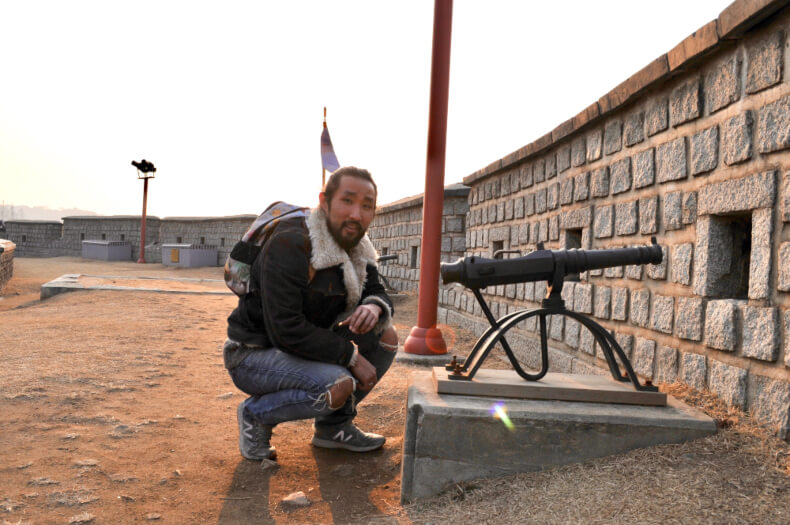
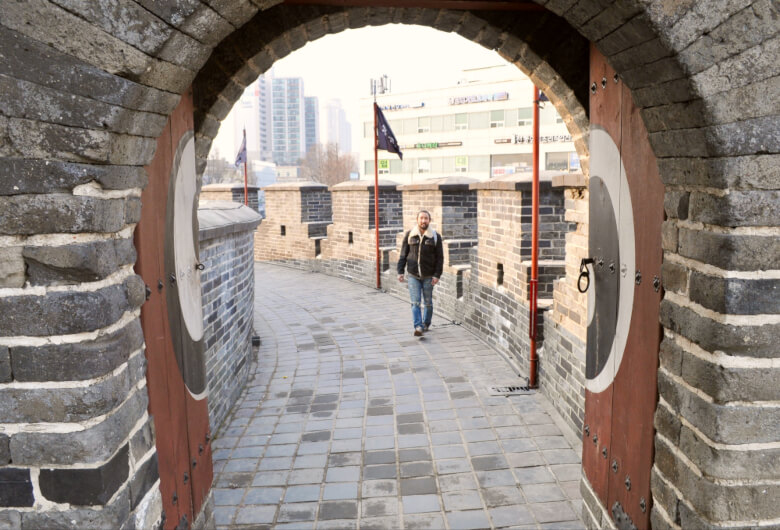
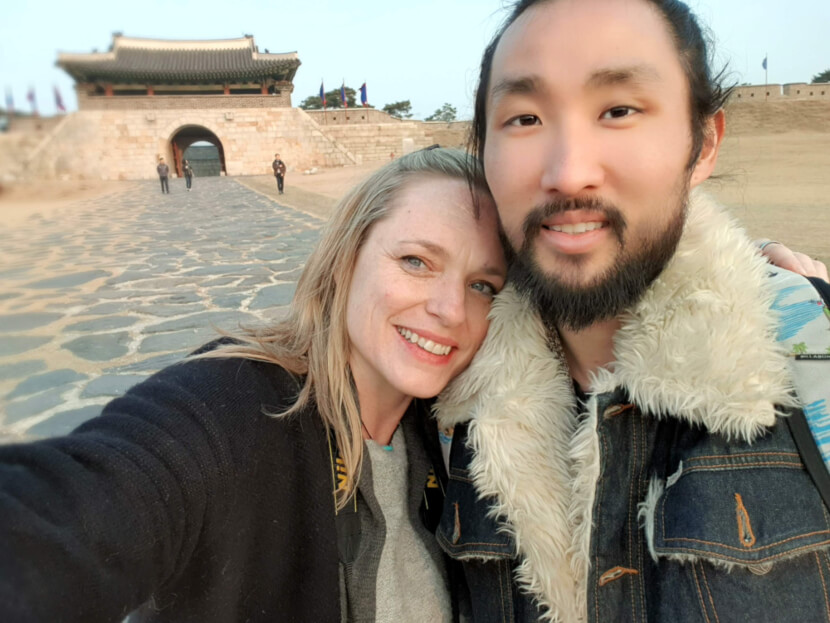
Posing on the BattlementsTroops could protect themselves from the enemy by ducking behind the parapets as the fired arrows through the embrasures.An old archery gun? Eun on the North gate battlementsChangnyongmun pavilion
It took three years to build Hwaseong, and was built with the latest technology of the times, and it incorporated eastern and western architectural design elements. Two other aspects that make it unique and a part of UNESCO’s heritage list is its military and commercial functions along with it being built over mountains and a river. It influenced Korean architecture for years to come. It never did become the new capital though, because soon after it was completed the King died. If you are interested in architecture, in particular military architecture, I recommend starting with this wikipedia page and continuing on from there. The page gives a lot of detail on all parts of the fortress. It was built to withstand war and invaders, but of course King Jeongjo and those who designed it had no idea of the violence, weaponry, and destruction that would come from the 20th century wars.
The view along the walk toward the NE side of the fortress.
Hwahongmun the Northern Floodgate
A Devastating History
During the Korean War up to 60% of the fortress had been damaged. It was reconstructed in the 1970’s using the “Records of Hwaseong Fortress Construction” that were written in 1801 not long after the king had died. It is not visible to the untrained eye as to what parts had been rebuilt and which are authentic. Having learned about this destruction while visiting the Hwaseong Fortress, reminded me of visiting parts of Germany and Poland. Cities like Nuremberg and Warsaw, that were 85% to 95% destroyed yet recreated to such historical accuracy that one would never know that bombs had been dropped on the streets where you stood. Suwon, like Seoul had been taken by the North Korean army very early into the war. What many people outside of Korea don’t know is that 5 million people lost their lives, more than half of whom were civilians. Much of the fighting was around Suwon which is only 45 kilometers away from the capital where the first invasion took place. Yet, today, walking the battlements of this ancient wall that was built over 200 years ago, and is still standing after multiple Japanese invasions; destruction during Japanese colonization; attacks during WWII; and then lastly the Korean War, if you didn’t know the history, you would never know what had happened here. You cannot tell that these walls had ever fallen nor that in 2006 an arsonist tried to burn one of the towers down.
What remained of Dongbukgongsimdon after the bombings in the Korean WarDongbukgongsimdon the northeastern watchtower also called “Conch Shell Tower.”
We only Saw Half of the Fortress
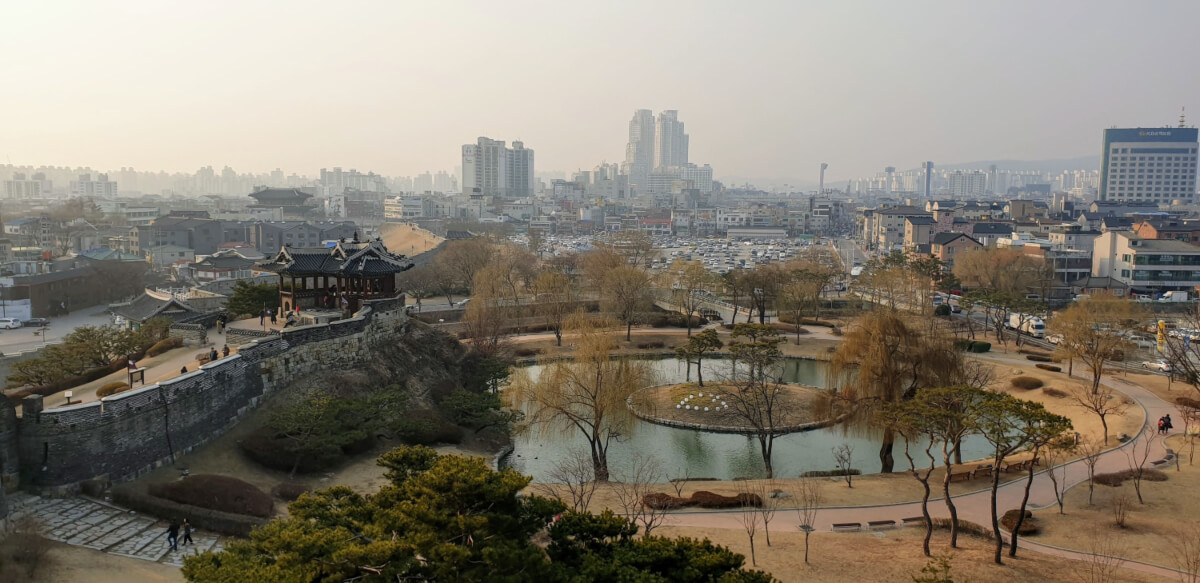
I know that we didn’t walk the nearly 4 miles around the fortress, but we spent about four hours out there that day. I did much of my research after the visit which is too bad since knowing a history of a place while visiting makes it all the more interesting. We started our exploration at Janganmun Gate which is the north gate of the city. Unfortunately, the air was not that good on the day we visited. The pollution levels were a bit high and the photos have that reflective glare that one gets when the sunlight is filtered through smog.
Yongyeon pond and Dongbukgakru command post.
At the time of our visit Janganmun Gate was under some reconstruction, so we were not able to see the interior of the gate, but we were able to go inside the pavillon on the top of the gate where the gaurds would have rested in between sentry duty. From the north gate we headed toward the east.
Yeonmudae also named Dongjangdae. This is the eastern command post.
We walked half-way around the wall, mainly sticking to the wall itself and not going into the interior parts of the city. We will have to make another trip out to explore more extensively; especially now, knowing more about the fortress and its history.
ChangryongmunGate to YeonmudaeYeonmudaeYeonmudae a training site for martial arts.YeonmudaeYeonmudae stone steps
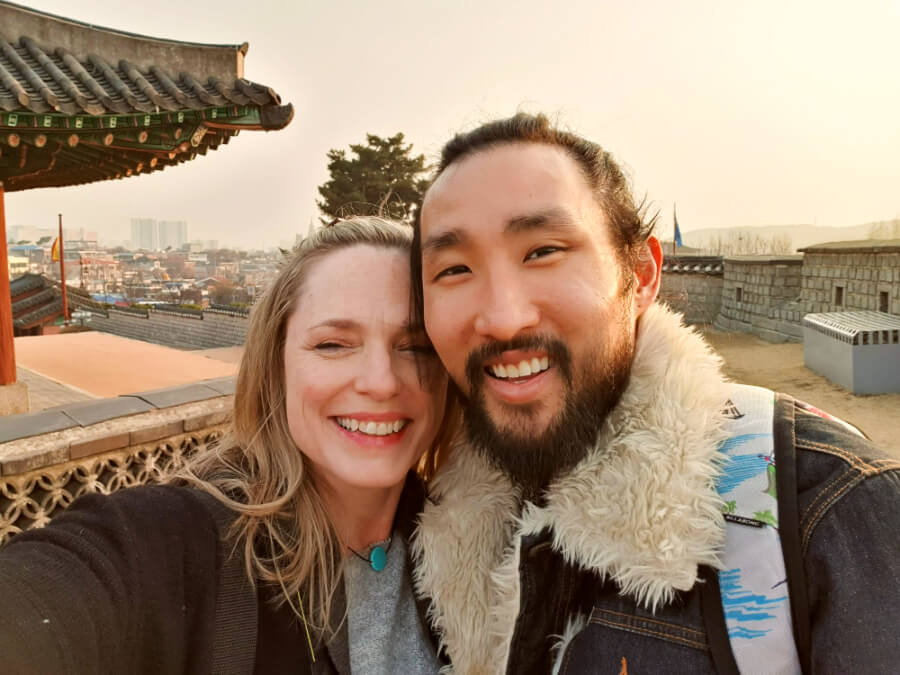
Posing in front of Yeonmudae
East gate of Dongjangdae the command post.
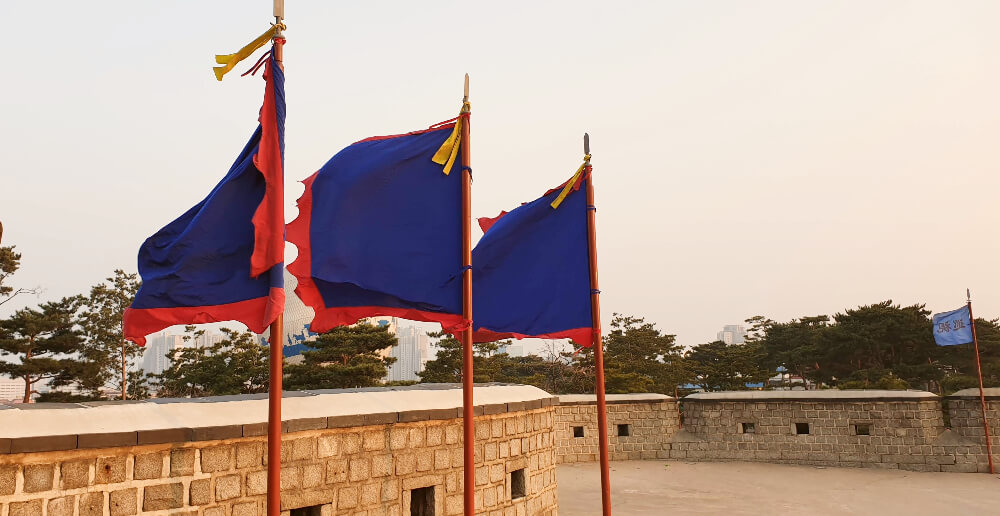
Flags at Changnyongmun the east gate.
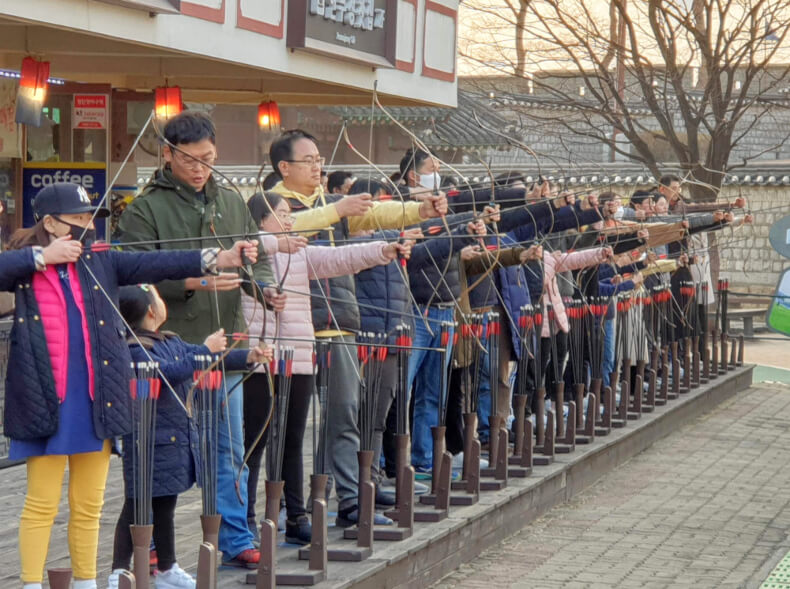
We made it a little past the east gate also called Changnyongmun, (also called Dongmun) before we started to get hungry and also before it got too dark. Our visit to the fortress was in the late fall and night began early. On the way we passed an archery field called Dongbuknodae where soldiers were intended to practice their archery. Today, for 2,000 won (about $1.75) you can try to shoot an arrow and step into the ghostly shoes of Joseon soldiers.
People trying their hand at archeryChangryongmun archery field.
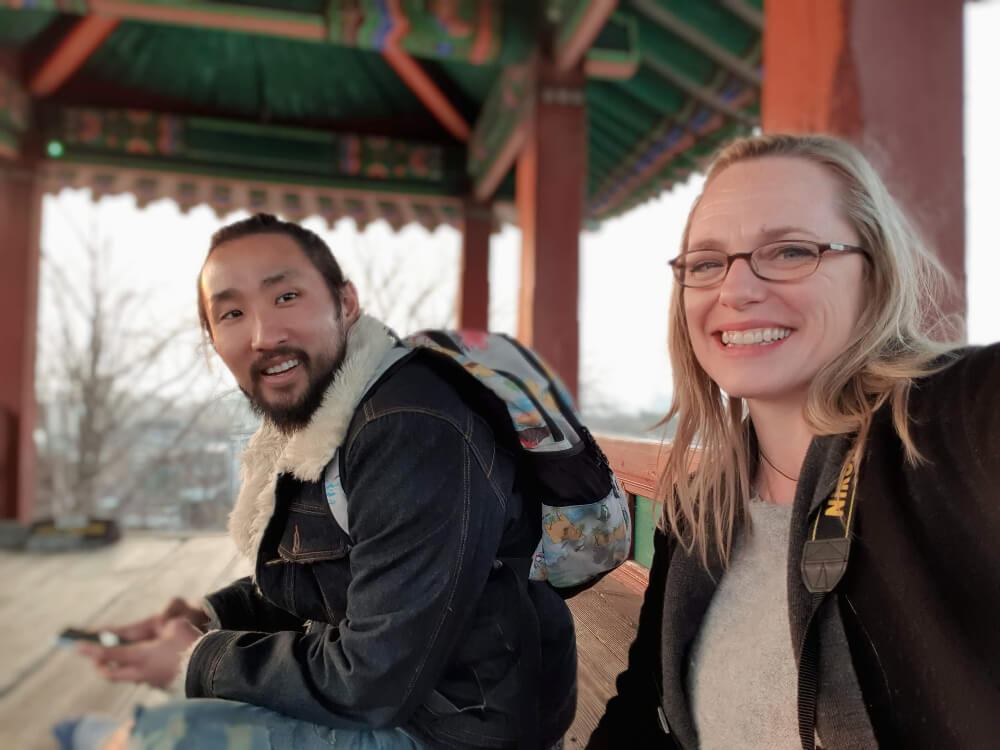
We reached the east gate and wandered along this portion of the wall and explored towers and crossbow platforms. We rested in a pavilion called Dongilporu, and watched the sun set behind the mountain.
ChangryongmunDongilporuPavilion chasing after flowers and floating along with willow branches.Changryongmun Gate
Changnyongmun Gate, also known as Dongmun, is the eastern gate of Hwaseong.
As soon as the sun dropped out of view the air quickly dipped from comfortable to chilly, and we decided to end our exploration due to the chill, the dark, and we were both hungry. We headed back toward the North gate and cut away from the wall. We were not certain as to which side of the wall were were on at one point, but we allowed our noses to guide us toward food. What we could smell was fried chicken. Which made sense since Suwon has a street called Chicken Street that is famous for fried chicken.
Bongdon signal beacons
By way of back roads we walked past dilapidated homes and empty lots. We wandered through small markets and then found our way back toward the wall. Using GPS we found our way to Chicken Street which was also part of this trip’s visit. I wrote a post on chicken street here.
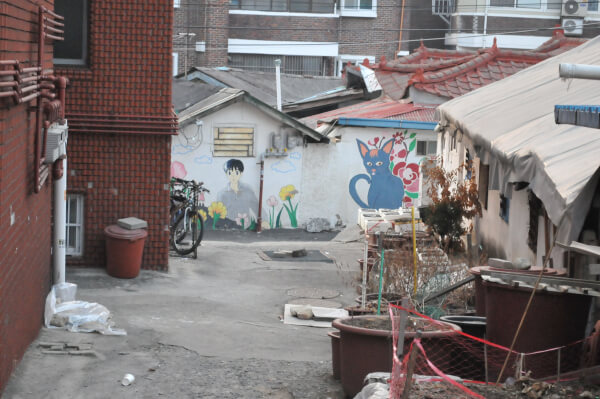
Houses outside the SE side of the FortressHouses outside the SE side of the FortressA sweet puppy we met on our wandering South flood gate over the Suwoncheon stream
We saw less than half of the fortress. If you want to see everything in a day you’ll need to come early as there is much to see. Along with the many features on the wall itself there are also the places within the walled city, including the tomb of Prince Sado, the palaces, and the shrines. It is our intention to return, and of course if you make your way out to the Fortress you must also visit Chicken Street for some excellent fried chicken.
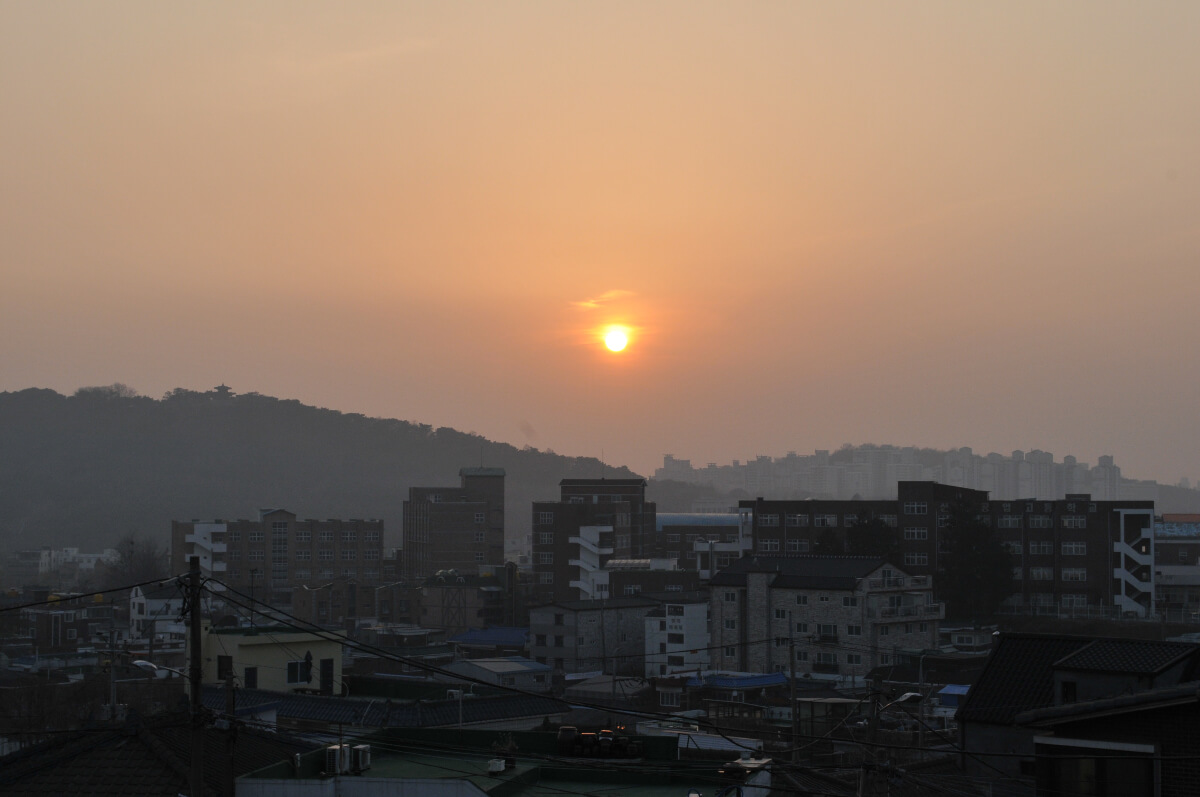
Sunset in Suwon
If you are looking for day trips to take outside of Seoul this is a good one. Depending on where you are staying it is 45 minutes to an hour subway/bus ride outside of Seoul. Seoul is a fun city to visit and travel to, but if you make it as far as South Korea, it is in your best interest to see what is also offered outside of Seoul.
Till next time.
Accidental Vagabond
Help keep this Blog Going. If you enjoy the content please donate. All donations go to keeping the blog up and running.
Sources are listed below. If you’d like more information on a certain subject click on the bold text and it will take you to a source. There are hundreds of blog posts on The 5 Grand Palaces, anyone of them will tell you about each palace, including this one. However, this blog is pretty selfish, since I talk about me.
What are the 5 Grand Palaces of Seoul?
I lived in Seoul from 2018 to 2023, and during that time I visited three of the 5 grand palaces. Two questions that may arise from this statement may be, “What are the 5 grand palaces”, and “you were in Seoul for five years, why only three palaces?”
I’m glad you asked.
What are the 5 Grand Palaces?
The Joseon Dynasty, also seen written in English asChosŏn, was the longest and last imperial dynasty of Korea. It was founded in 1392, (100 years before Christopher Columbus took credit for discovering America) by King Taejo, who was previously known as the general Yi Seong-gye. Yi Seong-gye declared himself the ruler of the new dynasty after overthrowing, exiling and then secretly killing, the king of the Goryeo Dynasty, which had been around for 475 years. Not a bad run, Goryeo. He ascended to the throne as King Taejo, marking the start of the Joseon Dynasty, which would last for approximately five centuries until 1910, about 40 years longer than Goryeo. Put into some context of time, as of writing this post in 2023 the United States isn’t even 250 years old. We haven’t even made it halfway. Yet we act like we know it all. The capital was initially established inHanyang, which is present-day Seoul. During the 500 plus year reign 5 palaces were built between 1395 and 1617. However all 5 palaces have been subjected to destruction through invasions, wars, uprisings, and occupations, so new buildings and expansions had been constructed over the course of the 500 years. There have also been many renovations and later reconstructions that have continued up until today.
Why Only Visit 3 palaces in 5 years?
Although all 5 palaces are relatively close to each other, and not too far from where I lived, living in a place and visiting/vacationing in a place are two different things. Just like living anywhere your days are consumed by work and daily tasks and dull responsibilities and desperate moments of escape through Netflix and other streaming services. When it came to vacation time we often would leave Seoul to explore other places. I did try to see all the palaces, but due to confusion, I ended up visiting Gyeonbok palace multiple times, when I probably could have been visiting the remaining 2, more on this later.
Amisan garden with Chimneys. Built in 1869. Korean National treasure No. 811
The construction timeline for the major palaces in Seoul is as follows:
Initially constructed in 1405, Changdeokgung was later expanded and became one of the main palaces in Seoul. It served as a secondary palace to Gyeongbokgung.
Originating in the Goryeo Dynasty (built in 1104) and transformed during the Joseon era. Changgyeong was built on the site of and renovated from parts of the summer palace “Suganggung” of the Goryeo Dynasty. Changgyeonggung underwent a name change and several reconstructions. It served various purposes over the centuries, including as a residence for queens and concubines, and as a temporary residence for the Japanese governor-general during the colonial period.
Initially constructed in the late 16th century, Deoksugung served different roles throughout its history, including as a residence for King Seonjo and later as a temporary royal residence during the late 19th and early 20th centuries.
Established in 1617, Gyeonghuigung served as a secondary palace and underwent multiple reconstructions. It was the last of the Five Grand Palaces to be built. Although, not the last to be completed.
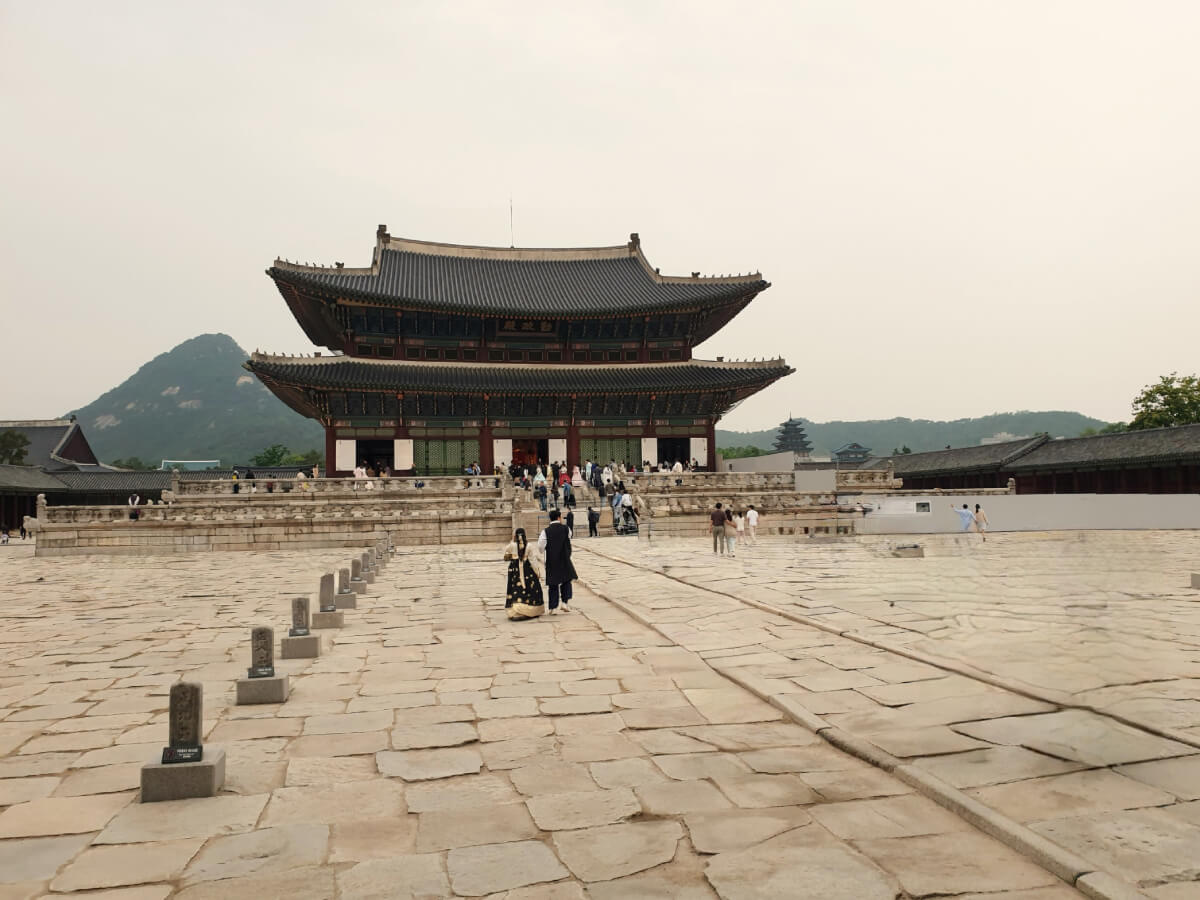
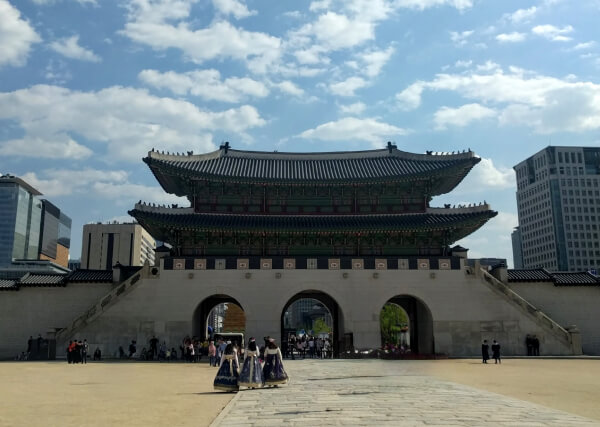
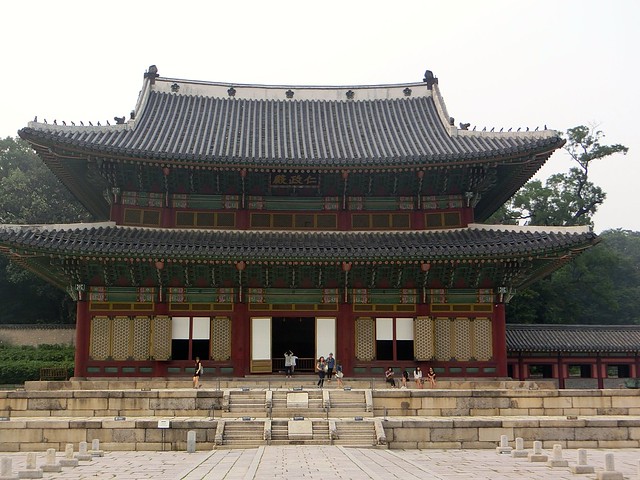
Geunjeongjeon Hall
The Palaces and My Visits
14th Century
Gyeongbokgung (경복궁)
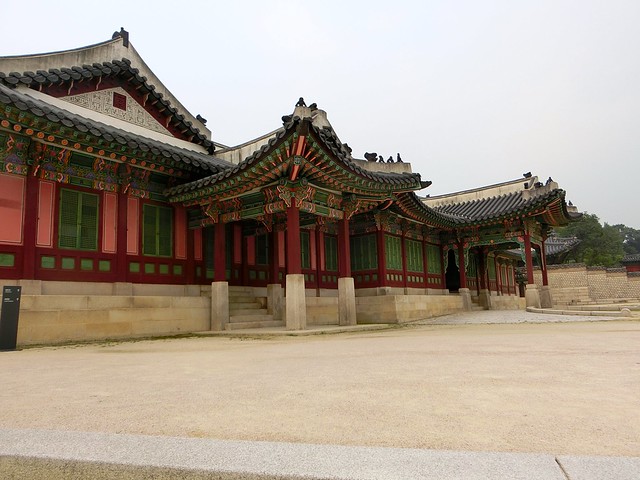
Gyeongbokgung (Gyeongbok Palace) was the first of the five Grand Palaces of Seoul to be built during the long 500 plus years’ reign. Gyeongbokgung was built in 1395, and it is the largest of all five. Its architecture and design is magnificent and bold. The wood structures are bright reds and blues and the fired clay tiled rooftops sweep like the upturned wings of birds of prey. Small intricate carvings adorn the tiles, and each end beam is painted with colorful patterns.
There is a lot to Korean architecture much like the Chinese and Japanese there is a purpose and meaning behind the building. In Korea it has a lot to do with nature and something called geomancy which I plan to write about at a later time. The structure is conspicuous with its impressive gates, halls, and tall beams and beautiful gardens. It is the largest of all five of the Grand Palaces, and every website and blog that I visited claimed it to be “arguably the most beautiful”. I do believe one can argue this remark as beauty is subjective. I don’t know if it’s the most beautiful overall, but it is large and has some beautiful parts, nothing is ugly, but most beautiful is as I said, subjective. However, I do believe it is one of the most popular of the five and most visited.
As mentioned, the palace was originally built in 1395, that’s almost 100 years before Columbus stumbled onto an already inhabited land and claimed it for Spain. In the 16th century (1592 to be more exact) the palace was demolished and destroyed by the Japanese, and not reconstructed until 1867, the same year that Alaska was purchased from Russia.
During the Japanese occupation of the 20th century, the Japanese destroyed or dismantled all but 10 of the original buildings, and then to add insult to injury they built the Imperial Government building on the site of the palace and directly in front of Geunjeongjeon Hall the former throne room of the Kings of the Joseon Dynasty. In this way the Korean’s not only lost their independence and didn’t know if they had a future they also were denied a view of their past. Why would the Japanese not destroy all evidence of the palace? One could argue that they kept what they thought was the most beautiful for themselves, like the pavilion and the surrounding garden. During the occupation the throne room was often used as an exhibition hall taking away all sense of authority and reducing it to a commercial space. Long after the occupation, which ended with WW2 for obvious reasons, and the devastation of the Korean war; restoration of Gyeongbuk began in 1989. The Japanese General Government building was demolished in 1995.
I’ve visited this palace at least seven times.
My first visit to Gyeonbokgung was in the spring of 2017. At the time, I was living in Gwanggyo, which is a city in Gyeonggi, a neighboring province. It is about an hour away from Seoul by subway. During my first visit, I didn’t enter the gate but wandered about the East side of the palace near the National Folk Museum.
My second visit was in the summer of 2017. I was still living in Gwanggyo, and during this visit I went with a friend of mine who had been living in Dongcheon, another small city in Gyeonggi-do. On the weekends we would often meet up on the subway and then take theShinbundangline into Seoul. On this particular visit we entered through the East side but only took a few pictures inside the outer courtyard or oejeon where you can see the inside of the Gwanghwamun Gate(southern and main gate) and the outside of Heungnyemun Gate which is the second gate of the palace that will lead you into the inner court or naejeon.
On my third visit to Gyeonbukgung, also in the summer of 2017, I finally went inside the second gate (Heungnyemun) and onto the palace grounds. Visit three was also with a friend of mine that was visiting fromMasan, a small city in the southern part of South Korea. Aside from seeing more of the palace during this visit we also partook in a tea ceremony.
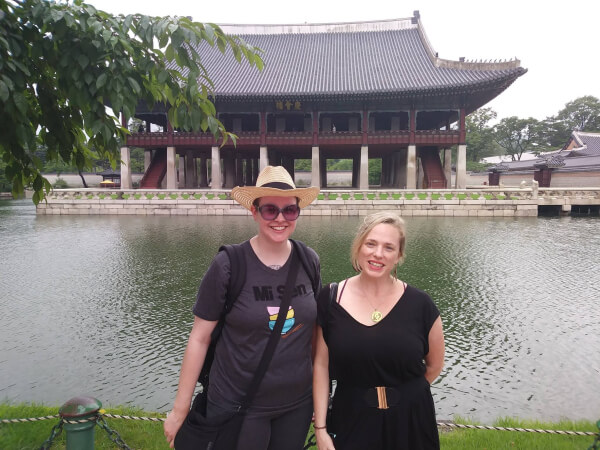
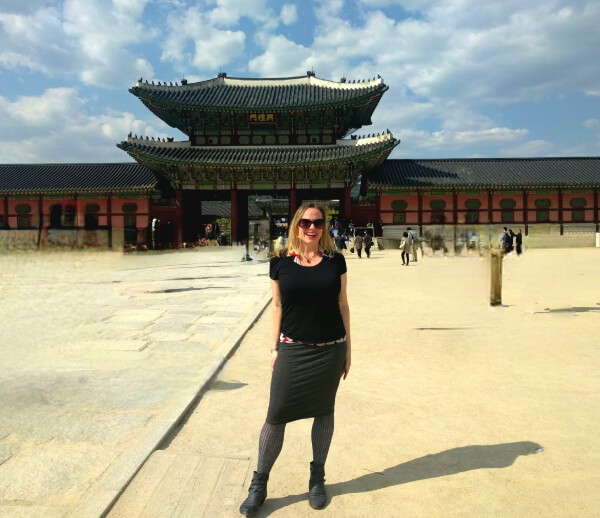
Visit Number 3in front of Royal Banquet Hall Gyeonghoeru Visit Number 5 at Heungnyemun Gate
My fourth visit was in the fall of 2018. At this time I had moved to Seoul and lived about a 30 minute bus ride from Gyeonbukgung. A friend of mine had come to visit from China, and we visited the palace, but only the outer courtyard.
My fifth visit was in the spring of 2019 when some friends from Prague (Czechia) came to visit. Now, on this visit I selfishly tried to take them to Changdeokgung because I wanted to see the secret garden, but I got the Hyangwonjeong Pavilionconfused with the Huwonor Biwon also known as “the secret garden”.
The reason for my confusion was because during my 2017 visit the pavilion was under construction, and my brain had decided that this was the secret garden. I never bothered to look it up. I also just never remembered which palace it was that I kept visiting, so when I arrived for the fifth time, I remember thinking, “ah damn, I always come to the same palace.” My friends of course had never been to any of the palaces so it was fine. The pavilion was still under construction.
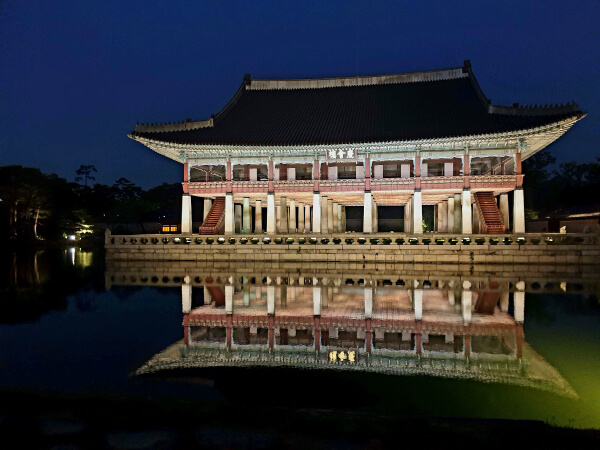
My sixth visit took place in the spring of 2023. Probably, for the first time in my many visits to Gyeonbukgung, I went intentionally. The unknown and fear of the pandemic was in the rearview mirror, and more and more things had opened up. For the first time since I had moved to Seoul Gyeonbukgung was open in the evening. Eun and I went together for this summer event.
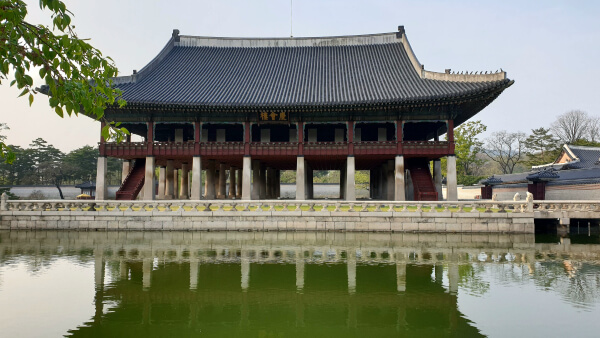
Gyeonghoeru, The Royal Banquet Hall lit up at night
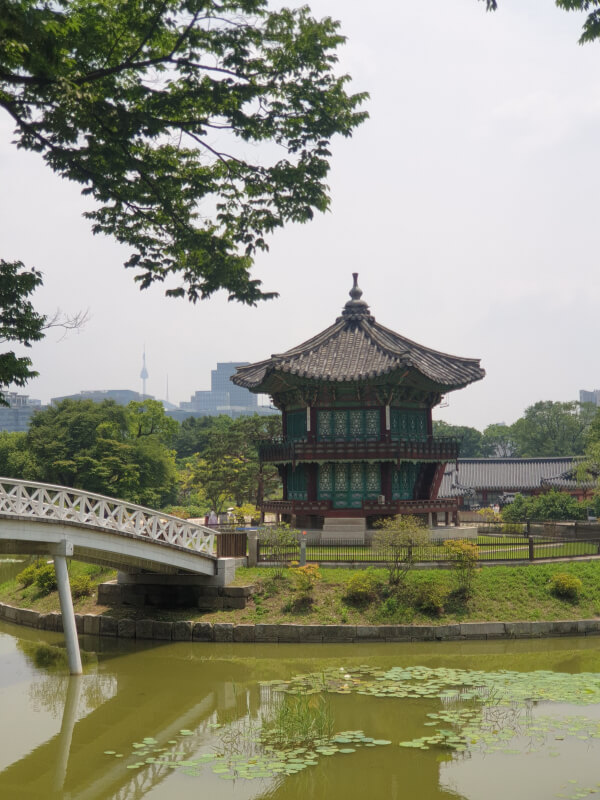
My seventh and final visit was in the summer of 2023. I again went intentionally, this time to finally see the Hyangwonjeong Pavilion which had been under construction since my first visit inside the palace in 2017.
The Hyangwonjeong Pavilion in the background, March 2023
15th Century
Changdeokgung (창덕궁)
Changdeok palace was constructed in 1405, as a secondary palace to Gyeongbokgung, nearly 90 years before Columbus crashed into the Bahamas. After its initial construction the palace complex was expanded and it became the most favored by Korean kings from the late 15th century onwards. Known for its beautiful rear garden blending with the natural landscape which is part of geomancy. It is also the location of the famous Secret Garden, Biwon (비원) in Korean. This garden was built as a place for the royal family and women of the palace to relax and enjoy. Changdeokgung was badly damaged during the Imjin War the 1592-1596, and 1597-1598 a series of invasions by the Japanese. If you recall, Gyeongbokgung was destroyed in 1592, which would make Changdeokgung the primary palace by default. Although, Changdeokgung was also badly damaged in the wars which would mean that the main palace would have to be moved yet again to Changgyeongung which it’s lucky they already had the palace built; more on that next. Changdeokgung was rebuilt in 1609 (two years after Jamestown had been settled), but was damaged again when it was burnt down in 1623 by a military coup. Changedeokgung has been damaged multiple times over the centuries, however during each reconstruction it has remained true to its original form and because of this authenticity it was added to the list of UNESCO world heritage sites in 1997.
This is one of the palaces I never had the chance to visit. In fact, part of the reason I visited Gyeongbukgung so many times is because I kept trying to visit Changdeokgung, but got confused. They are not that far from each other and when looking on a map they look quite close. In fact, you use the same subway line to get there. It is possible to walk from Gyeongbukgung to Changdeokgung. In actuality all 5 of the palaces are in relative walking distance, but if you are short on time or don’t want to walk 45 minutes (I said relative as in meaning possible) the buses are a great way to go from palace to palace.
I regret not seeing this palace as its reputation for beauty is high. Plus the famous secret garden which you have to purchase a second ticket to enter, so you need to time your purchase and entrance right, especially during the crowded summers. This timing thing has never been a forte of mine. A friend and I did try to make it to Changdeokgung in my last month of living in Seoul, but it was during the Royal Cultural Festivaland all the tickets to Changdeokgung and Gyeonbokgung had been sold out. Alas.
15th Century
Changgyeonggung (창경궁)
Named Changgyeongung in 1483 (still before Columbus, and his invasion of the already populated land we now call America) this palace has gone through many reconstructions. I have read that it was built by a king for a king. I have also read that it was built as a residential place for queens and concubines. Once, I overheard a person in line for a ticket say that it was built for some King’s mother. The last one was not a reliable resource.
It was first called Suganggung and was built in 1104 during the Goryeo reign as a summer palace for King Sukjong of the Goryeo dynasty. After Yi Seong-gye defeated Goryeo he resided in Suganggung until Gyeongbukgung was built. A side note, Kaesong also seen written as Gaegyeong was the capital of the Goryeo dynasty which is in what we now call North Korea. It can be difficult to picture it with our modern maps and politics, but Goryeo once controlled all of the land that we now call North and South Korea. Later in the mid-1400’s under the fourth ruler of the Joseon Dynasty, King Sejong (the Great King who invented Hungul the Korean alphabet) built the palace as a gift for his father, the third Joseon King, King Taejong; more like a resting place than a gift. I found one site that stated that King Sejong built Changgyeonggung in 1418, whereas most sites including Wikipedia state mid-1400’s. I’m not great at math, but 1418 seems to me to be a lot closer to early 1400’s than mid-1400’s. Since King Taejong died in 1422, I’m going to go with Go!Go! Hanguk’s date until I get my hands on some printed text. Another side note, when it comes to dates on construction or establishment which just means that they decided that on this particular property they are planning to build a palace, Changgyeonggung is the most confusing to get the dates clear. My guess is that there hasn’t been a lot of English write ups on the Goryeo Dynasty because there isn’t much left to see of this dynasty, and the top sites are travel sites, so its a lot of regurgitation of the same information. I have my own deduction as to why it is difficult to tact down an exact date. My thoughts are that in 1104 there was already a palace in the same location. King Sukjong’s summer palace that may or may not have been called Suganggung. Then in 1392 after the fall of the Goryeo Dynasty, King Taejo the first of the King’s of the Joseon Dynasty moved into the former summer palace while Gyeongbukgung was being built. So, obviously some structure had to already be in place, and the man’s a king so it can’t be a shabby shack, and it was a royal summer palace, so I imagine it was beautiful in its own right. Then presumably, in 1418ish, King Sejong either added on or renovated or expanded the former Goryeo structure. I suppose he could have had it all torn down, but I don’t know, I’m just tossing this idea around trying to elucidate for myself when this palace was actually built. During the time that King Sejong built the palace and King Taejong resided there it was called Suganggung, this is for certain. Then in 1483, it was renovated and enlarged by King Seonjong the ninth King of the Joseon Dynasty. Perhaps it was during this time that the intention of its construction was to be a residential home for the queen, and the king’s concubines. Okay back to the main focus:
Myeongjeongjeon
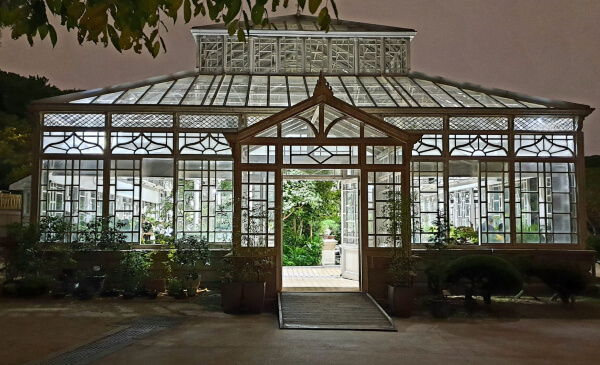
There was a lot of upheaval and destruction at Changgyeonggung through multiple Japanese invasions and during Japanese colonialism. Due to the multiple damages, destruction, rebuilding, and renovations over the centuries, Changgyeongung features a mix of architectural styles, including traditional Korean and Western influences. The palace grounds include gardens and a victorian style greenhouse designed by the famous Japanese horticulturist Hayato Fukuba, and built by a French architectural company, whose name I haven’t yet located. Changgyeonggung features a large botanical garden with many indigenous Korean plant species. During the Japanese occupation that began in 1910, Changgyeonggung was turned into a zoo. The zoo was Korea’s first, and built in 1909, which date wise informs you that Japan was already planning to occupy Korea. I also saw a source that said the Daeonsil, the greenhouse, was built in 1907 which if true shows that the Japanese were planning their occupation at least 3 years in advance of the “official date.” I imagine all occupations take a bit of planning. After the end of the Japanese occupation the palace was restored to much of its original design, and many of the Japanese buildings were torn down, however the greenhouse, which is quite lovely, remains. When I say original I mean either the 1418 design, but more likely the 1483 design when it was given the name Changgyeongung.
Honghwamun, The Outer Gate to Changgyeonggung
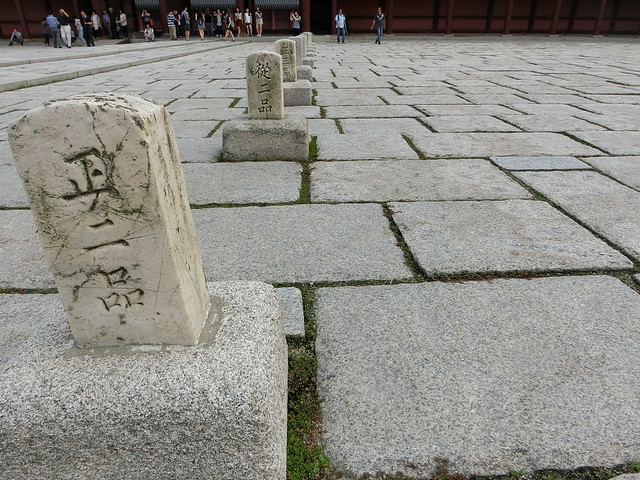
The first time I came to Changgyeongung, was the very first time I ever came to South Korea. I first visited Seoul in 2014, during a 24 hour layover on a trip from China to the Czech Republic (Czechia). I had stayed in a hostel with the word “Banana” in its name. During my layover I wandered the neighborhood which was a multitude of connecting alleyways; ate in a small little high quality hole in in the wall restaurant; and I visited a palace. At the time, I never imagined that I would, not only return to Korea, but that I would live there for 7 years. I didn’t know the name of the palace I had visited as I didn’t speak to anyone other than the hostel receptionist during check in, and with a sales girl at Tony Moly (토니모리) as I bought my first Korean beauty product of snail cream, not even knowing that the Korean beauty industry was a multi-billion dollar business; nor that I just bought a cream made of snails. I only saw a very tiny part of it, as I didn’t see the greenhouse or the beautiful pond surrounded by lush green trees and bushes, yet it stuck with me. I was so in awe of the outer stone courtyard and the standing tiles that looked like grave stones, that I now know are rank stones which marked where members of the royal court were permitted to stand during ceremonies. I moved to Seoul in 2018, and since I had arrived in the major metropolitan city, I had been searching for the palace I had first visited 3 years prior. Hence, another reason why I had visited Gyeongbokgung so many times. Each time I would go to Gyeongbokgung, I knew I was not at the right place, but I could not recall which palace was my first.
Daeonsil Greenhouse
It wasn’t until my last month in Seoul when a friend and I walked from Gyeongbokgung in the direction of what we thought would be Changdeokgung. It was a 45 minute walk to Changgyeongung. The palace was open for the summer nights, and my friend and I were able to enjoy a light show that played on a tree that grew on a small island in the manmade pond. Once inside the courtyard, I recognized it immediately as the palace I had visited in 2015. It felt like I had come full circle. Changgyeongung and Changdeokgung are practically connected, so it is easy to confuse one for the other.
Rank Stones at Changgyeonggung
16th Century
Deoksugung (덕수궁)
Deoksugung Palace, originally known as Gyeongungung, was established in the late 16th century during the reign of King Seonjo the 14th king of the Joseon Dynasty. This palace like Changgyeonggung has a complicated and confusing history, hence the “late 16th century” date. Before it became a palace it was the home of Grand Prince Wolsan, the older brother of King Seongjong the 9th Joseon king. Prince Wolsan died in 1488 a solid 100 years before the Imjin Wars, so either his residence remained intact and lived in by other family members or it was empty. The plan to actually turn it into a royal palace came about in 1592, coincidentally around the same time that Gyeongbukgung was destroyed. Construction on Deoksugung (it wouldn’t get this name until 1907) or Gyeongungung began in 1592(two years after the Roanoke Colony had disappeared), but due to the Japanese invasions of Korea (1592-1596 & 1597-1598, Imjin Wars), it was interrupted. Because of the war, many structures of Gyeongungung were damaged or left incomplete during the initial construction phase in 1592. I am not sure what parts of Gyeongungung were from Grand Prince Wolsan’s residence is any part was, but the palace wasn’t completed until 1595 or 1958. Meanwhile, in the America’s during the same time we were having our own colonial invasions. In 1598, the same year that Gyeongungung was completed Juan de Oñate attacked and massacred the Ácoma Pueblo in what is now New Mexico.
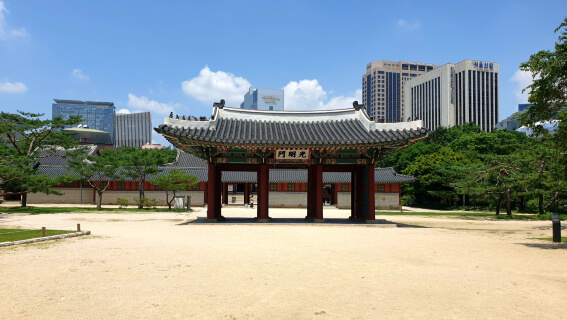
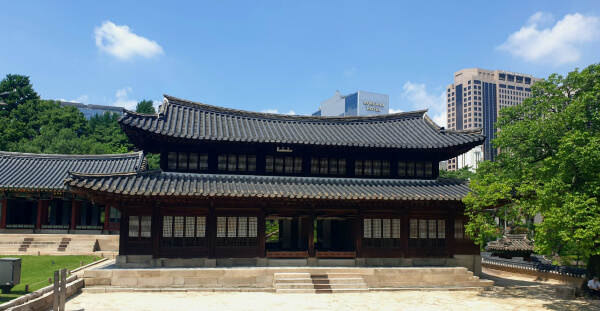
Gwangmyeongmun GateSeokeodang
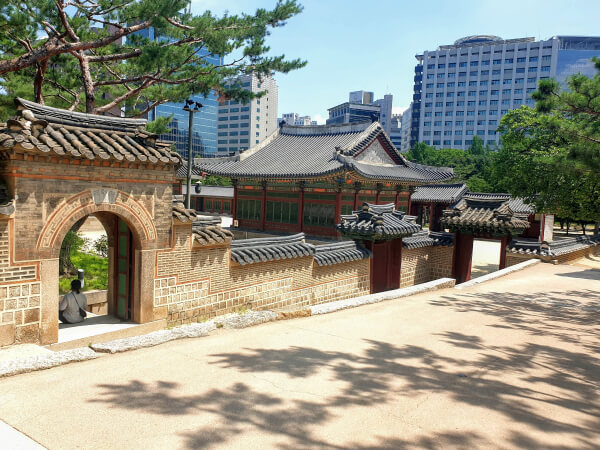
Gyeongungung was meant to be an auxiliary palace, but it became a temporary royal residence after the Japanese destroyed Gyeongbokgung in 1592, along with badly damaging Changdeokgung and Changgyeonggung. It became an official royal palace in 1611 when the King Gwanghaegun, the 15th ruler, finally decided to give it the name Gyeongungung. Prior to 1611, I don’t know what they called it. Uncle Wolsan’s place? The palace was completed in 1595, but it has a unique fusion of traditional Korean and Western architecture after a Western-style wing was added in 1897. This Western-style building, Jeonggwanheon, was designed by a Russian architect. It was turned into a cafeteria during the Japanese occupation. In 1907, the year the greenhouse at Changgyeonggung was built, Gyeongungung’s name was changed to Deoksugung. The name which means longevity was chosen in hopes that it would save the dynasty (at the time declared and Empire) and the Korean peoples, but unfortunately, as history shows, the Joseon family dynasty would fall, and Korea would be occupied for 35 years. As for Deoksugung, much of the original palace was destroyed or dismantled and the palace that you can see and visit today is only 1/3 its original size.
Seokjojeon Fountain in front of Seokjojeon
Although I have passed this palace multiple times since I had lived in Seoul, it wasn’t until 2023, my last days in Seoul, that I finally made a visit. The main gate of Deoksugung is often overcrowded with protesters, often of the older generation, and there are large banners, that at times, over shadow the main gate. The protestors often deterred me from entering the palace. In the beginning, I thought maybe they were protesting the actual palace, but after years of living in Seoul, I had learned that on the weekends there is always a protest, and all this political activity takes place in the square across from City Hall and Seoul Plaza. Protests will extend down the length of Sejong road leading to Gwanghwamun square as this is where many of the embassies are located including the U.S. Embassy.
Indoor walls of Deoksu Palace
The day my friend and I went to the palace was Pride week and it was meant to be the day of the Pride parade which we both would have loved to have seen, but a far-right religious and anti-LGBTQ+ group had managed to snag the space for their Youth for Christ march. Although the Pride Organization had applied well in advance as they do each year since they have held the parade, Korea’s new and very conservative President granted the day to the church, as he said “events for children and teenagers get a priority when requests are filed for a same date”. (I must say though, as someone who was there, that was the angriest children’s event I’ve ever been forced to listen to.) As we passed through the gate and onto the palace grounds, we could hear the angry screams and shouts from the church group, and like a dome of verbiage the screams followed us to nearly every part of the palace grounds. It was an incredibly hot day and all that hellfire, damnation, and brimstone gave our tour of the grounds an unpleasant vibe. I would have preferred fun music of Pride over the screams or better yet silence, but we did our best to enjoy the palace grounds. Once the marching started the angry group took their yells on the road, it left leaving only the sounds of the city which blended into a dull hum, hiss and honks.
17th Century
Gyeonghuigung (경희궁)
Established in 1617 (the year that Pocahontas died), it was the last of the Five Grand Palaces to be built. Although the foundation for the palace was in 1617, Gyeonghuigung wasn’t constructed until 1623 and underwent multiple reconstructions. Gyeonghuigung served as a secondary palace to Gyeongbokgung, but later served as the main palace during the 19th century. It was remodeled in 1855 with an architectural style integrating tradition and innovation. It was the setting for major political events such as King Gojong‘s return from the Russian legation where he sought refuge in 1896, and Korea’s independence proclamation from Imperial China’s rule in 1897. It was also the site of where the Korean Empire was proclaimed in 1897. Much of the palace was destroyed by fires, and during the Japanese occupation many of the buildings had been dissmantaled. Restoration efforts have been ongoing, however, because the reconstruction didn’t begin until the 1990’s and the city had already been built up, a lot of what was lost can’t be restored. As of today, only 33% of the palace exists.
I never made it to Gyeonhuigung. During my last month in Seoul it was my intention to visit all five of the palaces, but unfortunately due to time constraints and schedule conflicts I was not able to reach this goal. In truth, I don’t even know exactly where this palace is located. I know it is either in Jongno or Insadong where the other four palaces are located and it is also located on the west side of what was the old city capital Hanseong.
Conclusion
Thank you for reliving this palace journey with me. I feel fortunate to have been able to see 3 of the 5 and I hope that I make it back to Seoul in the near future in order to finally see Changdeokgung and Gyeonhuigung, and of course, The Secret Garden.
Come back for future posts on greater details of each palace. I will also have write ups on other fortresses and buddhist temples, along with a two part story on our walk around the Seoul City Wall; the ancient former wall of the Hanseong Capital which was built during the Joseon Dynasty.
Till next time.
Accidental Vagabond
Help Keep this blog going. Any and all donations go to keeping this blog up.
* Wikipedia provided the first step to basic information with links that lead to further resources. Please, if you can, donate to Wikipedia to keep it open for all people to use. Privatization can lead to abuse of information. If we collectively support it will help to keep the flow of information open and more accountable. I make a small monthly donation, and would love to donate more, which one day if profits come, I will. It's a great starting point when looking for information.
Other sources were Britannica, Korea.net, Go!Go!Hanguk, and many travel blogs.
There She Goes Again is a good blog for information if you wish to travel to South Korea. I used her blog a lot before visiting places in South Korea. I'd also like to recommend Korea By Me, as I have a soft spot for them for giving me a chance, plus they have a lot of information about Korea from a diverse group of people who are currently living in South Korea.
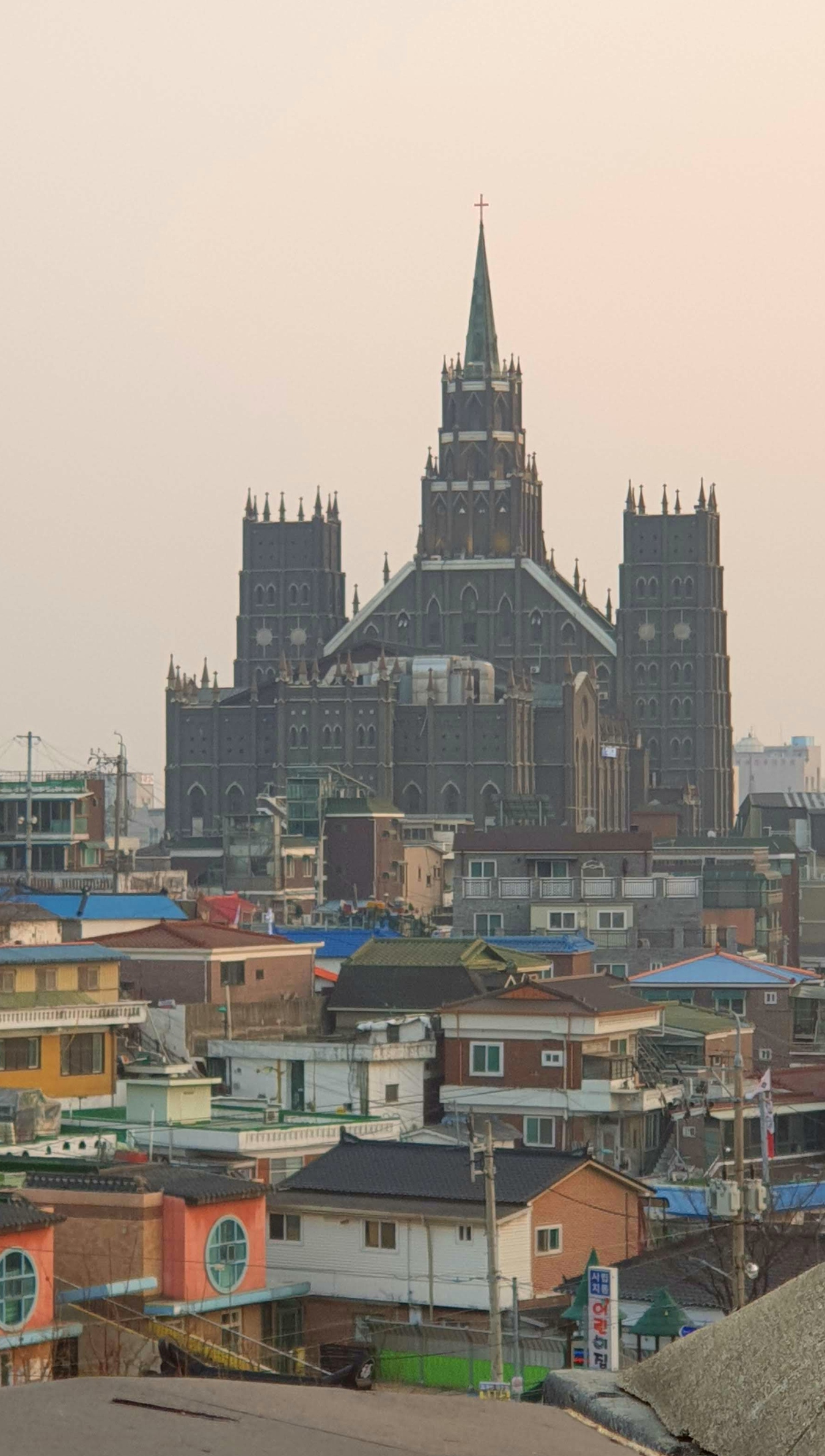
About a half an hour by car, or an hour by bus, outside of Seoul is a place called Hwaseong. It is a district in one of the most populated provinces of South Korea, Gyeonggi-do. If you live in Seoul it sometimes feels like it is all Seoul since this metropolitan city is gigantic and spread out, but the real reason you would feel this way is because Gyeonggi-do is a province that surrounds Seoul; which is called a special city. Suwon-si or Suwon city is south of Seoul, and it is the capital of Gyeonggi-do. This area is famous for the Hwaesong Fortress a UNESCO World Heritage site that was built during the Joseon Dynasty. It is a beautiful and completely intact fortress that epitomizes the military architecture of the time period (late 18th century). It is worth the trip from Seoul, and I highly recommend a visit, however this post is not about the Fortress. This is about a little street tucked back away behind the Fortress, which if you like fried chicken is also well worth the visit.
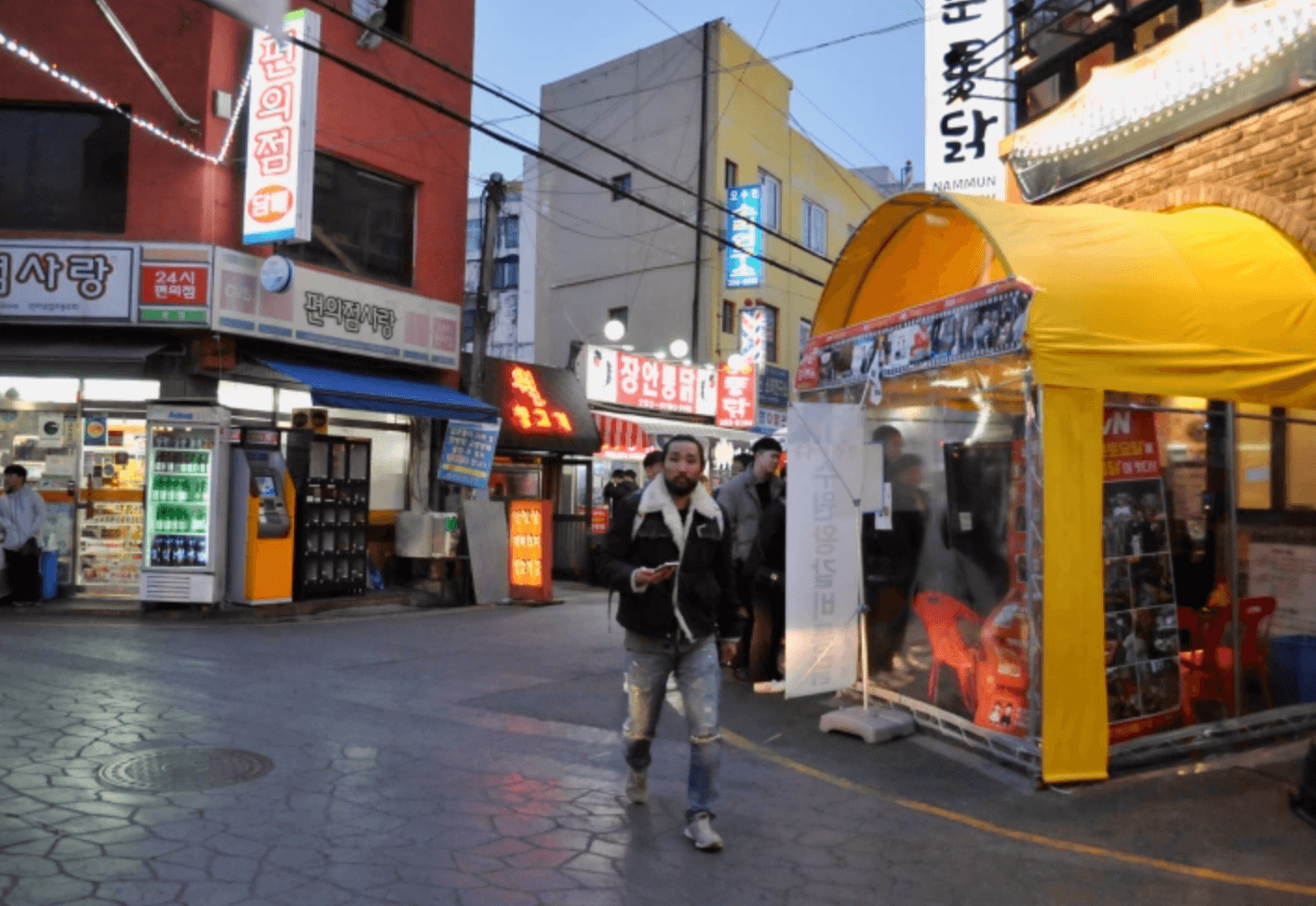
Chicken Street
I didn’t know it when I first moved to Korea from the States, but I now know that fried chicken is the go-to-feel-good-food in Korea. You can have a little chicken, a little beer, add some friends to the mix and you get chimaek.
The word comes from the first part of the word chicken—chi plus part of the word maekju (the Korean word for beer)—maek put them together and you get chimaek: chicken and beer.
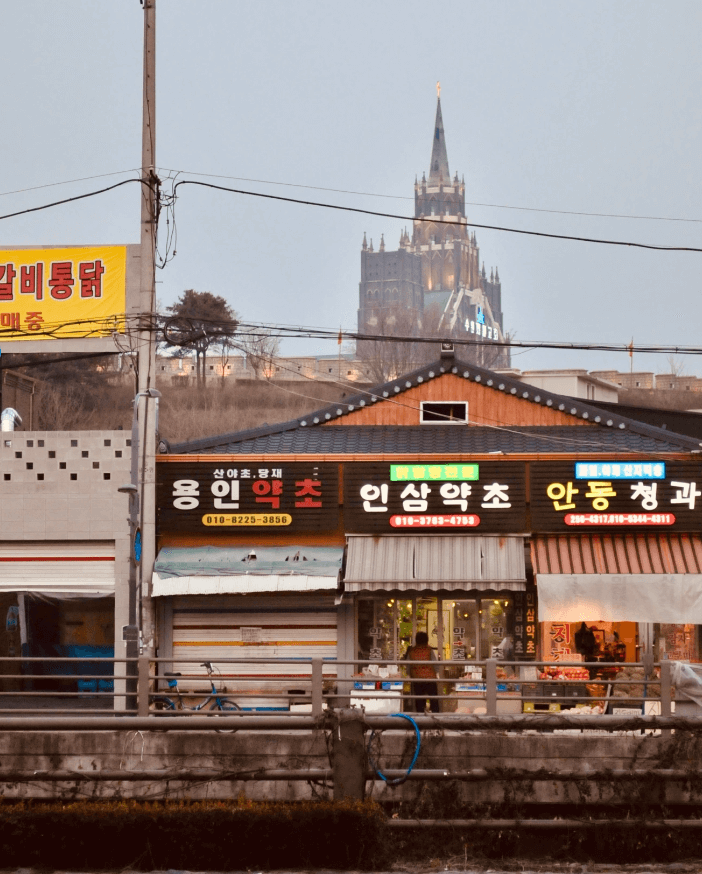
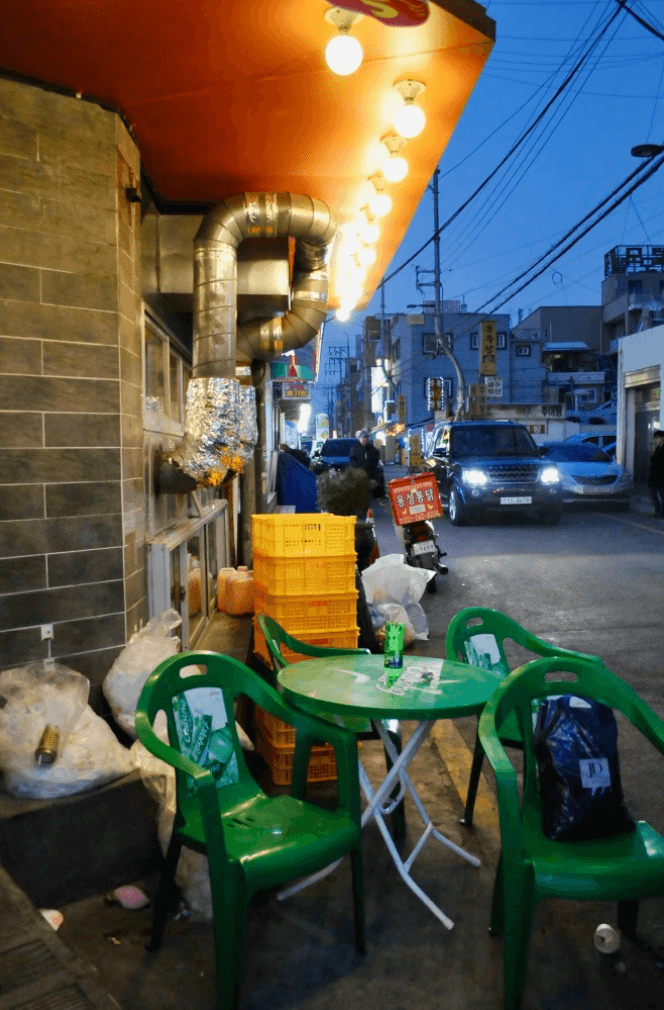
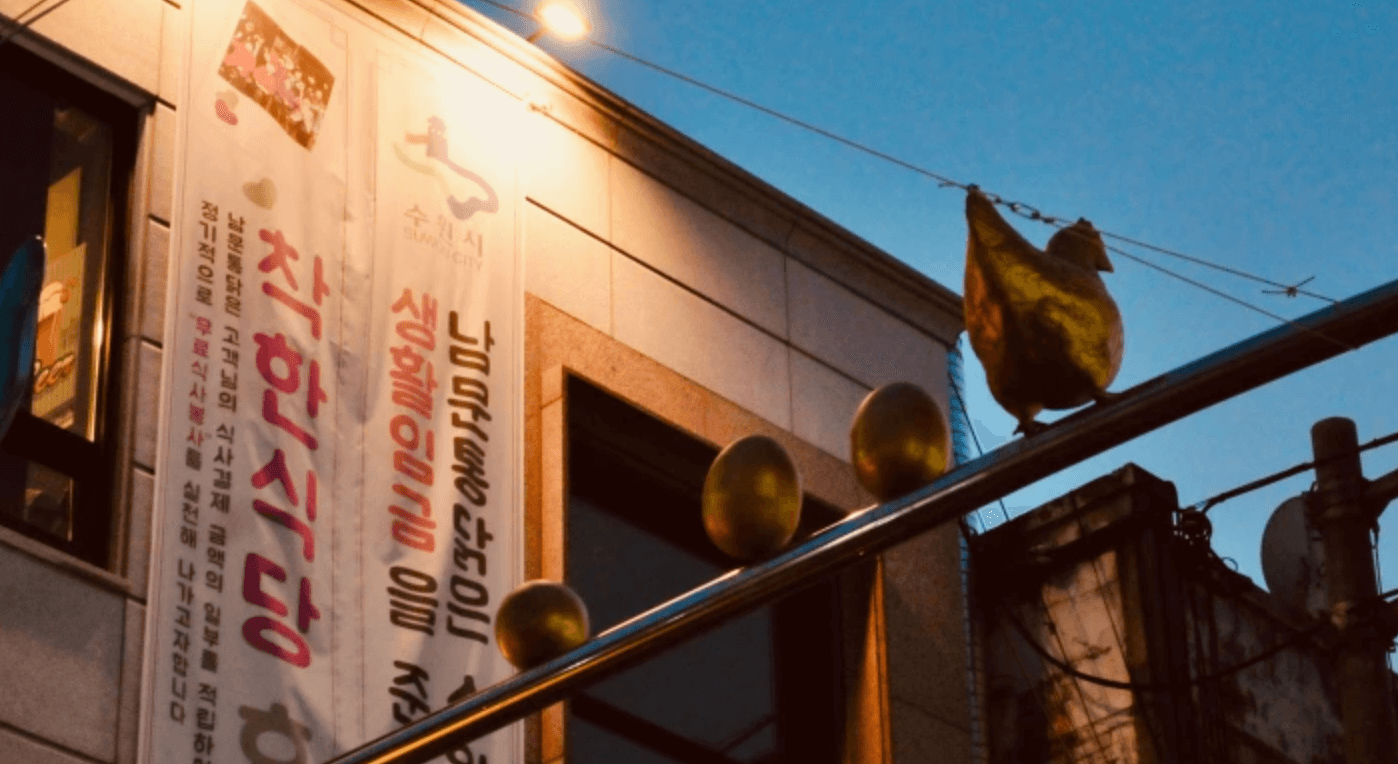
To the South East side of the Fortress near the South Gate named Paldalmun (also known as Nammun), and near the canal you will find chicken street. When you visit the Hwaseong Fortress there is a point during your exploration, as you walk closer to the south end, when you begin to smell the fried chicken in the air.
There are literally chicken restaurants next to, across the street from, and on every corner, from each other.
This street is very popular and even on a slow day there are lines outside every restaurant.
Picking a restaurant and waiting in line to be served.
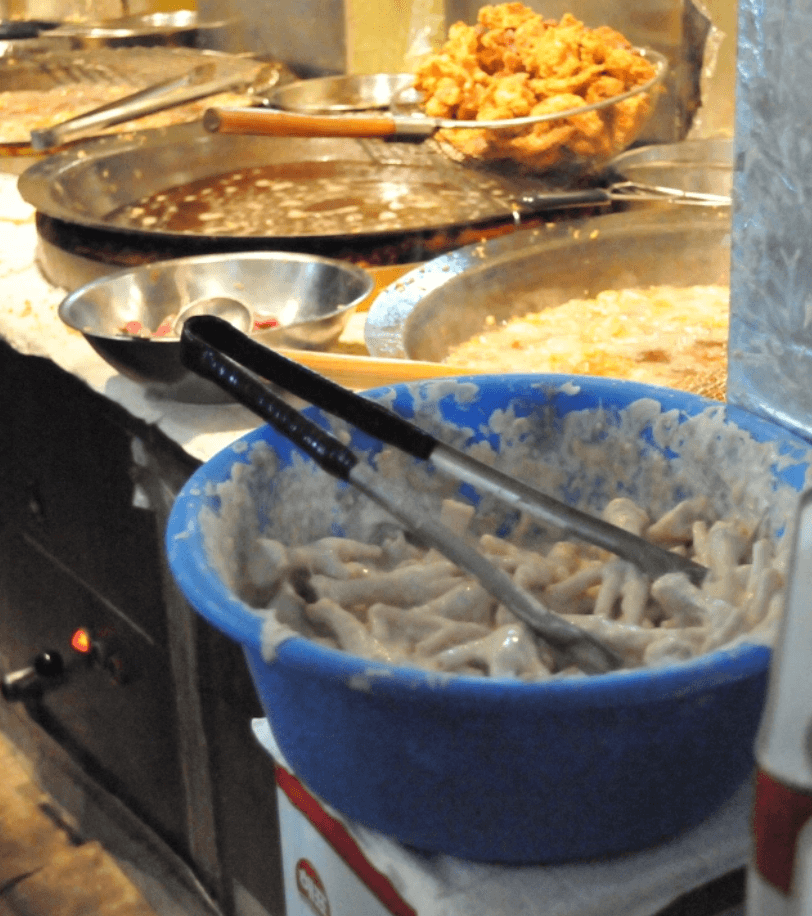
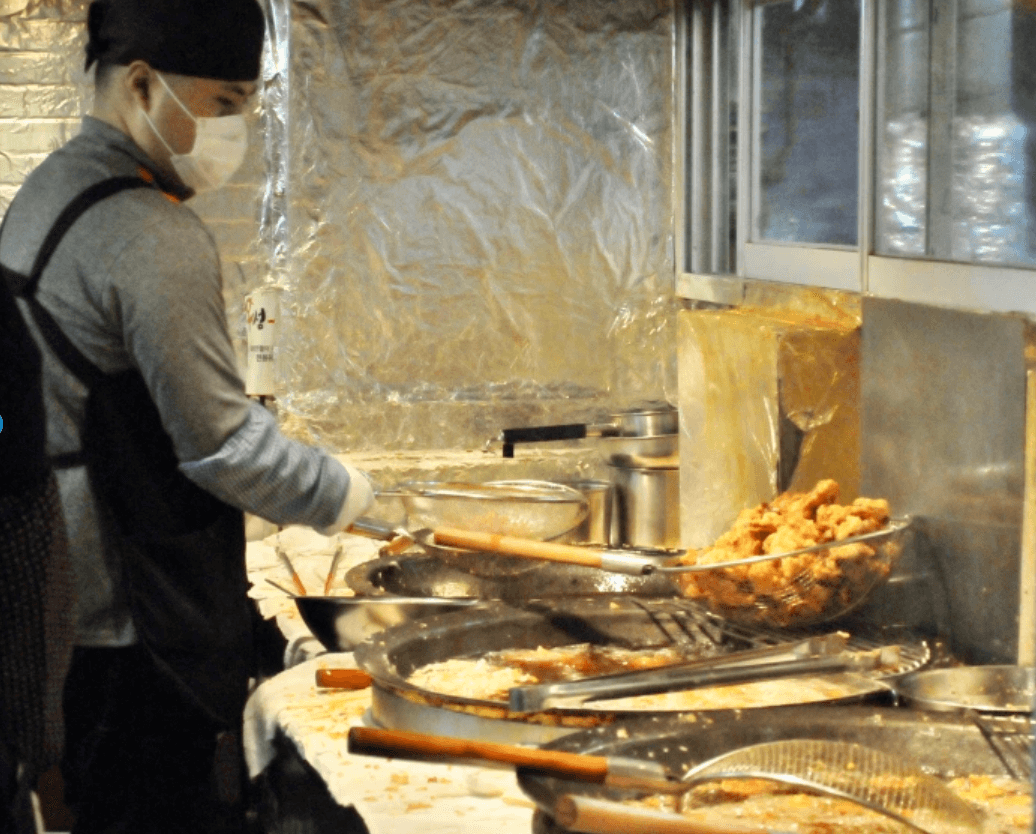
The restaurant we went to was called Yongsung Tongdak, a chicken restaurant which has been making fried chicken for over 30 years. The chicken is fried in giant cauldrons called gamasots. Gamasots are a type of ancient Korean style of cooking pots that date back to the 1300’s.
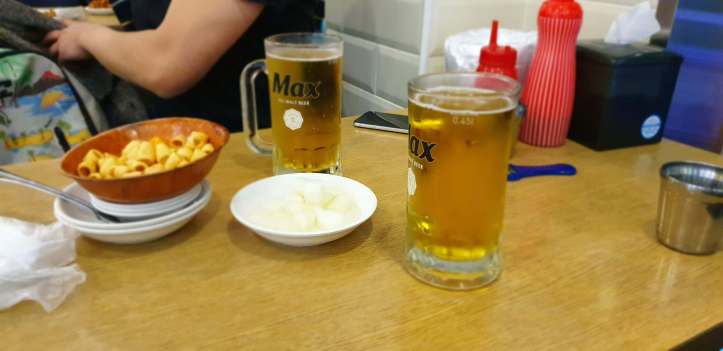
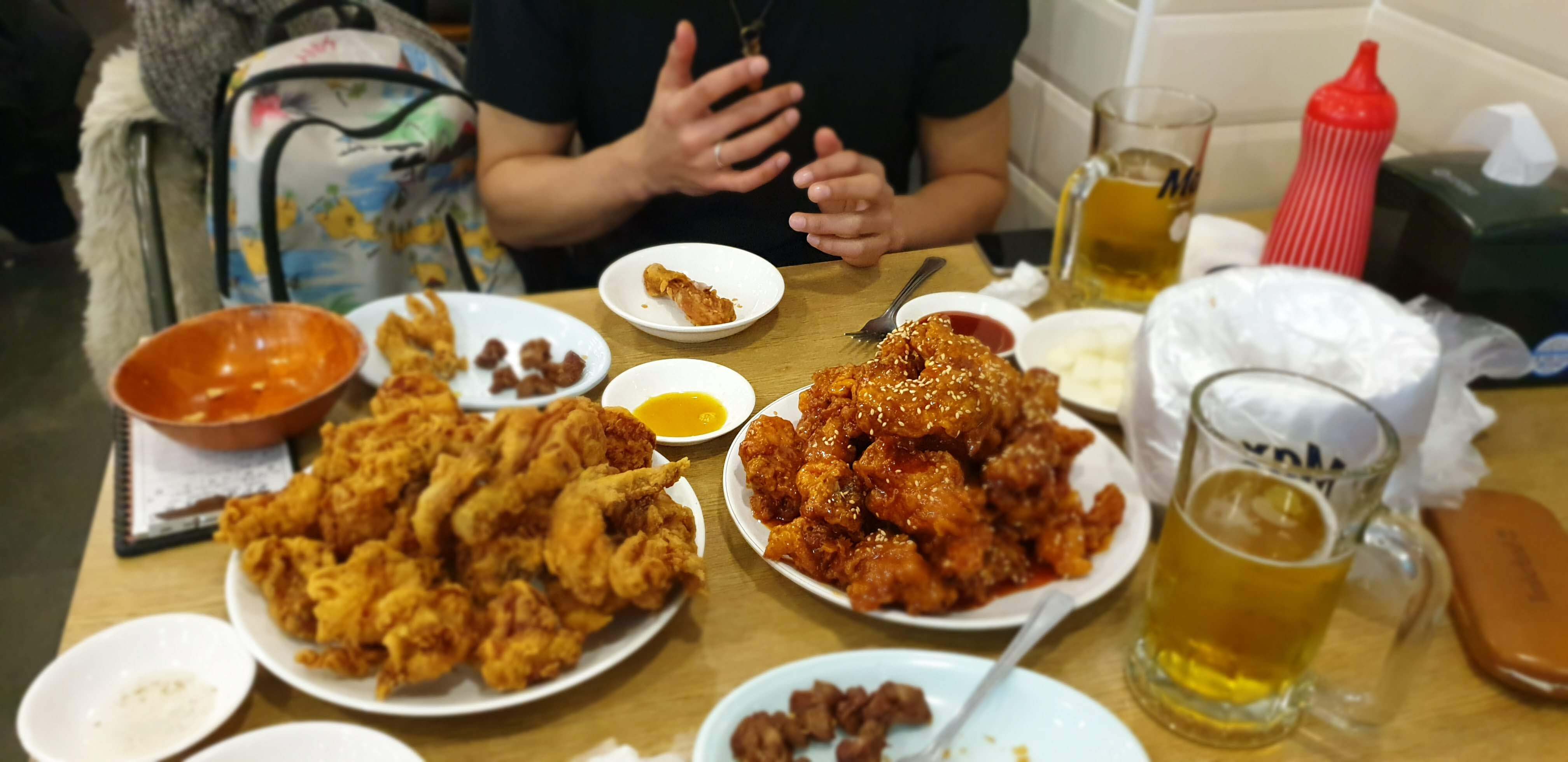
We ordered right away as there were only two types of chicken to choose from, traditional fried chicken and a spicy marinated fried chicken, and of course we chose both. We ordered maekju (beer) and the server brought us some rice snacks and pickled radish.
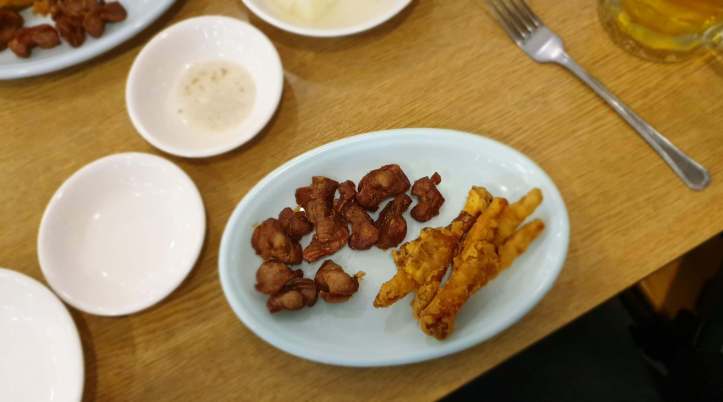
They also brought us some fried chicken feet and fried gizzards as snacks. You dip the fried bits into a small dish of salt, incase your blood pressure isn’t high enough.
Soon our huge order of chicken arrived. It was served with a mustard dipping sauce, a salt dip, and sweet gochujang- a red chili dipping sauce very common in Korean cooking. The portion was huge, so we ended up taking a lot of it home. It was still delicious the next day.
The chicken was fantastic. This was probably the crispiest fried chicken I have ever eaten. Crispy and crunchy on the outside and very moist on the inside. The spicy chicken was spicy, but not so spicy that it was difficult to eat nor did it burn your lips. It had a smooth spice that lingered on your tongue and a slightly sweet aftertaste.
If you ever come to visit Seoul in South Korea, you must make a day trip to Hwaseong-si in which you should to visit the Hwaseong Fortress, but don’t eat before go because you need to add a trip to chicken street. It is easy to find, just follow your nose.
The day is August 9th, and I am sitting in my hotel room to avoid the sweltering heat in Busan. A heat that I am not accustomed to as of yet. I’m not certain one truly acclimates fully to heat and humidity, but people do live in it.
My first days in Busan began with angst. I had flown from Portland to San Francisco on Virgin America, and then from SFO to Beijing to Busan on Air China. Two transfers, two airlines, three security checks (China’s was the toughest) and because of the time difference it seemed like it took me two days. I had left on the 4th and I arrived on the 6th. What happened to the 5th? But, more importantly, what happened to my luggage? Somewhere in all of that transferring my luggage was lost. I wasn’t calm about it, but also there isn’t much I can do. It felt like a big loss, and not the best way to arrive in my new foreign city.
I’ve moved to Busan for at least a year, and I was feeling apprehensive about the move. I can’t say why I felt or feel apprehensive. This will be my third time moving out of the U.S. on some crazy adventure that I don’t plan well. It’s the fifth foreign country I’ve moved to, and my second Asian city to live in. One would think that by now I would feel more comfortable with the whole affair, but apparently I don’t. Apparently, I have a hard time doing it, but by the time I return to the states, I no longer remember my trepidations, and I do the damn thing all over again. I’ve never lost luggage before though so it is an added challenge. I tell myself, as my friends also tell me, “I have to believe things will work out. It will come back to me.” I try to put my faith in this thinking, but it didn’t stop me from crying my eyes out thinking about certain things I had in the case. That awesome jacket. My shoes; the one’s I loved. My brand new external hard drive that I had meant to put in my carry on, but forgot to. Then of course, my travel journal that is filled with pictures of my mom and home- it is something that gives me peace. That’s what really hurts. That can’t be replaced. So, I cried my first evening in Busan. I cried because my luggage was lost, and I cried because as per-usual, I don’t know what I’m doing nor do I know why I decided to go this route, and I’m afraid. That’s all normal for me. The thing is, I do know what I’m doing. I know more now this time then ever, but it doesn’t stop me from doubting myself or my choices. That too seems to be normal.
A friend met me at the airport. I was very grateful. I had felt uneasy on my arrival, what, with exhaustion, loss of stuff, and second-guessing my life choices. It was good to have a familiar face greet me in an unfamiliar place. Nikki, who I had met at Angloville in Poland a little over a year ago, guided me onto the subway and into the city where I am am being put up in a hotel near Nampo district. I’m to be in this hotel during my training period for my school. It’s about two weeks. I am not officially hired until I successfully complete the training. So who knows, maybe I will be back in the U.S. in two weeks more broke and in debt than ever, and with no clothes. Let’s hope not.
Nikki and I wander a bit in the heat till we found a little restaurant where we ate cold noodle soup and kimchi and other delightful Korean snacks. As we walked around in the district of my new Asian city, I couldn’t help but compare Busan to Zhengzhou. Asian cities are so different from European cities as they are different from American or New World cities. The smells are different. The architecture, and the urban planning is all different. I don’t know a lot about Busan yet, but I believe a lot of it was destroyed in the Korean War so much of the urban planning is post- 1960’s. Also the land scape is hilly so that creates a different type of planning. There are some similarities to Zhengzhou in one particular smell and in the people, but they are only subtle similarities, and there were differences in what seemed familiar. Immediately, I noticed that it isn’t nearly as crowded here. In fact, the side streets were often empty. When it comes to the hustle and bustle of the subway people seem to be more polite here. There is some pushing, but nothing compared to China. If someone pushes past you they seem to be from the older generation and not to aggressive about it. In China, I found it to be very aggressive and all ages. I felt a bit like there was a sense of panic in Zhengzhou like a person needed to push everyone out of the way or they’d be left behind. Plus, in China there was the whole cutting in line (which really annoyed me) which I haven’t encountered here at least not in my one day. There was a similar smell. It wasn’t all over or as potent as in Zhengzhou, but it was the same smell. It is a terrible sewer smell that is sharp and pungent. It was very prominent in Zhengzhou, but I would only occasionally catch a whiff of the smell in some alleyways in Busan. Sewage actually smells different in China and Korea (in the two places I’ve been) then in American cities. It all smells like shit and bad, but it also has a different kind of bad. A sour kind of bad. Oddly, I find that fascinating. I imagine it is what we eat and how we live.
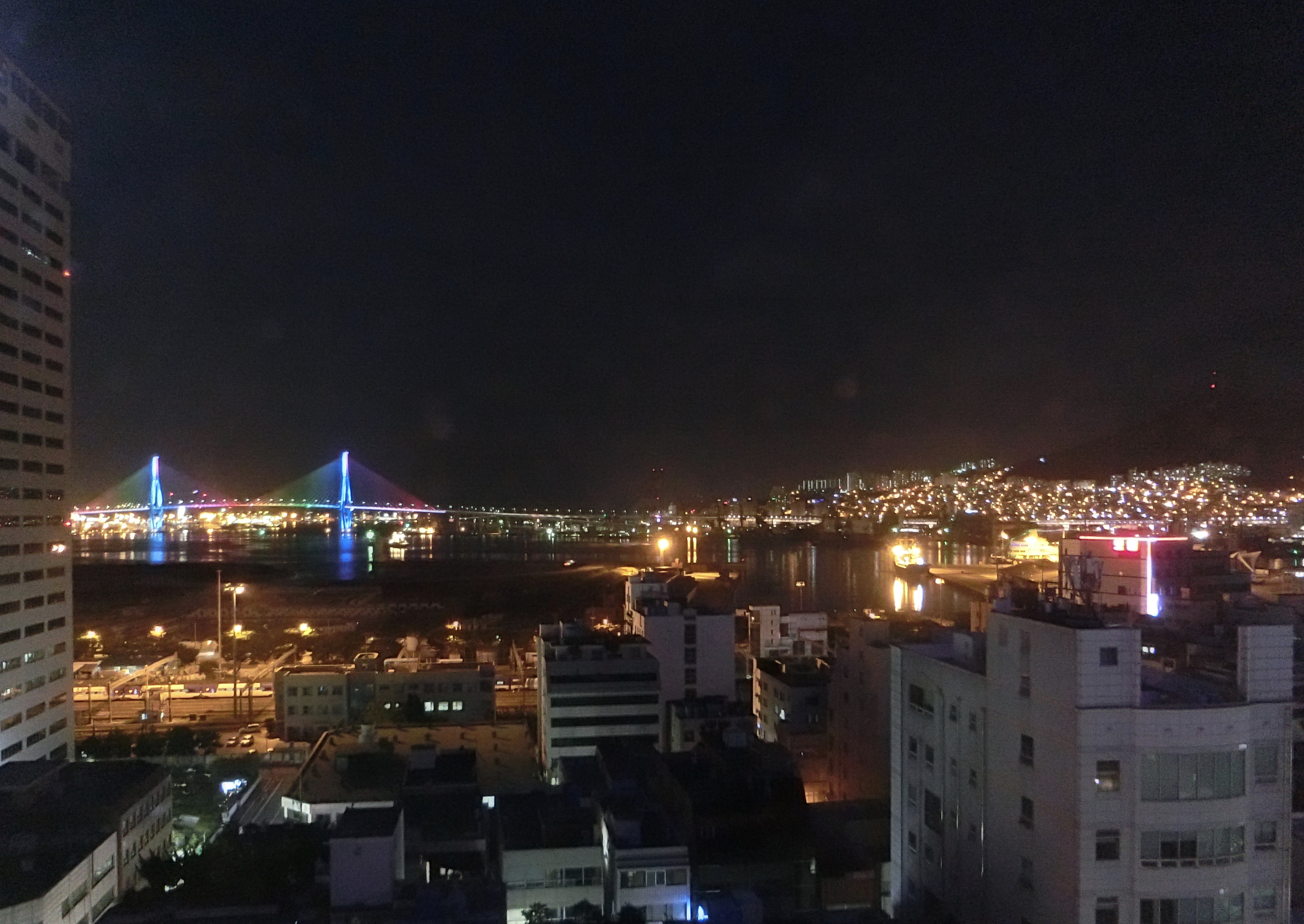
After Nikki left I returned to my room, and cried a little. Then stared out at my view. I do have a nice view of the port from my window. I am far from the popular beaches but I can see the bridge that lights up like a rainbow bridge at night and connects the Yeongdo-gu island to the mainland. I can also see Mt. Bongnaesan and all the lights from whatever and whomever is living over there. Looking out the window calmed me some, and my exhaustion overwhelmed me. I tried to read a bit before going to sleep, but I was out before 9 p.m.
In the morning after struggling to contact Virgin America, and not getting much help via chat (I have no phone right now so it adds more to the difficulty) I had another cry, and then told myself, I needed to get it together. I’m here. There’s not much I can do but hope. I can cry all I want, but it isn’t making anything better. Although, it did feel pretty good to cry. I ate the complementary breakfast offered in the hotel. It was kimchi, and rice, and some quail eggs. There was also some cakes that I think may have been fish, and a finely grated white cabbage salad. It wasn’t amazing, but it was fine. I am already a big fan of kimchi. After eating, I was determined to try and explore. I wandered a bit through some streets until I found my way to Yongdusan park.
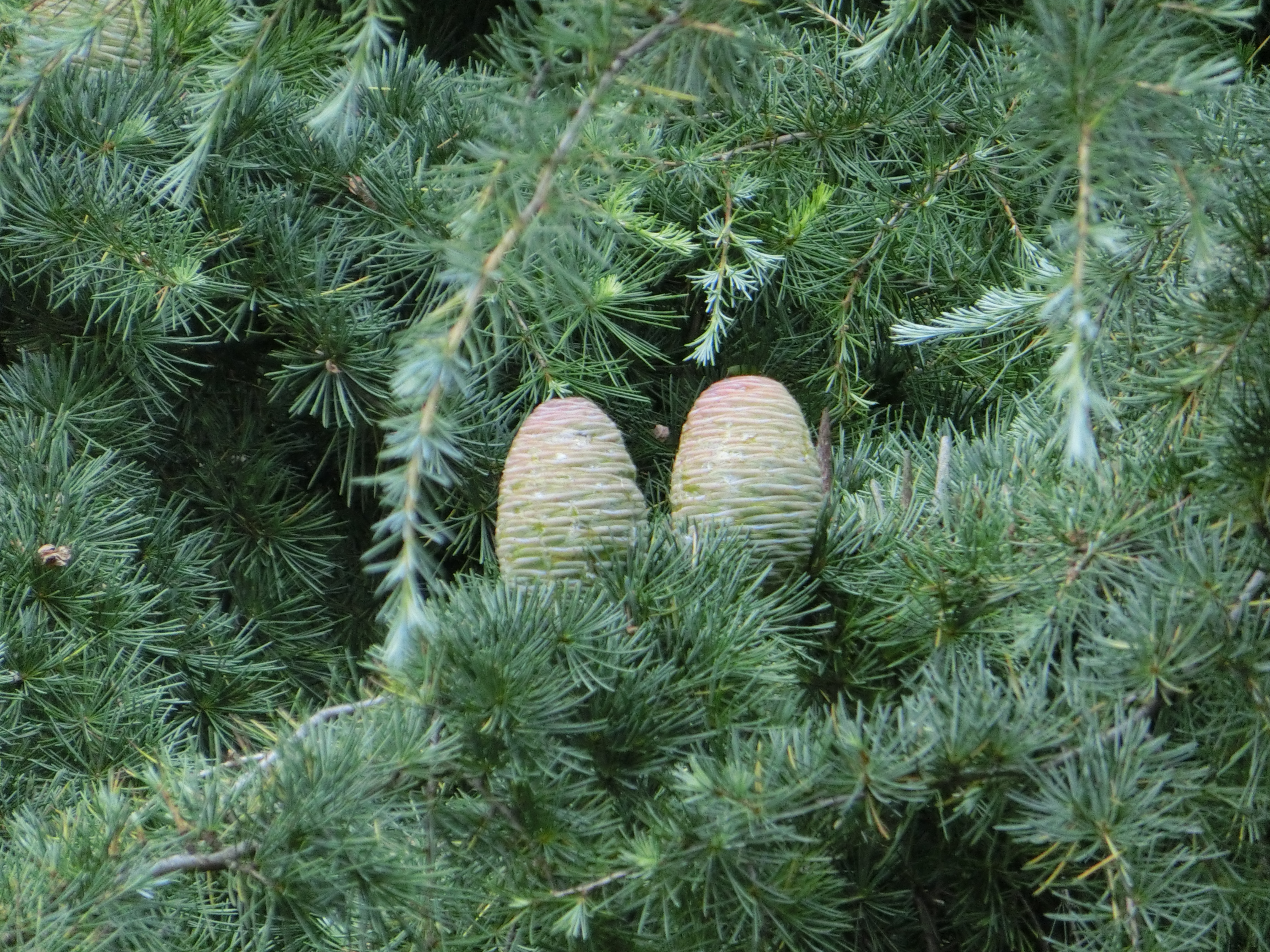
Immediately upon stepping under the trees of the park I was surround by a cacophony of buzzing and caterwauling. I can only guess that it was insects. For a moment, I had thought the caterwaul was coming from strange birds, but the consistency and pattern of repetition and tone matched with the other buzzing which I knew to be beetles. So I’ve concluded, that indeed, there are some monstrous bugs living in the trees above us. There were subtle things that captured me as I wandered melting in the humidity that was already high by 10 am. The insects that I could hear, but not see. The bark of some of the trees that seemed to look as if it was melting, and the soft shapely pinecones that sat delicately side by side in a tree as if they were siblings. They are siblings. I enjoyed the Busan tower, and the various Korean design of some of the buildings, but really it was the nature in the park that was the most interesting part. I took some photos, and as I did a man offered to take my picture. I’m sure he wanted money for it, because he was trying to pose me. I’ve never been all that comfortable with strangers taking my picture- especially when they offer it. I don’t think I photograph all that well so I’m pretty awkward about the whole affair. Still, he took them and I walked away. I began to feel damaged by the heat and I gave up my exploration. I felt a little better, and I was glad I got myself away from myself.
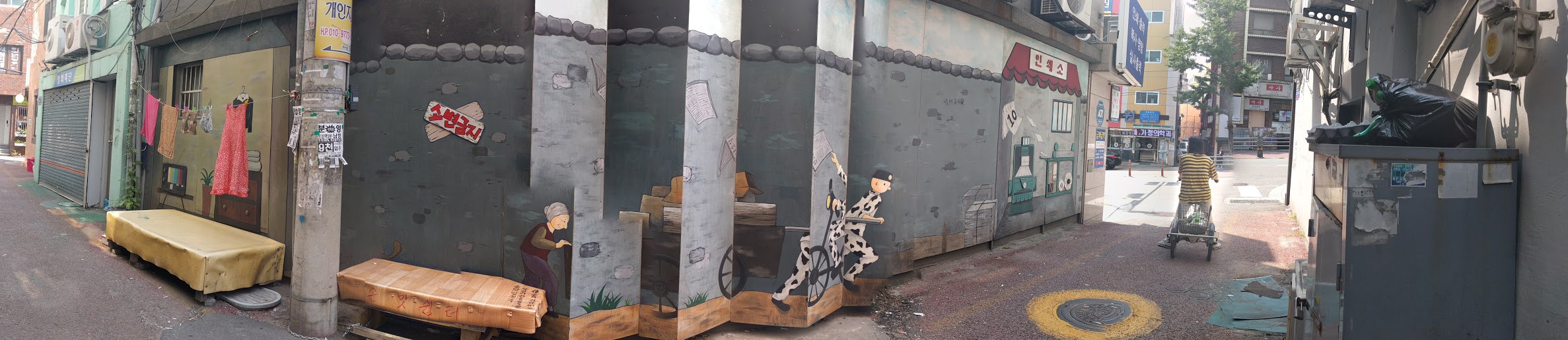
As I wandered back to the hotel I discovered art and murals in various alleyways and I saw a numerous amount of coffee houses. I had thought I would be giving up coffee for a year, but it appears like Busan has more coffee places in just this neighborhood than all of the city of Portland. It is good coffee too.
After waiting for nearly four months, my criminal background check finally arrived last week, and with it came my permission slip to look for a new job overseas. I had originally intended on leaving in February, but sometimes things don’t go as intended. I’ve decided to look at these extra months as a time for me to get healthy and to really focus on what I need in my life to give me happiness.
It had taken about 3 months to get on the Oregon Health Care plan, but thankfully it exists because I have been able to go to the dentist, and to the doctors, and get myself back on track for a healthy mind and body. As the saying goes, “if you haven’t got your health, you haven’t got anything.” I hadn’t been feeling very good for awhile. I’m pretty certain I can guess the cause, but the point is that I’m back on a mission to feel strong again, and just in time too because I will be returning to the proverbial road.
I have been vacillating between applying to work in China and working in South Korea for a few months now. Many of my friends have been saying that Korea is the way to go, and have wondered why I would even consider China.
“You hated China.”
“You were miserable there.”
It’s true, I did hate much of my time in China, but aside from China there were other factors to my hating it; my mother dying, conflict with the director of the program, and culture shock all contributed to my hating much of my time in China. It is not easy to live in China. I do believe some people may thrive there, but in truth, I think it can be a tough adjustment for a multitude of reasons. I do believe all of those reasons can eventually be overcome if you want to stick it out in China, and that you can learn to accept things, and even grow to enjoy them; all but one that is.
Although, my time was difficult there, I had also gained a strange love for China. It’s difficult to explain, and maybe if it hadn’t of been a year it may not have gotten under my skin, but it did. It took about seven months of being away, but I slowly began to miss it. I missed certain things like food, and the crazy traffic, and riding my bike in that crazy traffic. The insane rides on e-bikes, babies in pants with bottoms, old ladies dancing in parks, kites everywhere, are among the few things I’ve missed. There were things there that mattered to me, and left an impression on me that I will carry for the remainder of my life. My kids mattered to me, they mattered a lot, and they were such a huge part of my experience in China. I spent more time with 15 to 18 year old Chinese kids than any other group of people, and the experiences with those kids which included a special trip to Kaifeng, really shaped my view of the country. The Chinese people I became friends with mattered to me. In China it can be difficult to know if Chinese people are really your friends if they actually like you as a person. There are so many people that want you to be around because you are western, and it is about status to call a westerner a friend. You will not ever be Chinese, and you will never be truly accepted into the culture, and because of this it can be hard to ever find that bond that we all crave in our friendships. Perhaps I am delusional, but I feel blessed in my belief that I was able to move beyond this barrier with very little effort with some of the Chinese friends I had made while there. I felt a real kinship with the people I called friends, even when we came up against massive cultural differences. There are Chinese people I do consider to be genuine friends, and I feel that they look on me as the same, not as a “western” friend, but as real friend the kind of friend that accept the whole cultural and enigmatic package that makes up each and everyone of us.
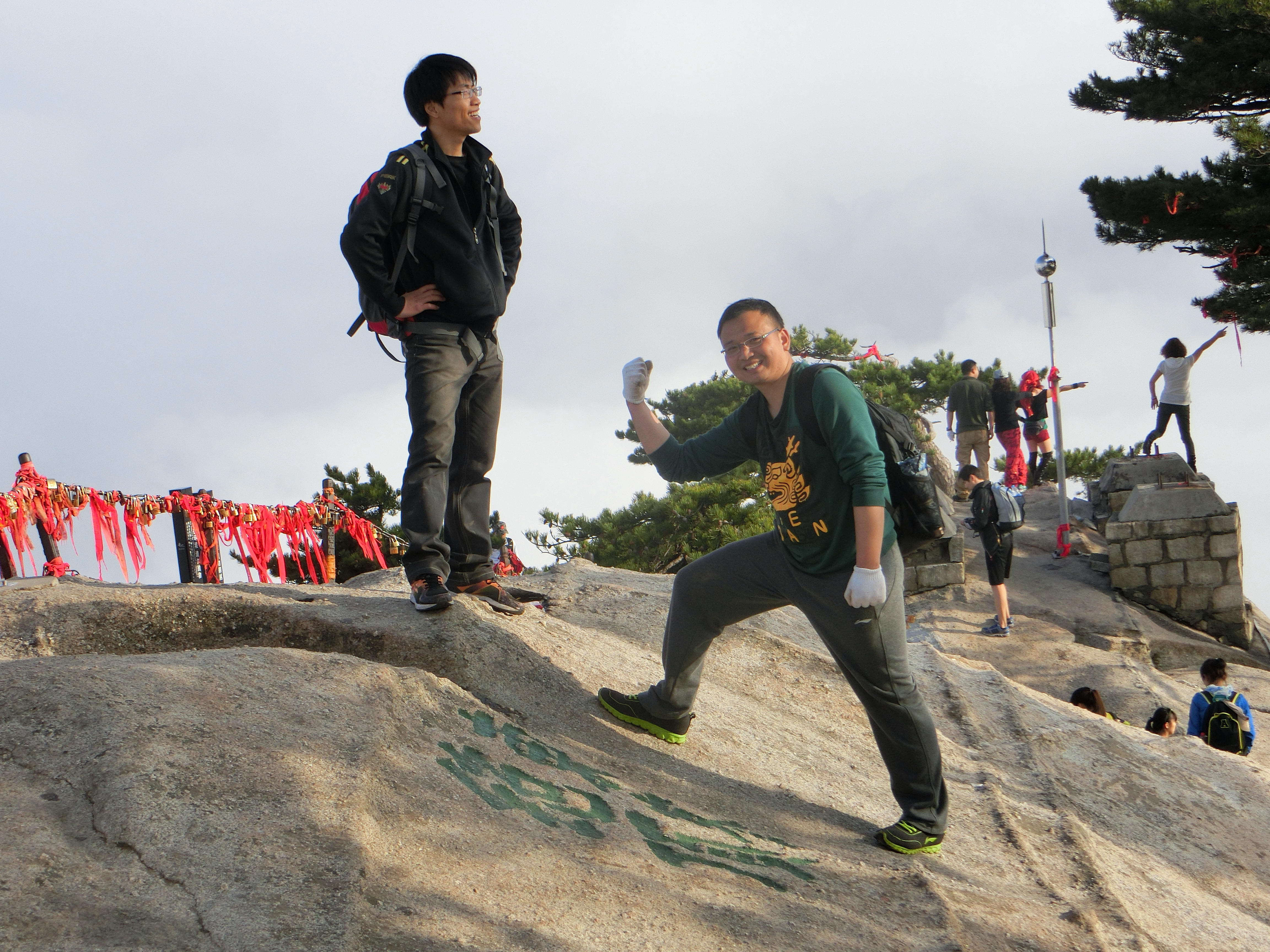
Xiang Kai and Sho Boa (Shawn) hiking up Mt. Hua
I have been fascinated with Chinese history since I was a little girl. I remember stacks of National Geographic magazines with images of China. I remember watching the student protests in Tiananmen Square live on television. I had taken a course in the history of Eastern Civilization in college and I had become immersed in the ancient history of the dynasties. When I was a girl there were only three things in the world I had wanted to see: The Pyramids of Egypt, the Acropolis of Athens, and the Terra Cotta Warriors of China (I can mark one off my list). Chinese films are among some of my favorite, and the dissidents of China are some of the bravest people in the world. There is much to be fascinated with in China, and there is a lot to grab your heart and keep you there, but for every amazing thing Chinese there is also something insidious. A drive for cultural success that is so strong that corruption and lies are an accepted part of the society norm creating at times a dog-eat-dog world. The repressive regimes from the cult of Mao to the current CCP that smothers the real strength of what is hidden in China. The annoying and ridiculous firewall put in place to control and suppress the people, and the denial of terrible events by erasing them from history. The horrific pollution that had for too long been acceptable in China, and ignored in the majority of the world. These are things that are difficult to live in, and I believe it is difficult for many Chinese too (judging by various conversations). China is a land of great contradictions and it is these contradictions which constantly push and pull at you. At me.
Some of my kids rehearsing for “The Outsiders”.
So, what are the deciding factors, what did it come down to when choosing between China and South Korea? The main motivation for China was a school. A drama school where I would be a theatre teacher, and where as part of my work I would be required to direct my own children’s plays. I contemplated this school for nearly a year. It would be a job that combined my theatre, my literature and my teaching skills. I would finally be working in a creative environment and for that I was willing to move to the polluted city of Beijing. Yet, it was during a bike ride in Portland that finally solidified my final decision.
It is now spring, and the sun is out and the sky is a clear blue that bends over the city with only a smattering of cumulus clouds dotting the sky like paint on a palette. The days have been beautiful and easy going. My moods have been hum-drum and dark, and sometimes this happens even when things are going well in my life, I need these beautiful days to help lift me from my internal darkness. I knew at that moment under the blue sky in the face of mount Tabor, the small extinct volcano covered in the rich green of white-cedar and poplars, that I needed to live in a beautiful place. As much as I had wanted the theatre school and as much as I was willing to return to China, I knew in my heart that returning to an over-populated, dirty, and congested city with air so bad that there were red alert days not allowing us to go outside, was not a good idea for me. I knew, no matter how great the school, my sadness would overcome me, and I can’t live like that.
I have started the interview process for jobs in South Korea, and I’ve focused my attention on applying to schools in places where the sky is blue and the ocean is near-by. The job matters, but the environment matters more.
As I had mentioned before I believe that most of the challenges of being a foreigner in China a person can overcome, but one. That one for me is the pollution. China is a geological diamond and a natural wonder of nature, but the coal and the money made on cheap labor and unregulated businesses that damage the country is more important then the jewel. I will one day return to China, but maybe as a visitor. Till then I will be in South Korea.
As the window to getting my visa in time to start work and return to Asia closes, I’ve started deliberating on what to do next or where to go next. A friend of mine once said, that I always have a plan B and a plan C. I didn’t know this about myself, since I rarely think I have a plan A. I mean, I think or imagine or talk about possibilities, but actual planning… I’m not so sure. I do believe I have a think B and a possibility C, but that’s as far as most of my planning goes. Then again, maybe I have a sense of terrible self-awareness.
I’ll just call them plans for connotation. Asia, was plan A, and I was pretty set on China, and this all had to do with a job teaching at a drama academy which would be so awesome (in my mind), but my major hesitation is that the pollution in China is deadly. I’m not real excited about breathing in Red Alert air, since I already did it for one year, and that’s one year less of my lung life without ever smoking a cigarette, that I’d rather not add to an already short life ( I mean with all there is to experience in the world). When I received a Facebook message from my wanderlust friend Keiko telling me to come to South Korea, I seriously considered it. I considered it enough to apply, and to do two interviews, plus get offered a position. Yet, I’ve been talking to the school in China for quite awhile, and they offered me more money than originally offered. I’d been on the fence, but it looks like the United States will be making the decision for me. As I wait for the necessary Criminal Background Check, and health insurance in order to get the necessary (and too expensive to pay out of pocket) health check for China, my entry time to the new semester is getting smaller. Also, China is looking like less of a possibility without the health check. But, I could miss out on both because of the semester starting before I can get there. I’ll have to apply later, and look for positions where they didn’t get enough teachers or teachers bailed, and that’s fine, but involves more waiting. It will be a mystery to even myself where I will end up next.
As I’ve been waiting here in Portland, kind of not doing anything, at all, I’ve been wondering what I’m going to do with the remaining half of my life (I’ve got a birthday approaching). I’ve been watching all of my friends settle into their lives, and I’m really proud of them. I know a bunch of small business owners, people living life the way they want, having families, and getting their homes, and people who seem to be really happy, which makes me happy. On a really selfish side it’s good to surround yourself with happy people because happiness is like a rabbit- it keeps breeding. Still, I’ve been thinking, “wait, but what am I doing, really?” The answer right now is “not much”. Right now, as of today, I have a good excuse since I’m waiting, but with this delay in getting my documents, the waiting will be moving into the depths of needing to do something, and oh my god I’m wasting my life and the common feeling of being lost. I know this because I know how I think. I’ve been asking myself all the questions from all the positivity blogs and websites or the big motivational sites: HOW TO LIVE THE LIFE YOU LOVE. BE THE ONE YOU DREAM TO BE. You know the ones they’re everywhere. I do believe it is good to reflect on yourself and your life, and to ask yourself the important questions because one day you’ll ask yourself the most important question: “if you are going to die right now, can you say to yourself that you truly made the most of your life? Did you live the life you wanted?” And, of course, I think all of us would like to say yes because it is our one precious life on this earth right now, and no matter what your beliefs you will never be this person in this body in this place in this time again- so hopefully it is a good place.
I had been playing it over in my mind; the mantra of do what you love, and asking myself what do I love? I’ve given up before on the thing I loved because of fear and low-selfworth, and I don’t want to do that again, so I asked myself, “what do I love? what makes me happy?” What really makes me happy, not the idea of what makes me happy, but the reality of what makes me happy. I created a short list:
Dancing; when I was on stage; snowboarding; teaching (not prepping for class- I don’t like that part); writing; reading; going to art museums; being out in nature; and just talking with people- lots of chatting and learning about people’s lives; and a ton of laughing; learning new things; and traveling- in fact the actual travel part- especially on trains (my favorite).
I wondered if it was possible to combine all of these things and still make a sustainable living especially since there isn’t a lot of “jobs” in the list at list not obvious work except teaching, but I’m not going to be a teacher in America. It’s not going to happen for a lot of reasons. The most obvious thing to me, but I don’t think it’s all that easy, is to become a travel writer. Travel writing, to me, almost seems similar to trying to make it as a performer: A lot of people want to do it, and you have to know how to sell and market yourself, and few actually make money at it. Even so, I feel like it’s probably the best way for me to combine all my loves (snowboarding by the way can be replaced by any number of sports or activities. I just have really fond memories of my snowboarding life in Germany). So that’s what I’m going to set as my future life goal, and I’ve started the process.
I read somewhere that it is important that once you set a goal to immediately jump into action. Not crazy action, of course, like if you want you run a marathon you try to run 26 miles in your first day, unless you already run marathons, that’s just stupid, and a great way to hurt yourself, and to quit. This action can be small, as long as it is an action in the direction toward your goal. So, that’s what I did. I made a decision to have my goal to be a travel writer. I’m starting small here, I’m not thinking making tons of money, and getting paid to travel, but I am thinking professional. I’m open to making money and having it take care of me, but I’m not thinking I’m going to take the internet by storm tomorrow. God, knows that’s the truth, I’ve had this blog for eight years’ and it has not caused any earthquakes. I have a lot to learn. A lot. So I’ve set my goal as a realistic accomplishable goal. It is very possible for me be a travel writer. I just set up a website, travel, take good pictures, and write about it: done. Making money, and sustaining your life as a travel writer is something else. The extra part I added about doing it in a professional way is to set me up for goal number two which is to make income as a professional travel writer. Right now I can’t focus on the actual goal of money because when I look at travel writers’ blogs, I think to myself, “Oh, god, I’ll never be able to get a following enough to make money.” I’ll never write like them or take pictures like them and their backgrounds are so geared for that life not mine, and on and on I’ll go. I have to keep my goals reachable. So right now it’s just a travel writer with a website set up, prepared, and open to receive income when the time is right. I sound like The Secret or something. Anyway, speaking of other travel writers, that is where I took my first steps of action.
I went to several travel sites and collected a list of the best travel blogs, and the best blogs to read for 2016. I found 57, there are more than that, but I wrote down the 57, and that was my action day 1. Then the next day I browsed 23 of them, and removed any that I didn’t think were my style or my scene. Unfortunately, I didn’t cut out that many. The following day, I went through the remaining 34, and made my final picks of travel blogs that I want to research for content, ideas, and inspiration. Again, unfortunately, I only managed to reduce a few from my original list of 57 to 42. My next part of the “action” (process) is actually reading these blogs which is why 42 is not exactly the ideal number. I have to read them. How am I to know the content, and to see what readers are reading, and what niche may be missing that only little ol’ me can fill if I don’t read them? So I’ve decide to create a little criteria that I’ll share later (because I haven’t made the list yet) to bring the list down to a reasonable number that I can actually follow and still manage to live my life.
Maybe you are wondering what the cut off was from the first round of traveler writers. Well, since you asked, I’ll tell you. Posh. I cut out the posh blogs or the blogs for rich folks. I know people without money like these blogs too just like they look at Goop by Gwyneth Paltrow or follow the Kardashians, but come on that’s fantasyland. I need to look at something I can actually do. There’s no way I can go to fancy posh hotels and top ten ritzy restaurants. That would basically make my travels last about one day. I need reasonable goals. I also cut out the crazy adventure extreme blogs. I’m not going to sustain myself on bugs of the Amazon, and jump from a helicopter to sandboard down a Namibian sand dune. Reasonable goals. There were a couple other blogs non-posey and non-extreme adventure that I was on the fence about because they just seemed like a little too pretty and too perfect, but I decided to put aside my initial judgements, and read through them a bit. As far as who I already gravitate to in the travel writing blog world I do have a few that I like even with only a small browse, and I’ll share those guys now:
I’ve already noticed a couple of themes in language use amongst almost all of the blogs: Digital nomad being a huge one and Lifestyle creator. I find them a little cheesy, but that’s marketing- it’s all kind of cheesy. I also noticed that most people seemed to have changed their lives and quit their office jobs to began their travel blogs in 2008. I don’t know why this time exactly- the economy maybe? That was when the market crashed. It’s just something I noticed.
There you go. So as I sit and watch my window of opportunity close to a couple of jobs in Asia, and then wait for a couple windows to open for new jobs in Asia, I’ll work on building a door and then opening it myself.
When my contract was up, and my visa expired I decided to not renew. Instead, I decided to leave China. I was ready to leave China. I had experienced the greatest loss of my life while I was living there, and that was the loss of my mother. Not only did I go through my experience of grief, which I still deal with, I had also simultaneously experienced culture shock. Culture shock is a strange beast and can be a bit difficult to recognize, but looking back on my time there I can say with certainty that I had had culture shock. Some days were worse than others. One would imagine that with death and shock that I would have been ready to run home, but for me there was no home. My mother was my home, and now that she was gone there was no place to call home. I did not want to return to America, but I didn’t want to be somewhere as challenging as China, yet I wanted something foreign; foreign to me. I decided to move to Prague in the Czech Republic.
My flight went first in the direction of South Korea and then towards Europe. I had decided to extend my layover to 24 hours and used the opportunity to see some bit of South Korea. I literally had 24 hours, and so I used that time to try to see as much as I could in a very short amount of time. There are many palaces in Seoul, and fortunately the Gyeonghuigung Palace was close to the hostel where I was staying. I can not for the life of me even begin to imagine how to pronounce the name of the place, but my single day in Seoul was a silent one anyway.
I wandered around the palace and walked around the district where I was staying. I had no idea of what kind of district I was visiting. Was it expensive? Was it where the foreigners lived? Was it a college area? I didn’t bother to figure it out. I only had two goals. One was to see something like a palace, and to get a small perception of what South Korea was like, in case I ever would want to return, and two, to find some food.
It was a solitary and quiet visit, and I can honestly say that a day is not enough time to spend in Seoul. It is a huge city with many different districts, and even in a single day I was not able to see the entire palace. Still, I’m glad I took the opportunity to take a peak. Compared to Zhengzhou, China, Seoul was a clean city. There was no trash on the street and the air was more clear although they did receive some of the pollution from China, and like China it felt very safe. So as I wandered through the streets I never felt worried that I would turn the wrong corner. There is so much freedom in this feeling of wandering.
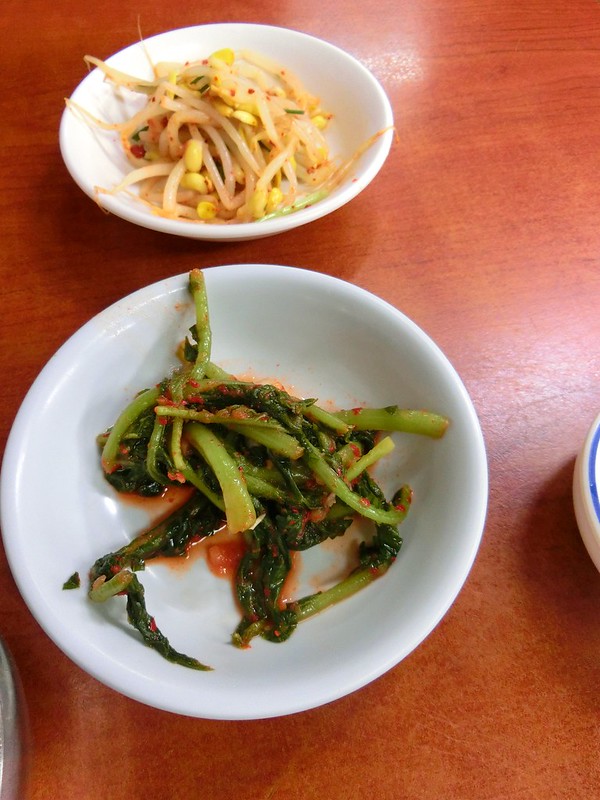
After I left the palace I decided to find somewhere to eat. I had wandered through the district for about two hours before I got lost in a market and then wandered down an alleyway. Here I hesitated because I was very hungry at this point and my hunger was clouding my ability to pick a location. It was at this moment when a Korean woman ushered me into her tiny little shop and she served me the special of the day.
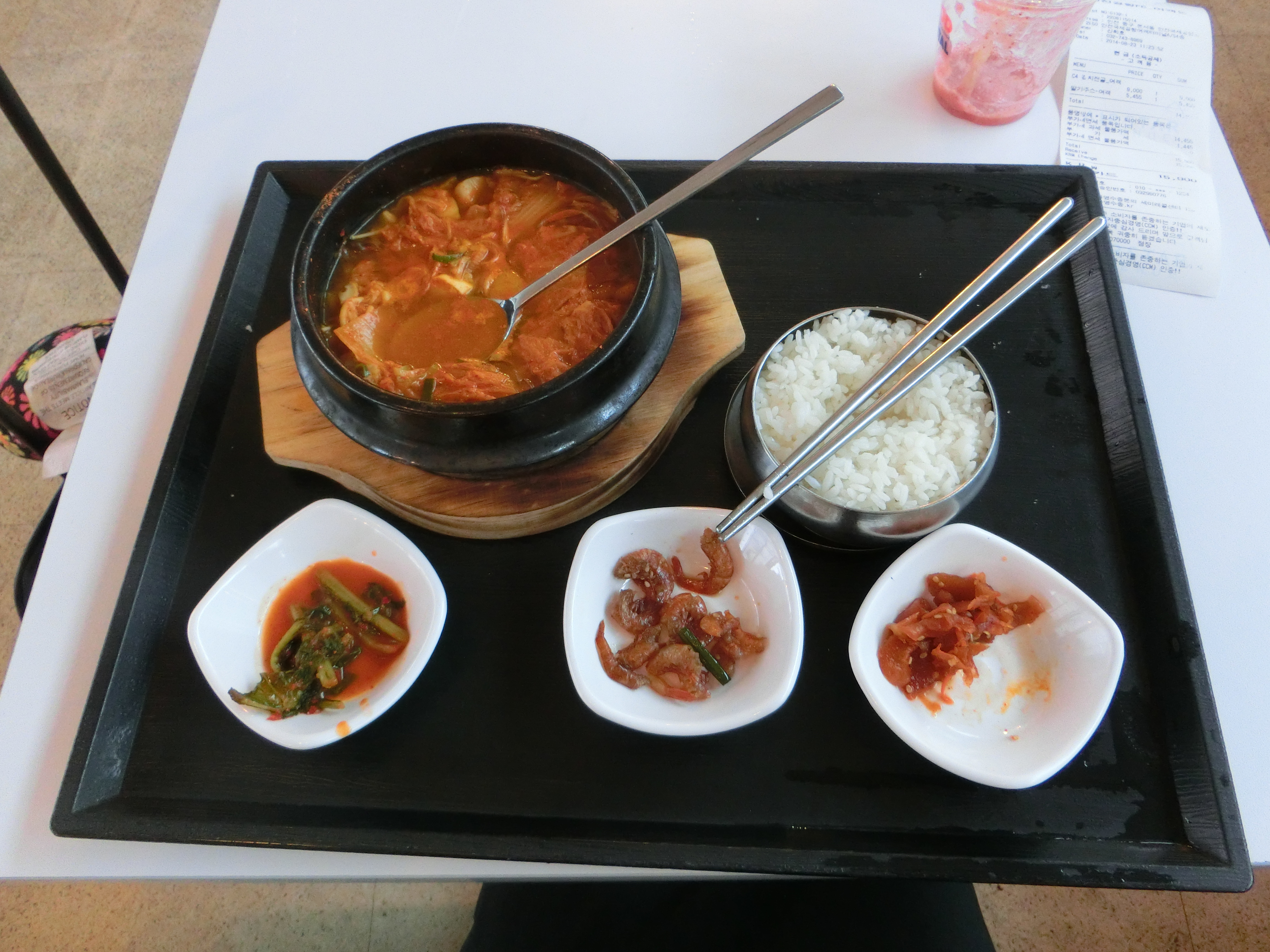
I cannot emphasize how much I love Korean food. I love the textures, the spices, the colors, and I love how it is served. Every food item has an individual plate and it is all served in a sensible portion size. You feel full, but never stuffed.
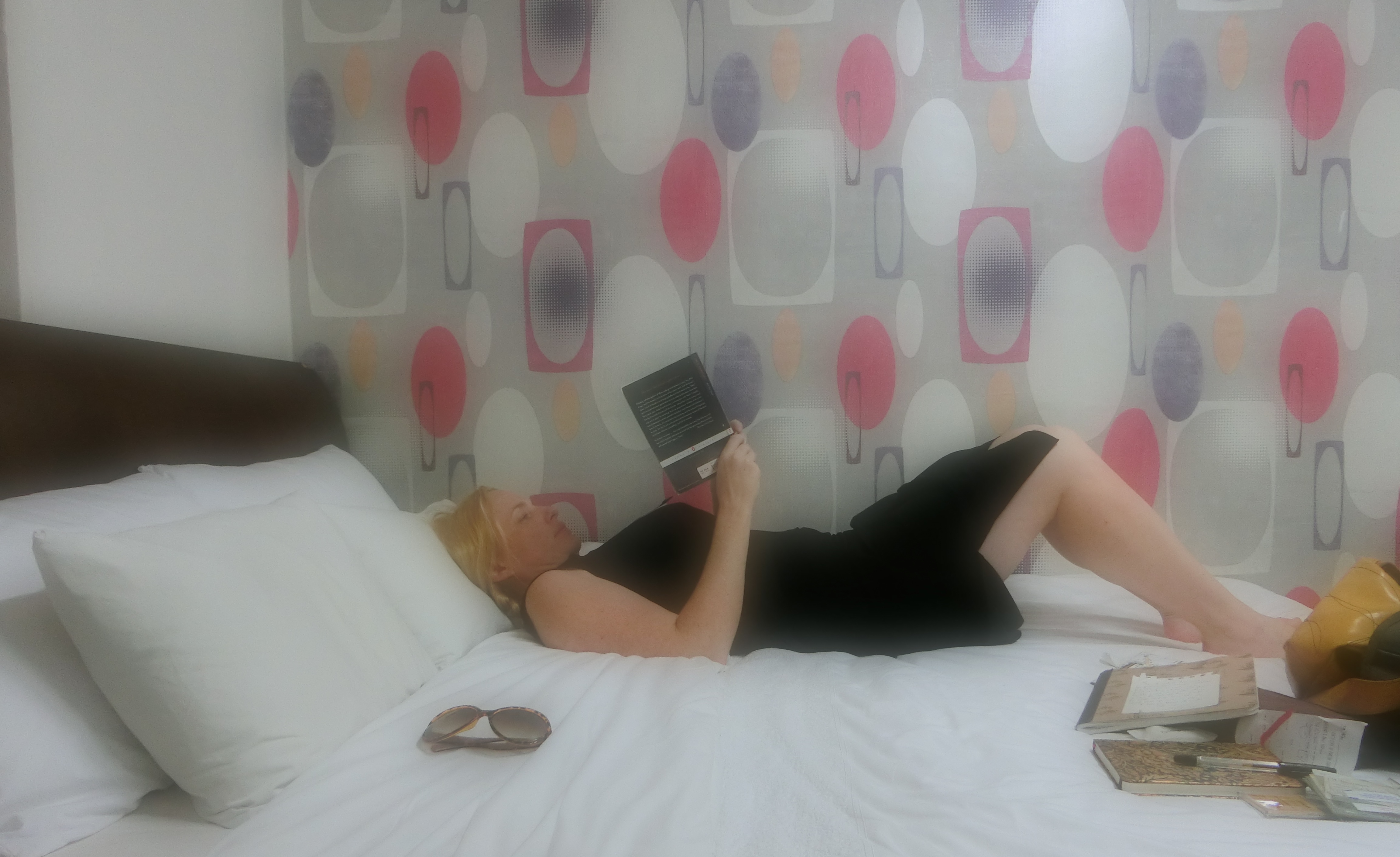
After eating I returned to my room that had pastel dots and square on the wall, and prepared for my long flight to Prague, and a new chapter of my life.
I am writing about all of this in the past tense because it is past. It has been over a year since I stepped foot onto a sidewalk of Seoul, and at the time of typing these words it has been almost two months since I’ve left my beautiful Prague. I currently sit in the dining room of my friend’s house where I am staying as I plan my next move. A dear friend of mine asked me recently, “So what is your plan? You always have a plan.” I wasn’t aware of this, but thinking back on my life and the choices I’ve made, I think it is true. I do always have a plan. I don’t always succeed in that plan, but it doesn’t matter because when one plan fades or fails I’ll soon have another.
So what is the plan? I plan to update this blog with the thoughts and memories and photos from the last two years of my life. I plan to return to my revery and release through writing, and I plan to have all of it documented here before I leave again. I am leaving again. At least that is the plan, and while it seems fairly strong that I will be returning to China, (and I’ll write more about that later) it is not impossible to imagine that I will also be returning to South Korea. I have too, because now I have a friend there, and I owe her a pillow.




































 The day is August 9th, and I am sitting in my hotel room to avoid the sweltering heat in Busan. A heat that I am not accustomed to as of yet. I’m not certain one truly acclimates fully to heat and humidity, but people do live in it.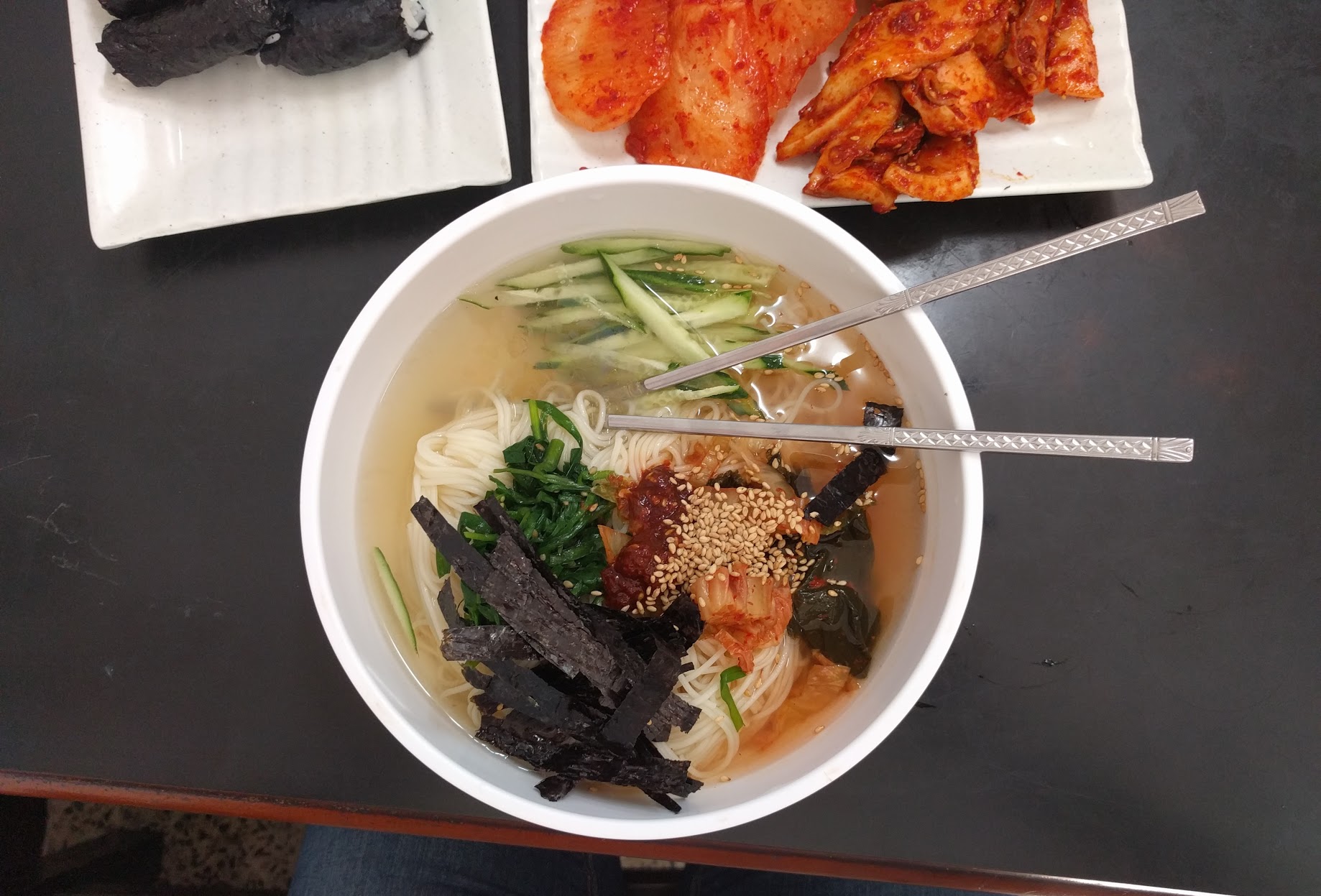












 An Accidental Vagabond