Stopping to Visit the Peonies of Luoyang

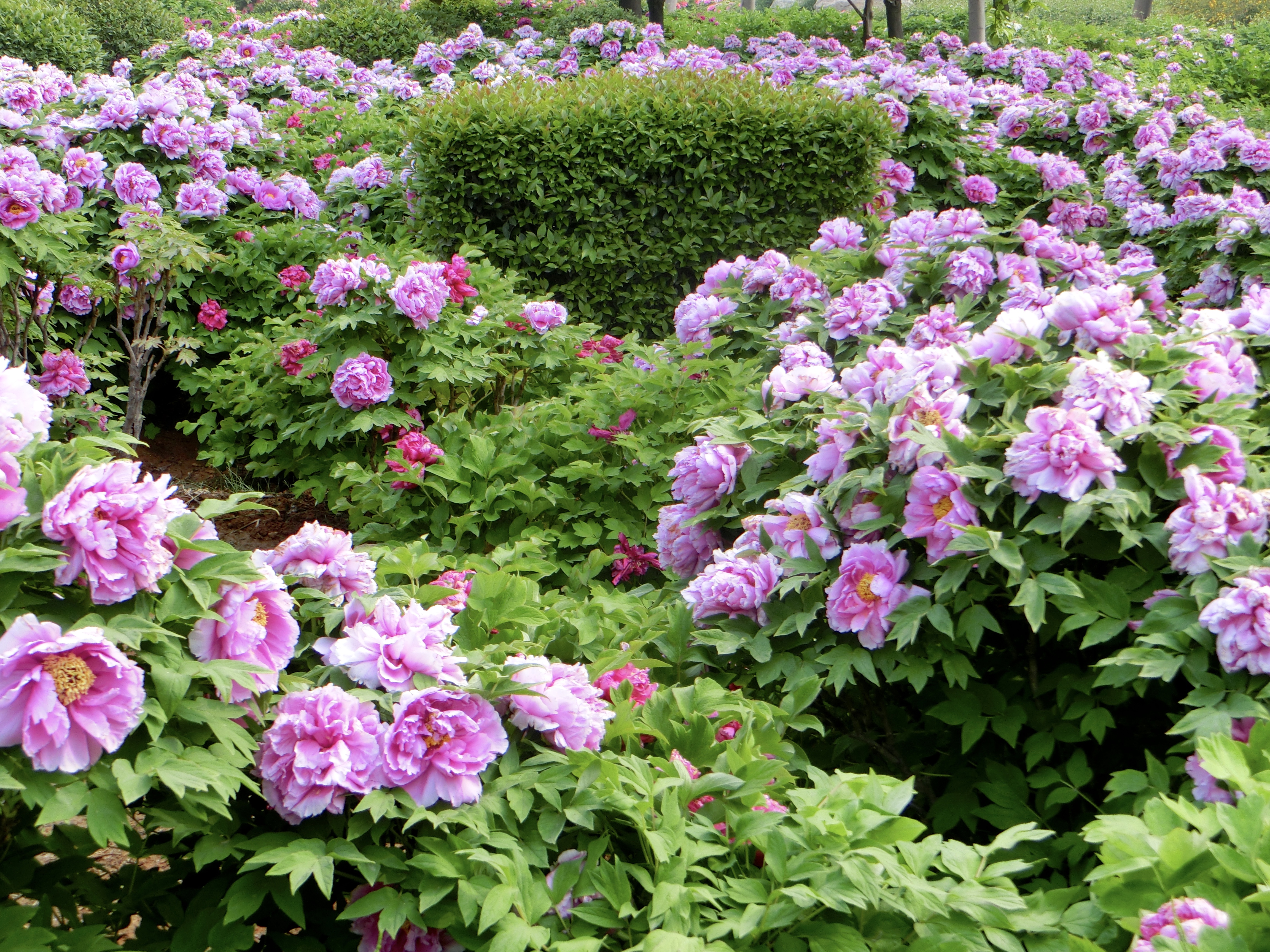
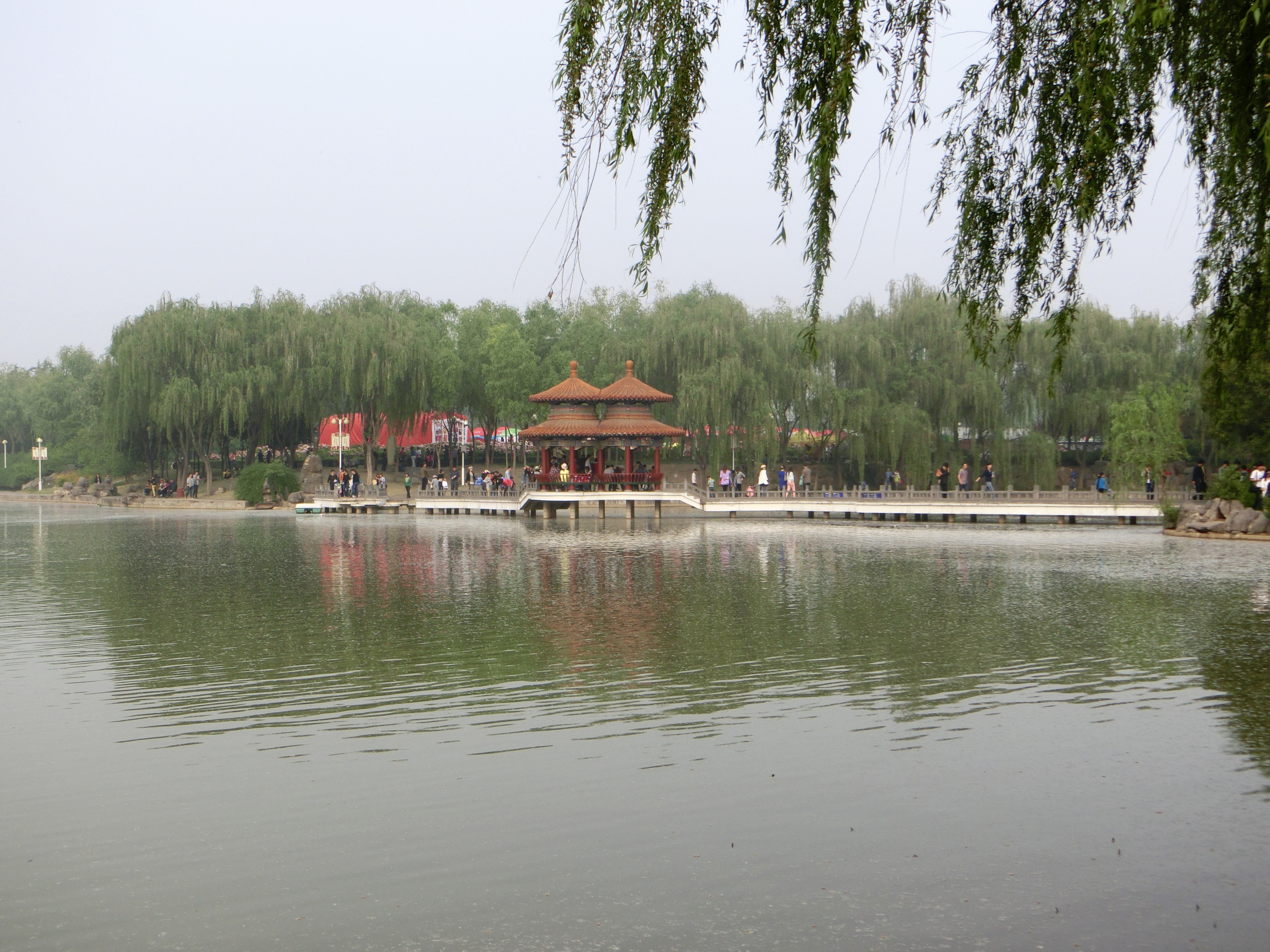
In Luoyang every year from mid-April to mid-May when the peonies are in full bloom the city celebrates the Peony Festival. There are many peony gardens to visit in the ancient city that was once the capital of China. The most famous and main garden is the Luoyang International Peony Garden. It is one of the oldest peony gardens in all of China.

CIMG4052

I did not go to this garden. I couldn’t tell you which garden I visited. All I can say is that I was in Luoyang during the Peony Festival.

It was May of 2014, the morning after I had just hiked Mt. Hua with my friend Sean, and his friend Xiang Kai. We had hiked for 14 hours the night before, ill prepared and with little experience, on one of the most dangerous mountains . I’m talking about myself as far as the experience hiker part goes, but I didn’t think Sean was an expert, and I knew Xiang Kai had not hiked many mountains. Hiking in China is different than hiking in the U.S. In the U.S. hiking is a solitary experience. You climb with one other person maybe a few people and perhaps you cross the path of another hiker or two, but mainly it is you and the wild, and the animals who ignore or watch you. In China (or at least on Mt. Song, and Mt. Hua, and the other mountain I hiked) there are no animals only hoards of people. I never saw any animals, not a squirrel or a lizard only a bird or two. I’d never seen so many people on a mountain at the same time except at a ski resort during a holiday. The day we hiked was rainy and cloudy so it wasn’t nearly as crowded as it could have been. Even on a bad weather weekend there will still be hundreds of people climbing. It doesn’t matter if you go early in the morning or late at night it’s still crowded. The key would be to go off season during the middle of the week and definitely not during any vacations or weekends, but when you’re a teacher you have the same schedule as all of China, so either you don’t go at all, or you experience it like all of China-crowded. I had decided that day that I would one day return to China, but not to work only to travel so that I could plan my visits to ancient sights and geological wonders on the off times, but those were and are daydreams for other days.

CIMG4044

It was Sean’s idea that we stop in Luoyang to attend the Peony festival. Xiang Kai had to work that evening so he would not be able to join us. I was exhausted. My body felt worn and broken and I was irritable and still fuming about Sean’s comment that I was too old to climb a mountain. Ignorant boy, my mind ruminated on his off handed remark about my age that only an ignorant boy would make. I had hoped his feet were still suffering from his badly chosen climbing shoes. The wise thing for me to do would have been to go home, eat something nutritious, and then go to bed, but when Sean made the spontaneous suggestion I felt I needed to go. Life is an unexpected ride and you never know when it will stop and where it will start and many times an opportunity is a one time only opportunity. When would I be in China again for the Peony Festival? I had already decided not to renew my contract. I had already decided to leave China. I could tell myself I would be back, but I didn’t know for certain. Some days I hated China, and would think, never again- never again will I return to this country. It had been a hard year for me, and not all China’s fault, but I was in China when my mother died. It was in China when the most important person in my life left this world. My worst fear had been awakened. How many times had she told me that she would not be able to live without me? How many times had I promised I would never let her die alone? How many times had I told myself I would return and take care of her? China was to be my last experience, my last galavant as an explorer of this world living a life style that I didn’t believe was meant for me. I had never imagined I would ever be able to travel, that I would have lived in foreign countries. I was an accidental traveler and it was time to return to my “real life” whatever that was meant to be. I was going to go back to California and going to care for my mother. I didn’t want to live in Chico because there wasn’t anything for me there, but she was there and she needed me. I had been too slow, and too selfish, and I had failed her. I failed as a daughter. I suffered through that guilt alone in a foreign country, a country so foreign from my own that even our process of grieving was different. My mother died alone, and I had not been there to help her.  My anger, and my guilt, and my pain all manifested into my frustrations about a country that was so incredibly different from my own. I did have Sean though, my friend with his choppy english and his oh- so Chinese ways of thinking. Sean my friend who stayed by my side the best he could and tried to show me the things he loved most about his country. Sean was an impatient Chinese teacher, and impatient about many things, and he expressed much frustration about where he was in his life, but through it all he taught me a lot about patience and how to deal with frustration and how to accept that where you are is where you are, but that change is always around the corner whether you want it or not. Uncertainty is the essential part of this life experience and in the uncertainty lies the choices.
CIMG4046

This was life, and I was still living, and I had to take the opportunities as they came no matter how much my body hurt, and how aggravated I had felt when would I have another chance? I agreed to stop in Luoyang and to see the Peonies.

My body was not in full agreement with my mind or my heart. As we wandered from the train station to the nearest garden my body began to pull rank and my brain switched sides and together they caused me to grumble and slouch and move among the flowers like an impetuous child snapping bored pictures here and there waiting to stop to take a nap. Once in the garden all I really wanted to do was lie down in a bed of purple peonies among all the butterflies and drift off into a deep sleep. I did my best to not unleash my grumpiness on Sean, and I allowed him to tell me stories about the history of China and the symbolism of the flowers. He was gracious enough to understand that I was not feeling my best, yet still seemed to enjoy my company. In the end I knew I was not fully present in the moment, and that my body and exhaustion had won this battle, but simultaneously I was aware of the value that the day, and the weekend held.

CIMG4028

We are gifted moments in life and too often they only come once. Some are large and noticeable, but most are small and subtle and too easily we miss them. We don’t take the chance to strike up a conversation with a stranger or take the path that no one is following. I know no other person from my life, as of yet, that has hiked a sacred mountain with friends from China, and eaten prepackaged chicken feet and teriyaki marinated boiled eggs, and then stopped off at a Peony festival that had been celebrated for two thousand years. When I do meet someone who has experienced this it won’t be the same as I had experienced it. We all experience our lives differently, we are similar, but still we are each unique.

I didn’t get to enjoy the Peonies to the fullest of my capacity, and I wasn’t able to collect the memories of the day here in a nice well packaged form to share with others as to the best way to see the Peonies. I didn’t have to because no matter where I go in the world I am going to be me. That means me in a bad mood, me in a good mood, me irrational and me aware. Me wonderful and me not wonderful. My goal is of course to lean my life more towards the awareness and wonderful, and to be in the presence of my life and embrace the moments. Some days work and some days don’t regardless if I am climbing a sacred mountain in China or washing laundry in a laundry mat in Portland, Oregon. Years later I can think back on my hike and my visit to an ancient garden with my friend from China, and look at the pictures I took of flowers that had been planted and cultivated for two thousand years. I can accept the fact that flowers and gardens are not top on my bucket list, and I can say to myself, I did that, and I went there, and I was in a bitchy, irritable, and grumpy ass mood, but I was there. I took that moment and received all that it offered me even if the gratitude came a week after some solid rest.

CIMG4029 CIMG4101

Memories of HuaShan

The sunlight woke me. I remained still on the cot where I had fallen asleep the night before. I was afraid to move because I strongly suspected that my body would react in pain from the damage I had inadvertently put it through the previous day.

I heard the men shifting on the two cots beside mine, and knew my inevitable pain was only seconds away. I would not be able to remain on a cot for the full month of recuperation I felt I was going to need. We had hiked HuaShan the day before, and we did it the Chinese way, as my friend Sho Boa recommended. I use the word recommend loosely as I could never feel like Sho Boa was recommending as much as insisting. The “Chinese way” according to Sho Boa, who is Chinese and from Dengfeng, was to take the slow night train to Huayin City, and then from there take a taxi to the base of the mountain. The ride would be eight hours, but Sho Boa insisted that we could sleep on the train and would be refreshed to begin our hike as soon as we arrived. I was hesitant about this choice as I lacked the amazing Chinese gift of sleeping anywhere, anytime, and in any kind of environment. Sho Boa insisted this would be the best way, and that this was how he did it a couple of years before when hiked with a group of his classmates during his college years.

“It’s a very Chinese way to experience it.” He said.

CIMG3718

In retrospect, as I felt the fluid eek around my knees and heard audible cracking sounds that had not been there before, and as I felt searing hot pain when I tried to bend them, I thought, he must have meant to say the cheap ass Chinese way to experience it. I mumbled cheap ass in my mind out of irritation, but I knew that it was half about having “the real experience” and half about not having the money. The bullet train would have taken us two hours and been much more comfortable, but neither Sho Boa or his friend Xiang Kai could afford the bullet train. I knew my salary as a foreign teacher was much higher than the salary that Xiang Kai made, even though we did the same job, afforded me not only enough to pay for my own ticket, but Sho Boa and Xiang Kai’s too. Sho Boa wouldn’t hear of it. It was a waste of money to spend, he said, and that I didn’t want to insult Xiang Kai with the offer. However, I vowed to myself that painful morning, that if I were ever to take another trip with Sho Boa I would rudely push aside his Chinese sensibilities and practicalities in favor of the imperialist American desire for comfort (which I knew many of the middle and upperclass Chinese were taking advantage.)

“Xiang Kai,” Sean said as he rose from his bed, “You were speaking in English in your sleep.”

“Was I?” Xiang Kai replied.

“Yes.” I said. “You screamed out in English in your sleep. Maybe you were still on the hike.”

“I have not spoke English to an English person in so long. I had spoke it all day with you it must have been in my dreams.” He said.

“They say that’s a good thing.” I said. “It means the language is in your subconscious.”

CIMG3715

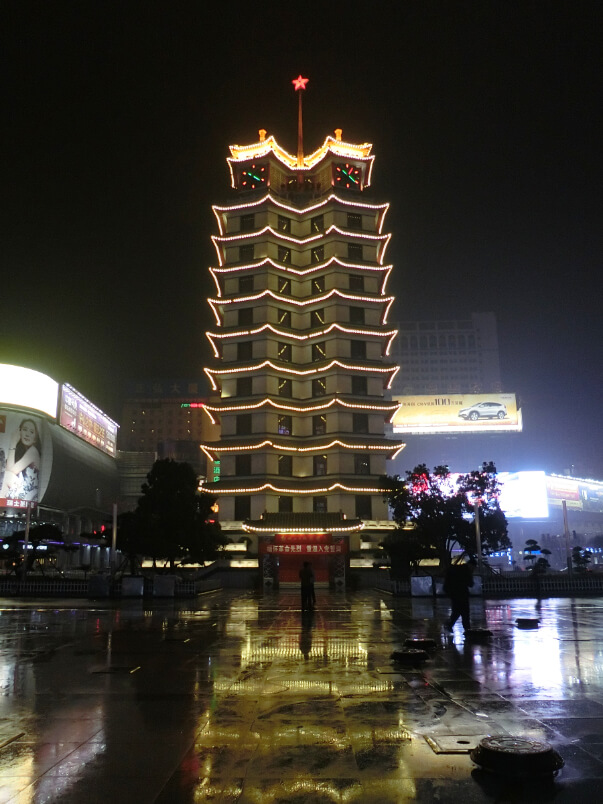
The night before Sho Boa met me at my apartment with Xiang Kai, and we all took a bus to the central train station in Zhengzhou. We arrived near Erqi Square (pronounced Archie square) around 11:00 p.m. Our train was scheduled to leave at 1:00 am so we used the time before departure to shop for snacks for the trip and the hike.

To say that Chinese do things differently than Americans do things is an understatement, but it is in the small actions of  life, the things we don’t really think about on a daily basis, when one discovers how even our thought processes and approaches to “the way to go about something” can be very different. For example, what you should eat when on a hike. My American mind immediately goes to foods with complex carbohydrates with sustainable energy, things like trail mixes with nuts, crackers, pretzels, and protein like beef jerky and maybe some dried fruit, and definitely water. Sho Boa’s thinking which I can only identify as Chinese thinking (not that I speak for all Americans and Sho Boa does not speak for all Chinese) was to get dried noodles, chicken feet, and some other dehydrated things I could not identify. We did agree that a hardboiled egg would be good, and of course water. We argued a lot in the store as to what would be the best to eat, but I acquiesced telling myself I was having the true Chinese experience. My gut was telling me this food was not going to be enough fuel for me.

I did not sleep on the train, for multiple reasons. In China once all the seats are sold on the train they continue to sell tickets (not on the bullet train) and the prices for standing are the same as the prices for seats. People crowed in the aisles leaning over the people in the seats all waiting for the moment when someone gets up so they can take the open seat. There is no space, and no fresh air, and if you do get up to use the bathroom you have to climb over people crumpled in the aisle way. When you return you have to argue with the person who took your seat to give your seat back which they will do, but they certainly don’t want to give it back, and I can understand why. There are three people to a row that face another row so you have six people in one section. I was the only foreigner and only white woman in the car, and quite possibly the train. In these situations I would often encounter staring and some people would sneak or blatantly take my photo, but at 1:00 in the morning on a crowded warm train no one cared about me other than the fact that I was sitting and when would I get up. I shared my section with five men who man-spread better than any men I have ever encountered leaving me with barely enough space to fit my ass. I mentioned that Chinese can sleep anywhere and in any environment and that is not an exaggeration. They can even sleep standing up. When the train reached Louyang it became more crowded and people were nearly sitting on top of each other. One man slept arched over me precariously balanced on the top of my seat.

At one point, the people in the section across from us who all seemed to be traveling together had people sitting on the top of the backrest. They were laughing and loud and playing a game, and watching programs on their phones at full volume. Sean who was sitting across from and facing me leaned forward.  Thumbing his hand in their direction he said, “Look at them. What do they think they are in their house?” He gave them a brief scowl and then quickly feel asleep. I watched him slumber with envious anger and an incredible urge to kick him awake so he could suffer like I was suffering. Xiang Kai was in a separate car, but had mentioned he had managed to sleep. When we arrived in Huayin City at 7:00 in the morning I had not slept one wink and with exhaustion I followed the two rested men to hike, unknown to me at the time, 7,000 ft.

arch

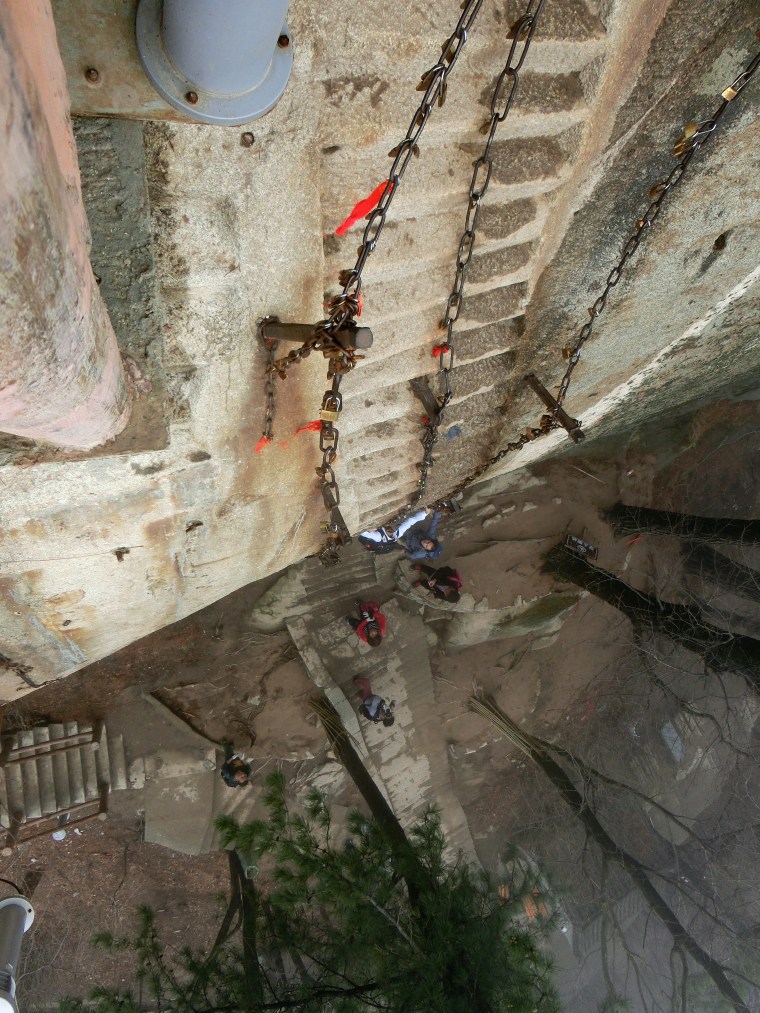
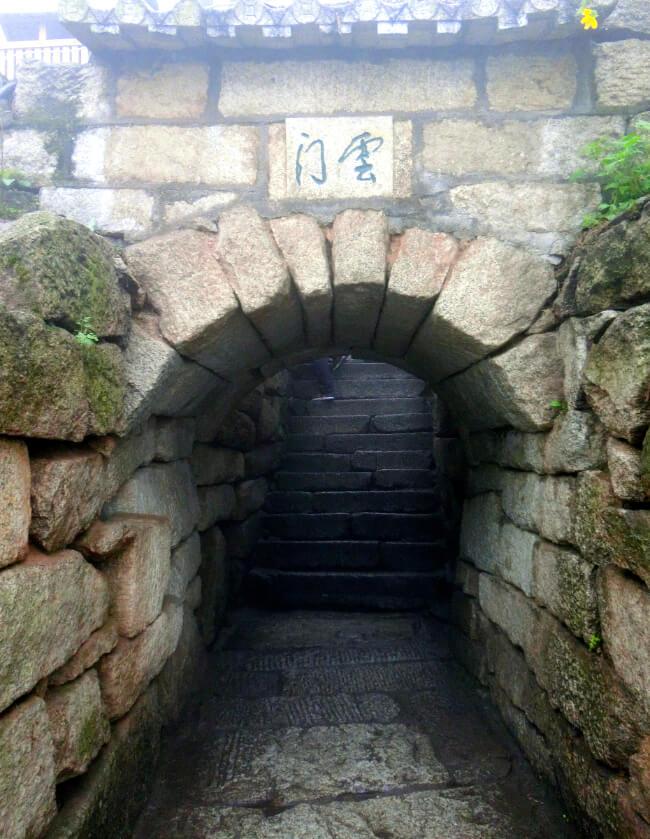
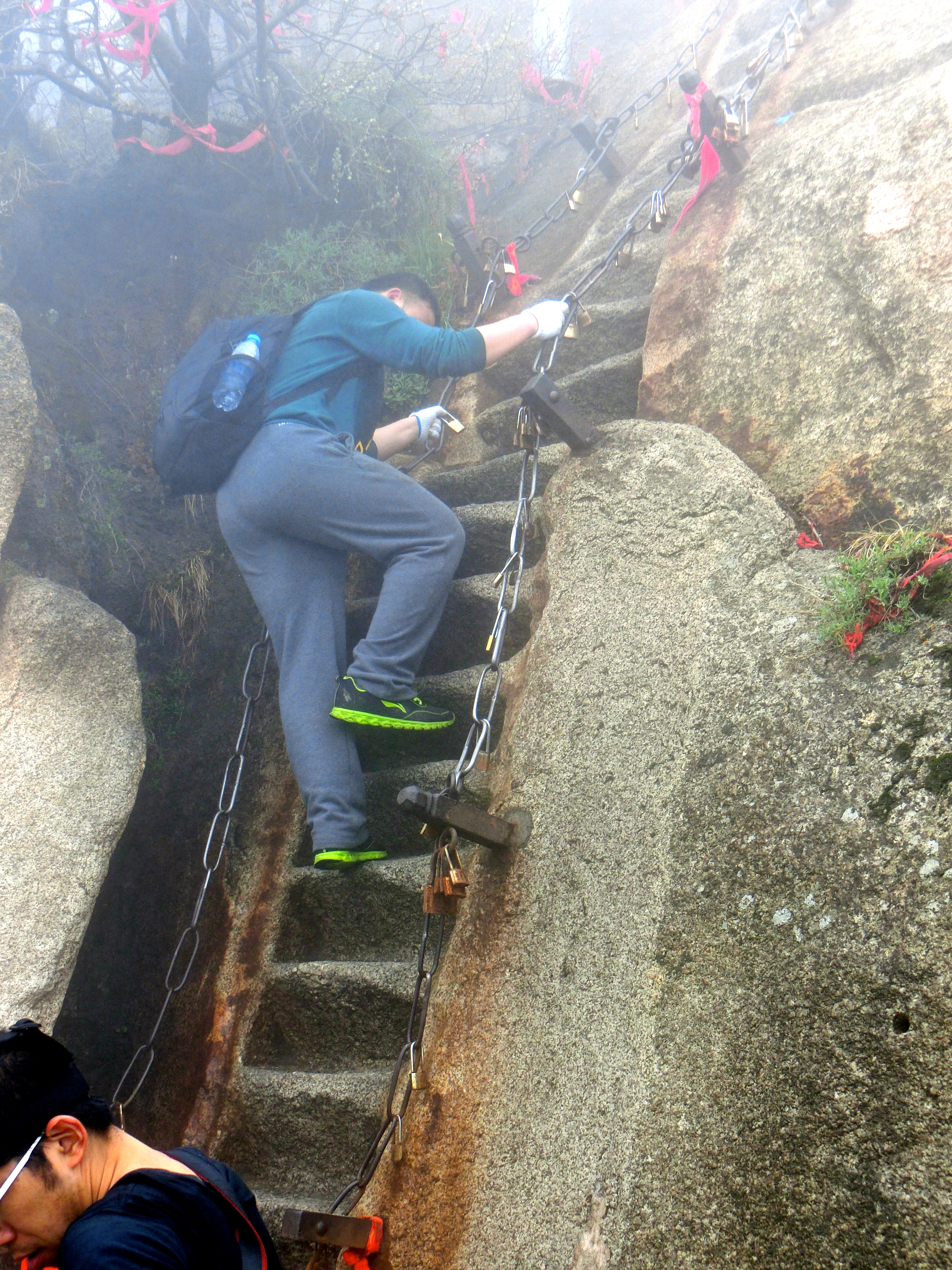
The hike had taken us nearly 14 hours. During that time we had managed to reach two of the three peaks  and four summits. We reached the south peak and the highest summit (the Landing Goose summit) as the sun set. It was beautiful, but also terrifying because I knew we had to hike back down in the darkness. I’ve read many foreign accounts of hiking Mt. Hua, and how it is not as dangerous to hike as they were lead to believe except for the west peak where there is the famous plank walk. Here you are strapped into a single belt and you walk a plank that is about three feet wide and attached to the side of the mountain with iron nails and chains, and it is a two way path but there is only room for going one way so you have to climb over people while you are thousands of feet above the ground. There are also tunnels built through the rock that fit the size of an average Chinese person. A larger person of girth would find themselves struggling to fit through the tunnel that runs vertical with chains on either side to pull yourself up as you find footing in carved steps that are almost two thousand plus years old. The day we had hiked a storm came through so the chains and the steps were wet and slippery. As Sean recommended us to take the dangerous way down, I began to feel genuine fear. I was running on very little energy having eaten nothing but chicken feet, and eggs, and not sleeping the night before. Already I had felt my arms give on me on the way up. The only thing that kept me holding on was the knowledge that if I fell I was going to take at least fifty people with me since we were climbing, in the words of my students, nose to ass. I told Sean that I didn’t think I could go the dangerous way in the dark.

“It isn’t dark. There are lights.” He said pointing below us.
“Tea lights do not count as lights.” I had said.

CIMG3798

I could not stop thinking of the tunnel that I knew we would pass through because it is the same way up as it is down. If people believe that the hike is dangerous in the day time it is exponentially more dangerous in the dark. Mt. Hua has become a huge tourist attraction for Chinese especially Chinese University students, and this once sacred buddhist pilgrimage has now become a kind of adventurous right of passage for young Chinese. Sean’s approach to the hike was to go at breakneck speed. I was absolutely apposed to this approach and thankfully Xiang Kai was on my side of thinking. Sean nagged us both to hurry up during the hike. Often Xiang Kai would sit and rest, and Sean would complain that we were too slow and we would miss the sunset.

“Ignore him.” Xiang Kai muttered to me. “He’s crazy.”

Thousands of Chinese and foreigners a year visit Mt. Hua, and because of the numbers, and of course the dangers involved the Chinese government had built stairs that were safer to climb and descend. I opted for these stairs for part of the way down not knowing that once on the stairs we couldn’t get back to the original path. This was also something Sean nagged me about during the decent. I knew I did not have the strength to hold my body through the tunnel, but I was also not prepared for over 50,000 steps that began to siphon all the fluid from my knees.

Step after step after step my knees began to stiffen until there were moments when I didn’t know if I could bend them. I became terrified that I was doing permanent damage to them. I kept my pain to myself so as to not have to hear Sean chastise me. I moved in silence until I could not longer hold in the pain. Tears swelled to my eyes as I felt my body break out into a sweat and my heart raced from pain and the anxiety of pain. I began thinking about people in concentration camps, and people sent on marches, and people tortured- if they could survive such unbearable suffering I could make it down this damn mountain. Then my knee froze for a second. If I were the tin man this would be the moment when I could not move because all my joints had rusted stuck.

“Sean.” I cried out. “We have to slow down. I am hurting so bad right now. We have to move slower or I will not make it down this mountain.”

He reluctantly slowed, but quickly began in his assessment of why it was that I was not able to move faster and why I was in pain.

“American’s are not as healthy as Chinese. Even when we are very old we can do this. I think it is because we begin exercising very young. And exercise is important and so we stay healthy.”

“I exercise.” I mumbled, “I’ve just never hiked 8,000 feet before- or 500 feet.”

“I think you are too old for this.” He said. “I should have thought about your age.”

Sean and Xiang Kai were 23 and I was 41. This was the final straw in my tolerance for his ongoing commentary and I stop walking.

“Sean.” I said glaring at him. “If you want to continue living, and make to my age, you really should stop talking right now.”

He looked at me knowingly and walked for the majority of the decent in silence.

Xiang Kai shuffled up along side me.

“I am in quite a lot of pain too, Adrienna. My shins and calves are hurting so badly I think they may tear. Try walking backward, I think it is helping me.”

Xiang Kai and I hiked the remaining way down the mountain backward which as he had suggested did alleviate the pain in my knees. At first Sean was far ahead of us, but at some point near the base of the mountain he began to slow down, and we eventually passed him.

“My feet are really hurting.” He called down to us. “Slow down for me.”

“No.” I said. “And good!”

Once we had reached the bottom Sean recommended we find a place to sleep and take the train in the morning. We all agreed, and he flagged down a motorcycle taxi. We sat Xiang Kai and myself and the driver all squeezed onto a single small motorcycle seat. He drove us to a restaurant where we waited for Sean who had walked. We rented a small single room with three cots and ascended more stairs under the watchful eye of the proprietor and proprietress who looked me over and probably wonder which of the Chinese boys was my boyfriend because how else could we all be sleeping together in the same room.

In the morning once we got moving and I had managed to get some fluid and circulation into my legs we climbed down the stairs to the small family owned and run restaurant.

“We must eat before we catch the train.” Sean recommended, and again Xiang Kai and I agreed with him.

We sat alone in the restaurant and ate large bowls of noodle soup as the owners watched me eat, and asked Sean and Xian Kai questions about me. I was so hungry from the hike I ate every last morsel of food in the bowl, and could have eaten more. Afterward, Sean flagged down a taxi and we took it to the train station where we awaited the next train to Zhengzhou.

During the ride back to Zhengzhou it was less crowded and we all were able to sit in the same section.

“It is the peony festival in Louyang.” Sean mentioned excitedly. “We should go. Do you want to go Adrienna?”

“I can not go.” Lamented Xiang Kai who had to go to a school meeting that evening, “but, you should go Adrienna. It is a very big thing in China.”

“Okay.” I agreed even though exhaustion was overtaking my body.

When the train stopped in Louyang, Sean and I said our good-byes to Xiang Kai and then watched the train leave the station as we waved to him.

“I think you will like the peonies.” Sean said, “They are very important part of China. And, there are no stairs.”

“That’s good.” I said as I hobbled behind him nursing my well earned broken knees.

It is been little over two years since I had gone on that hike with my friend Sean and Xiang Kai, but still I am reminded of the experience every time I climb a step since my knees are still feeling the pain. Although it was exhausting, and ill prepared and left me with bad knees, I’d go again. It’s a really beautiful mountain and there are many parts we didn’t make it to. I’d go again, but differently this time. I’d go with some sleep, take a fast train, and bring better food, and hike at a slower pace, maybe stay the night like many other Chinese do, and then hike down slowly in the morning. I’d invite Sean along too, and I’d tell him now we’ll do it with the American experience, because I’m old and Americans are out of shape, and we have to do it the old person way and not your cheap ass way of saving money on the slow train. And, of course, I’d get some support for my old lady knees.

CIMG3839

Returning to Asia

After waiting for nearly four months, my criminal background check finally arrived last week, and with it came my permission slip to look for a new job overseas. I had originally intended on leaving in February, but sometimes things don’t go as intended. I’ve decided to look at these extra months as a time for me to get healthy and to really focus on what I need in my life to give me happiness.

It had taken about 3 months to get on the Oregon Health Care plan, but thankfully it exists because I have been able to go to the dentist, and to the doctors, and get myself back on track for a healthy mind and body. As the saying goes, “if you haven’t got your health, you haven’t got anything.” I hadn’t been feeling very good for awhile. I’m pretty certain I can guess the cause, but the point is that I’m back on a mission to feel strong again, and just in time too because I will be returning to the proverbial road.

I have been vacillating between applying to work in China and working in South Korea for a few months now. Many of my friends have been saying that Korea is the way to go, and have wondered why I would even consider China.

CIMG0272

“You hated China.”
“You were miserable there.”

It’s true, I did hate much of my time in China, but aside from China there were other factors to my hating it; my mother dying, conflict with the director of the program, and culture shock all contributed to my hating much of my time in China. It is not easy to live in China. I do believe some people may thrive there, but in truth, I think it can be a tough adjustment for a multitude of reasons. I do believe all of those reasons can eventually be overcome if you want to stick it out in China, and that you can learn to accept things, and even grow to enjoy them; all but one that is.

Although, my time was difficult there, I had also gained a strange love for China. It’s difficult to explain, and maybe if it hadn’t of been a year it may not have gotten under my skin, but it did. It took about seven months of being away, but I slowly began to miss it. I missed certain things like food, and the crazy traffic, and riding my bike in that crazy traffic. The insane rides on e-bikes, babies in pants with bottoms, old ladies dancing in parks, kites everywhere, are among the few things I’ve missed. There were things there that mattered to me, and left an impression on me that I will carry for the remainder of my life. My kids mattered to me, they mattered a lot, and they were such a huge part of my experience in China. I spent more time with 15 to 18 year old Chinese kids than any other group of people, and the experiences with those kids which included a special trip to Kaifeng, really shaped my view of the country. The Chinese people I became friends with mattered to me. In China it can be difficult to know if Chinese people are really your friends if they actually like you as a person. There are so many people that want you to be around because you are western, and it is about status to call a westerner a friend. You will not ever be Chinese, and you will never be truly accepted into the culture, and because of this it can be hard to ever find that bond that we all crave in our friendships. Perhaps I am delusional, but I feel blessed in my belief that I was able to move beyond this barrier with very little effort with some of the Chinese friends I had made while there. I felt a real kinship with the people I called friends, even when we came up against massive cultural differences. There are Chinese people I do consider to be genuine friends, and I feel that they look on me as the same, not as a “western” friend, but as real friend the kind of friend that accept the whole cultural and enigmatic package that makes up each and everyone of us.

CIMG3838
Xiang Kai and Sho Boa (Shawn) hiking up Mt. Hua 

I have been fascinated with Chinese history since I was a little girl. I remember stacks of National Geographic magazines with images of China. I remember watching the student protests in Tiananmen Square live on television. I had taken a course in the history of Eastern Civilization in college and I had become immersed in the ancient history of the dynasties. When I was a girl there were only three things in the world I had wanted to see: The Pyramids of Egypt, the Acropolis of Athens, and the Terra Cotta Warriors of China (I can mark one off my list). Chinese films are among some of my favorite, and the dissidents of China are some of the bravest people in the world. There is much to be fascinated with in China, and there is a lot to grab your heart and keep you there, but for every amazing thing Chinese there is also something insidious. A drive for cultural success that is so strong that corruption and lies are an accepted part of the society norm creating at times a dog-eat-dog world. The repressive regimes from the cult of Mao to the current CCP that smothers the real strength of what is hidden in China. The annoying and ridiculous firewall put in place to control and suppress the people, and the denial of terrible events by erasing them from history. The horrific pollution that had for too long been acceptable in China, and ignored in the majority of the world. These are things that are difficult to live in, and I believe it is difficult for many Chinese too (judging by various conversations). China is a land of great contradictions and it is these contradictions which constantly push and pull at you. At me.

CIMG0926
Some of my kids rehearsing for “The Outsiders”.

CIMG5012

So, what are the deciding factors, what did it come down to when choosing between China and South Korea? The main motivation for China was a school. A drama school where I would be a theatre teacher, and where as part of my work I would be required to direct my own children’s plays. I contemplated this school for nearly a year. It would be a job that combined my theatre, my literature and my teaching skills. I would finally be working in a creative environment and for that I was willing to move to the polluted city of Beijing. Yet, it was during a bike ride in Portland that finally solidified my final decision.

It is now spring, and the sun is out and the sky is a clear blue that bends over the city with only a smattering of cumulus clouds dotting the sky like paint on a palette. The days have been beautiful and easy going. My moods have been hum-drum and dark, and sometimes this happens even when things are going well in my life, I need these beautiful days to help lift me from my internal darkness. I knew at that moment under the blue sky in the face of mount Tabor, the small extinct volcano covered in the rich green of white-cedar and poplars, that I needed to live in a beautiful place. As much as I had wanted the theatre school and as much as I was willing to return to China, I knew in my heart that returning to an over-populated, dirty, and congested city with air so bad that there were red alert days not allowing us to go outside, was not a good idea for me. I knew, no matter how great the school, my sadness would overcome me, and I can’t live like that.

I have started the interview process for jobs in South Korea, and I’ve focused my attention on applying to schools in places where the sky is blue and the ocean is near-by. The job matters, but the environment matters more.

As I had mentioned before I believe that most of the challenges of being a foreigner in China a person can overcome, but one. That one for me is the pollution. China is a geological diamond and a natural wonder of nature, but the coal and the money made on cheap labor and unregulated businesses that damage the country is more important then the jewel. I will one day return to China, but maybe as a visitor. Till then I will be in South Korea.

CIMG5101

The Yellow River Park in Zhengzhou

CIMG4400

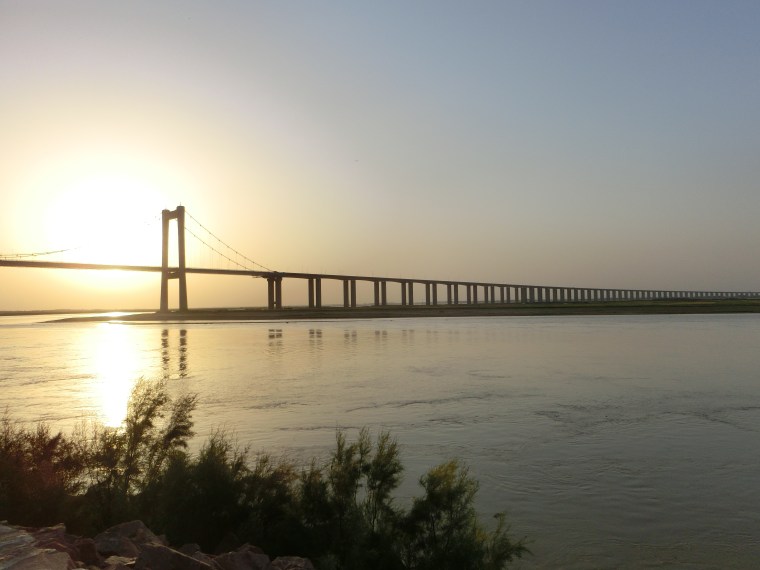
The Yellow River is called “The cradle of Chinese civilization”. Chinese dynasties were built along this river, and in the early periods of Chinese history the regions around the Yellow river were the most prosperous. It is the 3rd longest river in Asia, and the 6th in the world. It is a life giver and referred to in Chinese as the mother river, but it has also earned the name, “China’s sorrow.” This river has has taken well over a million lives. The river’s flooding from it’s constant changing of course from erosion has earned it the world reputation of being the only natural disaster in recorded history to kill more than a million people.

In the years between 1332 and 1333, seven million people were killed from theYellow river flooding, and the subsequent famine and disease that followed after. In 1887, 900,000 to 2 million people died, and in 1931, 1 to 4 million people died. The most interesting of floods happened in 1938 during the second Sino-Japanese war. The Chinese military decided to break the levees and flood the valley on purpose as a way to prevent the advancing Japanese army from reaching their goal of capturing Wuhan where at the time the temporary Chinese Government was set. The idea was to have “the water be a substitute for soldiers”.  5,000 to 9,000, Chinese civilians were killed in the floods, and an unknown number (but most likely not as many Chinese) of Japanese soldiers. The flood stopped the Japanese from capturing the city of Zhengzhou, but they still reached their goal of overtaking and capturing Wuhan.

A river that has birthed a civilization and taken away such a multitude of life is not going to  continue in modern China with out a park dedicated to it. The Yellow river park is located in the northern part of Zhengzhou, and can be long trip on a bus, but we were lucky to have a friend with a car, and he drove his family, and my friend’s family, and myself to the park for the day. This happened near the end of our stay in Zhengzhou so it was a nice way to end a year in this Chinese city of Northern China.

It’s a huge park with five sections. At the time of the visit, we were not informed of where we were or the significance of any of what we were looking at so much of it was just interesting for the sake of its existence, and carried little historical reference for any of us foreigners. Aside from the massive statue of Mao, I had to look up the names of other statues and buildings on the internet, and I wasn’t able to find the names of everything, but I was able to find some bits here and there.

CIMG4278

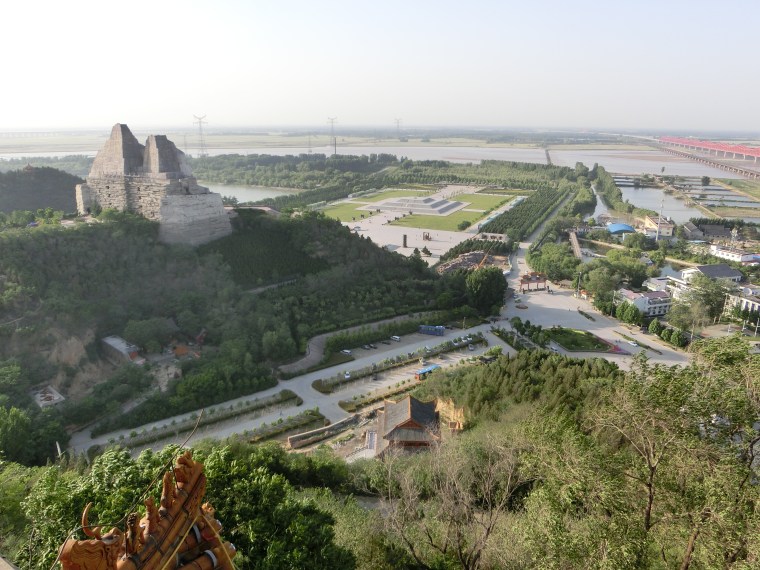
We first ascended a small mountain, and that is where we found the giant statue of Mao. The children quickly preceded to climb him in order to race to the top to see who could tag Mao’s mole first.  It is considered good luck to rub the hands of Mao. The infamous leader  is known for saying, “We must control the river,” which resulted in building dams and levees. The view from the statue of Moa looked down on the the wide and literally yellowish brown river. Looking down from the mountain we could see areas for rice paddies but most of the area is now used for the purpose of the park, and transferring the water from the river to Zhengzhou.

We crossed over a bridge called the Luotuo (camel) bridge which led to the Yueshan temple on Yue Mountain. There is a great view of the statues and the monument that they built below. I didn’t know the significance of much of what I was looking at, unfortunately, but what I’ve gleaned from the internet is that the giant statue on the mountain measuring 59ft high is the connected heads of Yandi and Huangdi the great ancestors of China, and they face the river in a symbolic reverence for this giver and taker of life. Information pretty much dies out from there.

CIMG4281CIMG4285CIMG4293CIMG4319

At the base of the part of the park that is called the Five Dragon Peak there is a statue of a Mother cradling her son. This statue is to represent the mother river and China, and their harmonious relationship (they’ve yet to build the statue of the mother dropping and shaking the baby to represent the times not so harmonious). The park also has statues of very famous calligraphy writers- non of whom I knew of, but calligraphy is an art form in China, and to be called a writer in China means that you do calligraphy. It was in this area of the park were we found a man who painted a quick drawing for each of us (for a cost) and then wrote a poem. I had asked my Chinese friends what the poem said, and they all replied, “It’s too hard to translate,” which I found to be the common response when asking for the translations of certain things.

CIMG4356

CIMG4389

Our tour guides drove us around to parts of the park where not all tourist were allowed to go which is the advantage of having your driver being a Zhengzhou cop, and he took us to a quiet area near a sharp curve in the river where there seemed to be people disgusting the construction of something. A woman rode out on horse back to deliver a message to people working, and then she quickly rode away as if riding back into the past. We were warned not to stand too close to the river, not because it can jump up and pull you in, but because the soil and silt is very soft and can suddenly crumble under your feet. It is this soft earth that causes the rapid erosion and the continuous changing of the river. Although, the river has not changed much since Moa exclaimed that it must be controlled.

CIMG4397CIMG4409CIMG4411

We ended at the base of the figure heads of Yandi and Huangdi where many Chinese were ringing giant bells, taking pictures and a couple of men were swinging whips over their heads to make giant cracking sounds that reminded me of firecrackers or gunshots. We watched the sun set behind wires and trees, and took the long traffic flooded drive back into Zhengzhou.

Faking China: A Theme Park

If you find yourself in Zhengzhou, China, which is in the Henan Province, which is in the north, and to the west of Beijing, and find yourself wanting to visit other parts of China too, but can’t for one reason or another, that’s okay because you can go to fake China in Zhengzhou. You never have to leave.

It’s been two years’ since I have lived in China, and even now certain memories return to me. Memories of me thinking, “What the hell is this?” and not knowing how to quite register the wonder and multitude of questions that China can at times offer. I had started saying to myself, “stopping asking why, there is no answer to why, it only is as it is. There is no why, and no answer, it’s just China.”

CIMG4930

China is naturally a geological and geographical land of amazing beauty (I won’t focus on the horrible pollution that is destroying that beauty, but I’ll still mention it as an aside because it’s important to be reminded that there is a lot to lose). There are landscapes that steal your breath away and fill your heart with awe, but China is also the land of manufactured worlds, and that too is…well…it can leave you speechless. There is as much natural beauty as there is… shall we call it–imitation.It is a matter of opinion on whether you think this is an eyesore and a waste or if you think it’s a brilliant oddity of manmade accidental art, but when you are standing in the middle of one these pretend places you can’t help but be…well…speechless, and oddly admirable of the juxtaposition of China and China’s imitation of other counties and itself. There are ghost cities, and copycat cities: the fake Paris and the fake Venice, for example which are also ghost cities, and there are amusement and theme parks that are just devoted to imitating cities; like Las Vegas in a park with no gambling or strippers or alcohol.

In Zhengzhou, where I had spent one year of my life, the school where I had been working at the time took our classes- the English Language school, No. 42-to a park on the outskirts of the city as part of a class excursion. In the past, I had heard that the school used to offer two class trips a year, and that they had visited actual famous sights and landmarks, but I guess by the time I had arrived they must have lost the budget or decided not to spend so much on the teachers and students- so we got fake China. I never learned the name of the park in Chinese or translated into English, and believe me I had tried. I searched the internet but couldn’t find any information on this mystery park visited by Chinese students and couples having their wedding pictures taken. The closest I found was the Century Park where all the students excitedly thought we were going until our bus passed it by and took us to a second tier theme park. There were audible groans of disappointment.

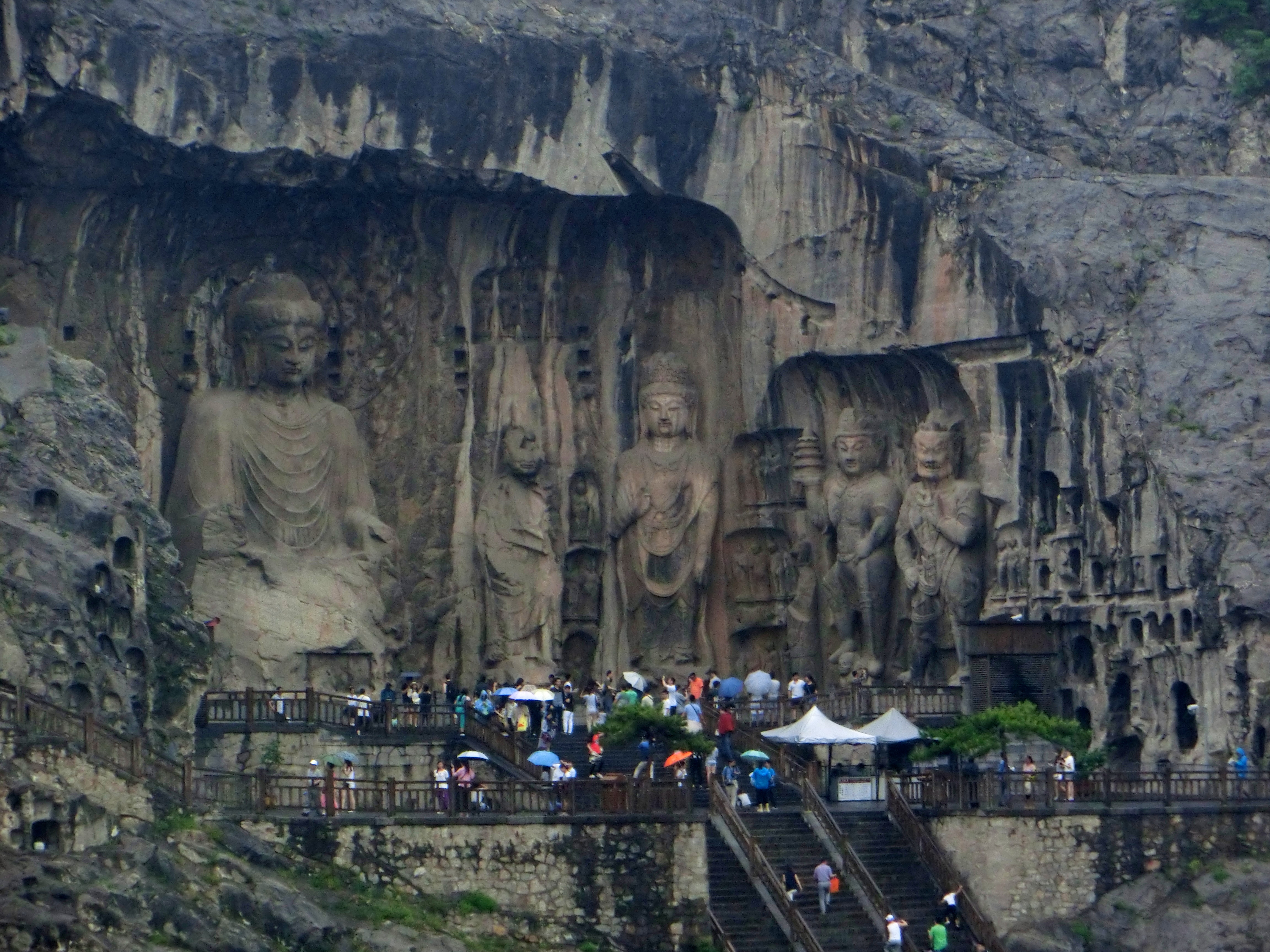
A picture of the Longmen Grottos from across the river.

Henan, the province of Zhengzhou, is a very important province in the history and the civilization of China. In fact, out of the eight ancient capitals of China four of them have been located in Henan. Zhengzhou was recently added to that list due to the discovery of an ancient dynasty perhaps the oldest of all the dynasties, the Shang dynasty (1558 b.c.- 1046 b.c.). When in Zhengzhou there is no remanence of the Shang’s presence except for a portion of an ancient settlement wall that looks today like a giant wall of dirt. You can find this wall in the eastern part of the city. The other Capital cities were once located in Luoyang, Kaifeng, and Anyang (where the oldest collection of Chinese writing was found written on ox bones and turtle shells. Evidence of the Shang dynasty had also been found in Anyang). Henan is not only the birthplace of the great Chinese dynasties,  but also Zen Buddhism, and Kung Fu. In this one province you can visit the oldest civilizations of China, and the explore the historical birthplaces of China’s societal foundations many of which still hold today, even many events leading to China’s communism were formed in Henan. In Luoyang there are the grottos an amazing religious site with over 100,000 carvings and status of Buddhist images. In Dengfeng and Shaolin are the schools of Kung Fu, and in Kaifeng the most famous judge in the history of China, Boa Zheng, had once resided. He was also called justice Bao because he was honest and upright, and even today he is the symbol of justice. A living history lesson at can be at your finger tips, but if you can’t get out of the city you can visit these ancient landmarks in one city park in Zhengzhou.

The area where the ancient wall from the Shang Dynasty was over 3,000 years ago.
Where there were once ancient ruins discovered in the 70's and 80's now families plant urban gardens.
Where there were once ancient ruins discovered in the 70’s and 80’s now families plant urban gardens.

I wasn’t really certain what to expect, and since at this point I had already lived in China for close to a year, I knew to expect the unexpected. All that could really be explained to me was that we were going to a park. I’ve decided to name it The Park of Great Things In Henan and Beyond, because every city and historical monument was represented in replica, not to size, for the Chinese tourists to enjoy. I say Chinese because this isn’t a park that many foreigner travelers may find themselves. Not many foreign travelers will even find themselves in Zhengzhou for more than a day. Most people come to Zhengzhou only to change trains unless they are actually living in the city. I remember a person once saying to me, “Zhengzhou? Oh yeah, I think I was there, in fact I got my wallet stolen in the Zhengzhou train station.”

CIMG3431
Not real
My student and I at the fake Longman grotto.
My student and I at the fake Longmen grotto.

Can’t visit Luoyang? No matter you can find the Grottoes here. Don’t have time to see the Iron Pagoda in Kaifeng? It’s here. You’ll never find yourself in Anyang? You guessed it, it’s here too. In fact, if you want you can see a part of the Great Wall here too. If you get tired of China you don’t ever have to leave the park because around the corner you will find Egypt right next to Greece, (of course) and all of Africa encompassed in two statues, and right next to Africa you’ll find Australia, exactly where you’d imagine it to be. The main highlights of the park were physically being there and kind of wondering why; discovering the pretty offensive perceptions of Africa (or maybe some island places?), the aged look of the park when it was only a couple of years old, having a water gun war on paddle boats, a Chinese man assuming I was a Christian because I am white/foreign and handing me his Bible to hold as he bowed to me several times, watching the multitude of wedding photography, skipping rocks with my students on a fake lake that had a water show, and spending time with students and teachers in a place that would and can only be experienced once in my entire life.

Fake Africa
Africa? The Polynesian Islands?

Fake Australia

Greece is only a pathway away from Egypt.
Wedding Shot
One of many couples getting their wedding shots which are a huge part of the marriage.
She hadn’t yet learned to skip stones.

If you want to see a few more photos from this theme park you can find them on my blog Simple.

The Trouble with Me in China, and Why I’m Returning

CIMG4996

It has been about two months that I have been back in the U.S. If things work out I will be back in China by February. I have all the necessary trepidations collected and percolating in my brain preparing for all the appropriate anxieties of “what ifs” and the “I don’t knows”. I feel quite prepared in that capacity. Some people, my friends who know me well, may wonder why I’m returning to China when I had expressed such a deep hatred for the place. The public, like my youtube channel and this blog space or even my Facebook, didn’t know I had such a hatred for the place, but I’m laying it all-out-on the line here people; I hated it. I think it is difficult to be truly honest about your feelings on social media and in a public forum because there is/can be so much backlash to everything you write. Honestly, I think it is okay to hate a place. The important part is to understand why you hate it and then to figure out if it is a fair reason to hate it, and if it is really something about yourself and your preconceived ideas that make you hate it, and again, is that a fair assessment. You know the: “It’s not the place it’s you,” effect. ETC…

I didn’t feel the need to express my true feelings to the great big world because it was too early. It took me a full year away from China to appreciate China, but while I was there it was difficult. It was difficult because I had culture shock. Part of the shock had to do with the experience of being, to sound cliche, the stranger in a strange land or to be more succinct, “the other”. It was difficult because I wasn’t used to being the only one that looked like me. I grew up in a white town with white people. America is a society that caters to white people even though America doesn’t want to admit it, it’s true. White people are everywhere; in the movies; in the magazines; on the news; everywhere. It’s so white when you’re white you don’t even know what it feels like to not belong even when you’re a misfit and you don’t belong- that is if you live in a white society. I also spent 13 years in Portland, Oregon, and Portland during the time I was there was voted one of the whitest cities in the United States. My point is, is that when you are the majority you don’t notice it even when you feel lonely and out of place, and yes, even when you feel cheated and misrepresented. You might think you don’t get any of the benefits of the majority because you are on the bottom of the heap of the majority, but you still pass as the majority and that passing is bigger than you think. Bascially, you don’t have to think about being white you just are a person (that by the way is part of what people mean by privilege: you are a person not a person with a skin color other than white). I had never thought of myself in the sense of “otherness.” Often I had felt like I didn’t always connect or fit-in with white America or even the American Dream because of what I felt internally (sometimes based on my experiences as a woman and as being raised poor and on welfare), but that is not the same as being “the other”. Then I moved to a place where I was the minority. Then I knew. No, to know is too strong a verb, you don’t know, I became sensitive to it; to skin color, to color and to race.

I’m not going to get into the conversation of racism in China versus racism in America or express some kind of kindred “I understand discrimination” because woes me I was a poor lonely white woman in China. Being white in China is exponentially different from being black (or latino, or native American…) in America, for one thing, a black person in America is an American (which I think some people have seemed to have gotten confused) while a white person in China is an American too (even when you are not) but you are also 100% not Chinese and nor will you ever be Chinese. The experience of white male versus the white female are different too and I’m not writing here to expose the great secret of the white man’s success with Chinese women, as well as there are many different nationalities and races of people who live in China and experience their own kind of foreigner experience. My point is to express the feeling of being a minority when you come from a world where you were the majority (even if not in actual numbers, but in power of a social system) and what that felt like to me and how it contributed to my experience of culture shock. My heightened sense of sensitivity and growing awareness and openness to listening to the words of American people of color (and new immigrants) is just a positive (I think positive) by-product of my experience, but it can never compare to what it feels like to grow up feeling like “the other” in a country that is supposed to be your home. When I use the word minority as applied to me in China I mean a minority by the definition of small in numbers: As in smaller less seen, and therefore standing out; not invisible; and a bit like a zoo animal. In my ignorance I had thought I would like the attention. As if I’d be like a movie star. But, I didn’t like the attention, and the attention wasn’t like being a movie star it was more like being a freak. Now, I’m just writing about the negative culture shock moments to build toward the positive ending in this post so hold your possible anger and go along with it…

The stares, Jim! The stares!

It was disconcerting. At first I tried to smile at people who stared hard at me, and occasionally someone would smile back, but most often a smile would only make the stare harder. I, of course, didn’t and couldn’t know what people were really thinking, but to me it was that I did not belong there. Not that people were going to push me out, but just that I was not a part of the community, and I could not blend in. I was noticeable everywhere I went. Some people wanted to take my picture, some people just wanted to stare at me, and children pointed and screamed. They didn’t scream in terror, I mean they screamed in delight, It was like: “MOMMY! LOOK AT THE CLOWN, MOMMY!” And, that was what got to me. Of course it was charming when a large group of school girls walked by and yelled out in english, “I love you!” But it wasn’t charming when a group of men would circle me and examined me like I was something to purchase, and yes that happened too. I will hands down admit I was not good at handling the attention, but I am also grateful because for the first time it made me feel, really feel (minus the violence) what it is to be a minority, and to be looked at for your skin, your eyes, your hair. Even though people thought I was beautiful or exotic it still made me uncomfortable because I was being examined. I have a rather extreme example of what I mean by examined: Once, I had to pee in a public restroom at the train station, and this bathroom was like a trough. It was open stalls where you would squat over this narrow little trench with the piss and shit running like two little rivers as if you were a giant straddling the land and defecating into the canyon below. I felt uncomfortable, not only because I sucked at the squat and because all this human feces was so close to me, but because there were no stalls, and I knew, I just knew someone was going to try to look at my vagina as I peed. How did I know this? because I had already been examined in a public shower before, not by everyone of course, but it only takes one person feeling completely fine examining you to make you feel awkward; but I had to pee. Most women walked by not caring, but then it happened. She saw me squatting, and she slowed down and tried to take a peek, but my attempt to gracelessly hide myself while simultaneously not pee on my feet or slip into the river of stench did register to her that she was violating my privacy, and dropped her head and quickly walked away, but the very fact that she would have felt okay trying to do it in the first place is what I mean about being examined.

At the school where I taught, huge groups of new potential students were touring the classrooms. There were hundreds of students. It was near the end of my year in China and I had already been accustomed to people being excited or surprised to see my skin and my hair, and my very American looking face. As I saw the large group of students walking towards the windows of my classroom where I was teaching, I could see some of the eyes of the kids light up as they saw me, and I knew it would be a matter of minutes till the cameras came out. I moved down off the podium as I was talking and into the thick of my class, as I did so the cameras began flashing. Many of the visiting students had pressed themselves up against the window to get a good shot. My own students, who looked at me like I was old news, and had had plenty of exposure to foreigners, gasped at the disruption, and a couple of the girls screamed in that very teenaged annoyed way, “Oh MY GOD!” And, some Chinese expletives were yelled as well. A few of them ran to the windows to lower the blinds.

“It’s like they think we’re animals in a zoo!” One of my students yelled.

I loved my students, even the students that would frustrate me. I wish I could have given them more. One day some of my students were telling me that if I went to a certain historical place, on a public holiday, I would be mobbed by the crowed because I was a foreigner, and a lot of villagers go there, and they may never have seen a white person or any foreigner before. So I said, “I’ll wear a hat and cover my hair”. My student shook her head, no. “I’ll wear a hat and sunglasses to cover my eyes”. My student shook her head, no. “I’ll wear a hat, and glasses, and a scarf around my face, and I’ll wear long sleeves and gloves to cover my skin”. “No,” my student said, “You’ll never be able to hide that nose.” (For those of you who don’t know Chinese people think foreigners have big noses. Some do.) It was difficult to be the only one who looked like me, but then there was the language too. Not only couldn’t I blend in because of my physical appearance, I also couldn’t communicate. I was surrounded by millions (literally millions) of people, and I was isolated. This was hard for me. This was just the beginning of the culture shock, then there was the actual culture- so different yet sometimes eerily familiar to my own; and then the pollution which was like the apocalypse (no joke); and the construction; and the population; and how education is conducted; and business is run; and the the shitty hierarchy of the work place for Chinese people; and so many nuanced things. And then, there was my mother’s death.

I sometimes think if my mom had not died, suddenly while I was in China, that I may have gotten past the culture shock phase, but because she did die, I was thrown into a despair that I couldn’t grasp, and with no close friends to turn to, friends who knew my relationship with my mother, and I felt lost. I felt an isolation I had never experienced before, an isolation that changed me, permanently. There were other things too: stress at school, and friendship loneliness, and just basic life stresses. When I was about to leave China I couldn’t get away fast enough. I thought to myself I fucking hate this country and I’ll never return, but I was lying to myself. I just didn’t know it.

It took me almost a full year away from China to finally appreciate it, and that appreciation first came through food and e-mails from a friend. I missed Chinese food. You can’t get Chinese food anywhere in the world other than China. That food you’re eating that you think is Chinese is nothing; it’s crap. Go to China, eat the food, you’ll find the food gods. It’s that good. Sure there’s crazy stuff like bird heads and tongues and testicles and yes some places still eat dogs and cats, and you’ll probably eat a rat thinking it’s chicken, but you don’t have to eat those things (if you know what you’re eating), there is so much to choose from so many amazing noodles, and spices, and broths, and vegetables…food ecstasy. The spices! Oh, the spices! Then there were my friends. The Chinese friends I had made who missed me and sent me e-mails hoping to not lose touch, and hoping that I would return to visit them again one day. And my foreign friends that stayed or returned and still sent messages and shared stories “of crazy life in China”. In all that isolation and loneliness and cultural shock I had made friends. Foreigner friends and Chinese friends. Good friends. I missed my students (who I will most likely never see again). Then there was Xi’an.

I lived in Zhengzhou. I can say, still, today as I write this, I didn’t like Zhengzhou. It wasn’t my kind of city, and the pollution was too much, and the construction was too much, and it wasn’t culturally interesting to me. I think maybe you have to be Chinese to appreciate the city, or maybe not, I don’t know why foreigners like it there, you’d have to ask them, it wasn’t the right place for me. If I had only spent my time in Zhengzhou which is where I spent most of my time, I may not have ever wanted to return to China, but I went to Kaifeng, Luoyang, and to Xi’an. All those places were just as polluted as Zhengzhou (don’t underestimate this pollution. It’s bad the world should care) but the beauty of the other cities and their cultural heritage helped me to overlook the pollution (to an extent). They were filled with history and were so exciting for me to visit. Then there was Xi’an. I had wanted to go to Xi’an since I was a little girl. Xi’an was one of my “before I die” places. I loved the city, and it was my last impression of China. China that is so huge and vast that I merely stuck my toe in the ocean of it. This last impression reminded me that I had wanted to visit China for a long time and there was so much to see and experience.

I am returning to China. This time to Beijing, and this time for the job not just China. My strongest interest is in the job. I’m not going to try to conquer China, to go back and say: “Yes! This time I made it!” I’m going because there is an opportunity for me, and also because there is so much more to see in China than Zhengzhou. I will be on the coast. In a new province. In the city of the last Dynasty. And, I’ve been to China, and I have a better idea of what to expect. It may be more difficult. I don’t know, but I’m not blinded by magazine articles and illusions of ‘What is China.” I find a humor now in the things that caused me stress. Not that I’m into people examining me peeing, but I also know that is not an everyday occurrence, and I’m mentally prepared unlike I was before. Plus, being able to tell a story about someone trying to watch you pee because you know they’re wondering if a white woman’s pee or vagina is the same as their own can be a pretty funny story to tell— afterwards, long afterwards. Beijing will be more crowded, and more polluted, but I won’t be arriving this time like a wide eyed idiot with the innocent thinking, “oh, it’ll be like I’m a movie star.” That was just a stupid thing to think. There are just somethings you can not know without experiencing them. I’ve experienced China once in one small part. This time I hope to do better. To feel better. To leave thinking, “Oh, I could visit again.”

CIMG5060

A Day in Seoul

CIMG6205

When my contract was up, and my visa expired I decided to not renew. Instead, I decided to leave China. I was ready to leave China. I had experienced the greatest loss of my life while I was living there, and that was the loss of my mother. Not only did I go through my experience of grief, which I still deal with, I had also simultaneously experienced culture shock. Culture shock is a strange beast and can be a bit difficult to recognize, but looking back on my time there I can say with certainty that I had had culture shock. Some days were worse than others. One would imagine that with death and shock that I would have been ready to run home, but for me there was no home. My mother was my home, and now that she was gone there was no place to call home. I did not want to return to America, but I didn’t want to be somewhere as challenging as China, yet I wanted something foreign; foreign to me. I decided to move to Prague in the Czech Republic.

CIMG6209
CIMG6213
CIMG6217

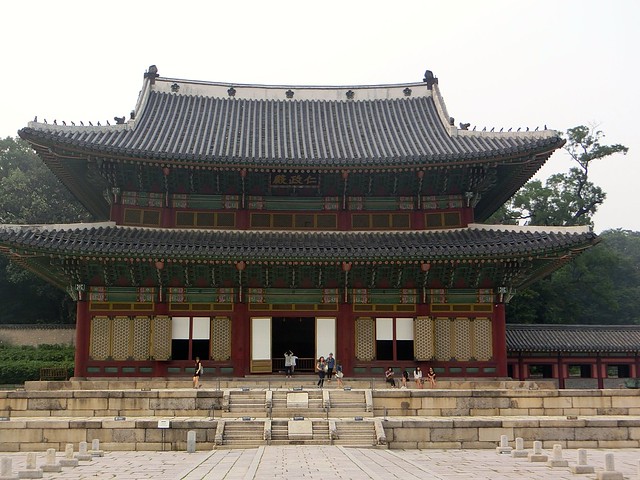
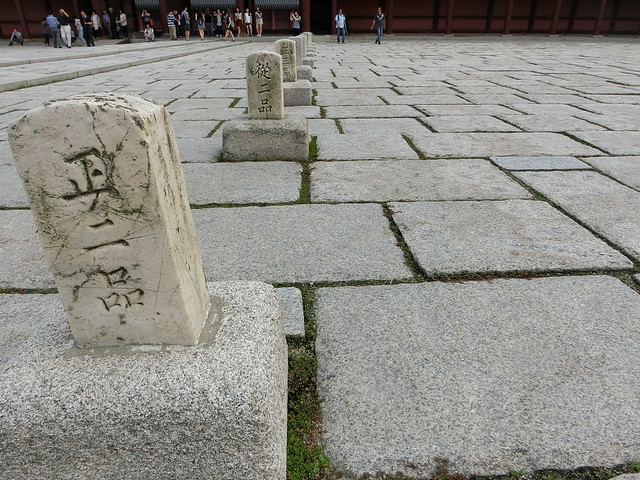
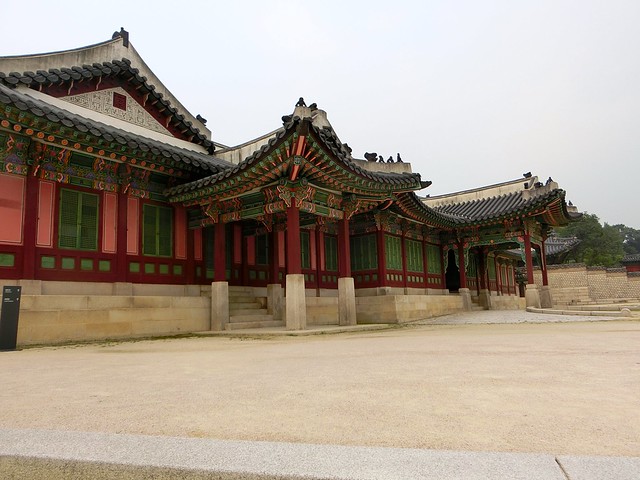
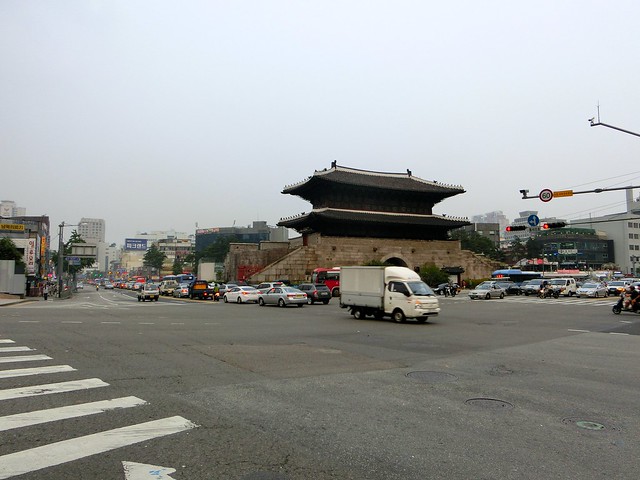
My flight went first in the direction of South Korea and then towards Europe. I had decided to extend my layover to 24 hours and used the opportunity to see some bit of South Korea. I literally had 24 hours, and so I used that time to try to see as much as I could in a very short amount of time. There are many palaces in Seoul, and fortunately the Gyeonghuigung Palace was close to the hostel where I was staying. I can not for the life of me even begin to imagine how to pronounce the name of the place, but my single day in Seoul was a silent one anyway.

CIMG6218
CIMG6221
CIMG6239

I wandered around the palace and walked around the district where I was staying. I had no idea of what kind of district I was visiting. Was it expensive? Was it where the foreigners lived? Was it a college area? I didn’t bother to figure it out. I only had two goals. One was to see something like a palace, and to get a small perception of what South Korea was like, in case I ever would want to return, and two, to find some food.

CIMG6240
CIMG6254

It was a solitary and quiet visit, and I can honestly say that a day is not enough time to spend in Seoul. It is a huge city with many different districts, and even in a single day I was not able to see the entire palace. Still, I’m glad I took the opportunity to take a peak. Compared to Zhengzhou, China, Seoul was a clean city. There was no trash on the street and the air was more clear although they did receive some of the pollution from China, and like China it felt very safe. So as I wandered through the streets I never felt worried that I would turn the wrong corner. There is so much freedom in this feeling of wandering.

CIMG6257

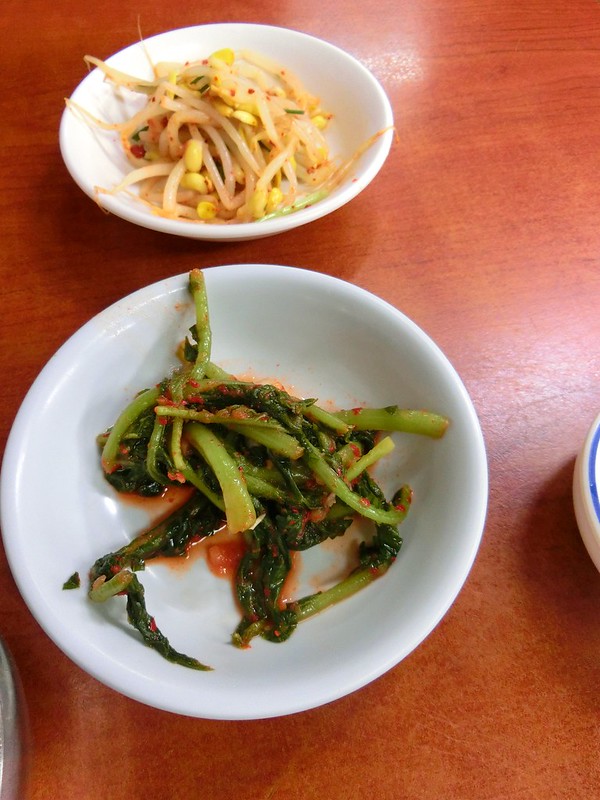
After I left the palace I decided to find somewhere to eat. I had wandered through the district for about two hours before I got lost in a market and then wandered down an alleyway. Here I hesitated because I was very hungry at this point and my hunger was clouding my ability to pick a location. It was at this moment when a Korean woman ushered me into her tiny little shop and she served me the special of the day.

CIMG6259
CIMG6263

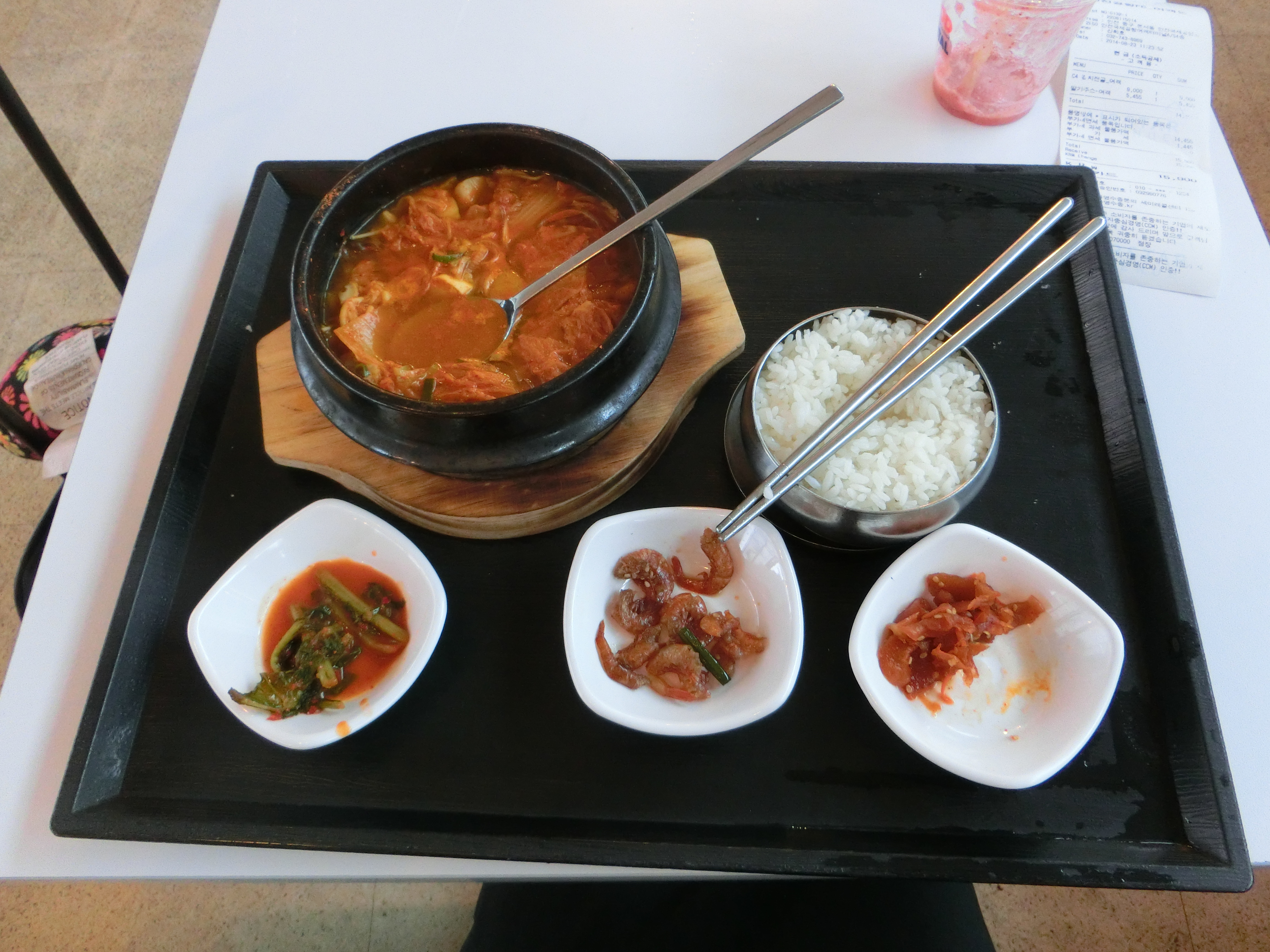
I cannot emphasize how much I love Korean food. I love the textures, the spices, the colors, and I love how it is served. Every food item has an individual plate and it is all served in a sensible portion size. You feel full, but never stuffed.

CIMG6260
CIMG6261
CIMG6262

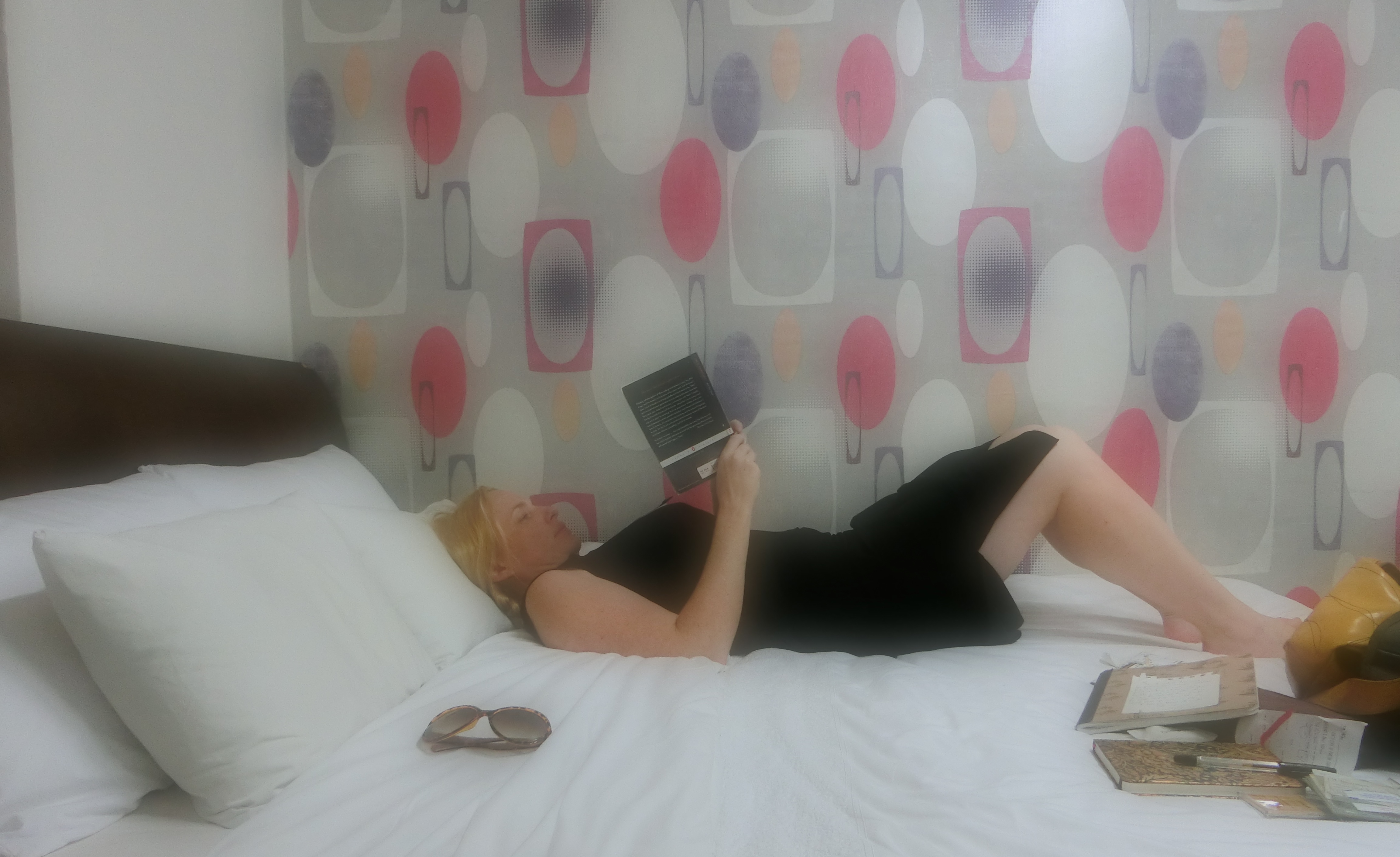
After eating I returned to my room that had pastel dots and square on the wall, and prepared for my long flight to Prague, and a new chapter of my life.

CIMG6294

I am writing about all of this in the past tense because it is past. It has been over a year since I stepped foot onto a sidewalk of Seoul, and at the time of typing these words it has been almost two months since I’ve left my beautiful Prague. I currently sit in the dining room of my friend’s house where I am staying as I plan my next move. A dear friend of mine asked me recently, “So what is your plan? You always have a plan.” I wasn’t aware of this, but thinking back on my life and the choices I’ve made, I think it is true. I do always have a plan. I don’t always succeed in that plan, but it doesn’t matter because when one plan fades or fails I’ll soon have another.

CIMG6317

So what is the plan? I plan to update this blog with the thoughts and memories and photos from the last two years of my life. I plan to return to my revery and release through writing, and I plan to have all of it documented here before I leave again. I am leaving again. At least that is the plan, and while it seems fairly strong that I will be returning to China, (and I’ll write more about that later) it is not impossible to imagine that I will also be returning to South Korea. I have too, because now I have a friend there, and I owe her a pillow.

CIMG6264

A Hike on Huashan China’s most Dangerous Mountain

Not too long after my mother died, my friend Wu Shao bo who calls himself Shawn, (many Chinese people will pick an English name when they are young) suggested that we should go to Huashan together. I agreed and he invited his friend Liu Xiang Kai, who I call Xiang Kai (Xiang sounds like Shee-ang) to join us.

The trip to the mountain although considered a sacred mountain was not meant to be a spiritual trip. After my visit to Shaolin, I had let go of the idea of China’s sacred places as being sacred. This was modern China, and much of the spiritual part of the journeys to places like the five sacred mountains, and Shaolin, along with any of the many buddhists temples were now commodities bought and sold to tourists. You could still find the faithful buddhist burning incense and saying prayers, but for what seemed like the majority of Chinese tourists prayers involved a camera of some sort. You could think that nature itself was some kind of spiritual experience, but the crowds and the litter that they brought with them, was too overwhelming to be able to absorb the majesty of the mountains. Eco- tourism is also huge in China and thousands of Chinese are flocking to mountain hikes, and gorges, and valleys for adventure and for photo ops.

Not to tear apart modern China, but up until about twenty years ago these mountains were hiked by monks, pilgrims, and occasionally hiking enthusiasts Chinese or otherwise who new or the secrets of the mountain. Today with the budding commerce of tourism and eco-tourism, and the fact that more and more Chinese have some leisure time, nature has become a literal stomping ground. China calls itself a communist society, but it has also embraced capitalism. I often saw many parallels between American capitalism and Chinese capitalism. I fully believe if Americans had the same population size as China that we too would destroy our own national forests. There are of course many, many, conscientious Chinese people who honor the earth, and do not like to see their beautiful country littered and polluted and they take measures to not add to the destruction , but for every 5 conscientious Chinese you have about 20 who don’t give a shit or think someone else will clean up the litter. In America our numbers are smaller, but the fact that there is an almost daily battle to preserve the land, it would not surprise me that if we had a population as large as China’s that we too would have an uneven balance of entitlement versus preservation. There are other factors involved of course, but the reality is that this once sacred and very dangerous mountain is not that sacred, but still very dangerous.

CIMG3912

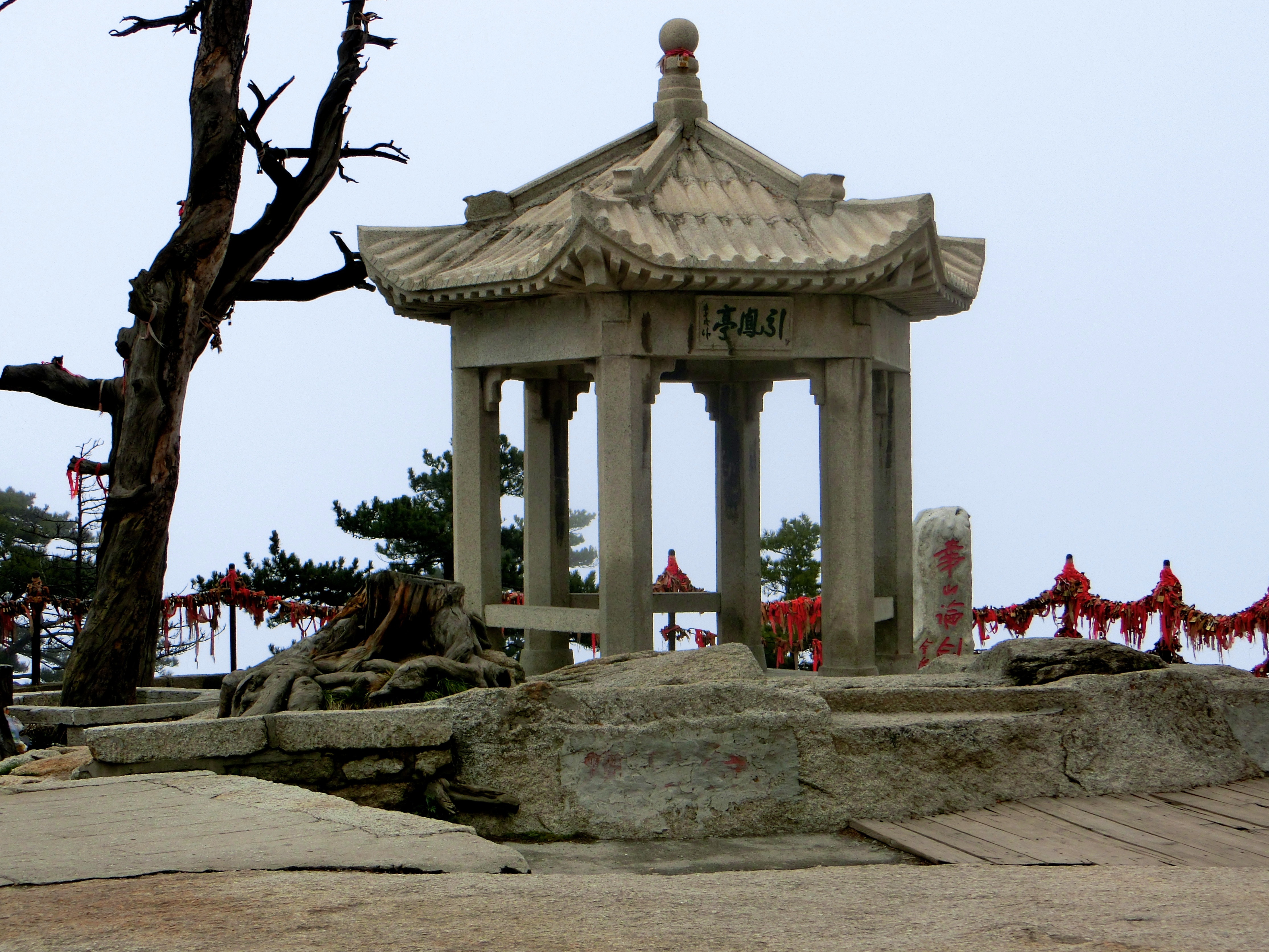
There are five sacred mountains in China, Taishan the East mountain in the Shangdong province, Hengshan the South mountain in the Hunan province, Hengshan the North mountain in the Shanxi province, Song Shan the Center mountain in Henan province, and Huashan the West mountain in the Shaanxi province. I had been to Song Shan when I had visited the Shaolin Temple. Hua Shan was close enough to travel to in a day, but it’s reputation was that of the five sacred mountains it was China’s most dangerous. It’s difficult to find numbers as to how many casualties have occurred on Mount Hua. My friend had told me that you can’t find any numbers because they don’t want to decrease the numbers of tourists, but with the sketchy conditions, and the large, large hiking populations by inexperienced climbers, and days of bad weather I’m sure the number is not small. I fit into a number of the above categories, and had a few moments where I felt like I couldn’t hold on, but my life literally depended on my keeping my grip. My life and the lives of about 50 people nose to ass beneath me.

As an outsider to China it is easy to attach myself to the romantic connotations associated with ancient Chinese traditions, Daoist beliefs and Buddhist rights of passage. Like some scene from Seven Year’s in Tibet or The Rivers Edge, I pictured myself reaching the peak of the mountain, and when in a moment of reverie the sunlight would break through the clouds or rise over the crest, and I would be filled with a sense of peace and gratitude and a higher understanding of what life is about or why we are here, why I am here, and then I’d feel a dawning acceptance of my mother’s death, and I’d understand- no- not understand but I’d know that it is beautiful. That death like life is beautiful. Sadly, but not surprisingly to say, I did not reach my zenith, I was not awash in enlightenment; I was achy and irritable. In retrospect, I’m a little disappointed I’m not writing a post about my spiritual awakening, but then again, perhaps my journey was to feel exactly what I felt; achy, despondent, irritable, depressed, and still, always still, grieving, and wanting my mother to be alive.

Although, as I mentioned above, that I did not view it as a spiritual exploration I still grabbed some of my mom’s ashes and put them in my back pack. I decided to take her with me. She never got to travel in her life and I thought I could take her with me now. If I made it to the peak then I would leave that little part of her there on that mountain top. It would be the closest I’d ever get to the stars (Everest is not in my future). If I made it.

CIMG3785

Shawn didn’t have a lot of money so he insisted that we take the cheapest slowest train. Although, knowing Shawn I think even if we had money he would insist we take the slowest and the cheapest. On the fast train we could have made it to HuaShan in about three or four hours, but on the very slow train it took us about 8 to 9 hours. We did the overnight train. The idea was to sleep on the train and then to start our hike in the morning. If you have ever traveled on a Chinese train in a non-sleeping compartment you’ll know sleeping on the train is not that easy unless of course you are Chinese. I’ve discovered that Chinese people in China can sleep anywhere. On the sidewalk, on their e-bikes, bent over or smooshed between seats. They are like cats able to find any place as a suitable place for sleep. I had often been overcome with jealousy at this ability since I find it so difficult to sleep sometimes even when I am in a bed in a dark room. The train was packed. On these trains once the seats are all sold they continue to sell seats so sometimes there are people standing in the isles for up to eight hours. People are constantly switching seats around every time someone leaves in the hopes that they can sit for a couple of minutes. When you are sitting you have people leaning against you or over you. It is a crowded that most Americans in America will not ever experience. We were in a section of six seats. Two rows of three facing each other. Shawn and I were able to sit across from each other but Xiang Kai had to find a seat somewhere else on the train. I am bigger in size than your average Chinese woman, but I am also smaller in size and sometimes width of your average Chinese man. All the seats were occupied by men, sleeping men who had spread out as much as they could in the spaces available leaving me with very little room, and since I did not have the Chinese power of sleeping I was awake for the entire 8 to 9 hour train ride. This is not the way I would recommend prepping for hiking the most dangerous of the five sacred mountains.

A photograph of Erqi Tower in Erqi Square in Zhenzhou, China.
Erqi Tower in Erqi Square, Zhengzhou, Henan, China.
Two friends in China posing in front of Erqi Tower in Zhengzhou.
Xiang Kai and Shawn in front of Erqi Tower, Zhengzhou.
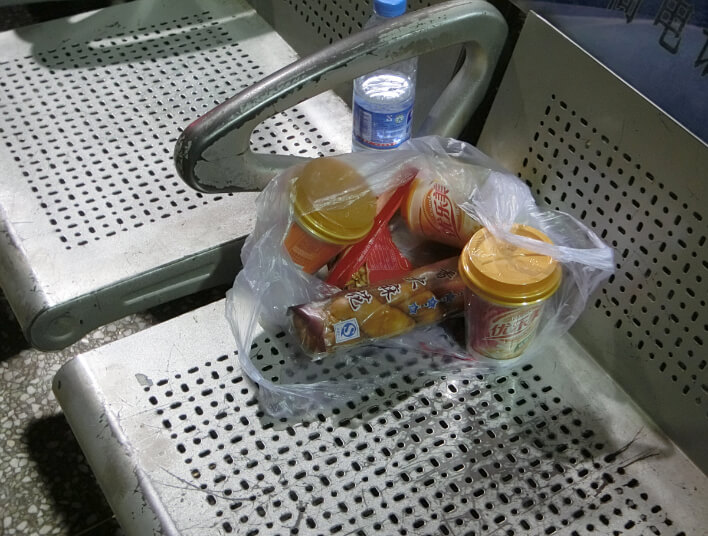
A bag of Chinese snacks on a chair in the Zhengzhou train station.
Snacks for the hike.
The interior of the Zhengzhou train station after midnight.
Zhengzhou Central Station after midnight.

We boarded the train around 1:00 am and arrived around 8:30. We took a taxi from the station to the town at the base of the mountain, and began our hike around 9:00 a.m. We had three large bottles of water, some strange meat paste, a few bready bits of snack food, and a bag of spicy chicken feet. I kept thinking shouldn’t we have some trail-mix or something?

chicken feet in packaging
Chicken feet

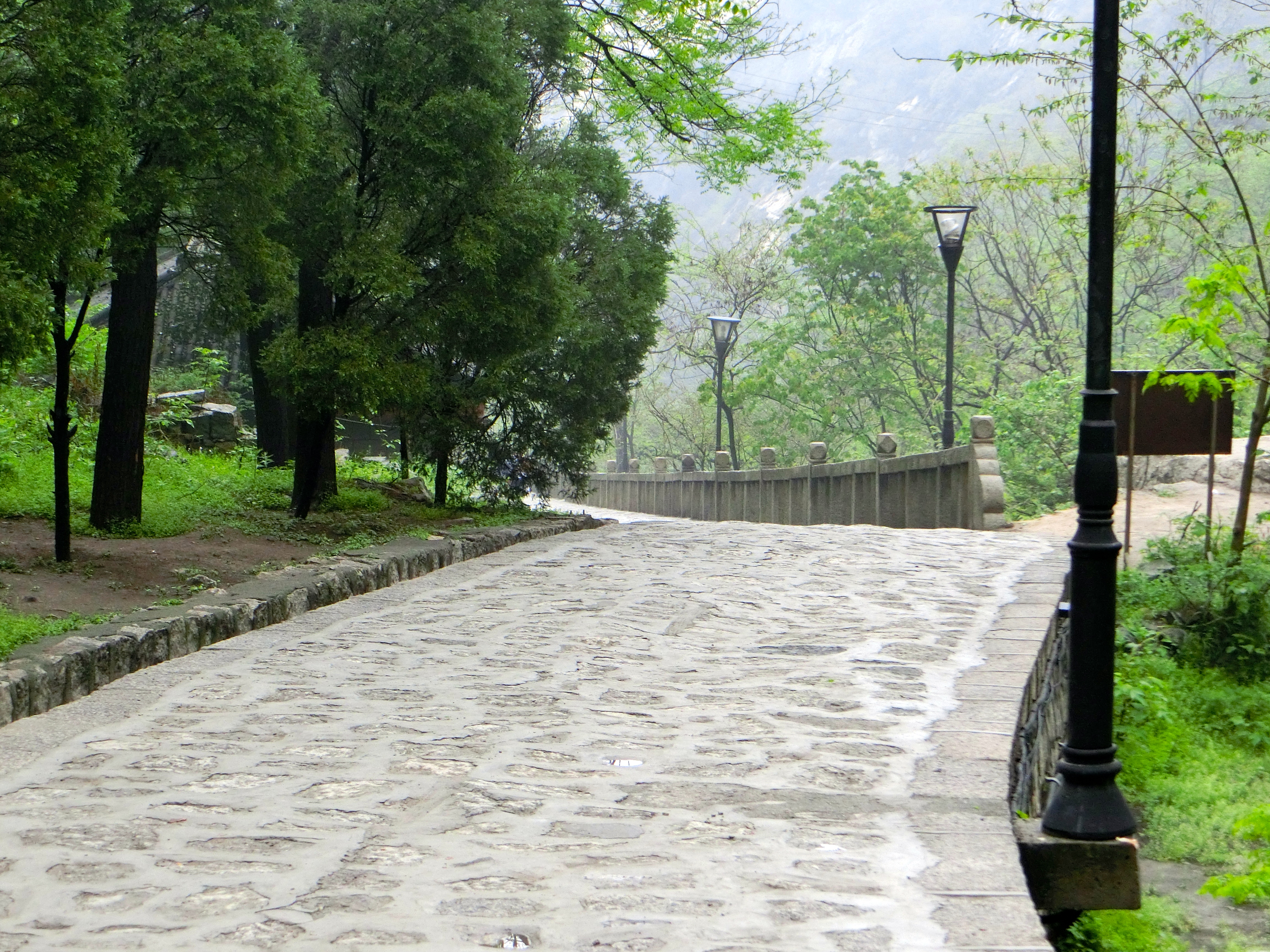
For hard core hikers the beginning of HuaShan is not much of a hike in the sense that it is paved for a large portion of the lower part. You do not disappear into the mountains you stick to the path. Once you ascend deeper into the mountain the hike becomes more of a challenge and more of a climb and sticking to the path becomes necessary to keeping yourself alive.

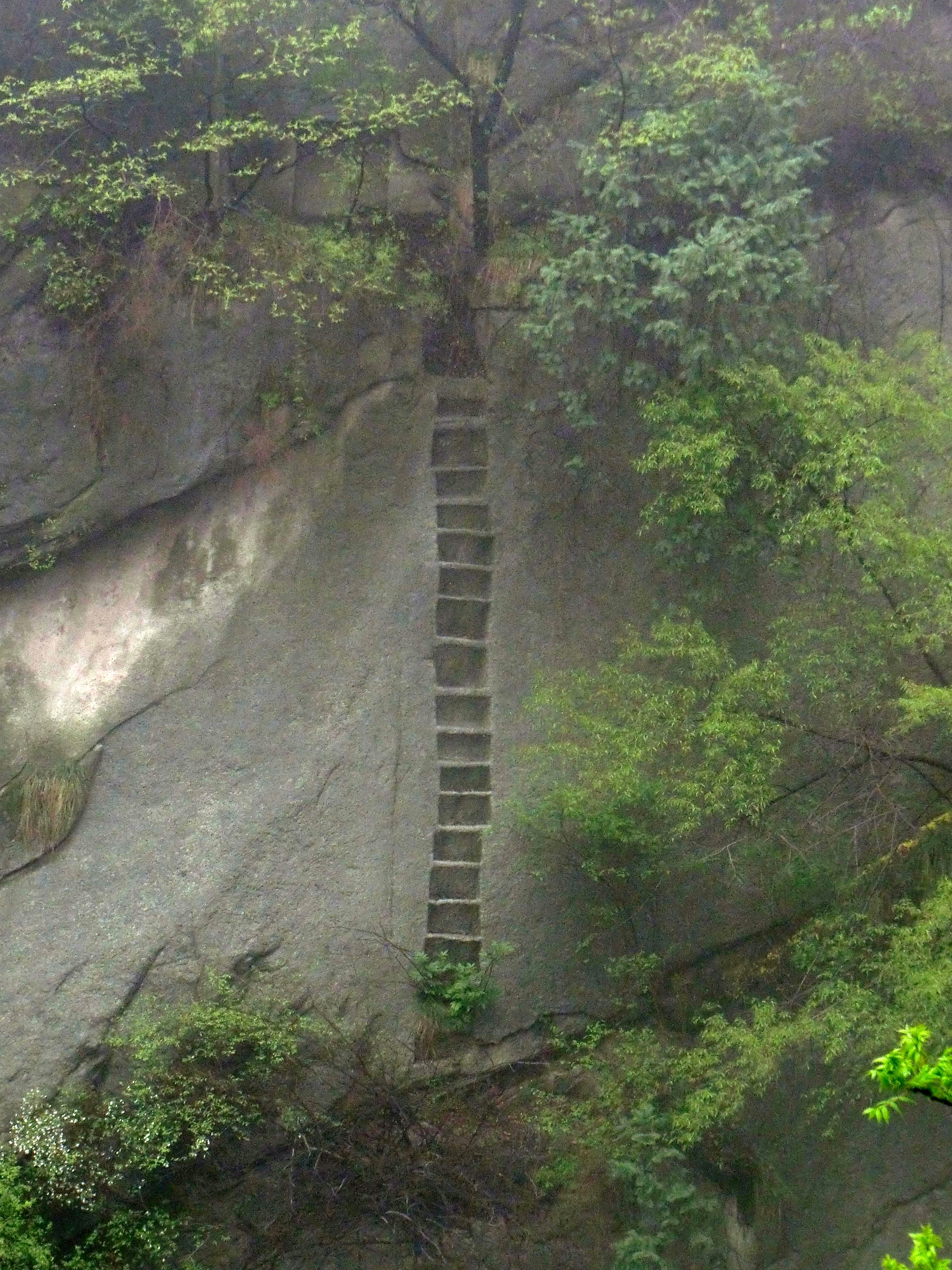
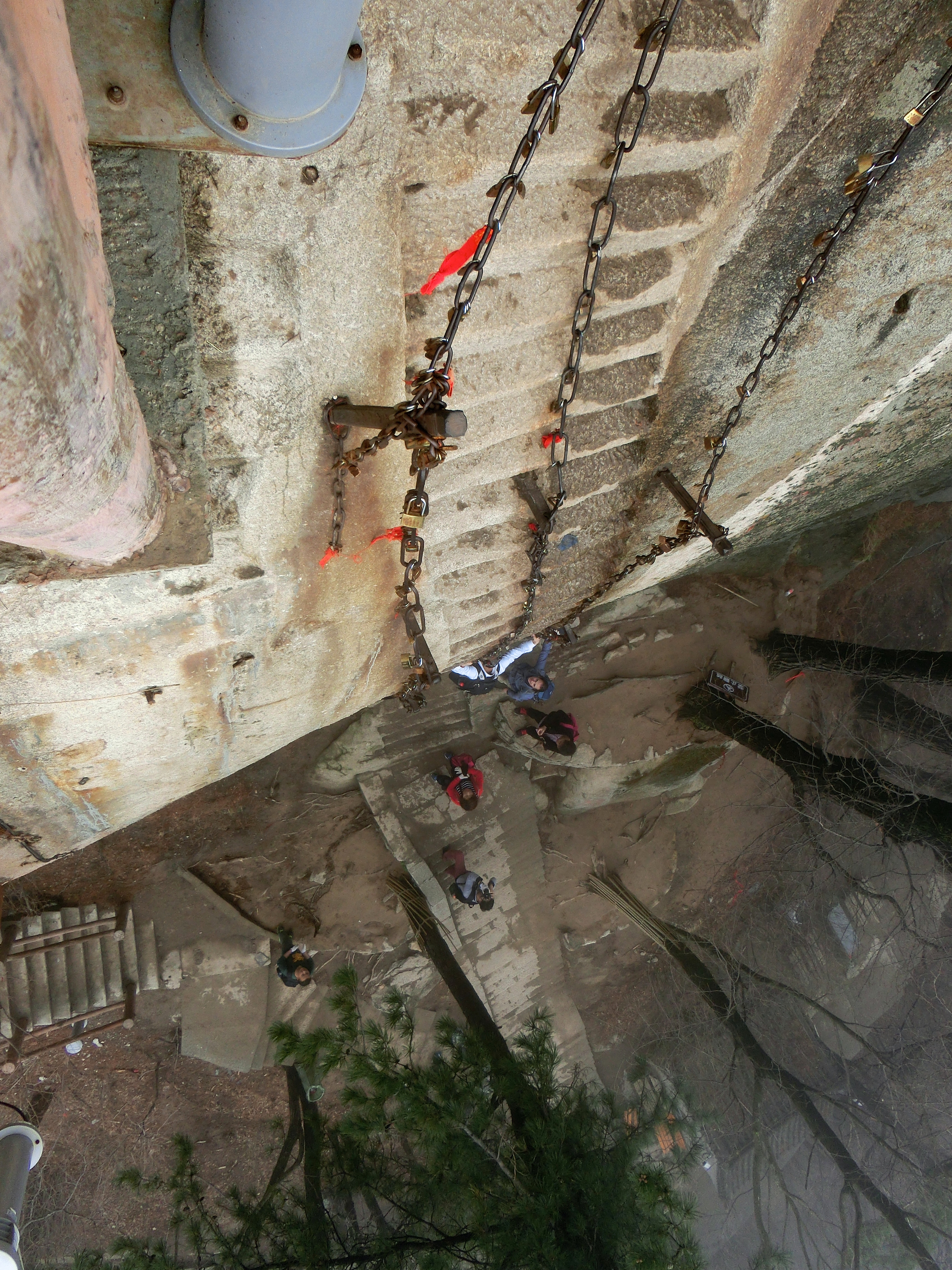
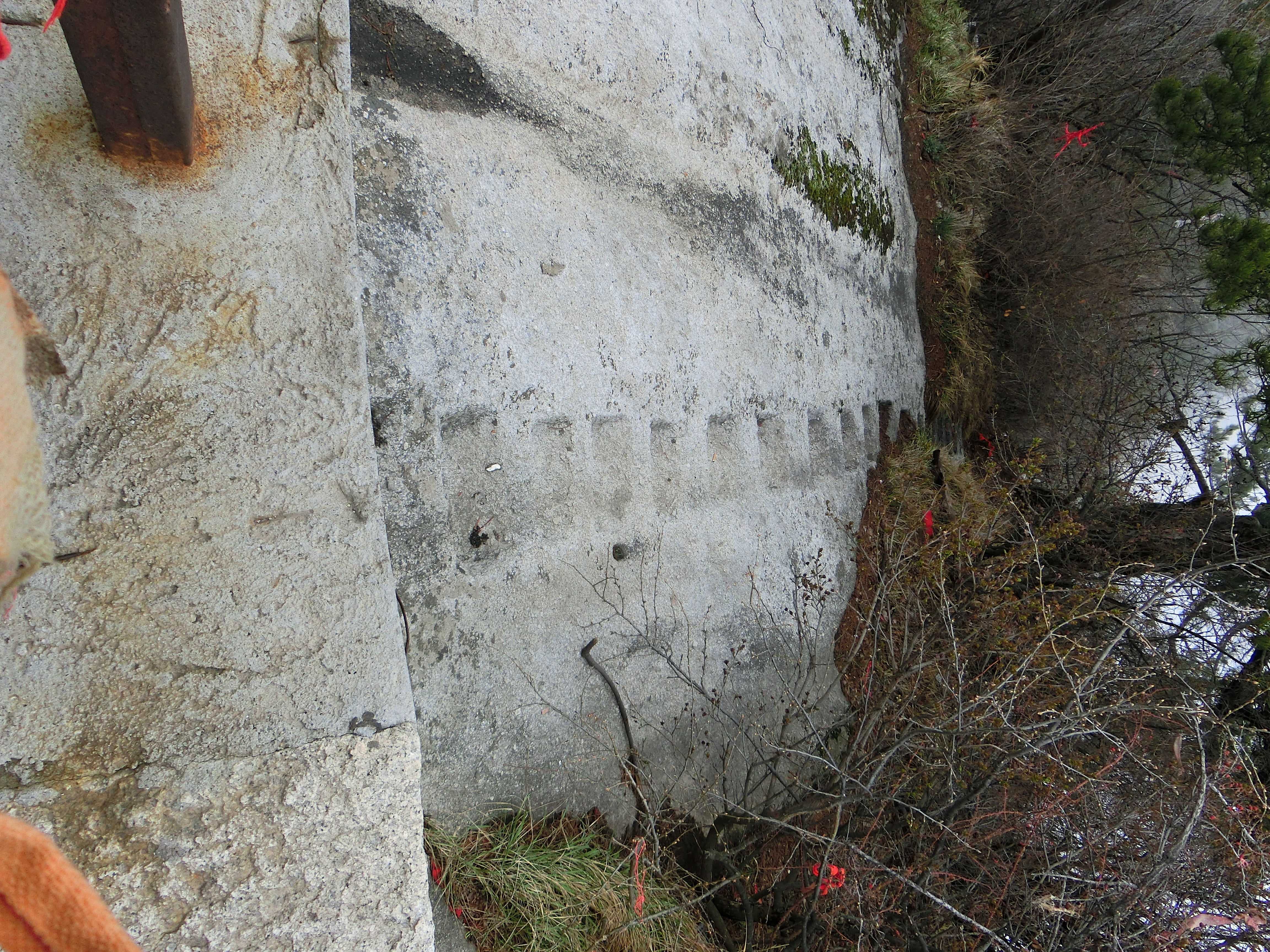
There are steps on Hua Shan. These steps were carved deep into the mountain’s side thousands of years ago, all by hand, and by the monks that would make their pilgrimages to the top where they could meditate. On the side of the steps chains have been drilled into the mountain for you to hold as you pull yourself up. You need upper body strength to help you on the climb. Upper body strength that at times I thought I might not have.

CIMG3640
ancient carved steps

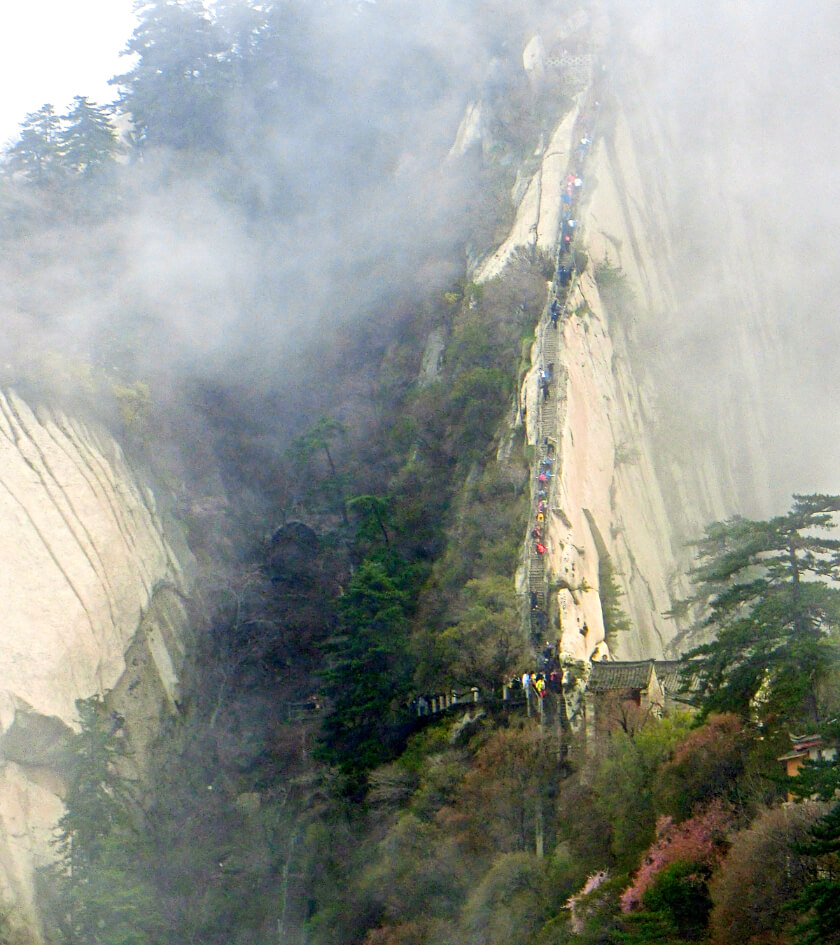
Compared to most saturdays it was not very crowded by Chinese standards of crowds. It had been a rainy night and it was cloudy and grey. On one hand it was nice because you had a small bit of breathing space (to me it was still very crowded but I was aware of what a real crowd in China was) perhaps during our climb there were about 200-300 people climbing Hua Shan that day but at night during our descend hundreds of new climbers were making the midnight treck. In total maybe 800 people were on the mountain. Oh, and the thing of Hua Shan: there is only one path up and one path down. When you are coming down and they are coming up you literally have to crawl over one another− crawl over one another 1,000 meters high on a steep mountain side with wet steps and cold thick metal chains, and you are climbing backward. You get the picture. The downside of the rainy day was that the steps were wet and slippery and at times the dark clouds dropped so low around the mountain that you could not see two feet in front of you. Then you had to climb over someone, I need to add, without any safety harnesses or safeties of any kind.

CIMG3550
A lying Buddhist
CIMG3587
The base of the mountain
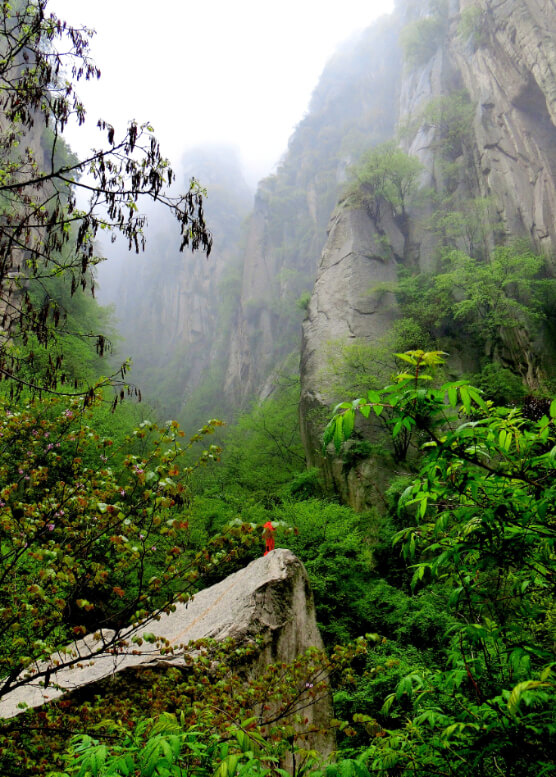
A view of the craggy mountains of china's Huashan
Mountain base
CIMG3556
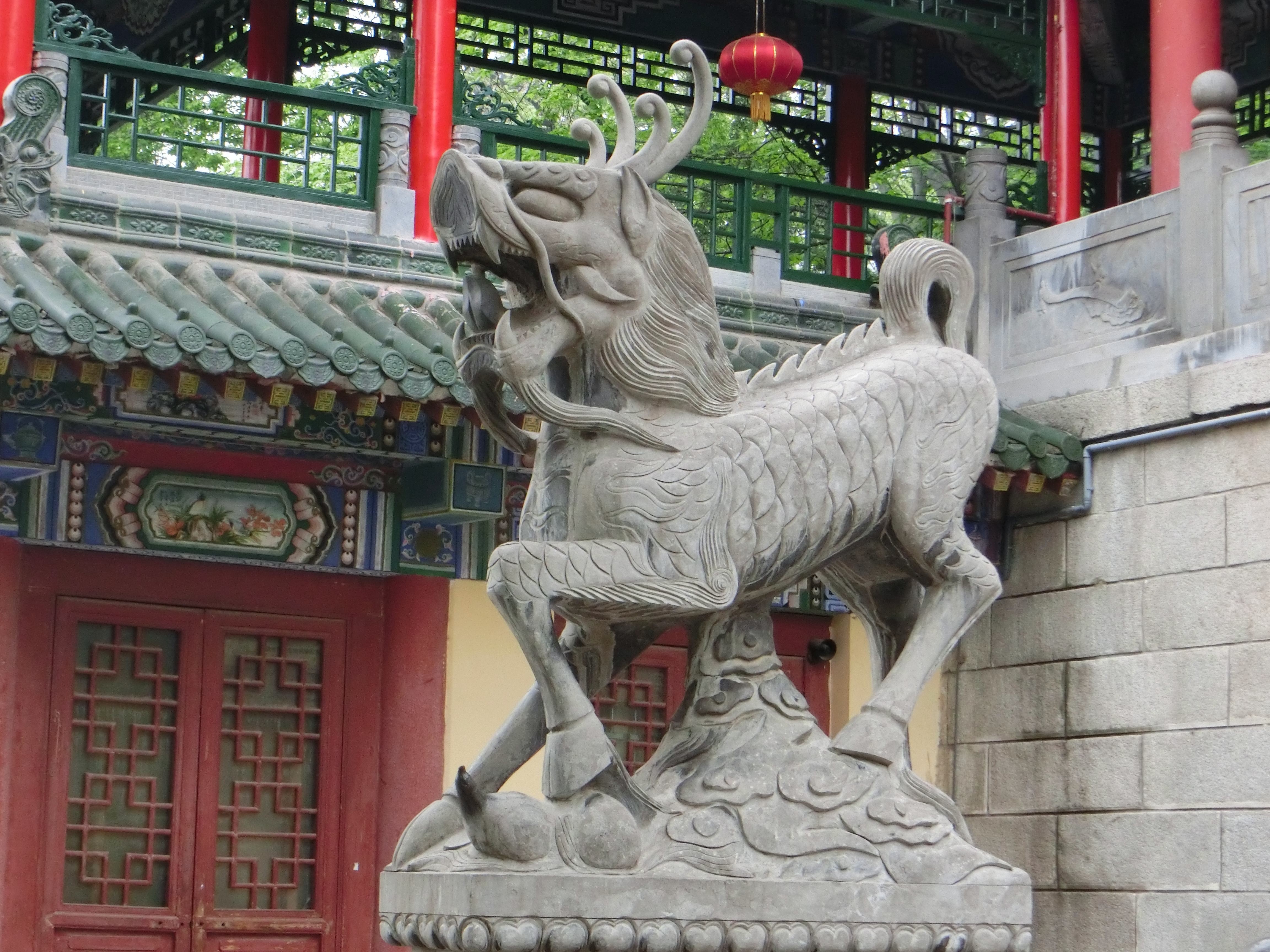
A Chinese mythical creature
CIMG3574
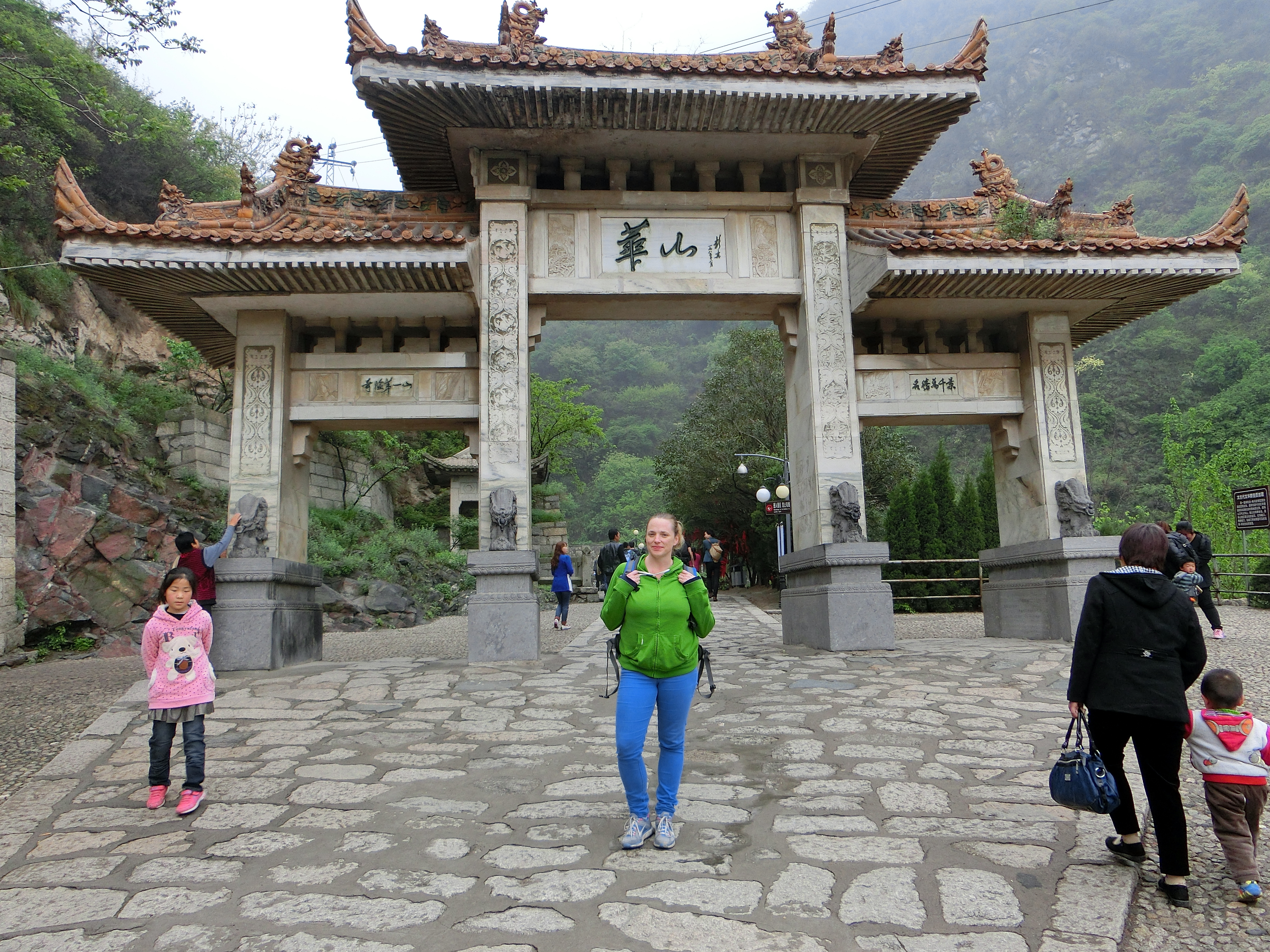
The gate to the mountain
CIMG3557
The park before the hike
CIMG3581
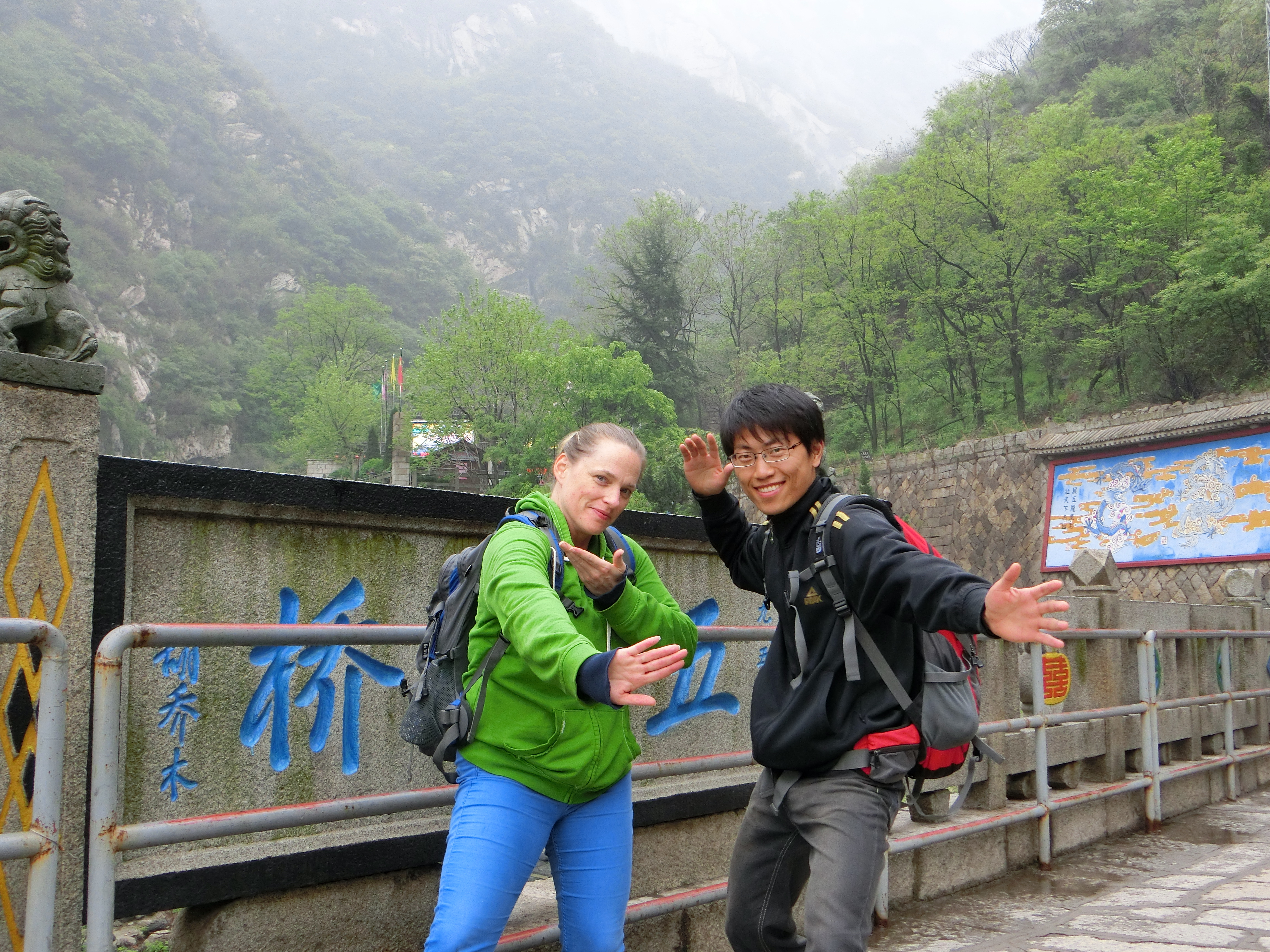
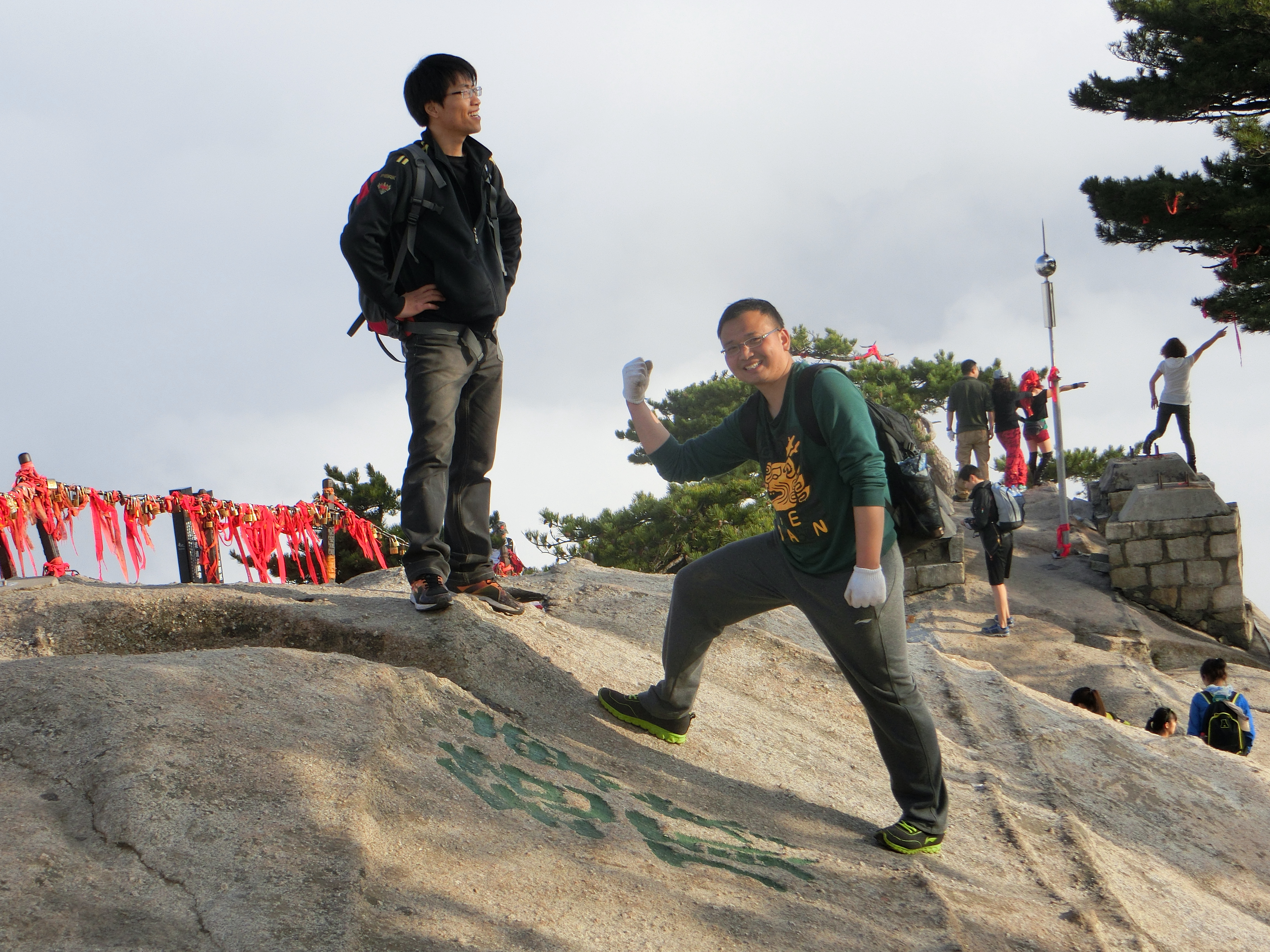
Xiang Kai and I preparing to fight the mountain spirits
An ancient stone tablet from Huashan in China against a bright red wall.

It took us another eight hours climbing vertical steps, sometimes through wet caves and on the edges of steep cliff sides. Shawn was our guide and he wanted to race to the top of the mountain. Often criticizing Xiang Kai and I if we wanted to sit for a moment or if we were moving too slow. I was grateful to have Xiang Kai on my side. Shawn was the adventurer climbing the mountain to defeat it, to reach the top a conquerer, and to reach the bottom in the fastest time possible. I’m not this person. I wanted to sit and reflect and bask in the nature, and the multitudes of people, around me. I did want to meditate, and reflect. I did want to absorb, but between the crowds and Shawn’s constant pushing us hiking Hua Shan felt more like a simulated virtual wii game than an actual hike and journey. I didn’t know what was in Xiang Kai’s mind except that he wanted to stop and sit as much as I did, and he would shoot me looks of disdain and irritation. Ignore him, he’d say from time to time, let’s sit, make him wait.

CIMG3560
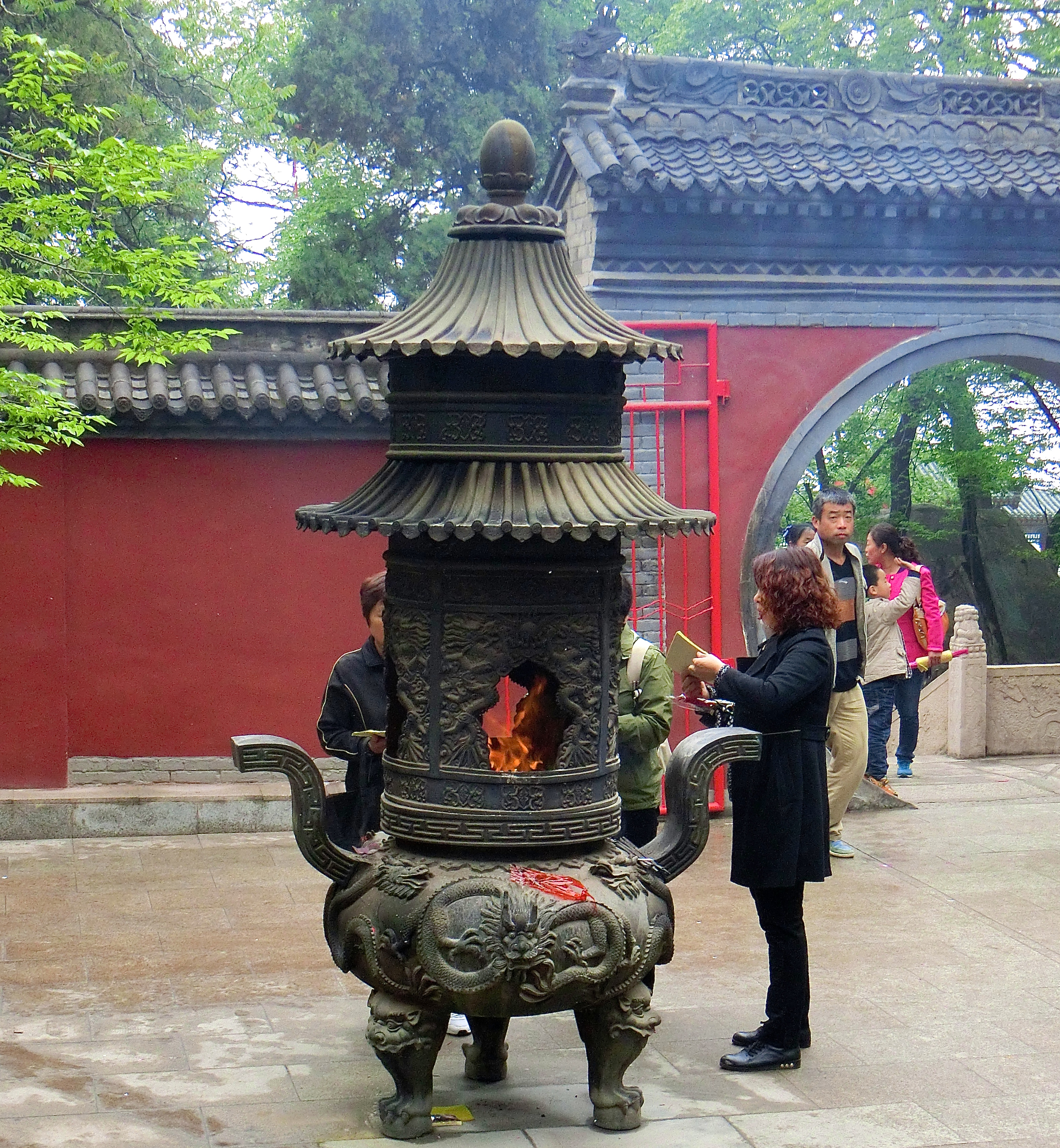
Burning incense and prayers
CIMG3563
Prayers
CIMG3778
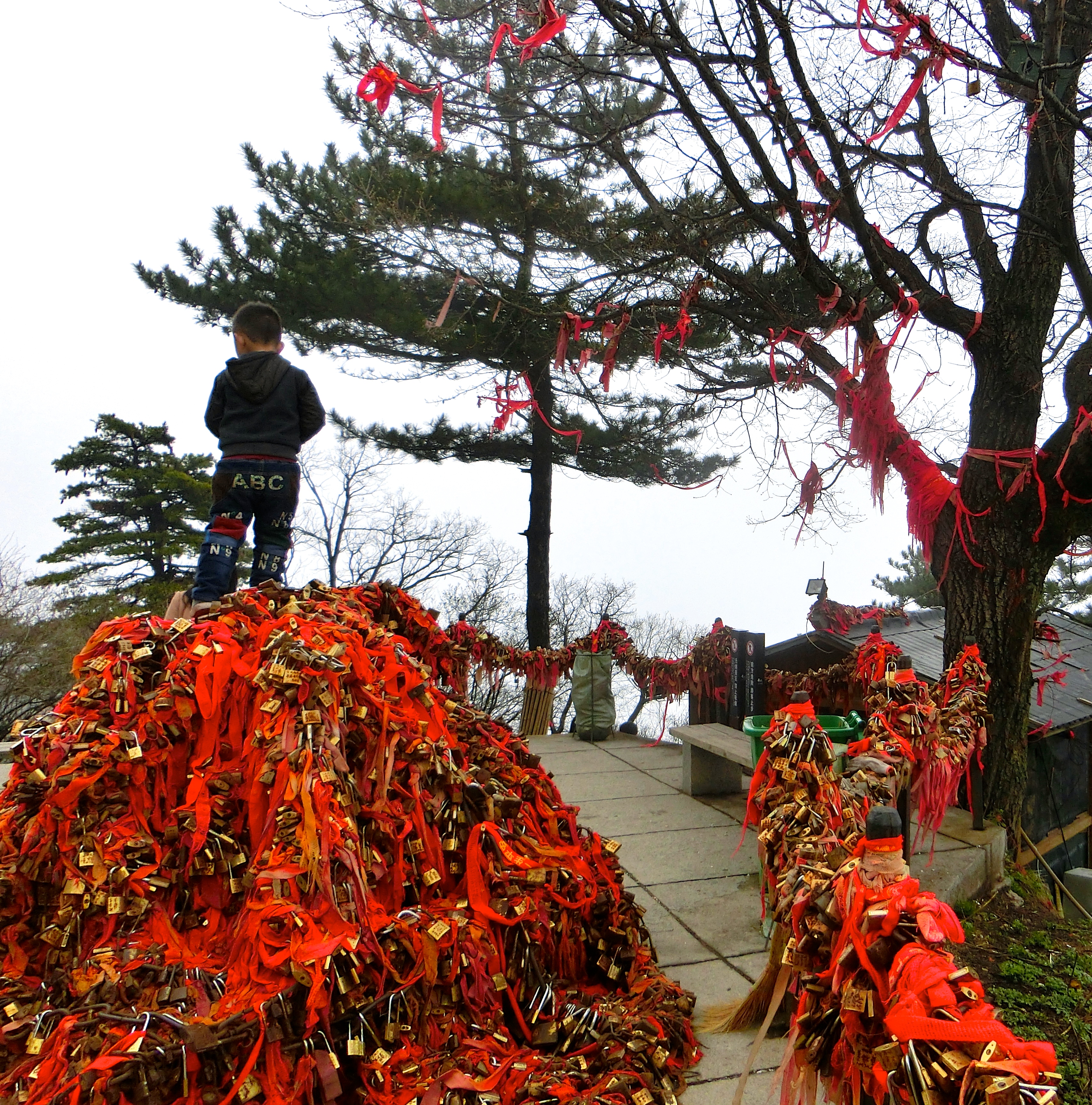
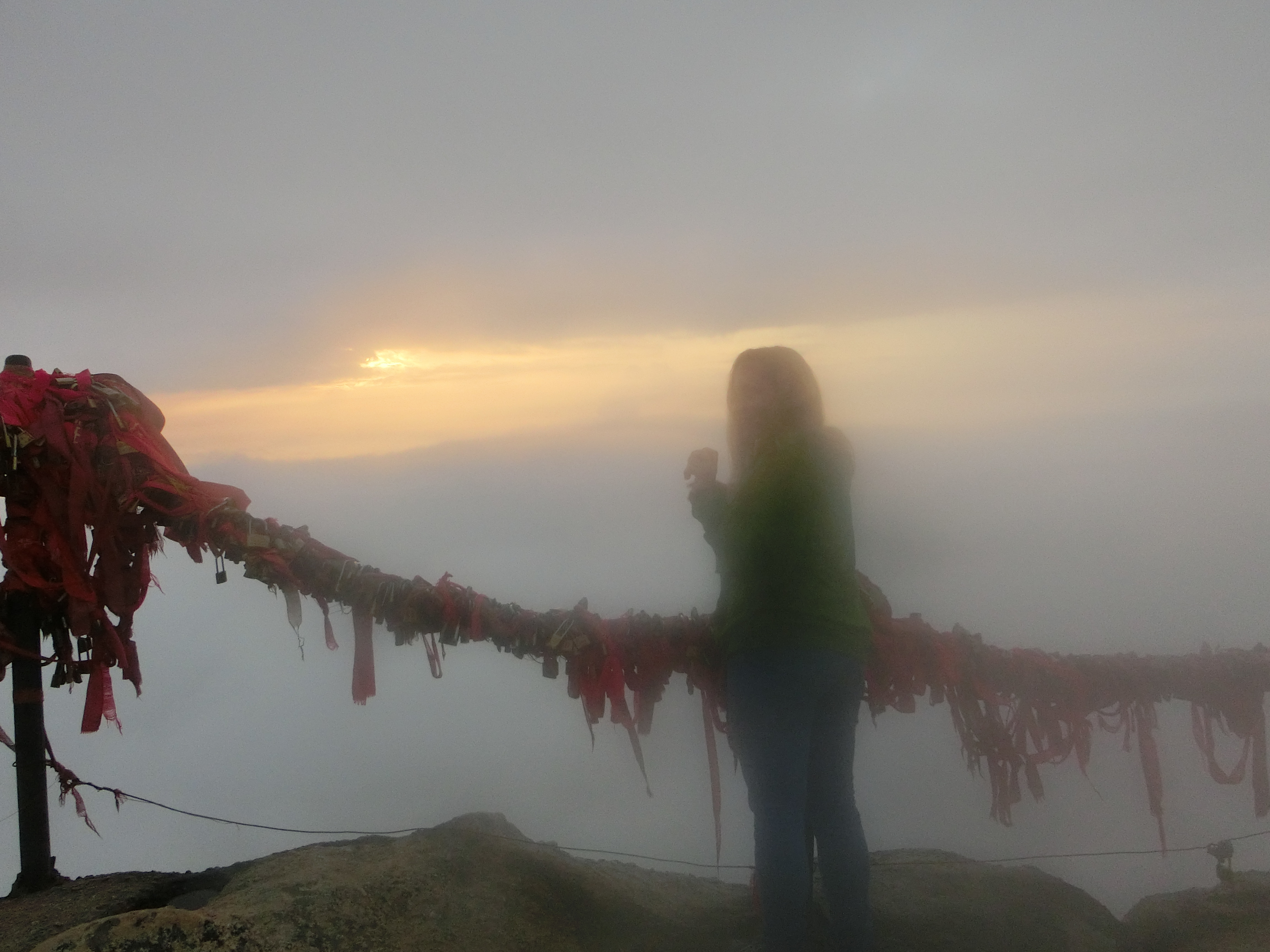
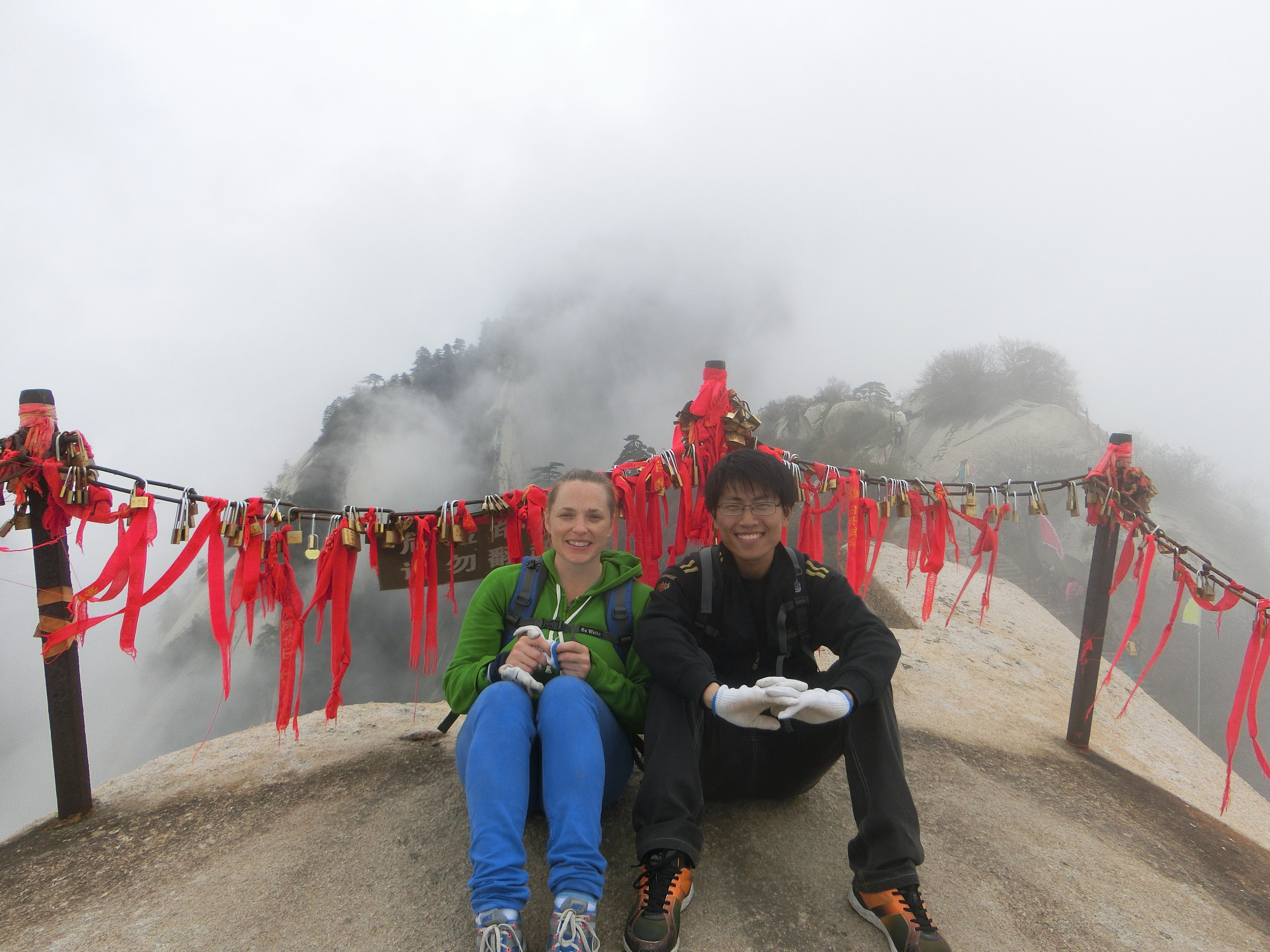
A mountain of ribbons and locks for luck.
CIMG3615
These men hike daily back and forth up to part of the mountains to deliver food and water to the shops and hotel.
A gateway to the western peak on Huashan.
The gate to the beginning of the real climb

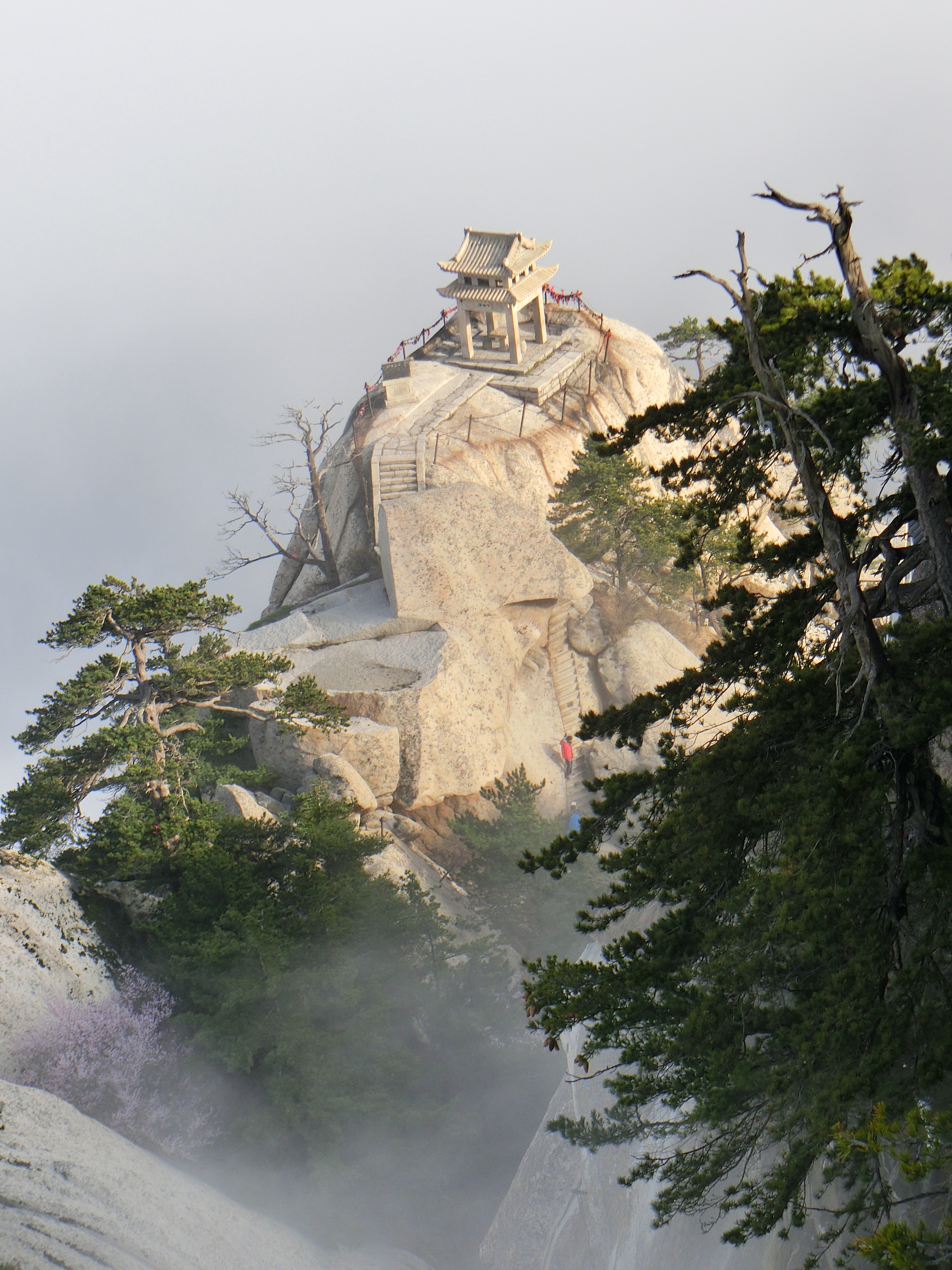
When we reached a peak we did take a moment to take a million photos, but also to just sit and be. It wasn’t easy to reach the peaks (unless you took the tram that I didn’t know about but explained how some Chinese girls were able to hike in flats and skirts) and when we would reach a peak the crowds would disperse and only 20 to 30 people were able to reach certain points. We went from the north peak to the west peak and to the south peak reaching 2,080 meters.

CIMG3664
The first set of stairs.
CIMG3680
The top of the first set of many stairs
CIMG3793
The stairway to heaven
CIMG3798
This was a crazy vertical climb and took a lot of upper body strength and courage. This was after climbing many other steep and long stairs carve into the mountain’s rock walls.
CIMG3788
Ancient step carvings possibly thousands of years old.

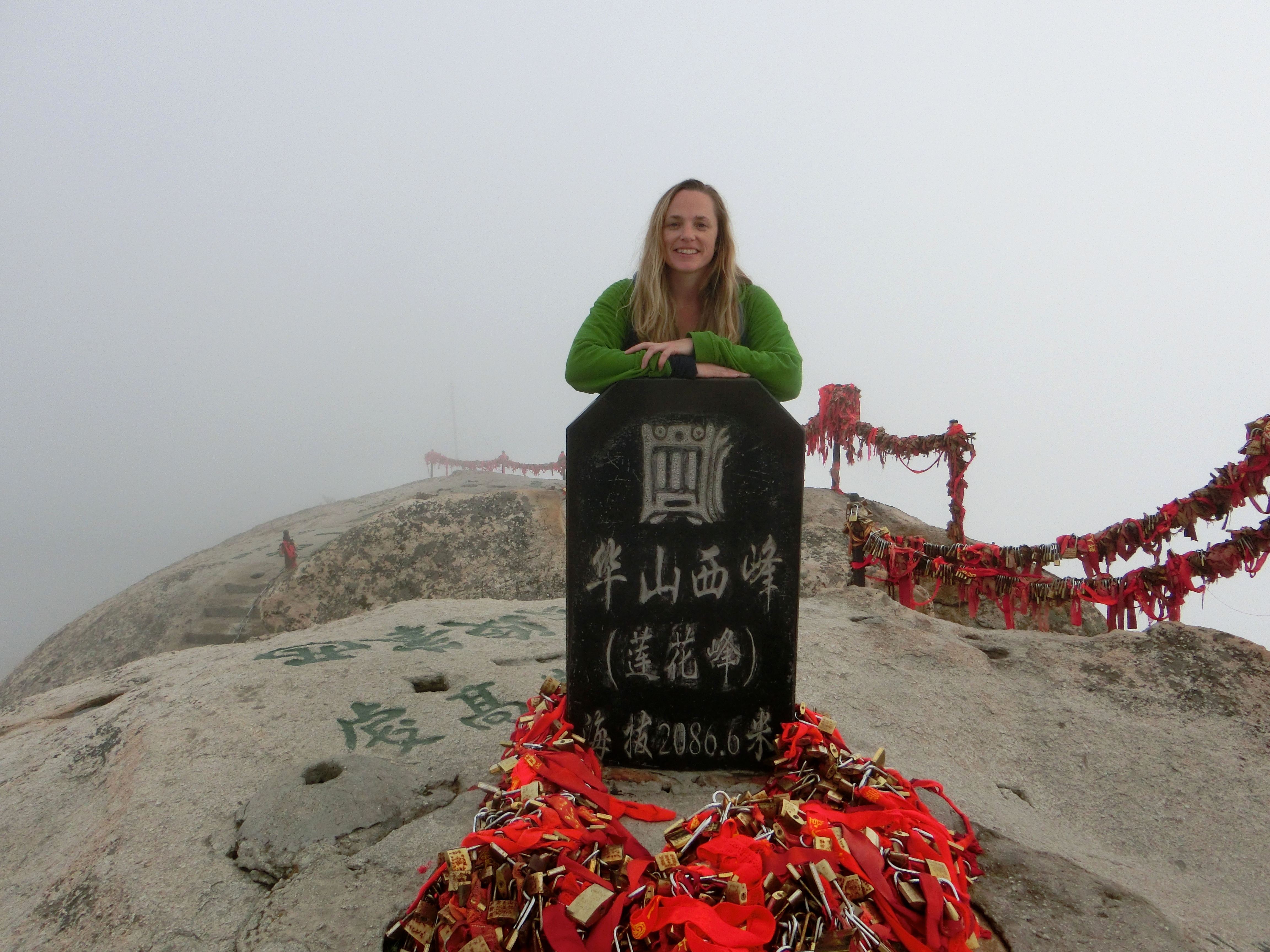
By the time we reached the top the sun was beginning to set and only five other people had made it to the top at the same time as us. It was cloudy but beautiful. Hiking to the north peak at 1,000 meters was the highest I had ever hiked, 2,000 meters had never happened in my life. I still thought the entire hike was absolutely crazy and badly planned, but I had survived the ascent and was now 2,080 meters above the sea level. Here I took a moment to pull out mom’s ashes and let her small bits of dust and bones catch onto the breeze and float away. It was actually more like that scene in The Big Lebowksi when they throw Danny’s ashes into the ocean and the wind blows the ashes all over them.

CIMG3967
Shawn and I at the South Peak
CIMG3951
Me and my mother’s ashes

As I dusted mom’s ashes of my sweatshirt I giggled because of course that would happen, and with my mom’s dark humor she would have been laughing. In fact we laughed so hard during that scene that she started coughing. This memory made me feel sad once again. Shawn asked me why I would bring some of my mother’s ashes to the mountain. “She’s not Chinese,” he said. I shrugged. “I don’t know,” I said. “She’s never been able to come here before, I wanted her to get the chance to travel.” I didn’t really know. Part of her was in the California Feather river, part of her was in the Trinity National forest, and the Pacific ocean, part of her was in the San Francisco bay, I didn’t know why. In death she had already been to more places than she ever went to in her life.

CIMG3704
Xiang Kai and I at the North Peak
CIMG3700
Shawn and I
A view of the narrow paths on the top of the western peak of Huashan in China.
If you look carefully you can see all the people walking on the blade of a mountain pass. This is 1,000 meters up.
CIMG3838
Success
CIMG3841
A small spot for meditation
CIMG3852
But, not an easy space to get to.
CIMG3839

It was seven when we reached the top and the sun had set. It was now dark on a steep dangerous mountain and we needed to reach the bottom. There were some lights, but not many. Shawn informed me that this mountain was a really popular hike for college students, but most of them liked to hike up at midnight and then stay the night on the north peak in order to see the sun rise. He said we should do it the next time. As romantic and as peaceful as that sounded in words the reality sounded terrible. Hundreds of flashing camera’s trying to simultaneously get the perfect shot of the sunrise.

“Maybe off off season,” I said.

CIMG3923
Through foggy woods
CIMG3896
Wishes thousands of meters high.
Bright red prayer ribbons tied to stems on Huashan in China.
A wish for peace
CIMG3998
The only lights to guide us back down from 2,000 meters
CIMG3935
Huashan 2,080 meters

Hearing From Former Students in China

China can be a challenging and difficult place to be a young student. This massive population and its limited high quality Universities makes the Gaokao, China’s college entrance exam, not only one of the toughest tests in the world it is also the test that determines a student’s academic future- therefore future. This test is taken by every Chinese student (except those who opt out by choosing to study abroad) and it is a test that they spend their entire middle school and high school lives preparing to take.

Universities are known more for having a good time in China than for studying, but there are a few top collages that many students in China dream of attending for academic purposes and those are universities in Beijing and Shanghai, and only the top Gaokao scores can attend these schools. Too add to the stress the desired score to attend college in these cities is different from province to province- for example if you are a student from the Province where I am currently living ,Henan, then you have to score higher on the Goakao than a student from Beijing or Shanghai or even a student from a Province with a lower population. The idea of this different scores plan is that it allows some balance. Henan is the most populated province in China and the thought is that if everyone was to need to the same score to get into a top University then there would be too many kids from Henan at all the top Universities. Honestly, I’m not certain how they came to this conclusion but if I were a student from Henan dreaming of going to a top University many of which are in not Henan I would feel that the scoring isn’t very fair, but I don’t make the rules.

During the school year at #47 I met a few students through our English corner- students who were not a part of my program, a Sino-U.S. program. One of these students, a young girl whose english blew away all of my students bound for the states, was a particular favorite of mine. She’s bright, ambitious, and a free-thinker. She’s fortunate enough to have parents that are pretty progressive so progressive in fact that they are not pressing marriage or even having a child (not yet anyway). She has some lofty goals. She wants to change the way China views mental health. This is a lofty goal. Currently, China’s view on mental health is fairly archaic, and those suffering from depression or bi-polar or even worse schizophrenia to name a few are left to the responsibility of the family who are unable to cope with these illnesses and of course those families and individuals suffer the stigmas that come along with backward thinking toward mental health issues. You can read about it here: http://www.theatlantic.com/china/archive/2013/07/unable-to-cope-chinas-inadequate-care-of-the-mentally-ill/278170/

and here: http://ajp.psychiatryonline.org/article.aspx?articleID=1682419

and here: http://www.foreignpolicy.com/articles/2011/01/26/the_madness_of_china_s_mental_health_system

To make an incredibly long story short- this student sent me a text message today: “Hello how are you? I wanted to share my news, I am going to Shanghai University!”

I was so excited to read this news because I know how hard the Gaokoa is and how many students that I ask about their dreams don’t emphasize those dreams much because they worry about the competition of this test. I texted her back expressing my joy to her and letting her know how proud I am to know her. She responded with the best text one can ever get from a teenager.
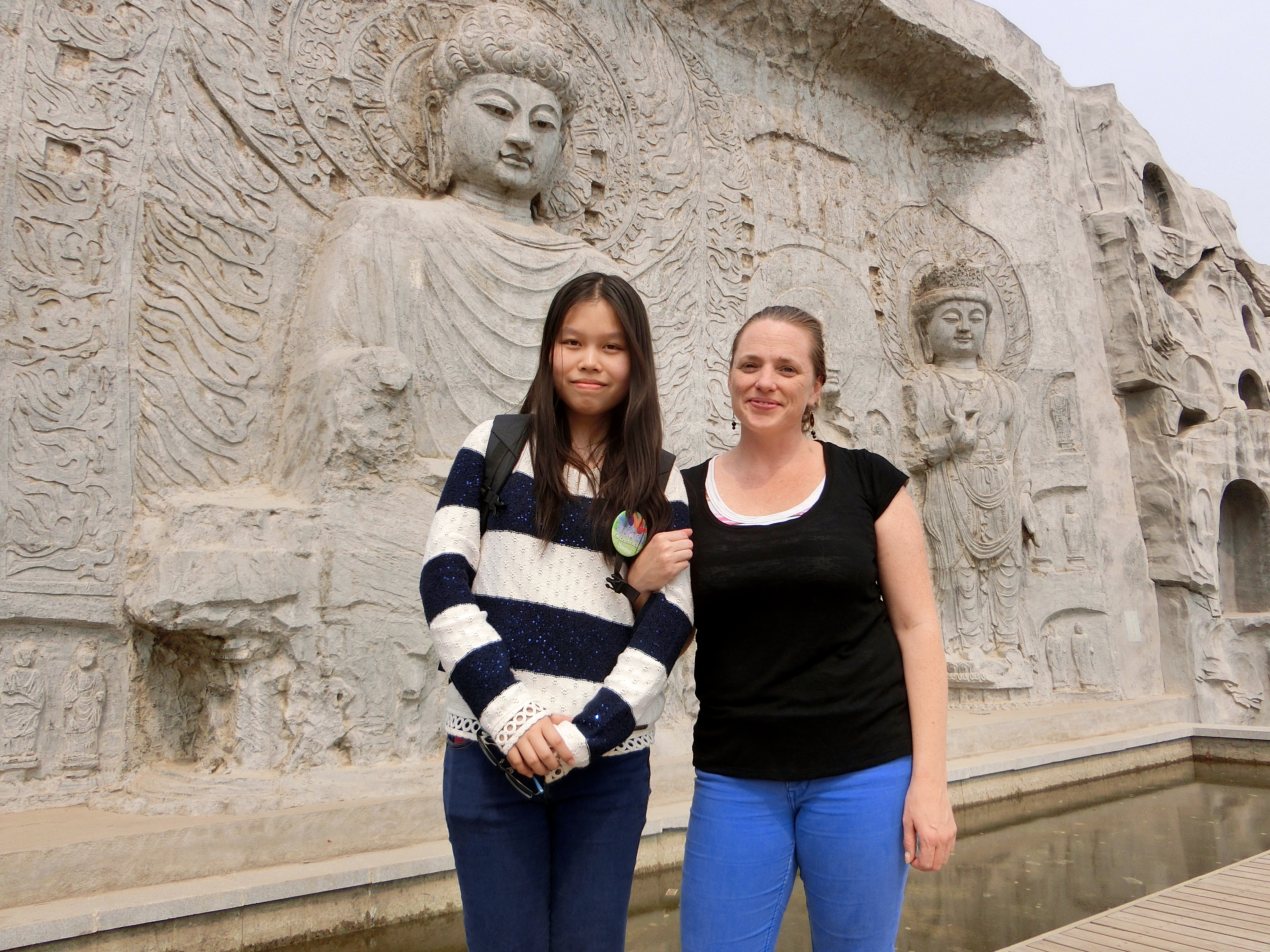
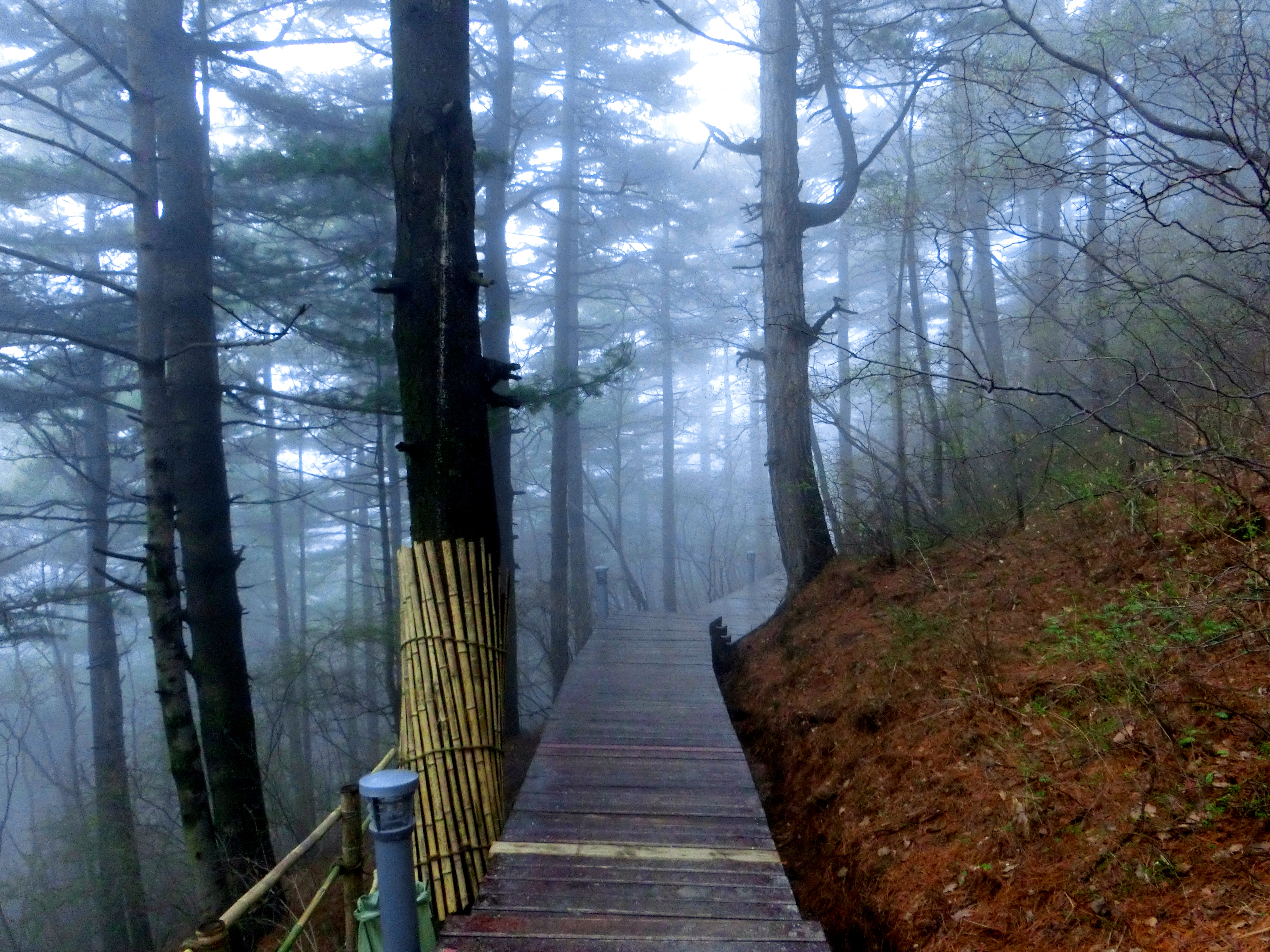
“We are closer to our dream now! Don’t forget that I will be your first student!”

She was never my student but I’m really honored that she considers me to be one of her teachers because all we ever did was talk about life and dreams.